The Moment of Decision
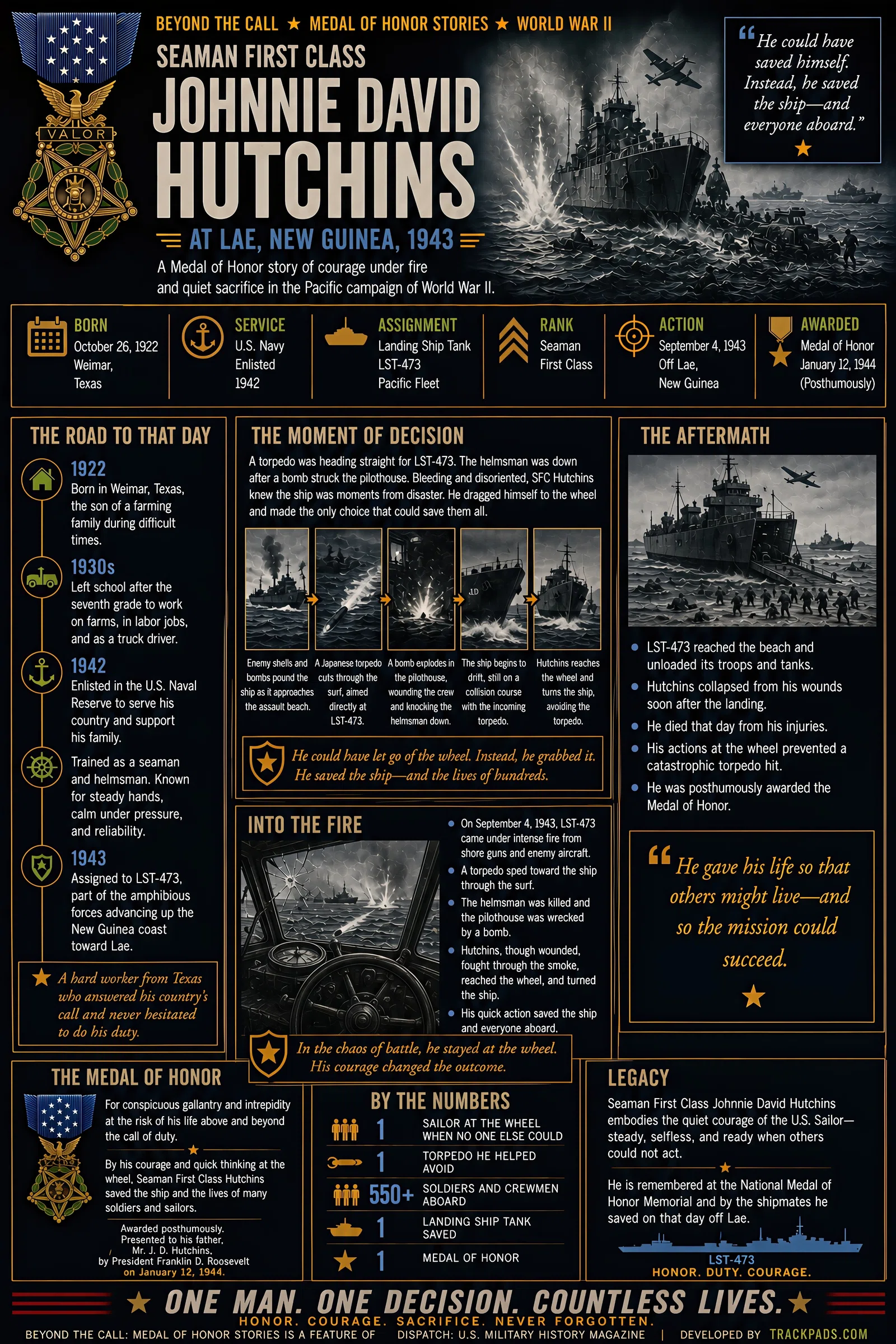
The shoreline of New Guinea was little more than a dark smudge ahead of the convoy, but the enemy had already found them. Shells from concealed Japanese guns walked the water around the slow, boxy landing ship tank as it crept toward the assault beach. Overhead, aircraft dived in, dropping bombs that threw pillars of water and steel into the air. Below deck, soldiers and tanks waited to land. On the bridge, a young sailor from Texas gripped the wheel, trying to keep the lumbering ship steady in the chaos.
A lookout’s cry cut through the roar of engines and gunfire. A torpedo, slipping through the surf, was streaking straight toward the ship’s vulnerable side. The helmsman began to swing the bow, fighting the ship’s sluggish response. Before he could complete the turn, a bomb slammed into the pilothouse. Metal shrieked. Glass and splinters tore through the compartment. Men were thrown to the deck.
In the stunned seconds that followed, the landing ship drifted, still on a collision course with the incoming torpedo. Smoke and dust filled the wheelhouse. The helmsman was down. Seaman First Class Johnnie David Hutchins, bleeding and half-blinded by the blast, understood what that meant for the ship and everyone aboard her. Instead of crawling for cover or calling for help, he dragged himself upright, reached for the wheel, and made his choice.
The Road to That Day
Johnnie David Hutchins was born in the small town of Weimar, in Colorado County, Texas, in 1922. He grew up in the lean years between the world wars, when steady work was hard to find and families made do with what they had. School gave way early to responsibility; he left the classroom after the seventh grade so he could earn money and help keep the household afloat. In fields, on job sites, and behind the wheel of trucks, he learned the value of showing up, working hard, and doing what needed to be done without complaint.
Like many young Americans of his generation, Hutchins watched the world darken in the late 1930s. War flared in Europe and Asia, and newsreels showed distant cities burning. When the United States was pulled fully into the conflict after Pearl Harbor, he was already used to long days and physical labor. The Navy offered a chance to serve, to send money home, and to be part of something larger than the small patch of Texas soil he knew so well. He enlisted in the Naval Reserve in 1942 and began the transition from farm and factory work to the demanding routines of seamanship.
Training introduced him to life at sea: learning to handle lines, read orders over the roar of engines, and steer large, unwieldy ships in close quarters. His background with machinery and vehicles made him a natural fit at the helm. Fellow sailors came to rely on his calm presence and steady hands, especially during the long, slow approaches that defined amphibious operations. By 1943, Hutchins was serving as a seaman first class aboard the landing ship tank LST-473, part of the amphibious forces driving up through New Guinea toward the Japanese-held port of Lae. The mission ahead would demand everything he had learned, and more.
Into the Fire
On 4 September 1943, LST-473 pushed through the choppy waters off Lae as part of a larger Allied armada fighting its way up the New Guinea coast. The slow, ungainly landing ship tank carried soldiers, vehicles, and supplies that would be needed the moment the ramps dropped on the beach. Around her, other LSTs, smaller landing craft, and escorting warships kept station in carefully planned formations, each vessel with a narrow job to do in a very tight space. Everyone aboard knew the Japanese would fight hard to keep Lae, a key port that anchored their defenses in the region.
As the convoy closed the distance, the sky and shoreline erupted. Japanese shore batteries began walking their fire out toward the ships, splashes from near misses throwing walls of water into the air. Enemy aircraft swept in to add their bombs to the chaos, diving out of broken cloud and streaking low over the waves. For the soldiers packed into the tank deck and troop spaces, the only signs of danger were the shuddering impacts and the shouted reports from topside. On the bridge, where Hutchins stood at the wheel, each shell splash and incoming aircraft mattered, because every change in course had to keep the ship on track for the beach while avoiding disaster.
LST-473 had only limited room to maneuver. The waters near the landing beaches were shallow, crowded with other vessels, and bounded by reefs and sandbars. Turning too sharply could ground the ship or throw the formation into confusion. Maintaining speed was just as critical, because the troops and cargo she carried were scheduled to hit the beach in a precise sequence. Hutchins’ job was to translate the conning officer’s shouted orders into smooth changes of course, swinging the long hull just enough to dodge bursts of fire and stay clear of neighboring ships.
Then the threat changed shape. Lookouts spotted the white track of a torpedo cutting through the surf, aimed directly at the ship’s broadside. A torpedo strike at that moment would have been catastrophic. The explosion could have torn open the hull below the waterline, flooding the tank deck, killing scores of men, and potentially blocking the narrow approach for the vessels behind. The conning officer ordered a turn to comb the torpedo’s path, trying to swing the bow toward the oncoming weapon so it would pass harmlessly down the side. Hutchins started the maneuver, feeling the wheel fight against him as the ship responded with agonizing slowness.
Before the turn could be completed, a bomb from an attacking aircraft smashed into or near the pilothouse, shattering steel and glass and filling the compartment with smoke, dust, and flying fragments. The helmsman was thrown from his position. For a moment, LST-473 drifted with no one at the wheel, still lying broadside to the onrushing torpedo. Hutchins had been in the center of that blast. The explosion left him mortally wounded, but still conscious enough to understand what was happening around him. He pulled himself back to the helm, hands closing over the wheel he had guided so many times before.
With what the citation later described as the last of his strength, Hutchins forced the wheel over to continue the evasive turn. The huge rudders bit into the water, and the bow began to swing. The torpedo passed harmlessly along the hull instead of detonating amidships. LST-473 remained afloat, able to carry out her mission and land her cargo of men and equipment on the New Guinea shore. Hutchins, still clinging to the wheel even as his strength failed, had bought that outcome with his life.
The Citation, Decoded
The official Medal of Honor citation for Seaman First Class Johnnie David Hutchins begins with the phrase “extraordinary heroism and conspicuous valor above and beyond the call of duty.” Those words are used sparingly, and in this case they point to a choice made in a fleeting, terrible moment. The citation describes the ship approaching an enemy-held beach under a “veritable hail of fire” from shore batteries and aerial bombardment. In practical terms, this meant that Hutchins was steering through a lethal corridor where each splash in the water marked a near miss and every incoming aircraft offered a new threat.
When the bomb blast dislodged the helmsman and left the ship helplessly exposed, the citation summarizes a chain of events that unfolded in seconds. A ship without someone at the wheel is not simply drifting. In a formation and under fire, it is a hazard to itself and to every vessel nearby. Hutchins’ decision to grasp the wheel while mortally wounded translated the abstract idea of intrepidity into something concrete: a bleeding sailor dragging himself upright to finish a turn that no one else could complete in time.
The final lines of the citation note that he expended the last of his strength maneuvering the ship clear, and that his final thoughts concerned only with the safety of his ship showed the depth of his commitment. His courage was not a single dramatic gesture but a sustained effort, second by second, until the ship was safe and he could hold on no longer.
Why It Mattered
The turn that Johnnie Hutchins finished with his last strength did much more than save a single ship. In the crowded, shallow waters off Lae, one crippled landing ship tank could have blocked the approach lanes for every vessel behind it, forcing last minute diversions or cancellations of landings that had been planned down to the minute. A torpedo exploding amidships could have broken LST-473’s back, spilling fuel and debris across the surface and sending troops, tanks, and supplies to the bottom just short of the beach where they were needed most.
Because Hutchins brought the ship through, the men aboard LST-473 reached the shore and joined the fight for Lae with their equipment intact. Their vehicles rolled down the ramps instead of rusting on the seafloor. Their weapons and ammunition strengthened the foothold that Allied forces were carving out on the New Guinea coast. In a campaign built on a long chain of amphibious assaults, every load of cargo delivered on time helped maintain pressure on Japanese defenses and shorten the struggle for each new objective.
The impact was also human in a quieter way. Survivors carried the memory of a ship that did not explode beneath them, of a landing that went ahead despite the storm of fire. Families back home welcomed sons and fathers who might otherwise have been lost in an anonymous transport disaster. On paper, the battle for Lae moved forward as planned. In reality, the calm of a young helmsman under fire helped ensure that hundreds of men got to live out the rest of their stories.
Leadership and Character
Hutchins never held a lofty rank or formal command, but leadership is often revealed long before someone wears an officer’s insignia. His choice to leave school early and help support his family showed a willingness to shoulder responsibility without fanfare. In the Navy, that same instinct emerged in long hours at the wheel, where a mistake could scrape paint, damage a ship, or worse. Shipmates came to trust that when Hutchins had the helm, courses would be held steadily and orders would be carried out without drama.
On the day of the Lae landings, that steady character met its ultimate test. Mortally wounded and half blinded, he saw that the thing he did best was still needed. No one ordered him back to the wheel. He chose it because he understood that steering the ship clear of the torpedo was more important than his own chance of survival. That is moral courage in its purest form, the willingness to accept certain death so that others might live.
Legacy and Memory
Johnnie David Hutchins did not live to see the end of the war he helped to win. His death was nearly simultaneous with his act of heroism, and news of his sacrifice traveled from the waters off New Guinea back to the small Texas community that had shaped him. For his family, the Medal of Honor that followed carried both pride and an unfillable absence.
The Navy made sure his name did not end with the closing of his service record. A destroyer escort bearing his name carried it across the world’s oceans, a reminder to every crew member that their ship honored a sailor who had once stood where they stood and faced fire without flinching. In his hometown and across Texas, memorials, plaques, and displays have helped keep his story alive, allowing generations who never knew him to understand the cost of the calm courage behind the citation. Each time his name is read at a ceremony, taught in a classroom, or revisited in a feature like this, the moment in the pilothouse of LST-473 is lifted out of anonymity.