Headline Wednesday · December 30, 2026
248 Populated Entries
Engagements and campaigns examined through objectives, terrain, forces, outcomes, and consequences.
Battles & Campaigns
Every result opens a permanent subject record with its reference context and connected Dispatch coverage. Filter by record type, editorial collection, or a word in the entry.
248 entries found.
The valley offered almost no cover. Shallow folds of earth and shattered shrubs were all that shielded the Marines of 1st Battalion, 5th Marines as they tried to push forward on Okinawa Shima on May 7, 1945. Ahead of them, on a high ridge at the valley’s mouth, a Japanese machine gun hammered the slopes, stitching bullets across every patch of ground where a helmet or sleeve dared to move. The air vibrated with the clatter of automatic fire and the flat crack of rounds striking rock.
Early in the Korean War, United Nations forces clung to a shrinking perimeter around Pusan while North Korean troops pressed hard along the front.
The air over Balete Pass crackled with small-arms fire and the flat explosions of grenades. On the steep slope of Hill B, a narrow finger of ground jutting out above the zigzag road that threaded the Caraballo Mountains, five exhausted American infantrymen hugged the earth around a captured Japanese trench. It was 8 May 1945, deep in the Battle of Luzon, and Private First Class Anton L.
On November 11th, 1918, guns along the Western Front at last fell silent as the armistice between the Allies and Germany took effect at the eleventh hour of the eleventh day of the eleventh month.
A story of high-tech American armor meeting Soviet-designed tanks in the desert and how it reshaped modern ground warfare.
The January sky over eastern Belgium is the color of steel, low clouds pressing down on snow-covered fields. An American armored task force eases forward along a narrow road when the world ahead of it suddenly erupts. Antitank rounds smash into the frozen earth, machine guns rake the ditches, and rifle fire lashes out from a ridgeline roughly two hundred yards in front of the column. Inside one of the lead tank destroyers, Corporal Arthur O.
As the First World War neared its end, Allied forces targeted the Hindenburg Line, Germany’s most formidable defensive system on the Western Front.
A story of a jungle airstrip, thin lines of Marines and soldiers, and how local air power reshaped the Pacific war.
In the aftermath of the fall of Atlanta during the Civil War, Confederate forces tried to strike back not by retaking the city, but by severing the Union army’s lifelines.
A story of a blood-soaked cornfield, a shallow creek, and a battle that reshaped the Union’s war.
In the Civil War's Eastern Theater, September 17th, 1862 brought the single bloodiest day in American military history along Antietam Creek in Maryland.
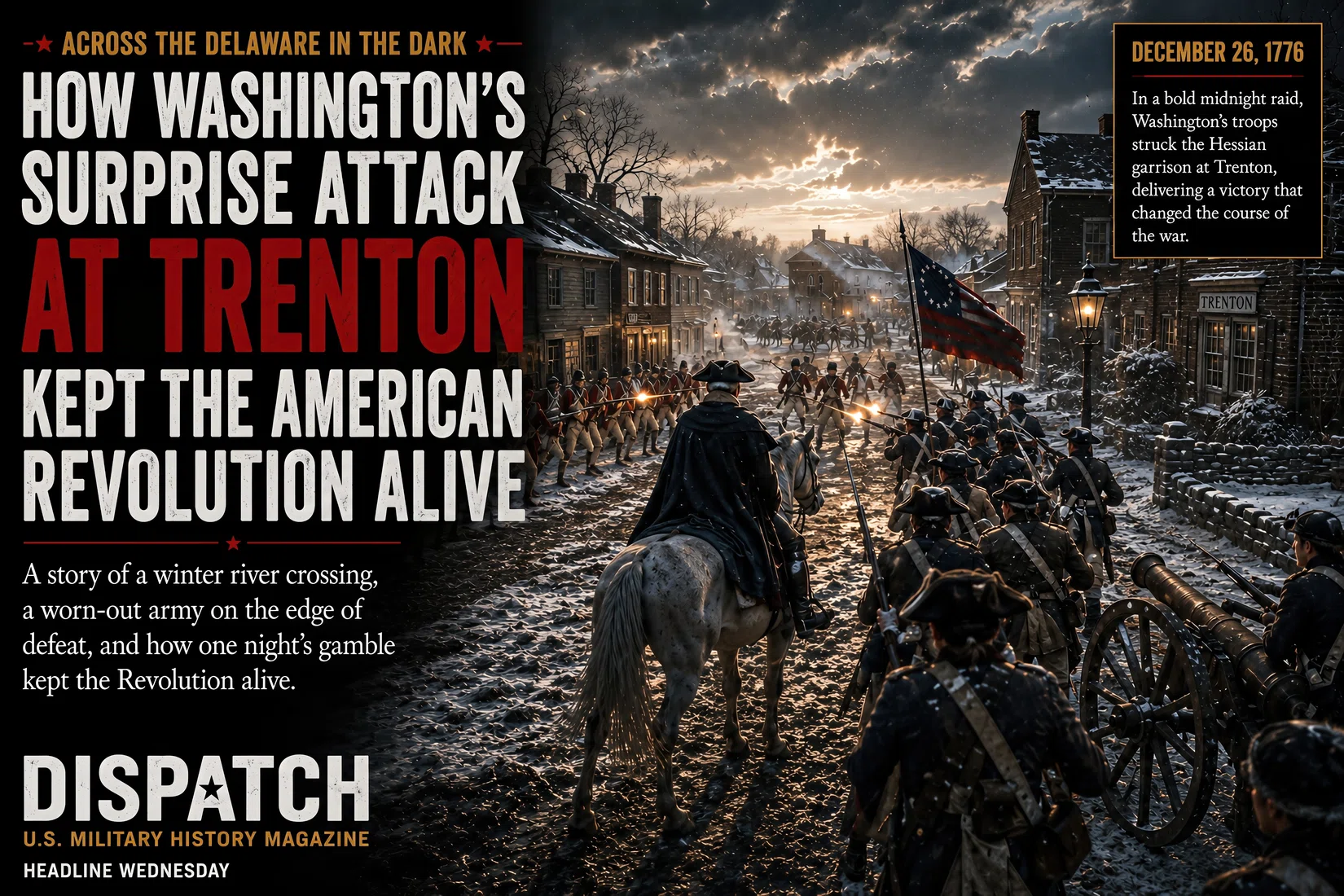
In the winter following the disastrous losses around New York, George Washington’s army clung to survival around Trenton.
Three years later and hundreds of miles to the west, another July battle marked a turning point in the struggle to save the Union. Outside Atlanta, Confederate General John Bell Hood launched a bold, flanking assault against Major General William T. Sherman’s forces, hoping to catch Union troops off balance and drive them away from the city.
On a wooded bluff above the Mississippi River in what is now Wisconsin, the Black Hawk War came to a bloody end. A small band of Sauk and Meskwaki people led by Black Hawk was trying to recross the river after months of pursuit by United States regulars and militia. At Bad Axe, soldiers, volunteers, and a river steamboat opened fire on warriors, women, and children crowded along the shore and in canoes.
Early in the Civil War, the Union still believed a quick, aggressive push might bring the rebellion to a close.
A story of a desperate stand in the woods and how it changed the wider war.
On August 16th, 1777, American militia under Brigadier General John Stark struck a British foraging column near Bennington in what is now Vermont. The British force, made up of German auxiliaries and Loyalists, had been sent out from General Burgoyne’s main army to gather supplies and horses for the invasion toward Albany.
Early in the Civil War, Union and Confederate forces clashed near Big Bethel Church in southeastern Virginia in one of the first significant land battles of the conflict. On June 10th, 1861, mostly inexperienced Union volunteers attempted a night march and dawn attack against Confederate positions but suffered from confusing orders, difficult terrain, and misidentification of friendly units.
In the autumn of the Petersburg Campaign, Union commanders launched a series of flanking offensives aimed at severing the rail and wagon routes that kept Robert E.
Just two years later, cavalrymen of the Union and Confederacy collided near Brandy Station, Virginia in what became the largest mounted battle ever fought in North America. On June 9th, 1863, Union cavalry crossed the Rappahannock River in a surprise attack aimed at probing Confederate movements as Robert E. Lee’s army shifted north toward Pennsylvania. Throughout the day, sabers and carbines flashed across fields and ridges as Union troopers challenged the reputation of J. E. B.
By February 23rd, 1847, the Battle of Buena Vista in northern Mexico had reached its decisive phase. General Zachary Taylor’s outnumbered American force, including U.S. regulars and state volunteer regiments, faced a much larger army led by Santa Anna along a series of ridges and arroyos near Saltillo. The terrain allowed the Americans to anchor their line, but Santa Anna probed for weak points all day, at times driving back portions of the U.S. front.
Just outside Manassas, Virginia, the first major land battle of the Civil War tore away any illusion of a quick, clean victory. Union forces under Brigadier General Irvin McDowell marched out from Washington hoping to strike inexperienced Confederate troops and end the rebellion in a single blow. Instead they found determined opposition and a battlefield that quickly grew chaotic, with brigades feeding in piecemeal and terrain that broke up neat formations.
The day after Washington accepted his new burden, militiamen outside Boston met the British army in one of the Revolution’s most famous early battles. Though remembered as the Battle of Bunker Hill, most of the fighting raged on nearby Breed’s Hill, where colonial forces hastily fortified a position overlooking the harbor. British commanders, determined to break the rebel grip on the peninsulas around Boston, launched repeated frontal assaults up the slopes in tight formations.
Before sunrise on November 20, 1917, the British attack began without the usual warning. There was no long preliminary bombardment to announce that an offensive was coming. No days of shellfire tearing the battlefield apart in advance. Instead, the opening movement at Cambrai depended on secrecy, timing, and the strange mechanical presence of hundreds of tanks moving toward the German line.
Related Dispatch
These current Dispatch articles connect directly to records in the Battles & Campaigns directory.