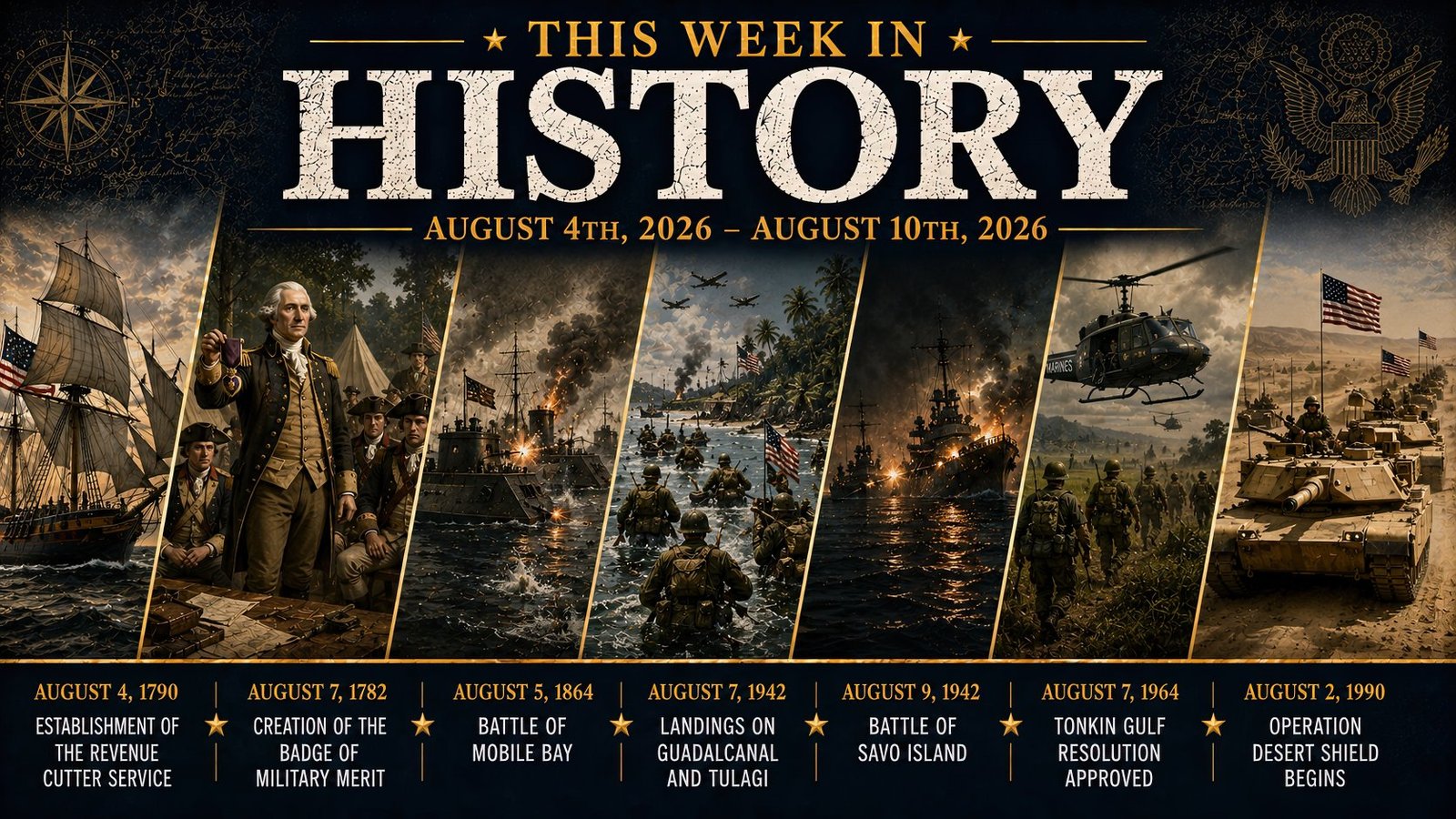
From August 4th, 2026 through August 10th, 2026, the calendar links moments of American service that stretch from the Revolutionary War encampments on the Hudson to armored columns rolling into the Arabian desert. In this week’s edition, anniversaries cluster around turning points: the creation of an early American combat decoration, the birth of a seagoing service, decisive naval actions in the Civil War, and hard-fought footholds in the Pacific during the Second World War. The same seven days also frame the arrival of Marines at a shrinking perimeter in Korea, a congressional resolution that helped open the long war in Vietnam, and the first deployments of Operation Desert Shield. Each episode sits in a wider story of how the United States raises, equips, and commits its forces. As always, This Week in U.S. Military History, the Tuesday feature of Dispatch: U.S. Military History Magazine, developed by Trackpads dot com, invites you to revisit these crossroads and consider what they meant to those who wore the uniform.
Creation of the Badge of Military Merit
In the late summer of the Revolutionary War, General George Washington issued a general order at his headquarters in Newburgh, New York, establishing a new distinction for enlisted soldiers and noncommissioned officers. The Badge of Military Merit took the form of a heart made of purple cloth, to be worn over the left breast by those who had performed “any singularly meritorious action” in the service of the Continental Army. At a time when European armies reserved most honors for officers and gentlemen, the badge signaled Washington’s desire to recognize courage and fidelity among ordinary soldiers. Only a few men received it during the war, but the idea lingered in American memory. When the modern Purple Heart was created in the twentieth century, it drew inspiration from this 1782 precedent and shifted its focus to those wounded or killed in action. Today’s observances on August 7th, marked as Purple Heart Day, look back to both the suffering and the steadfastness embodied in that original cloth heart.
Open the Wiki entryEstablishment of the Revenue Cutter Service
On August 4th, 1790, the young federal government took a practical step to secure both its finances and its coasts. Responding to proposals from Secretary of the Treasury Alexander Hamilton, Congress authorized the construction of a small fleet of revenue cutters to enforce customs laws and combat smuggling. These fast sailing vessels and their crews patrolled harbors and coastal routes, boarding ships, checking cargoes, and ensuring that customs duties reached the federal treasury. In an era before a standing navy had taken shape, the Revenue Cutter Service often represented the only federal armed presence along vast stretches of shoreline. Over time, the cutters took on additional missions, including search and rescue and support to naval operations in war. When the service later merged with the Life-Saving Service to form the United States Coast Guard, it brought with it this founding date and tradition. The August 4th anniversary therefore stands as the Coast Guard’s birthday and a reminder of the longstanding link between maritime law enforcement and national defense.
Open the Wiki entryBattle of Mobile Bay
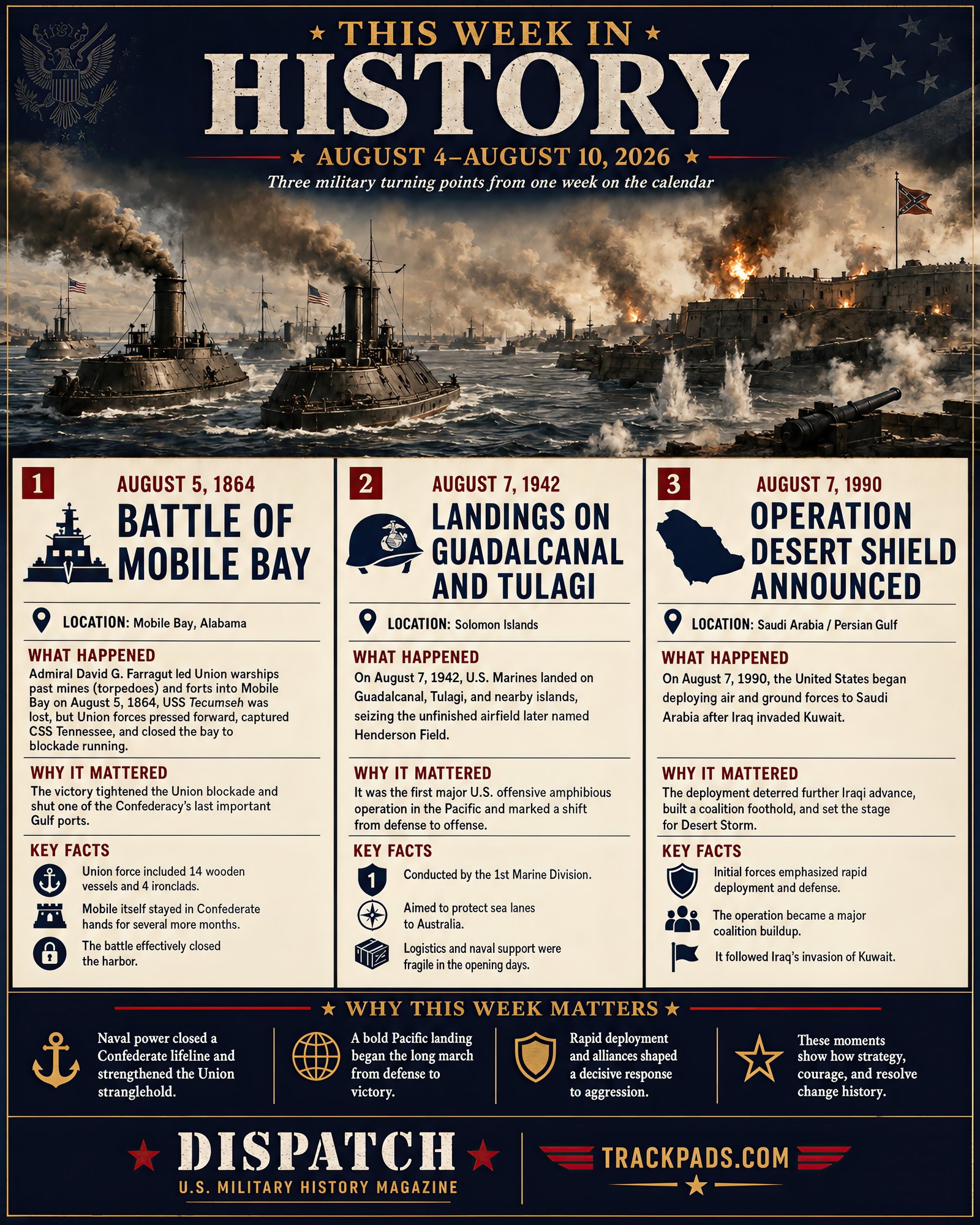
By August 5th, 1864, Union forces had spent years tightening the naval blockade that ringed the Confederacy, but the port of Mobile, Alabama, still offered the South a gateway to the Gulf. On that morning, Admiral David G. Farragut led a column of Union wooden warships and ironclads past the minefields—then known as “torpedoes”—and fortifications guarding the narrow channel into Mobile Bay. When one Union ironclad struck a mine and sank, hesitation rippled through the line, but Farragut is remembered for urging his ships forward despite the danger, a moment later distilled into the famous phrase “Damn the torpedoes, full speed ahead.” In the fighting that followed, Union guns battered and eventually captured the powerful Confederate ironclad CSS Tennessee and silenced key forts commanding the bay. Though the city of Mobile remained in Confederate hands for several more months, the harbor was effectively closed to blockade runners. The victory tightened economic pressure on the Confederacy and showcased how determined naval operations could help decide a continental civil war.
Open the Wiki entryLandings on Guadalcanal and Tulagi
On August 7th, 1942, United States forces launched their first major offensive of the Pacific War with amphibious landings in the Solomon Islands. Elements of the First Marine Division came ashore on Guadalcanal, Tulagi, and nearby islets to seize an airfield that Japanese engineers were building, one that threatened the sea lanes linking the United States and Australia. The landings surprised the defenders, allowing the Marines to take the unfinished airstrip, soon renamed Henderson Field, and establish a tenuous beachhead. Behind the immediate clash lay a broader strategic shift: until this point, the United States had largely been reacting to Japanese advances across the Pacific, but now it was seizing the initiative. Logistics were fragile, naval cover uncertain, and Japanese counterattacks would be fierce in the months that followed. Yet August 7th marked the opening move in a grueling campaign that would grind down Japanese forces and demonstrate that American amphibious operations could project power into contested waters. The anniversary underscores how a single decision to land on a remote island can reshape the trajectory of an entire theater.
Open the Wiki entryBattle of Savo Island
Just two nights after the Guadalcanal landings, the vulnerability of that new foothold became painfully clear. In the dark early hours of August 9th, 1942, a Japanese cruiser force slipped past Allied picket lines and radar screens to strike the screening cruisers guarding the approaches to Savo Island and the transport anchorage. In the confused close-range night battle that followed, several Allied heavy cruisers, including United States ships and the Australian cruiser HMAS Canberra, were hit repeatedly and sunk or left burning. The transports, with their vital cargoes for the Marines ashore, escaped destruction, but the price was heavy, and the surviving ships withdrew. The episode exposed serious weaknesses in Allied night fighting tactics, communications, and readiness, even with radar equipment available. In the weeks that followed, commanders pored over reports, adjusted training, and paid closer attention to how lookouts, radar operators, and gun crews worked together after dark. The Battle of Savo Island stands as a reminder that early phases of a campaign often bring harsh lessons, paid for in blood and steel, that shape how a navy fights the rest of the war.
Open the Wiki entryRescue of PT-109 survivors
The night action around the Solomons a year later produced a very different kind of story when Patrol Torpedo boat PT-109, commanded by Lieutenant John F. Kennedy, was rammed and cut in two by a Japanese destroyer in the early hours of August 2nd, 1943. Kennedy and most of his crew survived the collision but found themselves in the water amid wreckage, miles from friendly lines. Over several exhausting days, they swam to small islands, rationed what little food they had, and watched for any sign of rescue while Kennedy towed a badly burned crewman by a life jacket strap clenched in his teeth. With the help of local Solomon Islanders and a coastwatcher, Kennedy eventually sent a message carved into a coconut, and on August 8th a fellow patrol torpedo boat reached the survivors and brought them back. The episode became one of the war’s best-known small-unit survival tales, illustrating the hazards faced by small combat craft and the importance of local allies. It also later colored public perceptions of Kennedy’s personal courage when he entered national politics.
Open the Wiki entryGuam declared secured
On August 10th, 1944, American commanders declared Guam secured after nearly three weeks of brutal fighting that began with landings in late July. The island, seized by Japan shortly after the attack on Pearl Harbor, lay in a position that made it a natural forward base for the United States in the central Pacific. Marines and Army units fought their way inland from the beaches through ridges, tangled vegetation, and well-prepared Japanese defenses, confronting not only strongpoints and counterattacks but also the challenges of heat, terrain, and supply. By the time organized resistance ended, American forces controlled the island, though mopping-up operations and searches for isolated Japanese soldiers would continue. In the months that followed, Guam grew into a major logistics and air base, hosting long-range bombers that would strike the Japanese home islands. The August 10th milestone therefore marks not just the end of a costly island battle, but the opening of a new stage in the air campaign and the steady tightening of pressure on Japan.
Open the Wiki entryAtomic bombing of Hiroshima
On the morning of August 6th, 1945, a B-29 bomber of the United States Army Air Forces dropped the first atomic bomb used in war over the Japanese city of Hiroshima. In seconds, a blast and firestorm devastated much of the urban area, killing tens of thousands of people outright and leaving many more injured or exposed to radiation. American planners had chosen the target to demonstrate the power of the new weapon and to hit a city with military facilities and industrial connections, hoping to shock Japan’s leadership into surrender and avoid the projected casualties of an invasion. The attack also served as the first visible result of the secret Manhattan Project, which had brought together scientists, engineers, soldiers, and workers across the United States. News of the bombing reverberated through Allied capitals and the Japanese government alike, with reactions ranging from relief at a possible end to the war to deep unease about what such weapons meant for the future. The date stands as a turning point in both military technology and the moral questions surrounding its use.
Open the Wiki entryAtomic bombing of Nagasaki
Three days after Hiroshima, on August 9th, 1945, a second atomic bomb fell on the city of Nagasaki, delivered by another B-29 that had originally set out for a different target. Weather, fuel concerns, and mission decisions brought the bomber over Nagasaki, where the “Fat Man” device detonated with power even greater than the first weapon. The blast and resulting fires destroyed neighborhoods, factories, and military facilities, adding another wave of casualties to those already suffered across Japan from conventional bombing and the Hiroshima attack. At the same time, the Soviet Union’s entry into the war against Japan on August 8th further changed the strategic picture facing Tokyo. Within days of the Nagasaki bombing, Emperor Hirohito and key advisers moved toward accepting Allied surrender terms, leading to the announcement that the war would end. While historians continue to debate the relative weight of each factor, the August 9th strike clearly helped convince Japanese leaders that further resistance risked national annihilation. For the United States military, Nagasaki underscored both the destructive reach of atomic weapons and the responsibilities attached to their use.
Open the Wiki entryFirst Provisional Marine Brigade reaches Pusan
In early August 1950, the Korean War had entered a precarious phase as North Korean forces pushed United Nations troops back toward the southeastern tip of the peninsula. On August 7th, the First Provisional Marine Brigade, formed from elements of the First Marine Division, arrived at the port of Pusan to reinforce the hard-pressed defenders. These Marines brought with them not just additional infantry and supporting arms, but a reputation for aggressive action that commanders hoped would stiffen the line. Over the following weeks, the brigade launched a series of counterattacks along the Pusan Perimeter, moving rapidly to plug gaps and blunt enemy thrusts. The fighting was intense and costly, yet their presence helped prevent a collapse of the perimeter at a moment when the loss of Pusan could have meant defeat in the theater. The August 7th deployment therefore set the stage for later operations, including the Inchon landing, by preserving a foothold from which the United Nations could build up combat power.
Open the Wiki entryGulf of Tonkin Resolution
On August 7th, 1964, the United States Congress passed what became known as the Gulf of Tonkin Resolution, a short but far-reaching measure tied to contested events earlier that week. American destroyers operating off the coast of North Vietnam had reported an attack on August 2nd and a second, disputed encounter on August 4th, prompting the Johnson administration to order retaliatory air strikes, known as Operation Pierce Arrow, on August 5th. Seeking a show of unity and authority, the administration then asked Congress for a resolution affirming that the president could take all necessary measures to repel attacks and prevent further aggression in Southeast Asia. The House and Senate approved it by overwhelming margins, with little dissent and limited debate. In the years that followed, the resolution served as the primary legal framework cited for major expansions of United States ground and air operations in Vietnam, even as investigations raised serious questions about what had actually happened in the gulf. The August 7th anniversary therefore marks a political and military hinge point, when a short document opened the door to a long and costly war.
Open the Wiki entryOperation Desert Shield announced
By August 7th, 1990, Iraqi forces had already invaded and occupied Kuwait, raising fears that they might drive farther south toward the oil fields of Saudi Arabia and disrupt the broader balance of power in the Persian Gulf. On that date, the United States announced Operation Desert Shield, committing air and ground forces to Saudi Arabia at the request of its government and in coordination with other nations. Initial deployments included airborne and air defense units capable of arriving quickly to deter further Iraqi advances, followed by armored and mechanized formations that would build a substantial defensive line. The movement of forces also signaled a new era of rapid coalition building, as partners from Europe, the Middle East, and beyond joined in. For American service members, Desert Shield meant months of preparation in harsh desert conditions, living under the possibility that deterrence might fail and fighting might follow. The operation’s beginning in this August week sets the stage for the later offensive known as Desert Storm and highlights how swift decisions about deployment can help prevent an even wider conflict.
Open the Wiki entryAcross the Week
The anniversaries gathered between August 4th and August 10th trace a path from handmade purple hearts sewn for Revolutionary War soldiers to jet-powered aircraft and armored divisions shaping global crises. Along the way, they show how the United States has balanced symbols of individual sacrifice with the development of institutions such as the Coast Guard, and how bloody defeats at sea or ashore have often forced rapid learning. The week reminds us that victories like Mobile Bay and Guadalcanal came paired with harsh lessons at Savo Island, and that decisions made in distant legislative chambers or briefing rooms—whether in 1964 or 1990—can commit hundreds of thousands of people to war or to its brink. From small crews clinging to wreckage in the Solomons to brigade-sized reinforcements landing at Pusan, the stories share a common thread of endurance under pressure. As readers of Dispatch: U.S. Military History Magazine reflect on these dates, they can also consider how today’s service members stand in a line that runs directly through this crowded week on the calendar.