Reference Entry
BATTLE OF MOBILE BAY
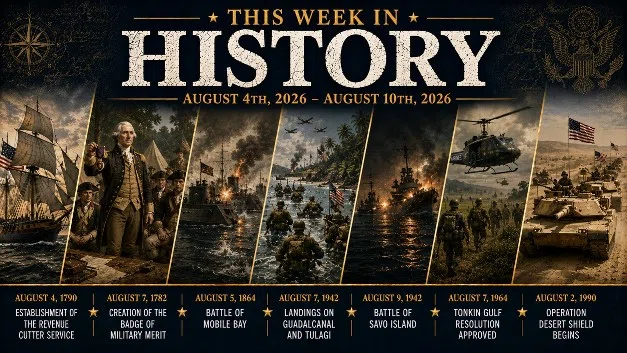
By August 5th, 1864, Union forces had spent years tightening the naval blockade that ringed the Confederacy, but the port of Mobile, Alabama, still offered the South a gateway to the Gulf. On that morning, Admiral David G. Farragut led a column of Union wooden warships and ironclads past the minefields—then known as “torpedoes”—and fortifications guarding the narrow channel into Mobile Bay.
Scope of this history
Expansion of the existing Mobile Bay record: naval action August 5 and entrance-fort operations through August 23, not the separate 1865 land campaign.
The objective was an entrance, not an immediate city occupation
Mobile was a major Confederate port, and its sheltered bay offered a protected maritime connection. By the summer of 1864, Union commanders could bring substantial naval force against the entrance. Capturing it would make the blockade more effective and deny the Confederacy the use of an important approach from the Gulf. The operation did not require the fleet to seize the inland city in the same action. [1]
The distinction is essential to the chronology. August 5 was the fleet battle; operations against the remaining entrance forts continued afterward. Mobile city itself remained in Confederate hands until the separate land campaign of 1865. A citation that compresses successful attacks on ships and batteries into one account should not be used to move the city’s capture back by eight months. [1]
A mixed fleet against forts, mines and a ram
David G. Farragut’s force included four monitors and fourteen wooden vessels, with Hartford serving as his flagship. Franklin Buchanan’s Confederate squadron centered on the armored ram Tennessee, supported by the smaller vessels Selma, Morgan and Gaines. Shore defenses strengthened that smaller naval force. The Union problem was therefore not simply defeating one enemy ship, but reaching useful water while exposed to several different threats. [2]
The pairing of armored and wooden vessels reflected those threats. The monitors could take a position toward Fort Morgan, while the larger wooden ships brought substantial batteries but remained vulnerable to shells and damage to machinery. Success depended on maintaining movement and order under fire, not on assuming that one kind of ship could solve every part of the engagement. [2]
The preparations behind the famous charge
Farragut’s July orders called for practical protection: remove unnecessary fittings, shelter vulnerable stations, protect machinery where possible and arrange vessels in lashed pairs. A smaller vessel could help move its partner if the larger ship lost power. These arrangements complicate the popular picture of an entirely improvised dash. The attack involved deliberate preparation for damage as well as the willingness to accept risk. [3]
The documents also show why orders and events must be read separately. A proposed formation was not automatically the exact formation used on the day, and early reports were revised as information arrived. This history uses those transcriptions to understand the operation; it does not treat them as verification of original Medal of Honor award orders. [3]
Tecumseh and the minefield
Tecumseh arrived shortly before the attack and led the monitors into the bay on August 5. In approaching the Confederate squadron, the monitor struck an underwater mine—then commonly called a torpedo—and sank rapidly. Armor that could resist gunfire did not remove the threat beneath the waterline. The loss created both a human catastrophe and an immediate navigational crisis for the ships following. [4]
The danger did not end with the sinking. Boats went to the assistance of survivors while the passage remained under fire. Charles Baker, Daniel Noble, James Avery and other members of Metacomet’s rescue boat are represented in the archive. Their citations describe the rescue itself, a distinct award action within the larger fleet battle. [5] [6] [7]
Farragut keeps the fleet moving
The familiar phrase “Damn the torpedoes” has come to stand for Farragut’s decision to continue. Accounts differ in the wording and sequence of his commands, and the compressed modern slogan should not be treated as a stenographic record. What matters operationally is the decision it represents: remaining stopped under the forts was dangerous too, and the fleet pressed ahead through the threatened passage. [8]
The passage was followed by a fight inside the bay, rather than by an immediate end to enemy resistance. The official report sequence distinguishes entry, pursuit and dispersal of gunboats, and the renewed challenge by Tennessee. Keeping those phases separate helps explain why some citations concern steering or ammunition supply during the passage while others involve close action against the ram. [9]
Damaged ships and the work of their crews
Oneida suffered serious damage, including a boiler hit. Galena, lashed alongside, helped carry the pair beyond the fort’s fire. The arrangement provided a practical demonstration of why coupled ships had been ordered in the first place. The survival of a damaged vessel could depend on its partner’s propulsion as much as on its own battery. [10]
Individual citations expose the labor behind the moving battle line. John H. Lawson returned to an ammunition station after being wounded aboard Hartford; Wilson Brown resumed his work after a shellburst knocked him unconscious. Alexander Mack’s Brooklyn citation records returning to his gun after treatment and being wounded again. These are accounts of sustained duties inside a ship’s fighting system, not merely dramatic moments seen from an admiral’s position. [11] [12] [13]
The Confederate gunboats
After the passage, Metacomet was able to separate from Hartford and pursue Confederate vessels. Under James E. Jouett, it captured Selma. The gunboat action mattered because the smaller Confederate ships could no longer operate as an intact supporting group around Tennessee. It also shows why a vessel’s role could change within the battle: a partner during the approach could become an independent pursuer once inside the bay. [14]
Tennessee’s isolated fight
Buchanan brought Tennessee back against the Union fleet despite its numerical superiority. The ram’s armor made it difficult to defeat quickly, but its opponents could combine repeated close-range fire with attempts to ram it. Damage to steering left the Confederate ship increasingly unable to maneuver. Protection and heavy guns were not enough when the vessel could no longer control its position. [15]
Tennessee eventually surrendered. Its loss removed the central armored threat, but did not mean that the entrance forts had all capitulated at the same moment. The battle is often remembered through the image of one ship surrounded by many; that image represents the closing ship-to-ship struggle, not the whole August operation. [15]
The forts fall afterward
The reduction of the entrance defenses required continued cooperation with Union troops under Gordon Granger. Fort Gaines surrendered on August 8; Fort Morgan held until August 23. Farragut’s ships continued to support operations after the fleet battle, and the captured Tennessee itself was brought into Union service against the remaining defenses. August 5 opened the way; subsequent operations secured the result. [1]
Galena’s service record includes support for the capture of Fort Morgan later in the month. That continuing duty is a useful reminder that a ship’s battle history rarely ended with the best-known morning. Blockade, bombardment, repair and renewed movement could follow one another even after the decisive enemy warship had surrendered. [10]
What the citations establish
The recipient links below are a reviewed selection from the archive, not a substitute for a crew list or a complete historical award roll. Some citations mention earlier service in the Mississippi campaign alongside Mobile Bay. Cornelius Cronin’s record does so explicitly. The Mobile relationship applies to the identified August 5 action, without relocating those earlier operations to Alabama. [16]
John Cooper’s profile contains more than one award. The Mobile Bay connection applies to the first award rather than indiscriminately to every citation on the page. Reading a recipient’s complete record alongside the operational history preserves the distinction between one person’s different actions, even when the same vessel or theater appears more than once. [17]
Source notes
Sources and further reading
Institutional histories establish the battle, incident, or unit context. Linked Trackpads recipient records preserve the award citations used for individual actions. The connections below are a reviewed selection, not a complete historical roll of awards.
- NHHC — Mobile Bay, 5–23 August 1864 ↗
- NHHC / DANFS — Hartford I ↗
- NHHC — Mobile Bay: Selected Documents ↗
- NHHC / DANFS — Tecumseh I ↗
- Charles Baker — preserved recipient citation ↗
- Daniel Noble — preserved recipient citation ↗
- James Avery — preserved recipient citation ↗
- NHHC — Famous Navy Quotations ↗
- NHHC — Farragut’s official Mobile Bay reports ↗
- NHHC / DANFS — Galena I ↗
- John Henry Lawson — preserved recipient citation ↗
- Wilson Brown — preserved recipient citation ↗
- Alexander Mack — preserved recipient citation ↗
- NHHC / DANFS — Jouett I, namesake biography ↗
- NHHC — Tennessee (Confederate ship history) ↗
- Cornelius Cronin — preserved recipient citation ↗
- John Cooper — preserved recipient citation ↗
Dated Historical Context
A RECORDED MOMENT IN HISTORY
Battle of Mobile Bay
By August 5th, 1864, Union forces had spent years tightening the naval blockade that ringed the Confederacy, but the port of Mobile, Alabama, still offered the South a gateway to the Gulf. On that morning, Admiral David G. Farragut led a column of Union wooden warships and ironclads past the minefields—then known as “torpedoes”—and fortifications guarding the narrow channel into Mobile Bay. When one Union ironclad struck a mine and sank, hesitation rippled through the line, but Farragut is remembered for urging his ships forward despite the danger, a moment later distilled into the famous phrase “Damn the torpedoes, full speed ahead.” In the fighting that followed, Union guns battered and eventually captured the powerful Confederate ironclad CSS Tennessee and silenced key forts commanding the bay. Though the city of Mobile remained in Confederate hands for several more months, the harbor was effectively closed to blockade runners. The victory tightened economic pressure on the Confederacy and showcased how determined naval operations could help decide a continental civil war.
Read the complete weekly DispatchTrackpads Source Register