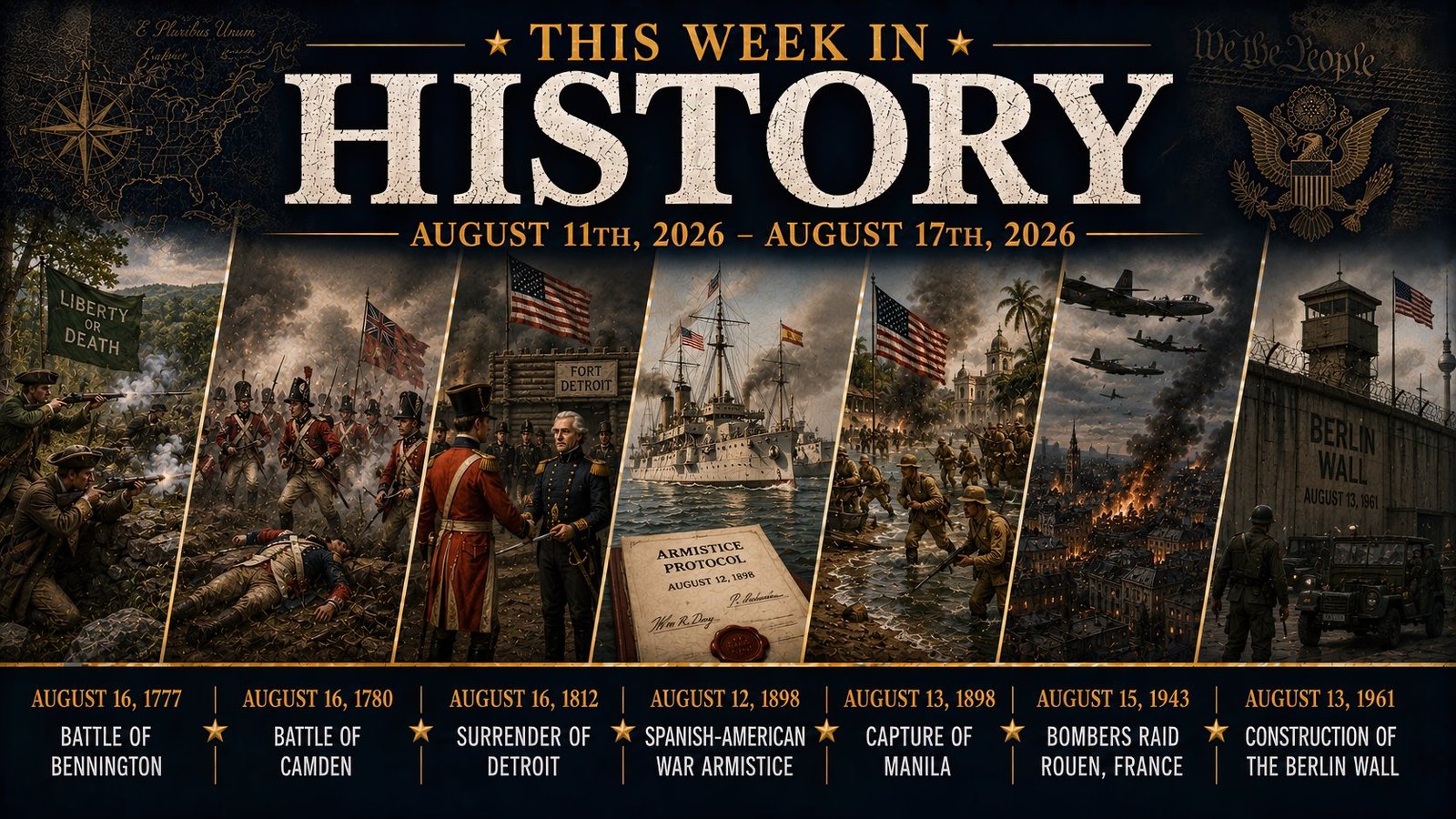
From August 11th, 2026 through August 17th, 2026, the calendar carries echoes of American soldiers, sailors, airmen, and Marines fighting, failing, learning, and ultimately reshaping the world around them. In this seven-day span, past years have seen militia stand their ground in New England, Continental regulars crushed in the Carolinas, and a stunned garrison surrender Detroit without a major fight. Decades later, these same dates would mark armistice terms in a short, sharp war with Spain and the capture of Manila that ushered in a new, contested era of overseas possessions. The week also holds the paper birth of a secret wartime engineering district, the roar of bombers crossing into occupied Europe, and amphibious landings that cracked German defenses from the Mediterranean coast. Finally, it includes the day Americans poured into the streets to mark victory over Japan, and another when barbed wire and concrete in Berlin forced the United States to confront a long Cold War. Together, these moments remind us how much can change in a few August days.
Battle of Bennington
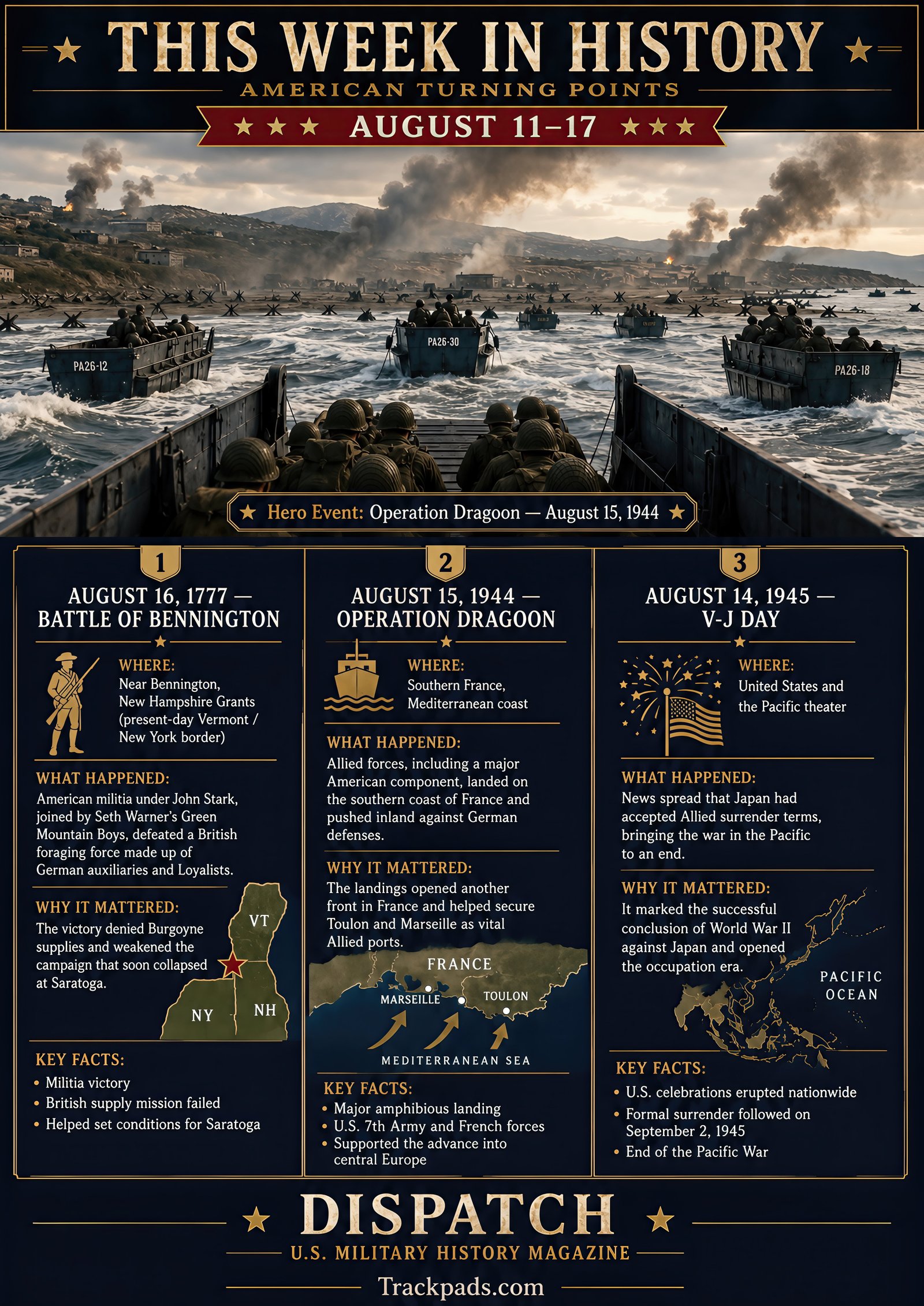
On August 16th, 1777, American militia under Brigadier General John Stark struck a British foraging column near Bennington in what is now Vermont. The British force, made up of German auxiliaries and Loyalists, had been sent out from General Burgoyne’s main army to gather supplies and horses for the invasion toward Albany. Stark’s New Hampshire, Massachusetts, and Vermont militia, joined by Green Mountain Boys under Seth Warner, attacked in a coordinated fashion, enveloping the enemy’s position. The resulting American victory cost the British much of a valuable detachment and denied Burgoyne the supplies and loyalist support he badly needed. The battle helped convince local communities that militia could stand up to professional troops when well led and fighting on familiar ground. In the larger campaign, Bennington weakened Burgoyne’s army just weeks before it marched into the disasters that culminated at Saratoga, a turning point that helped bring French support to the American cause.
Open the Wiki entryBattle of Camden
Three years later to the day, August 16th, 1780, the Continental Army suffered one of its worst defeats at Camden, South Carolina. Major General Horatio Gates led a hastily assembled army of Continentals and militia against a seasoned British force under Lord Cornwallis. Marching through swampy country on poor rations, many of Gates’s men were already in bad condition before the battle even began. When the armies collided before dawn, militia placed on the American left broke under the weight of disciplined British bayonet charges and fled the field. The collapse exposed the Continentals to attack from multiple directions, turning the engagement into a rout. Camden shattered American hopes for a quick recovery in the southern theater and discredited Gates as a commander. Yet the defeat also forced Congress and the Continental leadership to rethink southern strategy, eventually producing the more flexible campaigns of Nathanael Greene and his subordinates that would bleed British forces across the Carolinas.
Open the Wiki entrySurrender of Detroit
On August 16th, 1812, early in the War of 1812, Brigadier General William Hull surrendered the American post at Detroit to a smaller British force under Major General Isaac Brock. Hull had crossed into Canada weeks earlier with an army of regulars and militia but retreated after supply problems, poor coordination, and concerns about Native American allies fighting alongside the British. Brock moved quickly, bringing artillery and indigenous warriors to the Canadian side of the Detroit River and using bold messages and demonstrations to convince Hull that he faced overwhelming numbers. Despite having substantial guns and a defensive position, Hull capitulated without a major fight, turning over Detroit, its garrison, and valuable supplies. The surrender stunned Americans and provided a powerful boost to British morale in the Great Lakes region. It also highlighted the consequences of hesitant leadership, strained militia loyalty, and thin logistics on a distant frontier, lessons the United States would apply in later campaigns around the lakes and into Canada.
Open the Wiki entrySpanish-American War armistice
Jumping ahead to August 12th, 1898, American and Spanish representatives signed a protocol that halted fighting in the Spanish-American War. In a conflict that had opened only a few months earlier with battles around Cuba and the Philippines, United States forces quickly destroyed Spanish naval squadrons and seized key positions. The armistice reflected the realities at sea and ashore: Spanish fleets lay at the bottom of Santiago and Manila Bay, while American troops controlled much of Cuba and held a firm foothold in the Philippines. Under the protocol, the two sides agreed to end major operations while diplomats negotiated a formal peace treaty that would be signed later in Paris. For the United States, the August truce marked the moment when a regional war over Cuban independence turned into a global debate over empire, colonial rule, and America’s role beyond the hemisphere. It set the stage for new obligations, new bases, and new resistance movements in the years that followed.
Open the Wiki entryCapture of Manila
Just one day after the armistice protocol, on August 13th, 1898, American forces executed a planned assault that led to the capture of Manila in the Philippines. Communications delays meant that officers on the spot did not treat the earlier agreement as the end of hostilities, and the operation proceeded under prearranged signals with Spanish commanders in the city. United States troops advanced under covering fire from warships, pushing against Spanish defenses in what has often been described as a carefully managed engagement designed to preserve honor while acknowledging the inevitable outcome. When Manila surrendered, American forces gained control of a vital colonial capital and harbor, though Filipino revolutionary forces remained largely outside the process and soon challenged American occupation. The fall of Manila solidified the military position hinted at in the armistice and reinforced debates back home over annexation, self-determination, and the responsibilities that accompanied new territories acquired by force of arms.
Open the Wiki entryCreation of the Manhattan Engineer District
On August 13th, 1942, the United States Army Corps of Engineers officially established the Manhattan Engineer District, better known by the shortened phrase that would later describe the atomic bomb project. The district’s creation gave the Army formal responsibility for coordinating a vast, secret effort that drew together physicists, chemists, industrial firms, and military planners. Under this administrative umbrella, new laboratories and production sites would rise in remote locations, from Tennessee to New Mexico and beyond, all aimed at harnessing nuclear fission for weapons use before Germany or Japan could do the same. Though few Americans knew it at the time, the August paperwork laying out this district represented a major strategic gamble: diverting resources and scientific talent into a long-term project with uncertain chances of success. Its later results would fundamentally alter warfare, strategy, and ethical debates within the United States military, as atomic weapons reshaped planning from the final months of the Second World War into the Cold War that followed.
Open the Wiki entryFirst Eighth Air Force heavy bomber raid over Europe
Four days after the creation of that new engineering district, another milestone unfolded in the skies over occupied Europe on August 17th, 1942. That day, B-17 Flying Fortress bombers of the Eighth Air Force launched the first American heavy bomber raid against a target in occupied France, striking railyards and industrial facilities around Rouen. British-based American crews had trained for months to carry out daylight precision bombing, an approach that contrasted with the night area bombing practiced by the Royal Air Force. The raid was limited in scale but deep in symbolic meaning, announcing that United States air power had arrived in the European theater. In the years that followed, formations of American heavy bombers and their escort fighters would launch ever larger raids against German industry and transportation, suffering severe losses while also inflicting significant damage. The August 17th mission at Rouen marked the beginning of that long, costly air campaign that became central to Allied strategy.
Open the Wiki entryOperation Dragoon landings in southern France
On August 15th, 1944, Allied forces, including a substantial American component, stormed ashore along the southern coast of France in Operation Dragoon. While public attention and many soldiers’ memories focused on the earlier landings in Normandy, this Mediterranean assault opened a second front on French soil, aimed at seizing ports and driving north to link up with forces advancing from the Normandy beachhead. American and French troops pushed inland from beaches like Camel and Delta, supported by naval gunfire and air attacks that suppressed German coastal defenses. The operation rapidly secured key harbors such as Toulon and Marseille, providing much-needed logistical outlets that would feed the Allied advance into central Europe. For American commanders, Dragoon illustrated how amphibious doctrine refined in North Africa, Sicily, and Italy could be applied to open yet another avenue into Axis territory. It reminded both friend and foe that Allied sea power and planning could bring large ground forces ashore far from earlier battlefields.
Open the Wiki entryAcceptance of Japanese surrender terms (V-J Day)
The following summer, August 14th, 1945 became known to many Americans as V-J Day, the day news broke that Japan had accepted Allied surrender terms. After years of island campaigns, submarine warfare, strategic bombing, and the unprecedented use of atomic bombs, word finally spread across ships at sea, foxholes in the Pacific, and hometown streets that the fighting would soon end. In cities across the United States, spontaneous celebrations filled public squares, train stations, and harbors as service members on leave and civilians embraced, cheered, and sometimes simply stood in quiet relief. For those still deployed, the announcement meant a new set of questions: demobilization, occupation duties, and the long journey home. Militarily, the acceptance of surrender terms marked the successful conclusion of a global two-ocean war, but it also ushered in new responsibilities as American forces prepared to oversee occupation in Japan and confront emerging rivalries with former allies. The date stands as both a capstone and a doorway in United States military history.
Open the Wiki entryConstruction of the Berlin Wall begins
Finally, on August 13th, 1961, residents of West Berlin awoke to find barbed wire barriers and armed guards cutting across streets and neighborhoods as East German authorities began constructing what would become the Berlin Wall. For the American garrison and its British and French partners, the sudden division of the city turned familiar patrol routes and crossing points into potential flashpoints. Tanks, infantry, and military police units adjusted positions and procedures while senior commanders weighed how to demonstrate resolve without triggering open conflict. The wall’s construction dramatically reduced the flow of refugees from East to West but also hardened the line of confrontation in the heart of Europe, making Berlin a symbol of Cold War tensions. For American service members, defending access to the city became a long-term mission, with regular convoy movements along the corridors to West Berlin serving as both practical logistics and political message. August 13th thus marked another kind of battlefield: a divided city watched closely by both superpowers.
Open the Wiki entryAcross the Week
Across these seven days in August, the calendar offers a compressed tour of American arms and obligations, from improvised militia charges in wooded New England to armored patrols in a divided European capital. The week’s stories show victories that lifted morale, defeats that forced tactical and leadership reform, and decisions that carried the United States far beyond its original borders. They remind us that paperwork in a stateside office can launch projects that change warfare as much as any battlefield breakthrough, and that the end of one war often marks the beginning of new responsibilities. For today’s readers, whether veterans, families, or students of history, these anniversaries invite reflection on how quickly the character of conflict can shift while the burdens of service remain remarkably constant.