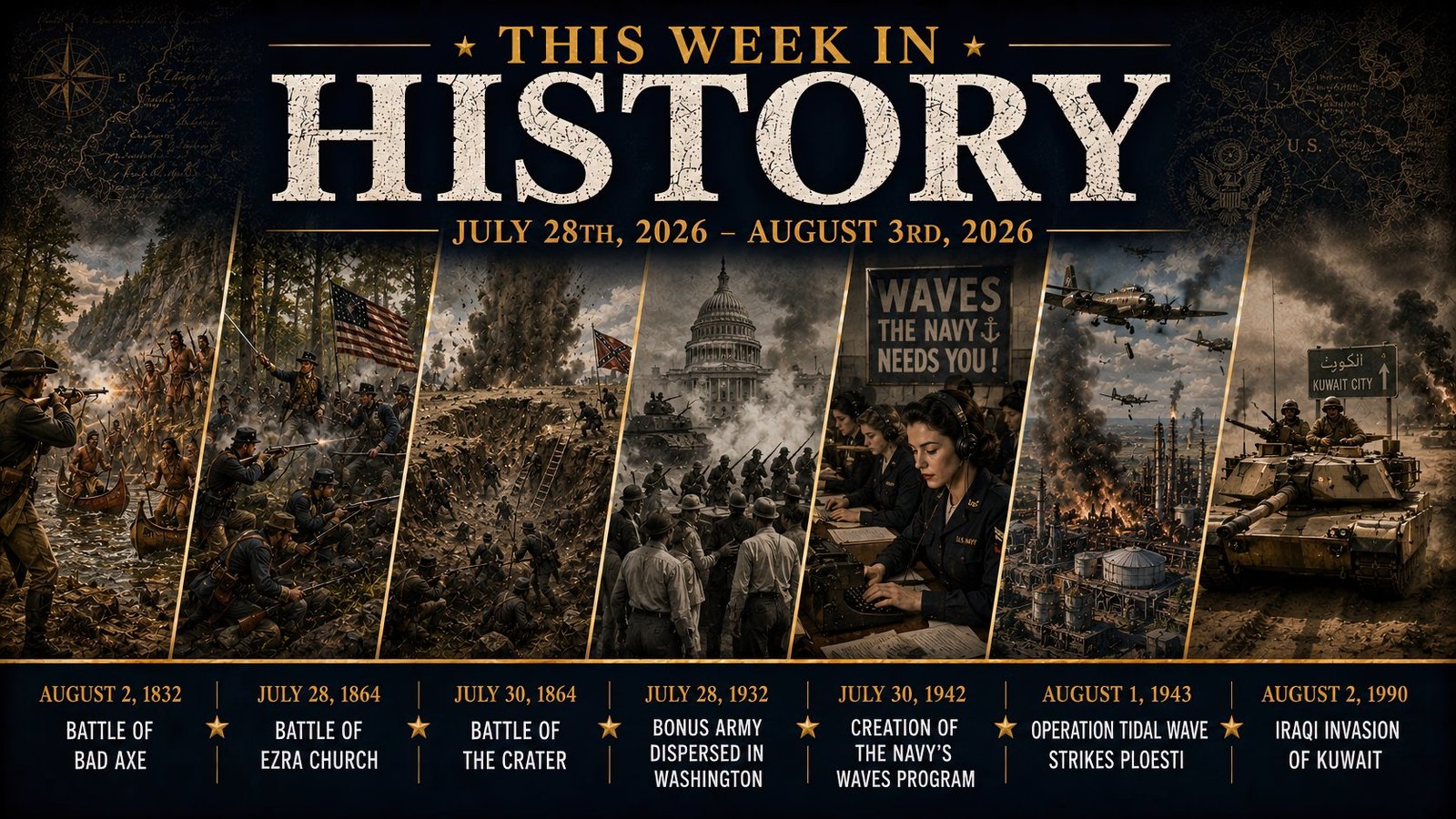
Late July and early August have often found American service members in hard, hot places, from Midwestern river bluffs to the burning decks of carriers off Vietnam. In this edition of “This Week in U.S. Military History,” we look at the span from July 28th, 2026 through August 3rd, 2026, and the moments that share those calendar days across nearly two centuries. The stories range from frontier warfare and Civil War trenches to global air raids, Cold War undersea voyages, and the shock of a modern invasion in the Persian Gulf. Some of these events are well-known turning points, others are grim cautionary tales or quiet milestones in organization and technology. Taken together, they show how decisions made in a single week of the year can echo through the lives of veterans, civilian leaders, and military families long afterward.
Battle of Bad Axe
On a wooded bluff above the Mississippi River in what is now Wisconsin, the Black Hawk War came to a bloody end. A small band of Sauk and Meskwaki people led by Black Hawk was trying to recross the river after months of pursuit by United States regulars and militia. At Bad Axe, soldiers, volunteers, and a river steamboat opened fire on warriors, women, and children crowded along the shore and in canoes. Accounts from the time describe a chaotic action in which attempts to surrender were often ignored and many noncombatants died. The battle effectively crushed organized Native resistance in that part of the upper Mississippi valley and cleared the way for rapid American settlement. For the Army, it was a hard lesson in irregular warfare on the frontier, and for Native communities it marked yet another tragic step in a long cycle of dispossession.
Open the Wiki entryBattle of Ezra Church
Fast-forward to the summer of the Civil War, and the terrain shifts to the outskirts of Atlanta. Major General William Tecumseh Sherman had pushed his three Union armies close to the rail lines that kept the Confederate stronghold supplied. Newly appointed Confederate commander John Bell Hood tried to break that grip with a series of aggressive counterattacks. At Ezra Church, west of the city, Union troops under Oliver O. Howard dug in along a low ridge as Hood’s men launched repeated frontal assaults. The fighting was brutal but one-sided, with Confederate brigades thrown back again and again against prepared rifle pits and artillery. Although the battle did not produce a dramatic breakthrough, it further eroded Hood’s army and tightened the noose around Atlanta. The costly failure at Ezra Church underscored how hard it was for the Confederacy to regain the initiative once Union forces seized key transportation hubs.
Open the Wiki entryBattle of the Crater
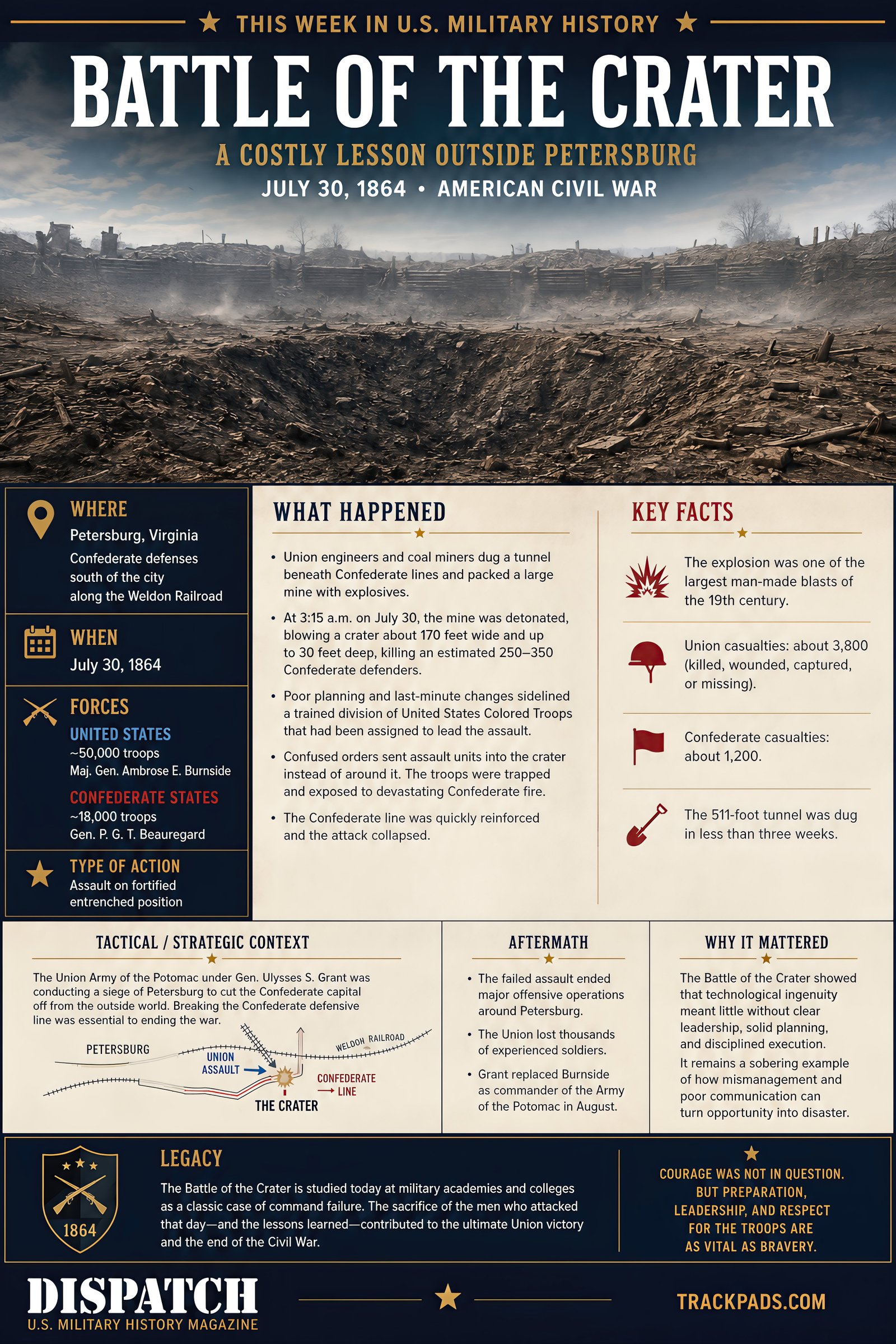
Two days later on the Eastern Front, another desperate attempt to break a stalemate unfolded outside Petersburg, Virginia. Union engineers and coal miners had spent weeks digging a tunnel beneath the Confederate lines, packing a massive mine with explosives under a salient in the defenses. At dawn on July 30th, the blast tore a huge crater in the earth, killing hundreds of Confederate soldiers instantly and opening a gap in the line. But what should have been an opportunity became a disaster. Poor planning, last-minute changes that sidelined a trained division of United States Colored Troops, and confused orders sent assault units plunging into the crater instead of around it. Trapped in the pit, they were raked by fire from Confederate reinforcements who quickly recovered. The failed assault cost the Union thousands of casualties and showed that technological ingenuity meant little without clear leadership, rehearsed plans, and respect for the troops chosen to carry them out.
Open the Wiki entryBonus Army dispersed in Washington
In the depths of the Great Depression, military service and economic hardship collided on the streets of the nation’s capital. World War I veterans had marched on Washington to demand early payment of bonuses promised for their wartime service, setting up sprawling camps along the Anacostia River and near the Capitol. As the standoff dragged on and tensions rose, the government ordered the camps cleared. On July 28th, Regular Army units with cavalry, infantry, and even a few tanks moved through the streets, using tear gas and bayonets to push the veterans and their families out. The sight of soldiers confronting former soldiers, many accompanied by wives and children, shocked much of the country. The episode damaged public confidence in the administration and underscored the importance of caring for veterans after the guns fall silent. Later legislation and programs would move, unevenly, toward a stronger safety net for those who had worn the uniform.
Open the Wiki entryCreation of the Navy’s WAVES program
As the demands of World War II grew, the United States Navy struggled to man new ships, bases, and shore commands. On July 30th, 1942, a law created Women Accepted for Volunteer Emergency Service, better known as WAVES, within the Naval Reserve. For the first time, women could serve as commissioned officers and enlisted sailors in the Navy in large numbers, though they were limited mainly to shore-based roles. Thousands answered the call, taking on duties in communications, logistics, intelligence, maintenance, and training that freed men for sea duty. The program challenged older ideas about who could serve and where, even as it reflected the gender assumptions of its time. By war’s end, WAVES had become an indispensable part of naval manpower. Their experience laid groundwork for the permanent integration of women into the sea services in the decades that followed.
Open the Wiki entryOperation Tidal Wave strikes Ploesti
The summer of 1943 found the United States Army Air Forces looking for ways to hit the Axis where it hurt most: oil. From airfields in North Africa, more than one hundred heavy bombers took off for a long-range, low-level mission against refineries around Ploesti, Romania, a key supplier of fuel to Germany. Flying at treetop height to evade radar and fighters, the crews encountered dense flak, smoke, and confusion around the target. Some formations became separated or misdirected, yet pressed their attacks through walls of fire and explosions. The raid inflicted serious damage and produced acts of extraordinary courage that would be recognized with the Medal of Honor. At the same time, losses were staggering and Romanian and German workers got many facilities back into operation sooner than hoped. Operation Tidal Wave highlighted both the promise and the limits of strategic bombing, and it spurred refinements in planning, navigation, and target analysis for later campaigns.
Open the Wiki entryPT-109 rammed in the Solomons
That same summer, halfway around the world, a small wooden patrol boat was cutting through the darkness of the Solomon Islands. PT-109, commanded by Lieutenant John F. Kennedy, was part of a group of motor torpedo boats tasked with intercepting Japanese shipping. In the early hours of August 2nd, a Japanese destroyer loomed out of the night and sliced through the slower patrol boat, killing two crewmen and flinging the survivors into burning fuel and debris. Over the next several days, Kennedy and his men swam to nearby islets, surviving on coconuts and rainwater while trying to signal friendly forces. Kennedy’s efforts to tow a badly wounded sailor by gripping a life-jacket strap in his teeth became a famous detail of the ordeal. Eventually, coastwatchers and local islanders helped arrange their rescue. The episode illustrated the hazards of small boat warfare in the Pacific and later became part of the future president’s public narrative of leadership under pressure.
Open the Wiki entrySinking of USS Indianapolis
As the Pacific war neared its end, the heavy cruiser USS Indianapolis completed a secret mission: delivering components of the first atomic bomb to a base on Tinian. After departing without a dedicated escort, the ship steamed west toward the Philippines. Shortly after midnight on July 30th, a Japanese submarine fired torpedoes that tore into the cruiser’s side. The ship sank in minutes, and around a thousand sailors and Marines were cast into the open ocean with few lifeboats. Because of communication failures and routine movements, the Indianapolis was not promptly reported overdue. For days, men floated in oil-slicked water, suffering from exposure, dehydration, and shark attacks until a passing aircraft spotted survivors by chance. Only a few hundred were eventually rescued. The tragedy led to intense scrutiny of wartime procedures and later changes in how ship movements and distress signals were tracked, as the Navy reckoned with one of the worst losses at sea in its history.
Open the Wiki entryUSS Nautilus reaches the North Pole underwater
In the Cold War, geography and technology combined to redefine what counted as a front line. The nuclear-powered submarine USS Nautilus had already shown that a boat freed from the need to surface for air could stay submerged for long periods. In early August 1958, Nautilus undertook a bold transit under the polar ice cap, passing directly beneath the geographic North Pole on August 3rd. The voyage demonstrated that American submarines could operate in a region once considered largely inaccessible, potentially approaching adversary coastlines from unexpected directions. It carried scientific value as well, adding to knowledge about the Arctic environment and ice thickness. Yet the strategic implications were what resonated most in military circles. The success of Nautilus foreshadowed a new era in which nuclear-powered submarines and ballistic missile boats would become central pillars of deterrence, silently patrolling oceans that no longer had true safe havens.
Open the Wiki entryFire aboard aircraft carrier USS Forrestal
Off the coast of Vietnam, the supercarrier USS Forrestal was preparing to launch another round of strikes when disaster struck. A malfunction caused a rocket on a parked fighter to fire across the crowded flight deck, smashing into another jet loaded with fuel and bombs. The resulting fires, explosions, and shrapnel tore through aircraft, equipment, and the sailors struggling to fight the blaze. Smoke filled compartments below decks as damage-control parties battled heat and confusion to keep the ship afloat. By the time the flames were brought under control, one hundred thirty-four sailors were dead and many more wounded. Investigations after the fire exposed flaws in ordnance handling, training, and protective gear on carriers of the era. The Forrestal disaster drove sweeping reforms in firefighting doctrine, equipment, and deck procedures, changes that would save lives on later deployments and shape how the Navy thought about survivability at sea.
Open the Wiki entryIraq invades Kuwait
The final events in this week’s window unfolded in the shifting landscape of the post–Cold War world. In the early hours of August 2nd, 1990, Iraqi armored and mechanized units crossed the border into Kuwait, quickly overwhelming the small country’s defenses and seizing its capital. The invasion stunned the region and set off a wave of diplomatic and military responses. For the United States, which had spent decades focused on Europe and Asia, the crisis demanded rapid reassessment of force posture in the Persian Gulf. Within days, American planners were organizing a large deployment to deter further Iraqi moves and to reassure partners, a buildup that would become Operation Desert Shield. The decision to respond with a broad coalition and a heavy air-land force, and the later combat of Desert Storm, grew directly out of that single night’s aggression. The invasion of Kuwait thus marked a new phase in American military engagement in the Middle East that continues to shape strategy and service today.
Open the Wiki entryAcross the Week
Across the span from frontier Wisconsin to the Persian Gulf, the events sharing these late July and early August dates highlight different faces of American arms. We see offensive gambles that went badly wrong and defensive stands that quietly shifted entire campaigns, as well as administrative decisions in Washington that altered who could serve and how veterans were treated. Aircrews over Romania, sailors adrift in the Pacific, submariners under the ice, and pilots on a burning flight deck all confronted risk in different forms but shared a core reliance on training and cohesion. At the same time, choices made by political leaders about war, peace, and nuclear arms altered the environment in which those forces operated. As you move through your own week from July 28th, 2026 through August 3rd, 2026, these stories offer reminders that history is built from both dramatic flashes and quiet reforms, all carried on the backs of individuals in uniform and the families who support them.