Beyond the Call · July 27, 2026
8 Populated Entries
Service life, institutions, memory, preservation, museums, and public history.
Military Life, Culture & Memory
Every result opens a permanent subject record with its reference context and connected Dispatch coverage. Filter by record type, editorial collection, or a word in the entry.
8 entries found.
A story of a grinding hill assault, exhausted rifle companies, and a single ridge that reshaped the war back home.
The snow was hard as concrete on the Belgian hillside, the January cold locking the ground into a sheet of ice. Staff Sergeant Curtis F. Shoup and the soldiers of his company lay sprawled on that frozen slope, their dark uniforms stark against the white as German machine guns raked the hillside. The attack had stalled almost as soon as it began. The enemy gun on the rising ground ahead had perfect fields of fire, sweeping every fold and hollow where the Americans tried to move.
Three years after major Confederate armies surrendered, the scars of the Civil War still marked towns and families across the reunited country. On May 30th, 1868, mourners gathered at Arlington National Cemetery and other burial grounds to decorate the graves of the war dead with flowers, flags, and wreaths. The observances followed a general order from a veterans’ organization calling for a national “Decoration Day” dedicated to remembering fallen soldiers from the Union ranks.
Night on Iwo Jima never really felt dark. The sky glowed faintly from flares and burning wreckage, and the volcanic ash underfoot seemed to swallow every step. In a shallow foxhole—a rough, shoulder-deep fighting position scraped into that ash—Private George Phillips stood watch while the rest of his squad finally slept. They had spent the night trading grenades and rifle fire with Japanese troops slipping through the lines.
In the final year of World War I, the thick tangle of Belleau Wood in France became the proving ground for American forces newly committed to the Western Front. Over weeks of grinding combat alongside French units, Marines from the Fifth and Sixth regiments launched repeated attacks against German machine-gun nests and dugouts that commanded open wheat fields.
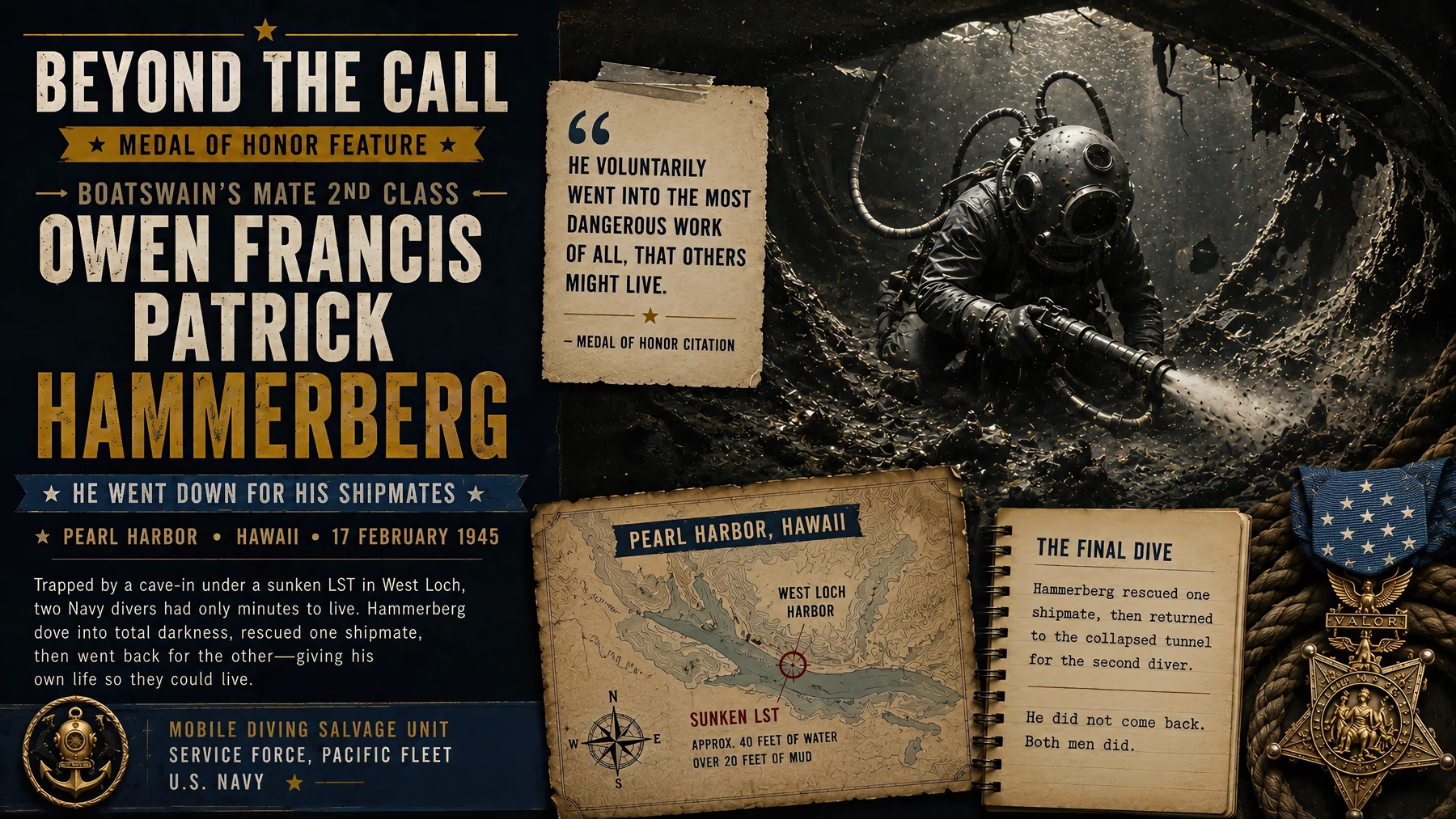
By February 1945, much of Pearl Harbor had returned to the business of war. Battleships and carriers came and went; convoys formed up and headed west toward Iwo Jima and Okinawa. But in a side channel called West Loch, the harbor still hid a graveyard. Months earlier, a chain of explosions had torn through a cluster of tank landing ships loading ammunition for the Pacific campaign.
The B-17 was almost home when the choice arrived over the radio: bail out, or try to land a dying airplane. The long mission over Leipzig was behind them, but the bomber itself was torn open—control cables shot away, engines coughing, the fuselage peppered with holes where German fighters had raked the formation. In the cockpit, the copilot lay dead. The pilot, badly wounded, had been dragged from his seat and now drifted in and out of consciousness, strapped down behind the controls.
The morning sky over northern Luzon is deceptively calm. From the cockpit of his sleek reconnaissance Mustang, Major William Arthur Shomo scans the broken clouds, hunting for airfields and antiaircraft positions that his ground commanders need to see. His mission is straightforward on paper: an armed photographic and strafing sweep over the Aparri and Laoag airdromes, far ahead of friendly lines.
Related Dispatch
These current Dispatch articles connect directly to records in the Military Life, Culture & Memory directory.