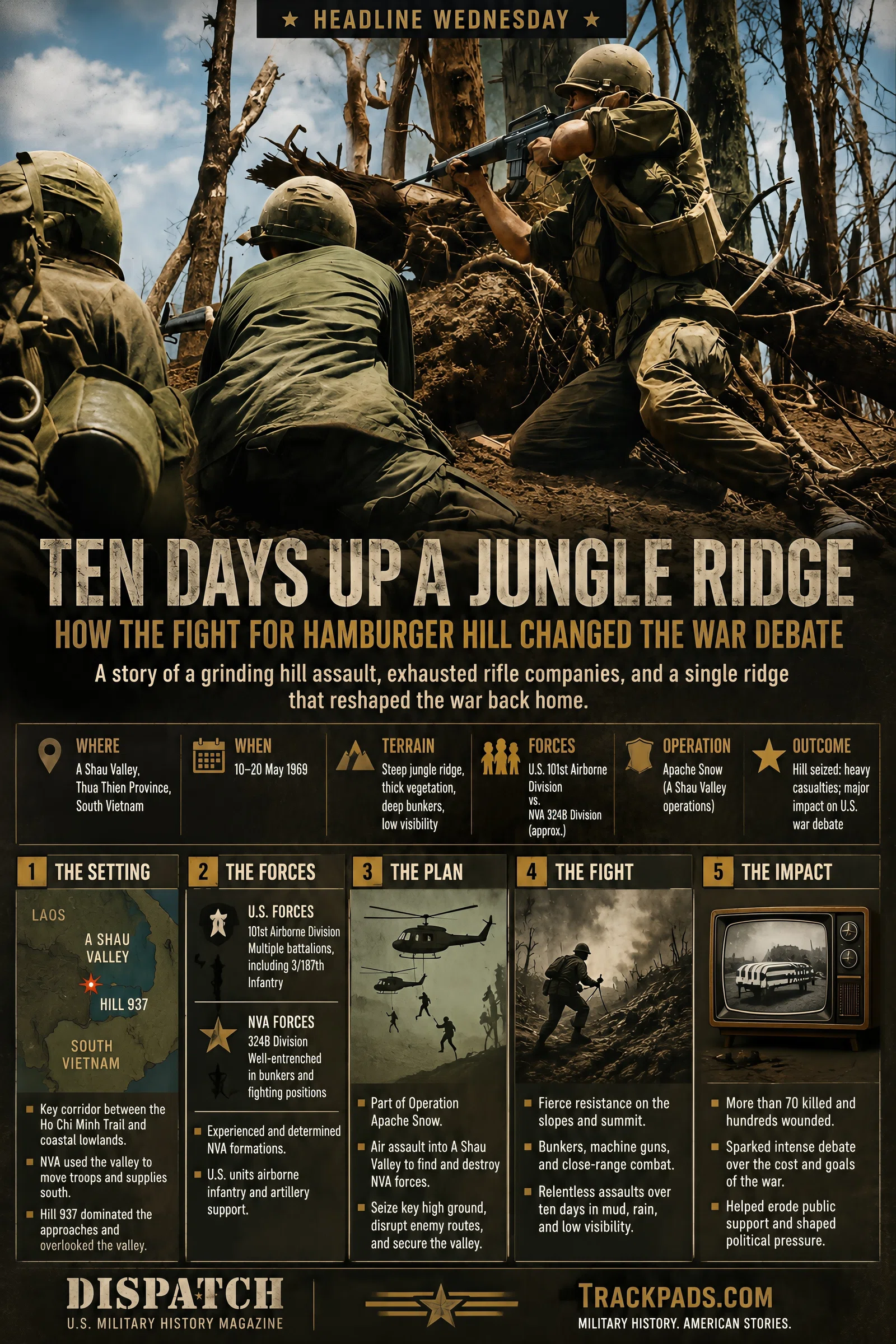
Into the Clouds Above Hill 937
The rain had already soaked through their ponchos by the time the first lift came in over the trees. Rotors beat the low clouds into shreds, throwing spray and mist across the jungle slopes that rose toward a nameless ridge on American maps and a numbered hill on enemy charts: 937 meters of mud, rock, and thick brush. Below, soldiers from the 101st Airborne Division stepped off into ankle-deep muck, heads bent under heavy rucksacks, pushing toward a crest they could not see through the fog. Somewhere up there, North Vietnamese Army troops waited in bunkers cut deep into the hillside.
The first firefights on the lower slopes did not look like a famous battle yet. A squad crossing a small stream took a burst of automatic fire from a concealed position, dropped, and crawled into the bank as their platoon leader shouted for smoke and supporting fire. A machine gun team tried to set up on a slight rise, only to find their field of fire blocked by bamboo and elephant grass. Radio calls crackled as company commanders tried to keep track of scattered contacts, shifting positions, and growing casualties in terrain that swallowed maps and grid lines.
Every step upward made the hill feel steeper and the jungle thicker. Men slipped backwards in the red mud, pulling each other up by rifle slings and web gear. Medevac helicopters hovered over small clearings cut with explosives, straining to hold themselves steady as wounded were dragged aboard under fire. The higher the companies climbed, the more deliberate the enemy fire became, as if the defenders were probing the Americans, measuring their strength and their willingness to keep coming. Somewhere in the mist, a hill that did not yet have a nickname was already turning into a test that would echo far beyond the A Shau Valley.
A Ridge With Outsized Consequences
Hill 937 sat along the spine of the A Shau Valley, a long, narrow corridor running close to the Laotian border in South Vietnam’s Thua Thien province. For years, the valley had served as a key route for North Vietnamese units moving men and supplies south, sheltered by jungle canopy and steep hills. To American commanders, the area represented more than just another patch of high ground. It was a gateway between the Ho Chi Minh Trail complex beyond the border and the coastal lowlands to the east, where major cities and bases lay within artillery range. Leaving the valley uncontested meant accepting a permanent enemy presence on the flank.
By the spring of 1969, the broader war was at an awkward crossroads. American troop levels had reached their peak and were beginning to edge downward, even as major formations still fought large engagements in the countryside. Search-and-destroy operations and body count statistics remained the centerpiece of strategy, but patience at home was thinning. Each new offensive had to deliver not only local tactical results but also something that could be defended to a skeptical public and to families who watched casualty figures crawl across television screens.
Within that tension, the decision to seize Hill 937 made military sense on paper. Intelligence indicated the presence of a substantial North Vietnamese force, believed to include elements of a seasoned regiment. The hill dominated approaches within the valley and offered observation over surrounding terrain. Knocking the defenders off that crest promised to disrupt enemy control of the area, deny them a strongpoint overlooking friendly firebases, and demonstrate that United States airborne infantry could still take and hold whatever ground their commanders selected. Yet the cost in men, effort, and time would be measured not just in the valley but in headlines and debate thousands of miles away, turning one jungle ridge into a symbol of the larger struggle over why the war was being fought at all.
From A Shau Plans to Hill 937
The road to Hill 937 began not with a single hilltop but with a map of the A Shau Valley covered in grease-pencil arrows. For years, American and South Vietnamese commanders had watched North Vietnamese units slip in and out of the valley, using its jungle floor and steep walls as a shield. In early 1969, they launched a series of operations meant to drive those units out and keep them off balance. One of these efforts, given the name Apache Snow, called for coordinated sweeps by the 101st Airborne Division and South Vietnamese forces across the high ground that framed the valley, looking for base camps, supply caches, and main force units.
Hill 937 did not stand out at first glance. On the operations overlay, it was one of many numbered elevations assigned to different battalions as they moved into their zones. The 3rd Brigade of the 101st, including the 3rd Battalion, 187th Infantry and other battalions, was tasked with pushing westward from firebases along the valley floor, probing the slopes for signs of organized resistance. The assumption, based on previous contacts, was that North Vietnamese units would fight delaying actions, then break contact and slip across the border into Laos when pressure grew too strong.
Reality proved harsher. As patrols moved toward Hill 937, they began to encounter stronger, more determined resistance than expected. Small skirmishes revealed bunkers and fighting positions that seemed deeper and more carefully sited than the usual temporary camps. Intelligence reports, pieced together from captured documents and radio intercepts, pointed to elements of a seasoned North Vietnamese regiment dug in on the mountain the locals called Ap Bia. What had been one objective among many now started to look like the centerpiece of the enemy’s defenses in this sector of the valley.
At brigade and battalion command posts, the picture came into focus in fits and starts. Commanders weighed the risk of a major assault up steep, jungle-choked slopes against the cost of leaving a well-prepared enemy strongpoint in place overlooking friendly firebases and movement routes. The decision that emerged was simple in phrasing and complex in consequences: the hill could not be left in North Vietnamese hands. Orders went out for the battalions to concentrate their efforts on Hill 937, to probe, fix, and then seize the crest. For the soldiers on the ground, that meant one thing. The ridge ahead was no longer just another climb. It was the main fight.
Ten Days of Climbing Fire
The battle that followed unfolded over ten days of almost continuous contact, as American companies clawed their way up the slopes and encountered layer after layer of defense. Early assaults probed the lower ridges, with platoons advancing until they ran into bursts of automatic fire and grenades from bunkers that seemed to appear out of the earth itself. Each time they took one position, another opened up a few dozen meters higher, forcing them back down the hill or into hasty defensive perimeters for the night. Artillery and air strikes hammered suspected strongpoints, but the jungle canopy and the enemy’s use of deeply dug bunkers blunted the effect.
From the perspective of a rifle squad, the hill became a maze of mud, roots, and sudden violence. Men hugged the ground as enemy mortars walked up and down the slopes. Calls for smoke and high explosive competed on the radio net with medevac requests. Squad leaders tried to keep their men moving forward in short rushes, counting on supporting fires to lift at just the right moment. A few meters of gain on the map felt like miles when each step might draw fire from a slit trench invisible until it opened up. Exhaustion and rain soaked into everything, making even simple tasks like changing magazines or dragging a wounded comrade uphill feel like moving through glue.
At company and battalion level, the fight turned into a grim calculation of ground taken versus casualties suffered. Commanders shifted units to attack from different approaches, trying to find weaknesses in the enemy’s bunker lines. One day’s attack might focus on a spur running off the main crest; the next might send a fresh company up a different finger of the ridge in the hope of outflanking interlocked fields of fire. Close air support aircraft roared overhead, dropping bombs and napalm on coordinates adjusted again and again as forward observers tried to peel away layers of defense. Each new assault built on the battered gains of the last, but the crest still refused to fall.
The North Vietnamese defenders fought with the advantage of prepared positions and intimate knowledge of the terrain. Their bunkers were cut into the hillside with logs and earth, often connected by covered trenches that allowed them to shift positions under fire. Machine guns were sited to sweep likely avenues of approach, while snipers and riflemen picked off exposed leaders and radio operators. When American troops closed in, defenders sometimes held their fire until the last possible moment, then unleashed volleys at ranges so short that the fight became hand grenades and bayonets rather than long-range firepower.
As the days wore on, reinforcing companies joined the battle, bringing fresh strength and new attempts up slopes already scarred by shell craters and blackened vegetation. Firebases in the valley below pumped out round after round to support each push, their guns firing almost continuously. Helicopters braved ground fire to bring in ammunition and lift out the wounded, weaving through clouds and smoke that clung to the ridge. Each evening, commanders tallied casualties and revised plans, determined to keep pressure on the defenders and avoid giving them time to rebuild shattered positions. By the time American troops closed within a short dash of the crest, Hill 937 had become less a spot on the map and more a shared ordeal known by a bitter nickname that would outlast the operation itself.
Firepower, Persistence, and a Breakthrough
What finally tipped the balance on Hill 937 was not a single dramatic charge but an accumulation of hard lessons, concentrated firepower, and sheer refusal to quit. As the days ground on, commanders refined their approach with each attack, plotting routes that tried to avoid known killing zones and adjusting artillery patterns to strip away layers of bunkers before infantry moved. Forward observers and air controllers learned where the enemy’s strongest positions lay, calling in repeated strikes on key ridgelines and bunker complexes. When the weather allowed, attack aircraft and bombers pounded the crest and its approaches, turning patches of jungle into splintered stumps and churned earth that made concealment harder for the defenders.
On the ground, companies reorganized and integrated replacements, mixing veterans of the first assaults with new arrivals who had yet to experience the hill’s particular brutality. Leaders at platoon and company level worked to keep their units moving in coordinated waves rather than isolated thrusts, using bounding overwatch and tighter control of supporting fires to prevent assaults from stalling in front of intact bunker lines. Infantry reduced individual positions with grenades and small arms, then immediately pushed past them to deny the defenders time to reoccupy or counterattack from alternate firing points. Each successful gain, however small, became a foothold for the next day’s advance.
The battle’s final phase saw multiple battalions converging on the crest in a carefully timed assault. Artillery and air strikes lifted in sequence, opening brief windows for infantry to rush forward before defenders could fully recover. North Vietnamese units, battered by days of bombardment and continuous contact, found their interconnected bunker system fractured and their ability to shift reserves under fire increasingly limited. Some positions still fought almost to the last man, but others gave way as American troops appeared in unexpected directions, having worked around earlier strongpoints. When soldiers from the attacking units finally crested the summit and found themselves on the highest ground, the view was less triumph than exhaustion: tangled trees, shattered bunkers, lingering smoke, and the knowledge that the ridge had been bought at steep cost.
A Captured Hill, Lingering Questions
Tactically, the capture of Hill 937 removed a major North Vietnamese strongpoint from the A Shau Valley and demonstrated that American airborne infantry could still assault and seize heavily fortified terrain under difficult conditions. The immediate aftermath saw units consolidating positions on and around the crest, clearing remaining bunkers, and treating or evacuating the many wounded accumulated over ten days of fighting. Casualty lists told the story in stark numbers, with significant losses in multiple companies and battalions. For the soldiers who had climbed and bled on the hill, the victory was marked less by celebration than by relief that the daily uphill assaults, and the constant expectation of contact, were finally over.
What happened next, however, ensured that Hamburger Hill would loom larger in memory than many other hard-fought engagements. Within a relatively short time, American units pulled back from the crest, as the operational focus in the valley shifted and the hill’s specific ground value declined. News reports and photographs highlighted the cost of the battle alongside the fact that the position was not being held long term. Critics seized on the contrast between the casualties suffered and the decision to relinquish the hill, arguing that it typified a body-count-minded strategy that spent lives for terrain that might soon be abandoned. Supporters countered that in a war of movement against an elusive enemy, forcing the opponent to suffer heavy losses and withdraw was itself a meaningful outcome.
In the political and public sphere, Hamburger Hill became shorthand for a broader debate about the direction of the war. Congressional hearings and commentary in the months that followed used the battle as a case study in how tactical decisions connected to strategic communication and public trust. The controversy helped accelerate a shift away from large-scale search-and-destroy operations toward policies that emphasized turning more of the fighting over to South Vietnamese forces. For students of military history today, the fight for Hill 937 remains a stark reminder that tactical success can carry strategic and moral costs, and that decisions made on a rain-soaked ridge in a remote valley can reshape conversations in capitals far away. It stands as a case where courage and skill at the small-unit level intersected with hard questions about purpose, strategy, and how a democracy wages a long war.