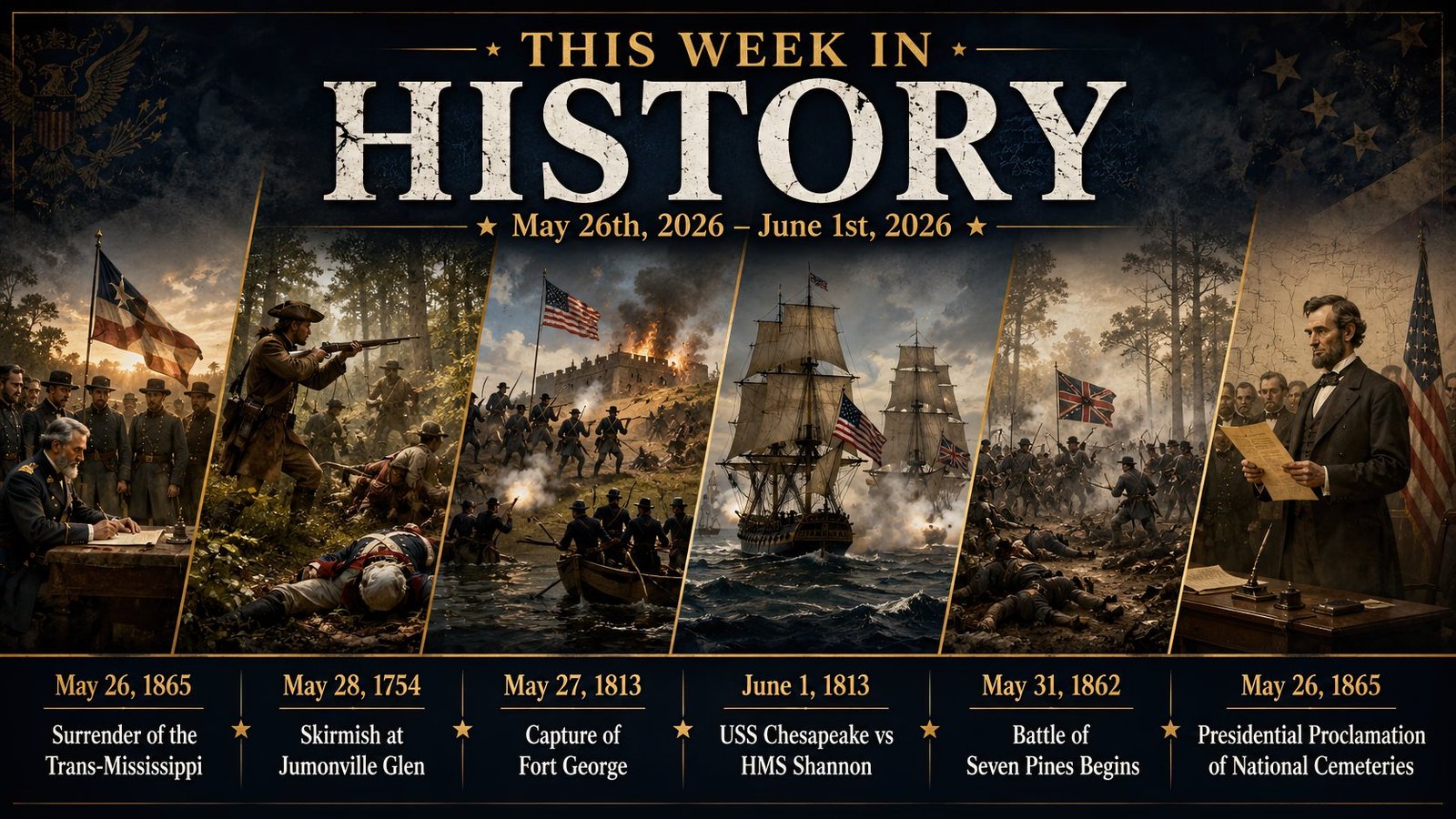
The stretch from May 26th, 2026 through June 1st, 2026 links battles in colonial forests, grim Civil War fields, and storm-lashed Pacific islands. Each calendar day in this week touches an anniversary where American troops tested new tactics, endured harsh learning curves, or marked the end of a long and bitter campaign. Some of these moments are famous turning points, like the rise of new commanders or the first major American attacks in France during the First World War. Others are quieter but no less important, including a presidential proclamation of emergency and the birth of a national day of remembrance for the fallen. Across the centuries, soldiers, sailors, Marines, and airmen fought under very different flags and technologies, yet they confronted the same hard questions of leadership, endurance, and purpose. This edition of “This Week in U.S. Military History” walks through several of those episodes and explores how they still echo in the armed forces and national memory today.
Skirmish at Jumonville Glen
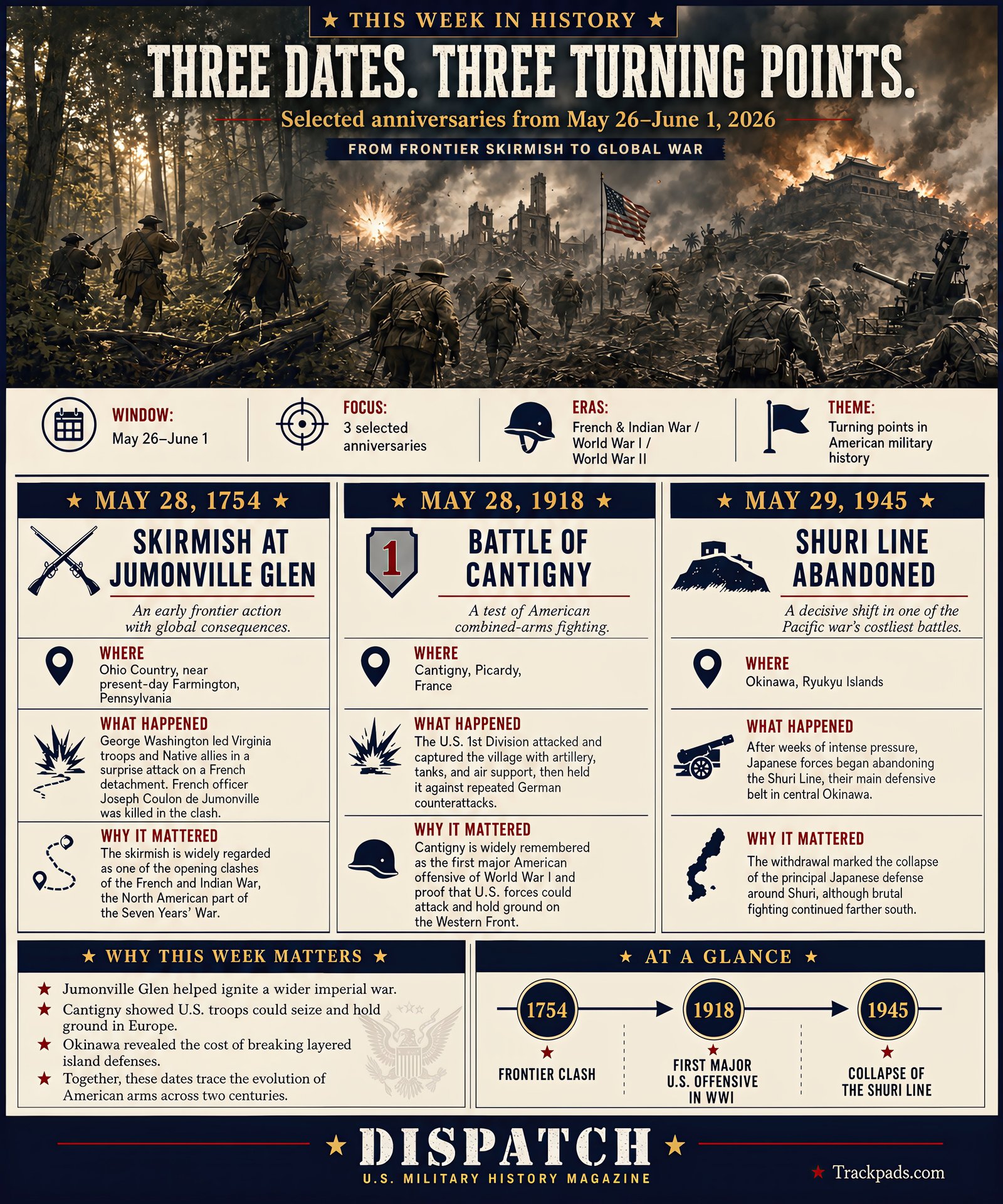
In late May of 1754, a young Virginia officer named George Washington led colonial troops and Native allies through the forests of the Ohio Country. Near a small encampment of French soldiers at a place later called Jumonville Glen, his party launched a surprise attack that killed or captured most of the detachment, including its commander. This clash between British colonial forces and the French, fought years before the independence of the United States, helped ignite the wider French and Indian War in North America. That war, in turn, merged into the global Seven Years’ War and reshaped control of the continent. For later American soldiers, Washington’s first combat showed how rough frontier engagements, alliances with Native nations, and imperial rivalries would influence the emerging military tradition. It also foreshadowed Washington’s own path as a commander whose experience was forged far from formal European battlefields.
Open the Wiki entryCapture of Fort George
During the War of 1812, the Niagara frontier became a key line where American and British forces tested each other’s strength. On May 27th, 1813, United States troops supported by naval gunfire came ashore near Fort George in Upper Canada and pushed inland under heavy resistance. The combined land and naval operation forced the British garrison to abandon the fort, giving American forces control of an important position opposite Fort Niagara. The capture did not end the campaigning along the border, and later reverses erased some of the gains made that day. Even so, the assault on Fort George demonstrated that United States forces could plan and execute amphibious landings and coordinate artillery, infantry, and ships in a complex operation. Lessons learned there would echo in how American officers thought about river and coastal attacks long after the small fort’s guns fell silent.
Open the Wiki entryUSS Chesapeake vs HMS Shannon
Just days after Fort George fell, another drama played out at sea off the American coast. On June 1st, 1813, the American frigate USS Chesapeake sailed from Boston to challenge the British blockading ship HMS Shannon. In a furious, close-range engagement that lasted only minutes, British gunnery and boarding tactics shattered the Chesapeake’s crew, leaving Captain James Lawrence mortally wounded. His dying words, often remembered as “Don’t give up the ship,” became a rallying cry even though the frigate was captured and taken to Halifax. The defeat underscored how uneven training and discipline could be in the early United States Navy, especially when crews were hastily assembled. At the same time, the battle highlighted the importance of continual practice in gunnery and seamanship, themes that would shape naval professionalism as the service grew more confident in later wars.
Open the Wiki entryBattle of Seven Pines begins
As the spring campaigns of the American Civil War unfolded in 1862, Union forces pressed down the Virginia Peninsula toward Richmond. On May 31st, 1862, Confederate troops struck back near the crossroads of Seven Pines and Fair Oaks, launching a fierce assault against elements of the Union Army of the Potomac. Confusion in the swampy terrain and miscoordination among Confederate commanders blunted what might have been a more decisive blow. During the fighting, Confederate commander Joseph E. Johnston was severely wounded, creating a sudden leadership vacuum near the Confederate capital. In the aftermath, Robert E. Lee was appointed to lead what would soon be known as the Army of Northern Virginia. The costly struggle at Seven Pines thus did more than fill casualty lists; it set the stage for a new Confederate command team whose campaigns would dominate the Eastern Theater for the next two years.
Open the Wiki entrySurrender of the Trans-Mississippi
While history often remembers the April surrender at Appomattox Court House as the Civil War’s end, organized Confederate resistance lingered west of the Mississippi River. On May 26th, 1865, officials representing General Edmund Kirby Smith’s Trans-Mississippi Department agreed to terms that effectively surrendered the last large Confederate field command. The agreement covered scattered forces in Texas, Louisiana, Arkansas, and the Indian Territory, where fighting and irregular warfare had continued even after eastern armies stacked arms. For Union troops and civilians in those regions, the surrender offered a pathway out of occupation duties and guerrilla violence toward the difficult work of Reconstruction. The capitulation also underscored how vast the wartime theater had become, stretching from Virginia to distant frontier posts. By late May, the Confederacy existed only in isolated pockets and memories, and the United States Army began shifting from combat operations to enforcing new federal policies in the recovering states.
Open the Wiki entryFirst national Decoration Day
Three years after major Confederate armies surrendered, the scars of the Civil War still marked towns and families across the reunited country. On May 30th, 1868, mourners gathered at Arlington National Cemetery and other burial grounds to decorate the graves of the war dead with flowers, flags, and wreaths. The observances followed a general order from a veterans’ organization calling for a national “Decoration Day” dedicated to remembering fallen soldiers from the Union ranks. Citizens, former soldiers, and families turned the day into a ritual of shared grief and gratitude, even as debates about reconciliation, emancipation, and citizenship remained unresolved. Over time, Decoration Day broadened to honor the dead from later wars and evolved into what is now known as Memorial Day. The ceremonies began a tradition in which public remembrance became part of how the nation understood the cost of its military victories.
Open the Wiki entryBattle of Cantigny
When the United States entered the First World War, many allies wondered how quickly American units could adapt to the brutal demands of the Western Front. On May 28th, 1918, the Army’s 1st Division attacked the German-held village of Cantigny in France, supported by tanks, artillery, and aircraft. The assault seized the shattered village and, more importantly, held it against persistent counterattacks and heavy shelling. American infantry and engineers worked under fire to strengthen new positions, repair communication lines, and evacuate wounded comrades from the ruined streets. Their success reassured French and British leaders that incoming United States forces could do more than fill trenches; they could take the offensive and hold captured ground. Cantigny thus marked a psychological and practical turning point, showcasing an emerging American style of combined arms fighting that would grow more confident in the months ahead.
Open the Wiki entryAmericans at Château-Thierry
Only days after Cantigny, the German army surged toward the Marne River, aiming for a breakthrough that might force France to its knees. On May 31st, 1918, elements of the American 3rd Division moved into position near the town of Château-Thierry, where bridges over the Marne became critical chokepoints. Working alongside French forces, American infantry and machine-gun crews helped hold those crossings against advancing German units, firing from hastily prepared positions on roads and riverbanks. Their stand bought time for additional reinforcements to arrive and stabilize the line, preventing a rapid enemy drive on Paris. The actions around Château-Thierry signaled that United States troops would not serve only in quiet sectors but would be thrown into the fiercest crises. For generations of American soldiers, the Marne River became a symbol of how quickly a young force could be asked to fight on critical ground.
Open the Wiki entry“Unlimited national emergency” proclaimed
Before the United States formally entered the Second World War, its leaders faced the challenge of preparing a still-divided public for the scale of the coming struggle. On May 27th, 1941, President Franklin D. Roosevelt used a nationwide address to proclaim an “unlimited national emergency,” warning that Axis victories overseas threatened American security. The declaration did not yet mean war, but it unlocked broader mobilization of industry, shipping, and the armed forces. Navy ships expanded patrols, Army units accelerated training, and production lines stepped up the manufacture of aircraft, ships, and munitions. The speech tied distant battles in Europe and Asia to the safety of the Western Hemisphere, shaping how citizens viewed the stakes. By late May of 1941, the United States military still stood technically at peace, yet it was already bending the nation’s economy and society toward a wartime footing.
Open the Wiki entryAttu declared secure
In the remote Aleutian Islands off Alaska, American and Japanese forces fought in some of the harshest conditions of the Second World War. On May 30th, 1943, after weeks of bitter combat on steep, fog-shrouded slopes, United States commanders declared the island of Attu secure. Japanese defenders had launched a massive final attack only days earlier, leaving tangled lines of casualties in a brutal close-quarters battle. For American soldiers, many of whom were new to Arctic warfare, the campaign tested their ability to fight in freezing temperatures, deep mud, and near-constant cloud cover. Securing Attu removed a foreign foothold from American territory and paved the way for operations to retake nearby Kiska. The Aleutian campaign never drew the attention of larger theaters, but it underscored that the Pacific war reached all the way to the nation’s own shores.
Open the Wiki entryShuri Line abandoned on Okinawa
As the Pacific war neared its climax, the Battle of Okinawa became one of the bloodiest and most complex operations ever undertaken by American forces. By late May of 1945, United States Army and Marine units had fought their way against layered Japanese defenses centered on the Shuri Line, a fortified belt anchored by Shuri Castle. On May 29th, 1945, Japanese commanders began abandoning this vital position under relentless artillery and air bombardment, slipping southward to new lines. For the Americans, the withdrawal marked the breaking of the main organized defense in central Okinawa, though it did not end fierce fighting on the island’s southern ridges and caves. The struggle for Shuri highlighted how costly it was to root out dug-in defenders willing to fight to the end. Those lessons weighed heavily on planners considering future operations against Japan’s home islands later in 1945.
Open the Wiki entryAcross the Week
The anniversaries gathered in this late-May and early-June window show how American arms evolved from colonial skirmishes to global campaigns. At Jumonville Glen and Fort George, early commanders learned how terrain, alliances, and naval support could decide small engagements with large consequences. In the Civil War entries, from Seven Pines to the Trans-Mississippi surrender and the first national Decoration Day, the focus shifts to leadership changes, the drawn-out nature of conflict, and the struggle to remember the dead fittingly. The First World War actions at Cantigny and Château-Thierry mark the arrival of United States forces as decisive partners in a coalition fight. Meanwhile, Roosevelt’s emergency proclamation, the Aleutian battles, and Okinawa reveal the scale of mobilization and sacrifice demanded in a truly global war. As readers consider these events, they connect the service of past generations to today’s soldiers, sailors, airmen, Marines, and guardians who still stand watch in a complex world.