A quiet corner of Pearl Harbor
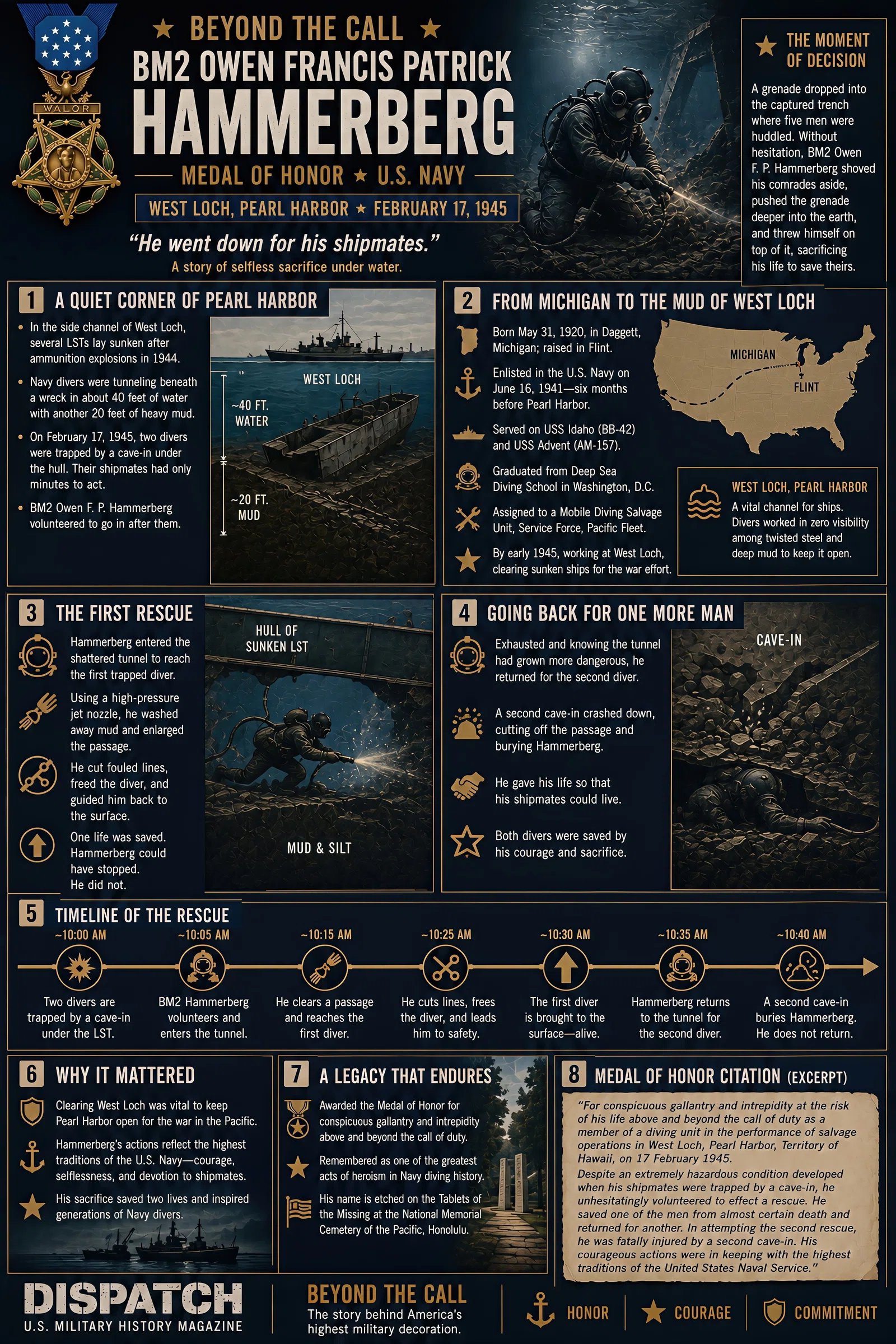
By February 1945, much of Pearl Harbor had returned to the business of war. Battleships and carriers came and went; convoys formed up and headed west toward Iwo Jima and Okinawa. But in a side channel called West Loch, the harbor still hid a graveyard. Months earlier, a chain of explosions had torn through a cluster of tank landing ships loading ammunition for the Pacific campaign. Several LSTs lay half-buried in mud, twisted and broken on the harbor floor, their steel hulls warped like crumpled paper.
To clear the channel, Navy divers were sent into water roughly forty feet deep, with another twenty feet of heavy harbor mud below. Their job was to tunnel beneath a sunken LST using jet nozzles—high-pressure hoses that could liquefy the ooze and slowly carve a passage so wreckage could be cut apart, lifted, and hauled away. It was slow, claustrophobic work. Visibility was essentially zero. The divers groped their way forward in blackness, feeling along jagged steel and shifting mud, always aware that a cave-in could turn the passage into a trap.
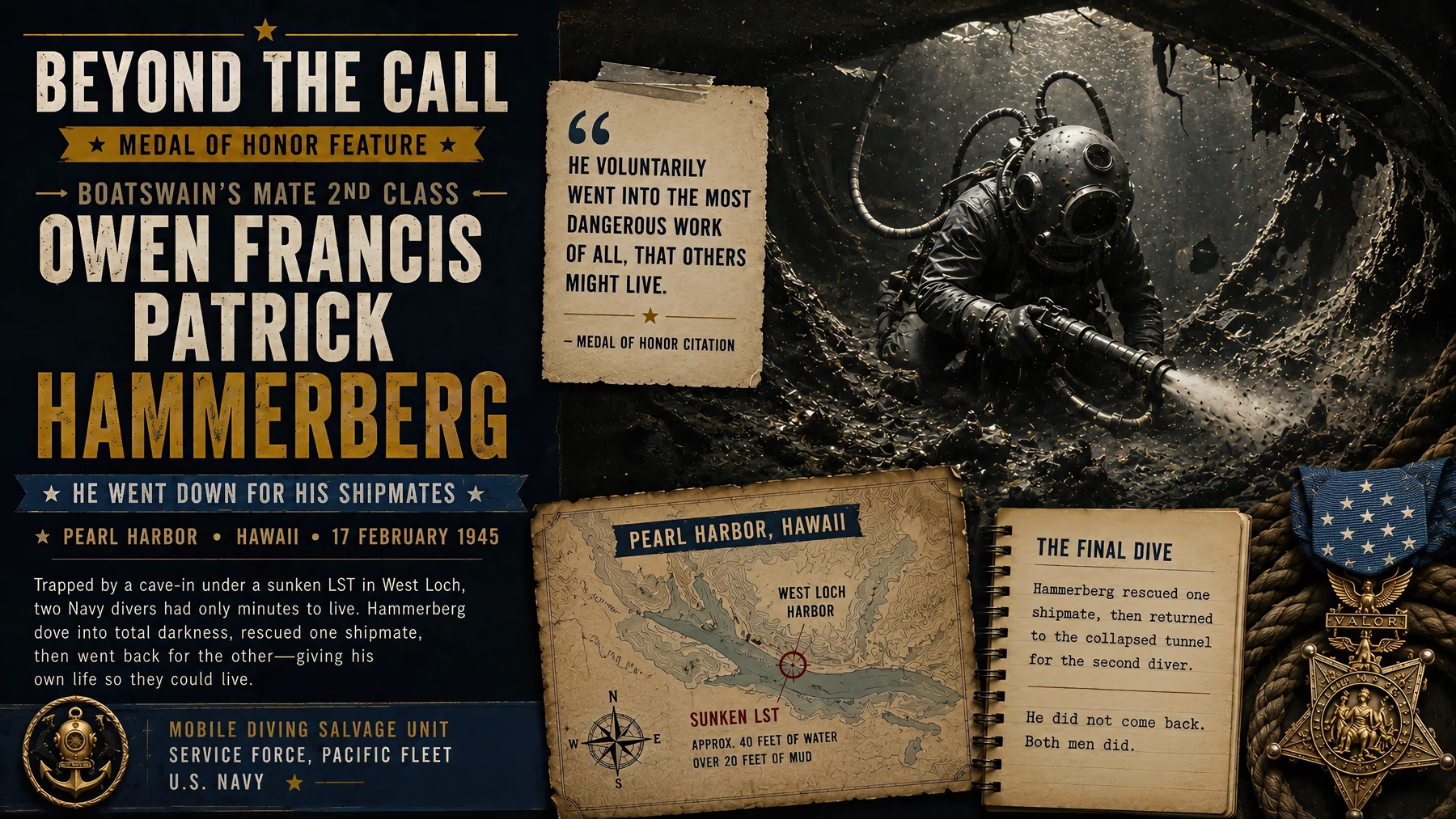
On the morning of 17 February, two of those divers vanished under the hull. A sudden collapse of steel and mud sealed their tunnel. Somewhere under the buried ship, in a pocket of foul water and air, two men were alive but pinned, their air hoses and lifelines snarled in wreckage. On the surface, watching the bubbles stop and the lines go taut, their shipmates knew how little time they had.
One of the divers preparing to go after them was a 24-year-old boatswain’s mate second class—broad-shouldered, dark-haired, with the calm, slightly serious expression seen in his official portrait. His name was Owen Francis Patrick Hammerberg.
From Michigan to the mud of West Loch
Hammerberg’s story began far from the Pacific. He was born on May 31, 1920, in the small town of Daggett in Michigan’s Upper Peninsula, a rural community of farms, forests, and long winters. When he was still young, his family moved south to Flint, a growing industrial city that drew workers from across the Midwest. There, like many young men of his generation, he came of age as the clouds of global war gathered.
He enlisted in the United States Navy on June 16, 1941—six months before Pearl Harbor was attacked. After boot camp, he served aboard the battleship USS Idaho and later the minesweeper USS Advent, learning seamanship and the rhythms of life at sea. Those early years gave him experience on big-gun capital ships and in the hazardous business of minesweeping, where a steady hand and attention to detail meant survival.
The Navy soon sent him to Deep Sea Diving School in Washington, D.C., where he qualified as a diver. It was a specialized, physically demanding field: long hours in heavy gear, complex procedures, and the constant mental discipline of working where a single mistake could be fatal. Graduates were expected to be calm problem-solvers, just as comfortable with cutting torches and salvage tools as they were with charts and line plans. Hammerberg fit that mold. When his training was complete, he was assigned to a Mobile Diving Salvage Unit with the Service Force of the Pacific Fleet—the small, expert teams responsible for recovering ships, clearing harbors, and making damaged ports usable again.
By early 1945, that assignment had brought him to West Loch. Above the surface, Pearl Harbor bustled with preparations for the final island campaigns. Below it, Hammerberg and his fellow divers fought a slower, colder battle: against mud, twisted steel, and time. None of them imagined that within hours, their work would produce one of the most extraordinary acts of non-combat heroism in Navy history—and that the quiet, steady diver from Michigan would not live to see the sun rise again.
The first rescue
When the cave-in came, it happened fast. The two working divers were beneath the sunken landing ship, pushing their jet nozzles forward, when a section of warped hull and mud shifted and collapsed. On the surface, their lifelines went slack, then tight, then still. Within seconds, the diving supervisor knew what that meant: somewhere under forty feet of water and another twenty feet of muck, two men were trapped in a flooded tunnel that had suddenly become a dead end.
Hammerberg listened as the situation was laid out. The tunnel was unstable. Jagged steel jutted into the passage. Any diver who went in after them risked having his own lifeline snagged, or being buried by the next slide of wreckage. Yet he stepped forward without hesitation. In full gear, he dropped into the harbor beside the salvage barge and followed the guidelines down into the cold, murky water, then into the cramped excavation the trapped men had created.
Working by touch alone, Hammerberg used his jet nozzle to “wash” a new passage through the mud, slowly enlarging the cramped tunnel. The force of the water turned the ooze into soup, which then settled behind him, threatening to close off his way back. Feeling ahead along twisted beams, he finally reached the first trapped diver, jammed against wreckage and wrapped in his own fouled lines. In pitch-black conditions, Hammerberg cut, freed, and cleared until the man could move, then guided him back along the tunnel to where others could pull him up. One life was saved. Hammerberg could have stopped there. He did not.
Going back for one more man
Exhausted from hours of straining in the confined space, Hammerberg signaled that he would return for the second missing diver. He understood that the tunnel was even more unstable now. Each jet of water he used to carve a path weakened the mud overhead; each movement of his weighted boots might trigger another slide of steel or silt. Nevertheless, he pushed deeper beneath the buried hull, inching forward in the dark, forcing a way through toward the last known position of his shipmate.
He was almost directly above the trapped man when the next collapse came. A heavy piece of wreckage dropped through the liquefied mud and slammed down across Hammerberg’s back and shoulders, pinning him crosswise over the man he had come to save. The blow drove him into the muck, but his body now formed a shield over the diver beneath, taking the full crush of the steel and mud while leaving a narrow pocket of space where the other man could still breathe and wait. Above them, unaware of the exact situation, the surface crew read the erratic signals in the lines and fought to understand what had happened.
It took long, grueling hours to dig back into the wreck and reach them. When salvage teams finally broke through, they found the second diver alive, protected by the dead weight of the man who had come for him. Hammerberg had succumbed under the terrible pressure and strain, dying in darkness far below the surface he had left to help his shipmates. His sacrifice, made in a harbor already stained by war, was as deliberate and selfless as any charge on a battlefield. It also marked one of the last great acts of non-combat heroism in the long struggle to win the Pacific.
“Above and beyond the call of duty”
In the months after his death, the Navy and the nation took stock of what had happened under the mud of West Loch. There was no enemy fire in that dark tunnel, no charging infantry or incoming shells—only wreckage, mud, and the cold pressure of the harbor. Yet the standard of courage had been the same. Hammerberg had gone back into a collapsing tunnel, exhausted and fully aware that each foot forward might be his last, because two shipmates were still down there. That choice—made once to save the first diver, and then again to search for the second—became the heart of his story.
On February 16, 1946, almost exactly a year after his final dive, his Medal of Honor was presented at Naval Air Station Grosse Ile in Michigan, close to the city where he had grown up. The decoration was awarded posthumously and accepted by his parents, Jonas Hammerberg and Elizabeth Moss, who had already buried their son at Holy Sepulchre Cemetery in Southfield. The official citation praised his “cool judgment,” “unfaltering professional skill,” and “consistent disregard of all personal danger,” language usually reserved for men under direct enemy fire. In Hammerberg’s case, it recognized that some of the most extraordinary risks of the war had been taken in places the public rarely saw—salvage channels, minefields, and the black water beneath damaged ships.
The citation also noted that his actions “contributed effectively to the saving of his two comrades.” That simple phrase carried a quiet weight. It made clear that Hammerberg’s death was not a tragic loss with no result. Two divers who might otherwise have been entombed beneath a wrecked landing ship returned to the surface alive because one man refused to stop when the work grew too dangerous. His award marked him as one of the last people ever to receive the Medal of Honor specifically for non-combat heroism, a reminder that valor is measured by sacrifice, not by the presence or absence of enemy guns.
Names written into steel and street signs
After the war, Hammerberg’s name did not remain confined to the lines of his citation. In the mid-1950s, the Navy commissioned a new destroyer escort, USS Hammerberg (DE-1015), and chose to name it for the young diver who had died in Pearl Harbor’s back channels. The ship carried his name on its stern across the Atlantic and Mediterranean during the Cold War years, a steel reminder that the traditions of the service were built as much on quiet sacrifice as on famous fleet actions. Sailors who served aboard her read his story and understood that their ship honored a man who had gone down into a wreck to save others and never come back.
Back in Michigan, his memory took root in more modest but equally meaningful ways. A street in Flint bears his name, linking the industrial city where he spent much of his youth to the harbor where he died. In Detroit, a playground was dedicated to him, giving children a place to play under the sign of a man who had given everything for his friends. In later years, a veterans’ organization in Saginaw County renamed its post in his honor, ensuring that local veterans would gather under his name and keep his story alive. These small acts of remembrance—street signs, plaques, and local dedications—may seem simple, but together they form a chain of memory that stretches from Daggett and Flint to the quiet waters of West Loch.
For visitors who find his grave in Southfield, the inscription on the stone joins him to thousands of others who served and never came home. Yet knowing the details of his final hours changes how one reads those words. They mark a man who did not die in a sudden, senseless accident, but in the deliberate act of shielding another human being from harm. In that sense, the cemetery, the ship, the streets, and the veterans’ hall all tell the same story: when the tunnel collapsed, Hammerberg chose to go down one more time.
The meaning of a diver’s sacrifice
Hammerberg’s death came as the Second World War was entering its final, bloody phase. In February 1945, Marines were about to raise the flag on Iwo Jima, and planners were already thinking ahead to Okinawa and, beyond that, a possible invasion of Japan. Compared with the sweeping campaigns of armies and fleets, the salvage work at West Loch might have seemed small. Yet the Navy could not move those fleets without safe harbors and clear channels, and it could not clear those channels without divers willing to crawl under broken hulls. Hammerberg’s courage under a sunken LST was one link in the vast chain of tasks that made the Pacific war effort possible.
His story also broadens our understanding of what “above and beyond the call of duty” can mean. Many Medal of Honor narratives describe fire-swept hilltops or bomb-raked decks. Hammerberg’s battlefield was a black tunnel of mud and steel. His enemies were time, exhaustion, and the invisible weight of a collapsing wreck. In that hostile environment, he made the same essential choice that many combat awardees did: to risk, and ultimately give, his life so that others might live. For students of military history, his case underlines that heroism is not limited to the front line; it also lives in maintenance shops, flight decks, engine rooms, and dive lockers, where quiet professionals face deadly risks without fanfare.
Today, modern Navy divers, explosive ordnance disposal teams, and salvage crews still work in dangerous conditions that rarely make headlines. When they study the service’s history, Hammerberg’s name stands out as a role model for technical excellence fused with moral courage. For veterans and civilians alike, his life offers a clear, sober lesson: duty sometimes demands that a person enter the dark, knowing they may not return, because someone else is already trapped there. This week’s Beyond the Call feature remembers Boatswain’s Mate Second Class Owen Francis Patrick Hammerberg, who went down for his shipmates—and whose sacrifice continues to light the way for those who follow.