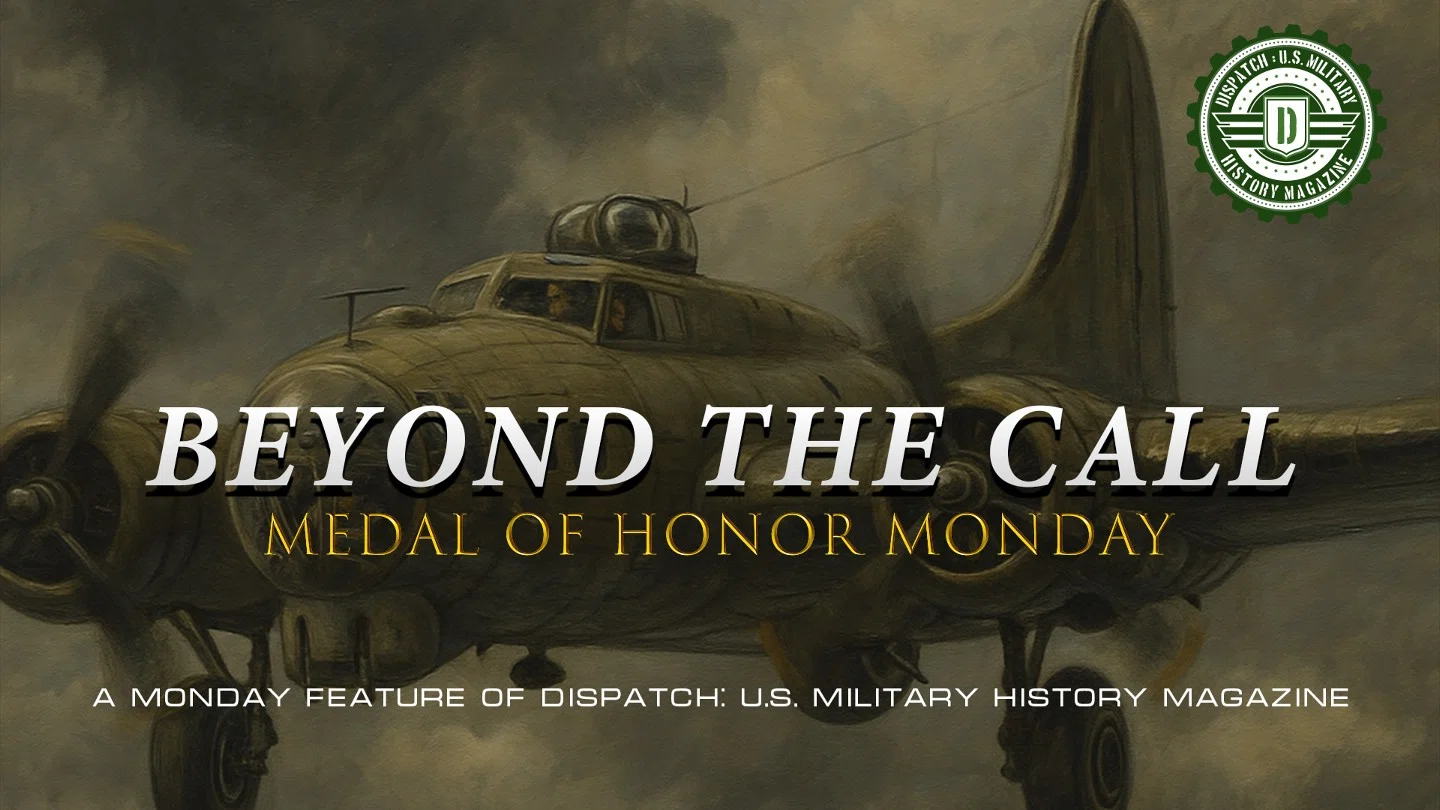
The Moment of Decision
The B-17 was almost home when the choice arrived over the radio: bail out, or try to land a dying airplane. The long mission over Leipzig was behind them, but the bomber itself was torn open—control cables shot away, engines coughing, the fuselage peppered with holes where German fighters had raked the formation. In the cockpit, the copilot lay dead. The pilot, badly wounded, had been dragged from his seat and now drifted in and out of consciousness, strapped down behind the controls.
Second Lieutenant Walter Edward Truemper, the navigator, had helped fight the aircraft back across enemy territory, working with the engineer and the remaining crew to keep it level and on course. Fuel leaked, instruments flickered, and each change in engine sound made everyone wonder if this was the moment the bomber would finally give up. Yet the English countryside was beneath them now, and the home airfield lay just ahead through the cloud.
Circling overhead, another aircraft watched their battered B-17 stagger along the final leg. On the ground, commanders looked at the damage and reached a grim conclusion: the crippled bomber was simply too broken for two relatively inexperienced men to land. The order went out—everyone who could was to jump.
Parachutes snapped open in the slipstream as crewmen obeyed, one by one. Inside the aircraft, Truemper and the flight engineer stayed by the wounded pilot. He was still alive, and he could not be moved. When the command came again to abandon the plane, their answer was simple and final: they would not leave him. In that moment, they chose to act far beyond the call of duty, and turned the stricken bomber toward the runway.
The Road to That Day
Walter Edward Truemper’s path to that cockpit began far from high-altitude combat. He was born in Aurora, Illinois, in 1918, one of many children in a family that came of age during the lean years between the world wars. The rhythms of his early life were those of a Midwestern town: school, church, family responsibilities, and the steady pull of work in a community used to tightening its belt and carrying on.
As a young man, he studied business and worked as an accounting clerk, a job defined by quiet precision and attention to detail. Those habits—careful math, calm under deadlines, and a willingness to carry responsibility without complaint—would later serve him well in a very different line of work. When the United States entered World War II and the Army began to grow at a staggering pace, Truemper left his civilian desk behind and enlisted from his hometown in the summer of 1942.
The Army first assigned him to a field artillery unit in Texas, where he learned the basics of soldiering: discipline, teamwork, and the harsh realities of training in heat and dust. From there he entered flight training, moving through pre-flight school, gunnery instruction, and finally advanced navigation. He learned to read the sky and the ground below with the same accuracy he once brought to ledgers and balance sheets, now under the pressure of night flights, bad weather, and strict instructors.
Commissioned as a second lieutenant in the Army Air Corps, he joined the bomber crews training in the United States before being sent overseas to England with the Eighth Air Force. At RAF Polebrook he became the navigator for a B-17 crew of the 510th Bombardment Squadron, 351st Bombardment Group—one of many crews flying deep into Germany as the air campaign intensified. By February 1944, they had settled into the brutal rhythm of daylight missions: early briefings, long climbs to altitude, and the constant threat of flak and fighters. The mission to Leipzig that would test everything he had learned was just one more target on the board—until it wasn’t.
Into the Fire
On the morning of February 20, 1944, the Eighth Air Force sent its heavy bombers deep into Germany to strike industrial targets around Leipzig. For the crews of the 351st Bombardment Group, it meant another long flight over the North Sea and across a gauntlet of flak guns and fighter bases. Second Lieutenant Walter Truemper’s B-17 took its place in the formation, the engines droning in steady rhythm as they climbed toward bombing altitude. The target lay far ahead, wrapped in haze and smoke, but everyone on board knew the pattern by heart: hold formation, ride through the bursts of antiaircraft fire, drop the bombs on command, and then hope to fight their way back out again.
Over enemy territory the sky turned violent. Black puffs of flak began to ring the formation, rocking the big bombers as they pressed on toward the target. Then the German fighters arrived, coming in fast from different angles, their cannon fire streaking through the formation. One of those passes tore into Truemper’s aircraft. The copilot was killed instantly at his controls, the pilot was badly wounded and knocked unconscious, the radio operator was hit, and the airframe shuddered under the impact of shells and bullets. Control surfaces were damaged, instruments failed, and for a moment the bomber seemed on the edge of spinning out of the sky.
In the chaos that followed, the navigator and the engineer left their normal positions to fight for the life of the aircraft. They pulled the wounded pilot from his seat, secured him as best they could, and struggled to bring the B-17 back under control. Neither man was trained to be a first pilot, yet they worked the remaining controls, compensated for damaged systems, and stabilized the bomber enough to stay in the air. Fire was brought under control, wounded men were checked, and slowly the airplane responded to their efforts. Instead of bailing out over enemy territory, they turned west, nursing the crippled ship toward home.
The return flight was a long, tense ordeal. The bomber had fallen out of formation and flew alone, vulnerable to more attacks and to the simple risk of systems failing under the strain. Inside, the surviving crew did what they could for the pilot and radio operator while Truemper and the engineer kept the aircraft on course. Every vibration, every cough from an engine, carried the threat that the fragile control they had gained might vanish. Yet mile by mile they crossed back over occupied territory, then over friendly waters, until at last the English coast came into view beneath the wings.
As they neared their home station, another aircraft flew close enough to see the damage and the improvised crew at the controls. On the ground, the seriousness of the situation became grimly apparent. The bomber had suffered such severe structural and control damage that experienced commanders doubted it could be brought down safely by men whose usual duties were navigation and engineering. After assessing what they could from the air and from radio reports, the commanding officer decided the risk of attempting a landing was too great. He ordered the crew to abandon the aircraft and parachute to safety, accepting that the wounded pilot, unable to be moved, would likely be lost.
Those orders were obeyed by the men who could still move to the exits. One by one, the remaining crew members clipped on parachutes and jumped, their lives depending on silk canopies and steady hands. In the cockpit area, however, Truemper and the engineer stayed with the unconscious pilot. When told again to leave the aircraft, they answered that the pilot was still alive and that they would not desert him. Only three men now remained inside the battered bomber as it came around toward the airfield. Twice they tried to bring it down, wrestling with damaged controls and fighting to keep the wings level. Twice the efforts failed, and each time they dragged the bomber back into the air rather than slam it into the ground. On the third attempt, the aircraft crashed into an open field short of safety, killing Truemper, the engineer, and the pilot they had refused to leave behind.
The Citation, Decoded
The official Medal of Honor citation begins with the familiar phrase “for conspicuous gallantry and intrepidity at the risk of life above and beyond the call of duty.” In practical terms, that language marks a clear line between what duty required and what these men chose to do. Their duty, once ordered to abandon the aircraft, was to save themselves and deny the enemy more targets. Instead, Truemper and the engineer measured their options against the life of their wounded pilot and decided that leaving him alone in a doomed airplane was unacceptable. The “risk of life” the citation mentions was not theoretical; by staying, they knowingly traded their chance of survival for the possibility of saving him.
Another key passage describes the condition of the aircraft when they made that choice. The copilot was dead at his station, the pilot was wounded and unconscious, the radio operator was injured, and the bomber itself was “severely damaged.” A B-17 was designed to be flown by two trained pilots, with multiple systems working together to keep such a heavy machine controllable. When those systems were shot apart, and the normal cockpit crew disabled, the odds of safely flying it home were extremely low. Yet the citation notes that Truemper and the remaining crew nevertheless managed to right the plane and bring it back over friendly territory, an achievement that reflects both technical skill under pressure and a refusal to surrender as long as the aircraft could still fly.
The citation then turns to the volunteers’ final decision. It records that Truemper and the engineer offered to attempt a landing, remained aboard after others had jumped, and stated firmly that they would not desert the wounded pilot. It notes their “unsurpassed courage and heroism” in making repeated landing attempts before the final crash. Behind those formal words lies a stark image: two young officers, neither of them the designated pilot, straining against damaged controls again and again rather than accept an outcome that would leave their comrade alone to die. The language of the citation captures this as an act beyond all expectation, where loyalty, responsibility, and sacrifice merge into a single, fatal choice.
Why It Mattered
At first glance, it can seem as if nothing was “saved” on that February afternoon: the bomber crashed, and three airmen died in an English field. The deeper truth is that the decisions made in those final minutes preserved almost everything the crew still could. By fighting the crippled B-17 back across Germany and the Channel, Walter Truemper and his comrades turned what might have been a mid-air breakup or a crash in enemy territory into a controlled return over friendly soil. That shift meant the surviving crew could jump where rescue forces, hospitals, and home airfields were within reach, instead of into captivity or worse.
Their refusal to abandon the wounded pilot also changed the moral shape of the story. In cold arithmetic, military planners worry about aircraft, training hours, and replacement crews. Inside the cockpit that day, the equation was simpler: a leader was still alive, and leaving him alone in a dying machine felt unthinkable. By staying, Truemper and the engineer demonstrated that the bond between crew members did not end when orders said it was time to go. Their sacrifice underlined a truth that many bomber crews already sensed—that trust in one another was the only constant in skies filled with flak and fighters.
Viewed in the wider context of the air war, their actions came during a critical period when daylight bombing missions aimed to break the enemy’s industrial strength and air defenses. Each sortie was part of a wider effort that demanded astonishing resilience from the units involved. Stories like this one helped define what that resilience looked like in human terms. For fellow airmen, the account of a navigator and an engineer fighting to save a wounded pilot became a quiet example of what it meant to keep faith with the crew, even when nothing more could be done for the airplane itself.
Leadership and Character
Walter Truemper did not hold a high command, and he did not write orders for others to follow. His leadership emerged in the way he accepted responsibility when chaos stripped away the normal hierarchy of the cockpit. As navigator, he could have stayed in the background once the aircraft was damaged, but instead he moved toward the problem, helped stabilize the bomber, and took on duties far beyond his formal training. In doing so he showed a form of initiative that does not shout; it simply goes where it is needed and begins to work. The decision to volunteer to help land the aircraft was the natural continuation of that instinct.
Another defining trait of his character was loyalty to individuals, not just to mission statements. The wounded pilot on that flight was no longer able to command, yet his life still anchored the choices of the men around him. When Truemper and the engineer told their superiors they would not desert him, they were not rejecting discipline; they were applying a deeper standard that values human life over personal safety. That balance between obedience and conscience is one of the hardest judgments any servicemember can face, and here it resolved in a willingness to share a comrade’s fate.
For today’s readers, whether in uniform or not, the lessons in this behavior are plain. Leadership may come from the person whose name is on the orders, or it may appear in the specialist who quietly steps into a gap because the situation demands it. Character is revealed in moments when all options are bad and time is short. In choosing to stay with their pilot, these airmen showed that courage is not only charging an enemy position; sometimes it is remaining in a doomed aircraft so another person does not face the end alone. That kind of courage leaves an impression long after the sound of engines and gunfire has faded.
Legacy and Memory
After the crash near Polebrook, the war moved on, as wars always do, but the memory of what had happened in that B-17 did not. Investigations confirmed the sequence of events, and in June 1944, the United States recognized the actions of Second Lieutenant Walter Edward Truemper and Staff Sergeant Archibald Mathies with the Medal of Honor, awarded posthumously to both men. Truemper’s body was returned home and laid to rest in Saint Paul’s Lutheran Cemetery in Montgomery, Illinois, close to the city where he had grown up. For his family, the navigator’s wings and the blue-ribboned medal became tangible reminders of a son who had left a clerk’s desk for the cockpit of a heavy bomber and never returned.
Over time, his name became part of the landscape in ways that thousands of airmen passing through would see without always knowing the full story. Streets on major training bases in the United States and at installations overseas were named in his honor, ensuring that the sound of his surname would be spoken every day in places where new generations of aircrew learned their trade. n Aurora, his hometown, a statue and other memorials give the community a place to gather, reflect, and teach younger residents about the navigator who placed loyalty above self-preservation.
His legacy is also shared with Mathies, the engineer who stayed with him in that battered bomber. Plaques, exhibits, and commemorations link their names side by side, often with the image of the Medal of Honor between them, a visual reminder that the story was never about one man alone. Together they represent the quiet heroism of aircrew members whose work was often unseen except at the moment of crisis. For students of military history, for airmen standing in line at a chow hall on a street that bears his name, and for families visiting a small Midwestern cemetery, remembering Walter Edward Truemper means recognizing that true courage can be as much about staying as it is about escaping.