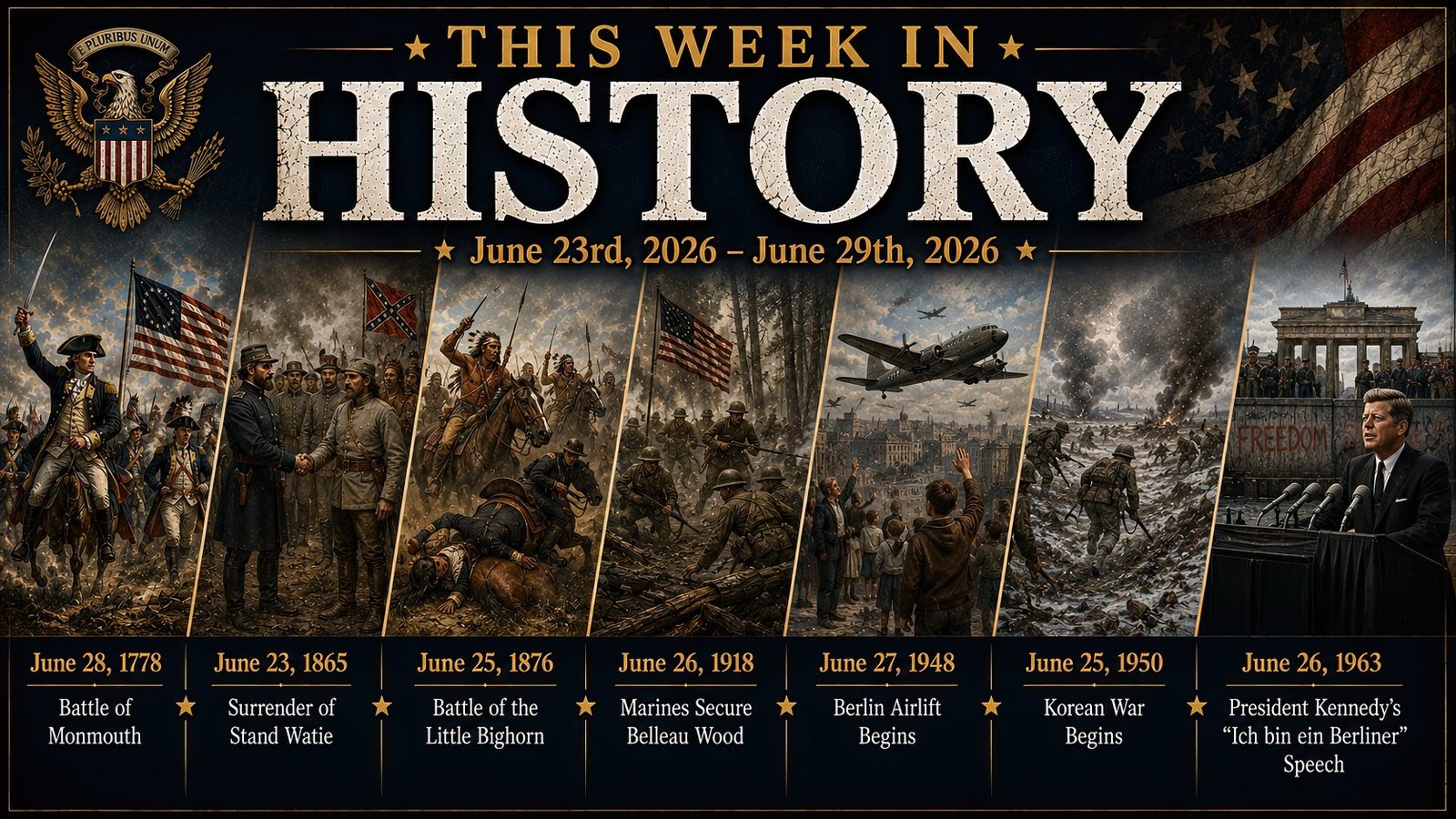
From June 23rd, 2026 through June 29th, 2026, the calendar brings together moments when American arms, diplomacy, and resolve were tested in very different ways. In these seven days across the centuries, we see a Continental Army learning to stand toe to toe with British regulars, frontier cavalry outmatched on the northern Plains, Marines clawing through a French forest, and aircrews threading corridors over a besieged European city. We watch the outlines of the modern world emerge in the wake of world war, feel the first sharp shocks of the Korean conflict, and hear a president’s words echo against the concrete of the Berlin Wall. Together, these anniversaries remind us that military history is not just a sequence of battles, but a long story of decisions, risks, and consequences. This week’s edition follows that story from the fields of New Jersey to the skies over Vietnam, pausing at each stop to ask what changed for American service members and the nation they served.
Battle of Monmouth
On a sweltering June day in New Jersey, George Washington’s Continental Army met British forces withdrawing from Philadelphia toward New York, and refused to break. The battle opened badly for the Americans as an advance under General Charles Lee faltered and retreated in confusion, but Washington rode forward, rallied the troops, and rebuilt the line near Monmouth Court House. Throughout the afternoon, Continental infantry held their ground under cannon fire and repeated British attacks, fighting not as a loose collection of militia but as a more disciplined army shaped by the winter at Valley Forge. The heat was so fierce that casualties from sunstroke began to rival those from bullets, and later stories told of camp followers carrying water to exhausted gunners, including the often-retold tale of Mary Ludwig Hays, sometimes nicknamed “Molly Pitcher.” When the guns finally fell silent, the British slipped away during the night, but Washington’s men had proven they could stand and trade blows in open battle. That performance strengthened American confidence and helped convince foreign observers that the new army was becoming a serious, professional force.
Open the Wiki entrySurrender of Stand Watie
In the closing weeks of the Civil War, most Confederate field armies had already stacked their arms when Brigadier General Stand Watie, a Cherokee leader, finally agreed to terms in Indian Territory. Watie had commanded Confederate Indian units in the Trans-Mississippi theater, where fighting mixed conventional campaigns with raids, guerrilla strikes, and bitter internal divisions among Native nations. His surrender near Doaksville on June 23rd, 1865 is often remembered as the last by a Confederate general, a symbolic endpoint for organized military resistance even as violence and hardship continued in the region. For Native soldiers who had fought on both sides, the moment underscored how deeply the larger American conflict had cut through tribal politics and communities. Federal authorities would soon turn from wartime command structures to postwar treaties and policies that reshaped life in Indian Territory. The surrender of Watie’s command closed one chapter of armed struggle, but it also foreshadowed years of negotiation, displacement, and contested memory for Native veterans and their families.
Open the Wiki entryBattle of the Little Bighorn
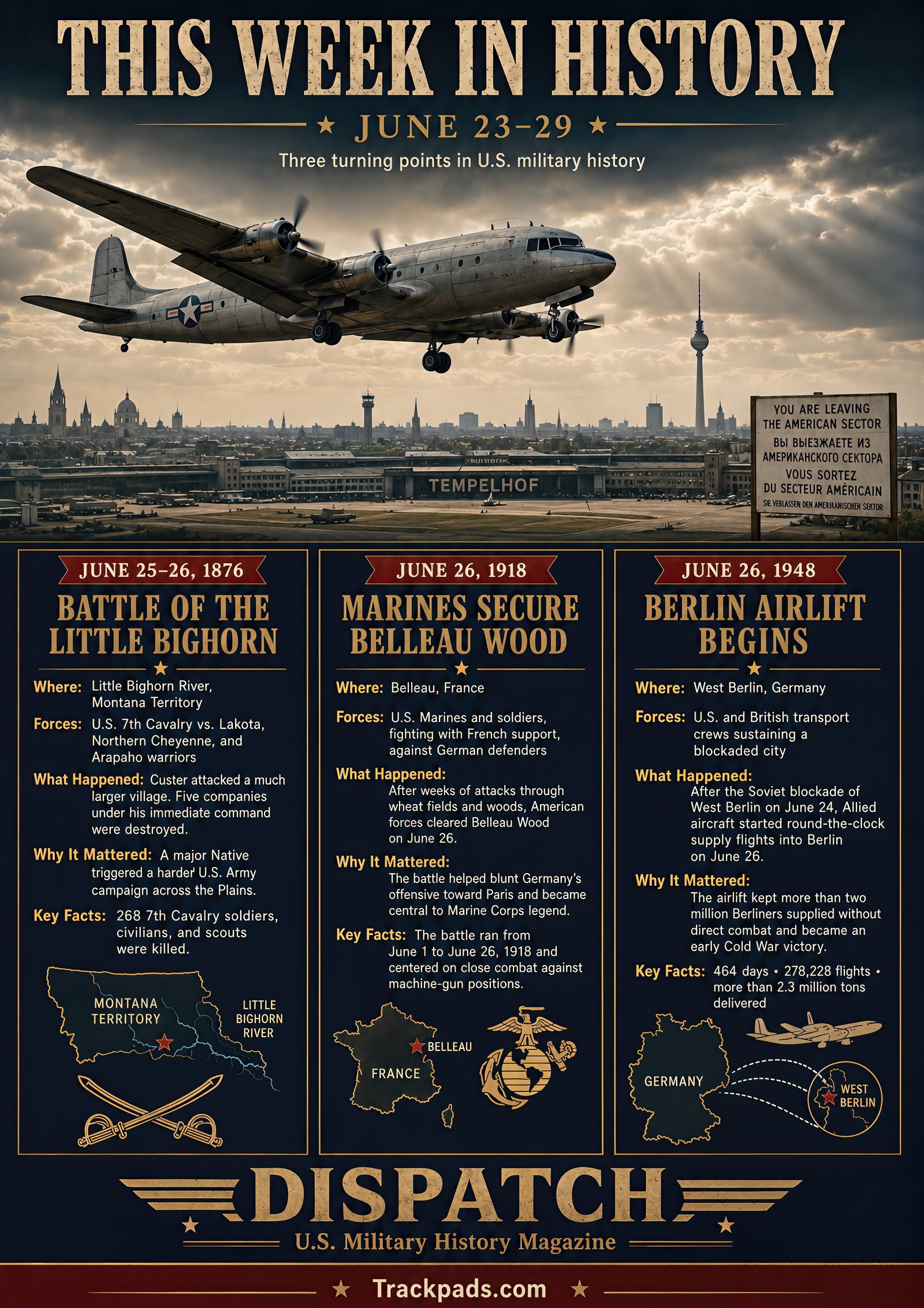
On the northern Plains, the date June 25th, 1876 is inseparable from the shock that followed the destruction of Lieutenant Colonel George Armstrong Custer’s battalion along the Little Bighorn River. Part of a larger campaign to push Lakota and Northern Cheyenne bands onto reservations, Custer’s Seventh Cavalry column advanced aggressively toward a large village whose size and fighting strength he underestimated. While other parts of the regiment fought ferocious actions on nearby ridges and bluffs, Custer’s immediate command was surrounded and overwhelmed, leaving no surviving soldiers from his portion of the field to tell the full story. The victory by Lakota and Northern Cheyenne warriors under leaders such as Crazy Horse and Sitting Bull demonstrated the power that a determined intertribal alliance could muster when fighting on familiar ground. In the months that followed, however, the United States Army intensified operations, bringing more troops and resources to bear until the balance of power shifted decisively. The battle thus stands as both a rare, stunning Native victory and a turning point that spurred an even more relentless phase of the Plains Wars.
Open the Wiki entryMarines secure Belleau Wood
In the final year of World War I, the thick tangle of Belleau Wood in France became the proving ground for American forces newly committed to the Western Front. Over weeks of grinding combat alongside French units, Marines from the Fifth and Sixth regiments launched repeated attacks against German machine-gun nests and dugouts that commanded open wheat fields. By June 26th, 1918, after costly fighting at close range among shattered trees and trenches, American troops finally secured the wood and pushed the enemy out of that sector. The battle’s imagery, from the words attributed to a Marine officer refusing to retreat to stories of German soldiers describing their opponents as “devil dogs,” fed a growing legend of Marine toughness. Yet behind the legend lay sobering casualty lists and a lesson in the brutal arithmetic of modern industrial warfare, where courage alone could not overcome entrenched automatic weapons without careful tactics and heavy support. Belleau Wood helped establish the Marine Corps in the American imagination as a shock force, and it signaled that the United States was willing to absorb serious losses to help turn the tide in Europe.
Open the Wiki entryTreaty of Versailles signed
A year to the day after gunfire at Monmouth, but in a different century and on another continent, representatives of the victorious Allied powers assembled in the Hall of Mirrors at Versailles to sign the treaty that formally ended World War I. For American troops, many of whom were already heading home, the signing marked the legal close of a conflict that had drawn the United States out of its traditional distance from European wars and into coalition warfare on a massive scale. The treaty redrew borders, imposed reparations on Germany, and created the League of Nations, an ambitious but fragile experiment in collective security. Back in the United States, debates over the treaty and the League would lead the Senate to reject formal ratification, leaving the country technically outside the new international framework even as American influence remained central. For millions of veterans and their families, however, the key impact was more immediate: demobilization, the struggle to reintegrate into civilian life, and the challenge of remembering a war that had ended the old order but not removed the causes of future conflict. The unresolved tensions embedded in the treaty would echo into the generation that fought World War II.
Open the Wiki entryCapture of Cherbourg
In the wake of the D-Day landings, Allied planners understood that securing a major port was essential if the Normandy foothold were to become a sustained campaign across France. That task fell largely to the United States VII Corps, which fought its way up the Cotentin Peninsula against German units determined to hold Cherbourg’s fortifications and coastal guns as long as possible. By June 26th, 1944, American forces had entered the city and compelled the surrender of its garrison, even as retreating defenders tried to wreck harbor facilities to deny their use. The port was heavily damaged and required extensive clearance and repair, but its eventual return to service allowed a steady flow of cargo, vehicles, and reinforcements directly into northern France rather than across the exposed beaches. Cherbourg’s capture turned Allied control of Normandy from a tenuous lodgment into a more sustainable base of operations, making later offensives toward the German border logistically possible. For soldiers who had fought through hedgerows and fortified lines, the fall of the city was both a relief and a reminder that the hardest phases of the European campaign still lay ahead.
Open the Wiki entryBerlin Blockade begins
Three years after the end of World War II in Europe, the uneasy coalition that had defeated Nazi Germany fractured sharply over the future of occupied territories. On June 24th, 1948, Soviet authorities cut road, rail, and canal traffic into the Western sectors of Berlin, effectively trying to starve out the American, British, and French presence deep inside their occupation zone. For the United States and its Allies, the move posed a stark choice: withdraw and concede the city’s fate, break the blockade by force at the risk of a new war, or find another way to sustain more than two million civilians and a small Allied garrison. The blockade became an early, defining crisis of the Cold War, turning abstract differences over currency reform and political alignment into a concrete test of will. American commanders and diplomats had to weigh the logistical realities of supporting a city without land access against the strategic consequences of either confrontation or retreat. The decision they ultimately embraced would showcase a different kind of power, one measured in cargo tonnage and flight schedules rather than artillery salvos.
Open the Wiki entryBerlin Airlift launches
Two days after the blockade began, American and British planners put into motion a response that few had imagined on such a scale: they would feed and fuel an entire city by air. On June 26th, 1948, transport aircraft began flying regular supply missions into Berlin, using narrow air corridors agreed upon at the end of World War II. What started as an emergency improvisation quickly grew into a vast operation, with C-47 and C-54 transports landing and taking off in a carefully choreographed sequence, delivering everything from coal to flour. American crews logged repeated trips in all weather, while ground personnel in Germany and back in the United States labored to maintain aircraft and manage the flow of cargo. For Berliners on the ground, the sound of engines overhead became a lifeline and a symbol of Western commitment, especially when pilots dropped small candy parachutes for children clustered near the runways. Over time, the airlift not only defeated the blockade without direct armed confrontation but also helped solidify alliances that would shape European security for decades. The success demonstrated how logistical ingenuity and sustained effort could meet a strategic challenge that traditional battle plans might have escalated disastrously.
Open the Wiki entryNorth Korea invades South Korea
Early on June 25th, 1950, North Korean forces crossed the thirty-eighth parallel in strength, spearheaded by tanks and infantry that quickly shattered many South Korean positions. For American commanders, the attack transformed Korea from a peripheral concern into the central crisis of the moment, testing the policy of containing communist expansion that had taken shape in the early Cold War. Reports from the peninsula revealed collapsing defensive lines and urgent appeals for assistance as United States advisers and embassy personnel scrambled to assess the situation. Within days, the United Nations Security Council condemned the invasion and called on member states to aid South Korea, opening the way for a U.S.-led coalition under the U.N. flag. For soldiers and airmen who would soon deploy, the war promised difficult terrain, harsh weather, and an enemy backed by larger powers. The sudden outbreak of large-scale combat in Korea signaled that the postwar world would not remain divided only on maps and in speeches; it could erupt into violent conflict in distant valleys and cities with very little warning.
Open the Wiki entryTruman orders U.S. forces to support Korea
Two days after the invasion began, President Harry Truman announced that he had ordered American air and naval forces to support South Korea and directed the Seventh Fleet to the waters near Taiwan. The decision, made without a formal congressional declaration of war, marked one of the earliest and most consequential uses of presidential authority to commit U.S. forces in the emerging Cold War. For pilots and sailors in the Pacific, the orders meant an abrupt shift from deterrence and occupation duties to active combat operations, with targets and rules of engagement being worked out quickly under intense pressure. The move also signaled to allies and adversaries alike that the United States was prepared to respond militarily to perceived aggression under the banner of collective security. At home, the decision sparked debates about the scope of American commitments and the risks of escalation, questions that would echo through later conflicts. On the ground in Korea, the arrival of American air power and naval gunfire would buy time for reinforcements and contribute to the fierce, often seesaw battles that defined the war’s early months.
Open the Wiki entryKennedy’s “Ich bin ein Berliner” speech
Standing before a large crowd in West Berlin on June 26th, 1963, President John F. Kennedy used a few carefully chosen phrases to encapsulate American support for a divided city. The Berlin Wall, erected nearly two years earlier, loomed as a concrete symbol of Cold War confrontation, and residents of the Western sectors lived each day with the knowledge that Soviet and East German forces stood just across the barrier. In his remarks, Kennedy connected their situation to broader ideals of freedom and human dignity, declaring that those who questioned the value of the free world should “come to Berlin,” and culminating in the now-famous line identifying himself with the city’s people. For local listeners, the speech offered reassurance that the United States would not abandon them despite nuclear tensions and shifting global crises. For American troops stationed in Germany, it underlined the importance of their presence as part of a broader deterrent posture. The visit reinforced Berlin’s role as a frontline of the Cold War and demonstrated how symbolic gestures, backed by credible military power, could shape morale and diplomacy even without a single shot being fired.
Open the Wiki entryRaids on North Vietnamese fuel depots
In the middle years of the Vietnam War, American leaders sought ways to weaken the enemy’s ability to move troops and supplies down long, fragile lines of communication. On June 29th, 1966, U.S. Air Force and Navy aircraft carried out major attacks on petroleum storage facilities near Hanoi and Haiphong, striking targets that had previously been off-limits or only lightly hit. The raids aimed to destroy large portions of North Vietnam’s fuel reserves, complicating the movement of trucks, artillery, and other equipment toward the front lines. Pilots and crews flying into heavily defended airspace faced dense anti-aircraft fire and the emerging threat of surface-to-air missiles, adding to the danger of each mission. While the strikes dealt a serious blow to concentrated fuel depots, North Vietnamese forces adapted by dispersing supplies and using smaller, harder-to-find storage sites. The attacks illustrated both the reach of American air power and its limits in achieving decisive strategic results, foreshadowing debates over bombing campaigns that would continue throughout the conflict.
Open the Wiki entryAcross the Week
Across this week in history, the through line is not a single theater or technology, but the recurring challenge of matching American commitments to the realities on the ground. At Monmouth and Belleau Wood, soldiers and Marines learned how training and discipline could transform raw courage into battlefield endurance, even at staggering cost. In the Plains and in Korea, misjudgments about an opponent’s strength and resolve led to hard lessons and rapid shifts in national strategy. Berlin’s crises and the air campaigns over Vietnam showed how aircraft, ports, treaties, and presidential speeches could all become tools in a larger struggle over political order and human freedom. For today’s service members and families, these anniversaries offer reminders that every decision to stand fast, to resupply a city, or to cross a line on the map shapes the lives of real people for generations. They invite us to consider how future leaders will balance risk, responsibility, and restraint when the next unexpected crisis appears on the calendar.