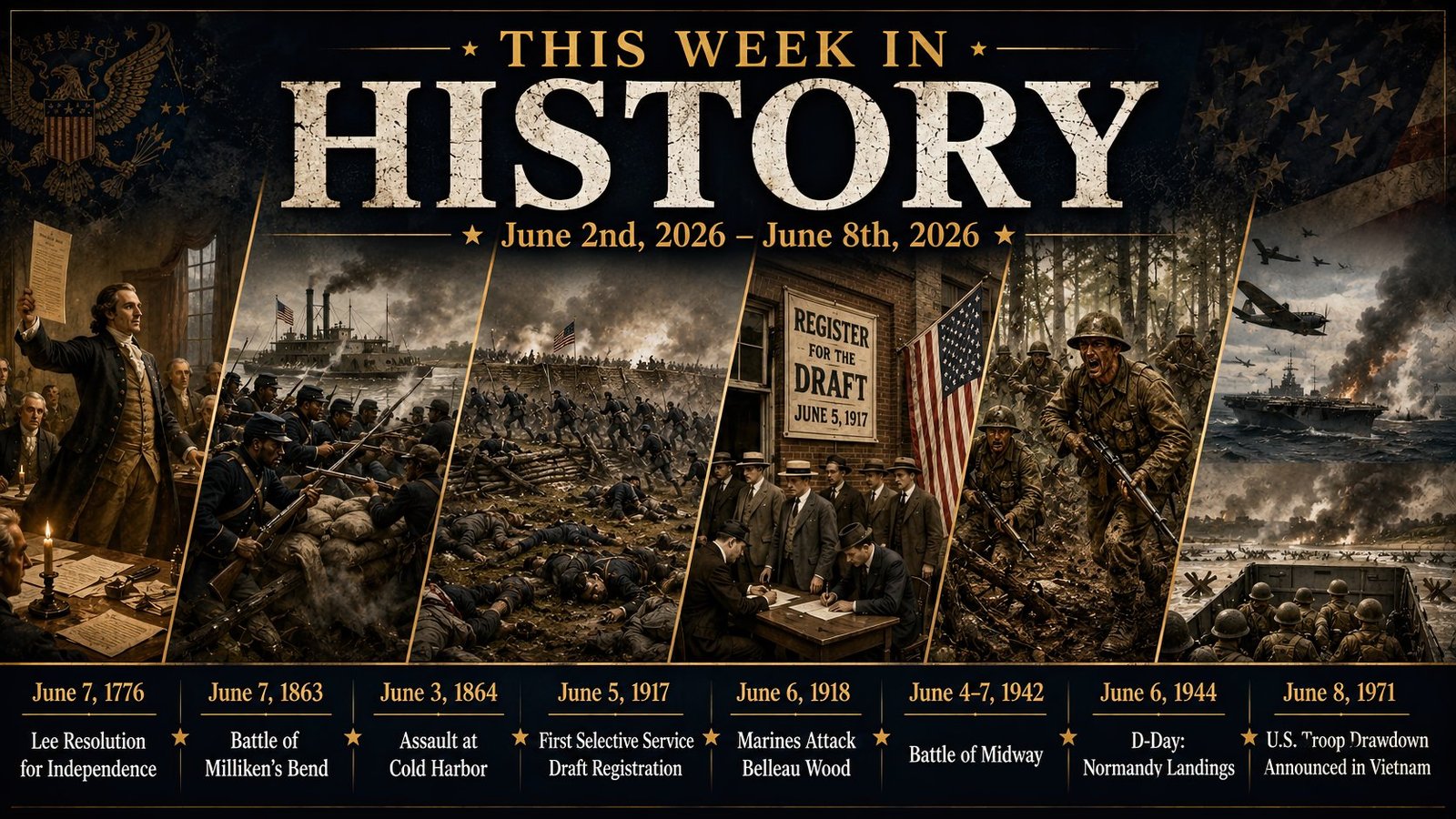
From June 2nd, 2026 through June 8th, 2026, the calendar brings us face to face with some of the most revealing moments in United States military history. In these same early June days, separated by decades, Congress edges toward declaring independence, African American soldiers fight hand to hand along the Mississippi, and Marines claw forward through a tangle of French woodland under machine-gun fire. Other anniversaries mark giant strategic turns, like the carrier battle at Midway and the Normandy landings, or quieter but still profound decisions, such as the first nationwide draft registration and an announcement that United States ground forces will begin leaving Vietnam. Together they show a force learning to mobilize whole societies, fight industrial wars on multiple continents, and carry the burdens of global commitments in the Cold War era. This Tuesday edition of “This Week in U.S. Military History” for Dispatch: U.S. Military History Magazine, developed by Trackpads dot com, walks through those connections and remembers the people who stood in the middle of them.
Lee Resolution for independence
In the summer of 1776, the Continental Army was already fighting the British Empire around Boston, New York, and in scattered frontier campaigns. On June 7th, 1776, Virginia delegate Richard Henry Lee put into words what that fighting increasingly implied, offering a resolution that the united colonies “are, and of right ought to be, free and independent states.” Debate over his proposal forced Congress to confront the true scale of the conflict and led to the appointment of a committee tasked with drafting a formal declaration. For soldiers in the field, the Lee Resolution helped align the political aim with their daily reality of campaigning under fire. In the long run it framed the war not as a struggle over representation inside an empire, but as a full bid for national independence, shaping American civil-military traditions ever since.
Open the Wiki entryBattle of Milliken’s Bend
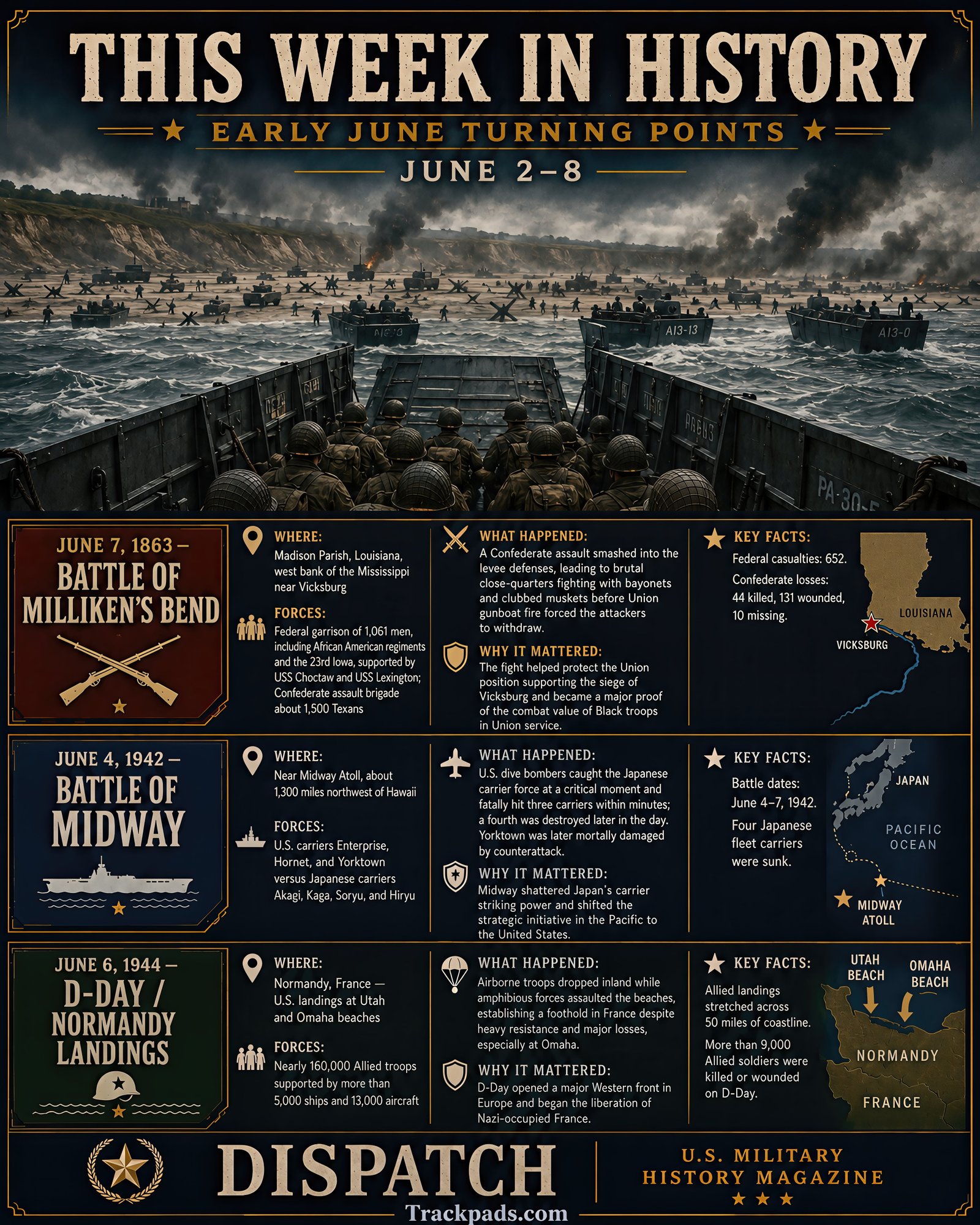
Almost ninety years later, early June once again found American soldiers in desperate combat, this time along the Mississippi River during the Civil War. On June 7th, 1863, Confederate troops attacked Union positions at Milliken’s Bend, a key supply point supporting the siege of Vicksburg. Many of the defenders were newly raised African American regiments, still short on training and equipment but determined to prove their worth. The fighting degenerated into close-quarters struggle with bayonets and clubbed muskets as the line bent but did not break, helped by fire from Union gunboats on the river. Casualties were severe, yet the performance of these units impressed many skeptical observers and strengthened the case for expanding the use of Black soldiers. The memory of Milliken’s Bend thus links the Vicksburg campaign to the broader transformation of the United States Army into a force that drew more fully on formerly enslaved Americans.
Open the Wiki entryAssault at Cold Harbor
Just a year later in war-time June, Union and Confederate armies were locked in the Overland Campaign, a grinding series of battles as Ulysses S. Grant tried to force Robert E. Lee’s Army of Northern Virginia back toward Richmond. On June 3rd, 1864, Grant launched a massive frontal assault at Cold Harbor, where entrenched Confederate troops held strong positions behind earthworks and rifle pits. In minutes, waves of attacking Union soldiers were cut down by small-arms and artillery fire, and repeated attempts to resume the attack only added to the toll. Veterans later remembered Cold Harbor as one of the most futile and bloody charges they had ever seen, and Grant himself came to regret ordering it. The battle underscored how field fortifications, rapid-fire weapons, and disciplined defenders could dominate open ground, offering a grim preview of industrial-age warfare and the kind of trench stalemates that would reappear on European battlefields half a century later.
Open the Wiki entryFirst Selective Service draft registration
When the United States entered World War I in April 1917, its small regular army was nowhere near large enough to fight on the Western Front. Congress responded by passing the Selective Service Act, and on June 5th, 1917, the nation held its first massive draft registration day. Across cities, small towns, and rural crossroads, millions of men lined up at local boards, filling out forms under the eyes of community leaders and veterans. The process was not just administrative; it symbolized the federal government’s ability to mobilize national manpower while still working through local institutions. For the Army, those registration cards became the raw material for building divisions that would fight at places like the Meuse-Argonne and Saint-Mihiel. In the broader sweep of United States military history, June 5th, 1917 marks a turning point toward modern conscription and the idea that large citizen armies might be raised, equipped, and shipped across an ocean in a matter of months.
Open the Wiki entryMarines attack Belleau Wood
Less than a year later, American forces were in the thick of combat in France. On June 6th, 1918, United States Marines and soldiers attacked German positions in and around Belleau Wood, a dense patch of forest near the Marne River. German offensives had driven the Allies back toward Paris, and the Americans were thrown into the line to help stop the advance. The assault ran into machine-gun nests, artillery fire, and tangled undergrowth that broke up formations and turned progress into a series of small-unit fights. Stories from the battle, including defiant remarks about refusing to retreat and repeated attacks under fire, became part of Marine Corps legend. The fighting at Belleau Wood helped blunt the German push and showcased American willingness to suffer heavy losses to hold critical ground, influencing how allied and enemy observers viewed the United States as a combat power.
Open the Wiki entryJapanese attack on Dutch Harbor
Early June took on new meaning in 1942, as the Pacific War reached North American shores. On June 3rd, 1942, Japanese carrier aircraft struck the United States Navy and Army installations at Dutch Harbor in the Aleutian Islands of Alaska Territory. The attack damaged fuel facilities, barracks, and anti-aircraft positions, and it was followed by further strikes the next day. For Americans, seeing bombs fall on a remote but still domestic outpost underscored that the Pacific conflict was not confined to Hawaii and far-flung islands. Strategically, the raid was part of a larger Japanese plan linked to the Midway operation, intended to divert United States attention and perhaps establish bases in the Aleutians. The defense of Dutch Harbor and the later campaign to retake the neighboring islands forced the United States military to fight in harsh, fog-bound conditions that demanded new approaches to logistics, air operations, and joint Army-Navy coordination.
Open the Wiki entryCarrier battle off Midway Atoll
While Dutch Harbor burned, the decisive blows of that wider Japanese plan were being struck far to the south. On June 4th, 1942, United States Navy carriers Enterprise, Yorktown, and Hornet launched waves of torpedo planes and dive bombers against a powerful Japanese carrier force near Midway Atoll. Early attacks by torpedo squadrons suffered terrible losses, but they drew enemy fighters and disrupted Japanese flight decks. Soon afterward, dive bombers arrived overhead to find Japanese carriers with fueled and armed aircraft still on board, and in a matter of minutes they scored hits that fatally damaged three of the four enemy flattops. A fourth carrier was destroyed later in the day, while Yorktown herself was mortally wounded by counterattacks. The Battle of Midway turned Japan’s carrier strength from an overwhelming advantage into a deficit and shifted the strategic initiative in the central Pacific to the United States, setting the stage for offensives at Guadalcanal and beyond.
Open the Wiki entryOperation Frantic shuttle bombing begins
Two years after Midway, the United States Army Air Forces were striking deep into Axis-held Europe, and June brought another innovation. On June 2nd, 1944, heavy bombers based in Britain launched the first “shuttle bombing” mission of what became known as Operation Frantic. Instead of returning to their original airfields, the bombers hit rail yards and other targets in Eastern Europe and then continued on to land at air bases in the Soviet Union. There they could be refueled, rearmed, and sent against additional targets before eventually flying home by another route. The operation demanded careful diplomatic coordination and complicated logistics, but it demonstrated the reach of Allied air power and created new options for attacking German supply lines from multiple directions. For the crews who flew these missions, the long legs over enemy territory and unfamiliar Soviet airfields added yet another layer of risk to an already dangerous strategic bombing campaign.
Open the Wiki entryUnited States troops enter Rome
On that same June weekend, United States soldiers were fighting on the ground in Italy. On June 4th, 1944, elements of the United States Fifth Army entered Rome after months of hard campaigning up the Italian peninsula, past Salerno, Cassino, and the Anzio beachhead. The capture of Italy’s capital marked the first time an Axis capital city fell into Allied hands, a powerful symbol of progress in a campaign sometimes overshadowed by events elsewhere. Roman civilians lined the streets to greet the advancing columns, even as some German units slipped away to form new defensive lines farther north. Militarily, the liberation of Rome did not end the fighting in Italy, which would grind on into 1945, but it secured a major political and logistical prize. The timing meant that news from Rome was quickly eclipsed by another event just across the Mediterranean, yet for the soldiers who fought there, June 4th remained a milestone earned at great cost.
Open the Wiki entryD-Day landings in Normandy
Two days later, early June turned into one of the most famous dates in world history. On June 6th, 1944, Allied forces stormed the beaches of Normandy in northern France in the opening phase of Operation Overlord. United States troops landed primarily at Utah and Omaha Beaches, facing a mix of flooded terrain, beach obstacles, and entrenched German defenders. At Omaha in particular, the first waves took heavy casualties under machine-gun and artillery fire before small groups of soldiers found ways to advance up the bluffs. By nightfall, despite the confusion and losses, the Allies had secured footholds along the coast and begun pushing inland. The Normandy landings opened a major Western front that forced Germany to fight on yet another large-scale ground theater, hastening the collapse of the Nazi regime and affirming the United States role as a leading coalition power in modern combined-arms warfare.
Open the Wiki entryAttack on USS Liberty
Not all early June anniversaries involve declared wars. On June 8th, 1967, during the Six-Day War in the Middle East, the United States signals intelligence ship USS Liberty was operating in international waters in the eastern Mediterranean. In the confusion of fast-moving ground and air fighting ashore, Israeli aircraft and torpedo boats mistook the ship for a hostile vessel and attacked, inflicting severe damage and killing dozens of American sailors. Survivors fought fires, tended to the wounded, and worked desperately to keep the ship afloat until help arrived. The incident prompted diplomatic apologies and compensation, but it also left lingering questions and deep scars among the crew and their families. For the United States military, the Liberty attack underscored the hazards that intelligence and support vessels face in crowded combat zones and led to changes in procedures, identification, and communication meant to reduce the risk of friendly forces striking each other in future crises.
Open the Wiki entryNixon announces Vietnam troop withdrawals
Two years later to the day, early June marked a turning point in another long and bitter conflict. On June 8th, 1969, President Richard Nixon met South Vietnamese President Nguyen Van Thieu on Midway Island in the Pacific to discuss the future of the Vietnam War. There he announced that the United States would begin withdrawing combat troops from South Vietnam, starting with a contingent of thousands of soldiers, as part of a broader effort later known as “Vietnamization.” The decision signaled a shift from building up American ground forces toward relying more heavily on South Vietnamese units, air power, and advisors while seeking a negotiated settlement. For service members in the theater and their families at home, the announcement held both hope and uncertainty, promising an eventual end to deployments while leaving open questions about the conflict’s outcome. In the longer view, June 8th, 1969 represents the start of a drawn-out drawdown that would reshape United States military posture in Southeast Asia and influence debates over intervention for decades.
Open the Wiki entryAcross the Week
Across this week’s span of June dates, United States military history moves from the bold words of independence to the grinding reality of Civil War fields, from mass mobilization and global war to the ambiguities of Cold War crises and limited conflicts. The stories range from famous operations like Midway and D-Day to lesser-known but vital actions at Milliken’s Bend, Dutch Harbor, and along the Italian roads into Rome. Together they trace an institution learning to harness national resources, fight coalition campaigns, and manage the political weight of decisions that send citizens into harm’s way. For today’s readers, including veterans, serving personnel, families, and students of history, these anniversaries are a reminder that the headlines of any given week rest on the courage and judgment of individuals standing in a particular place and time. As we move through another June, they offer a chance to reflect on how past choices still shape current service, strategy, and national memory.