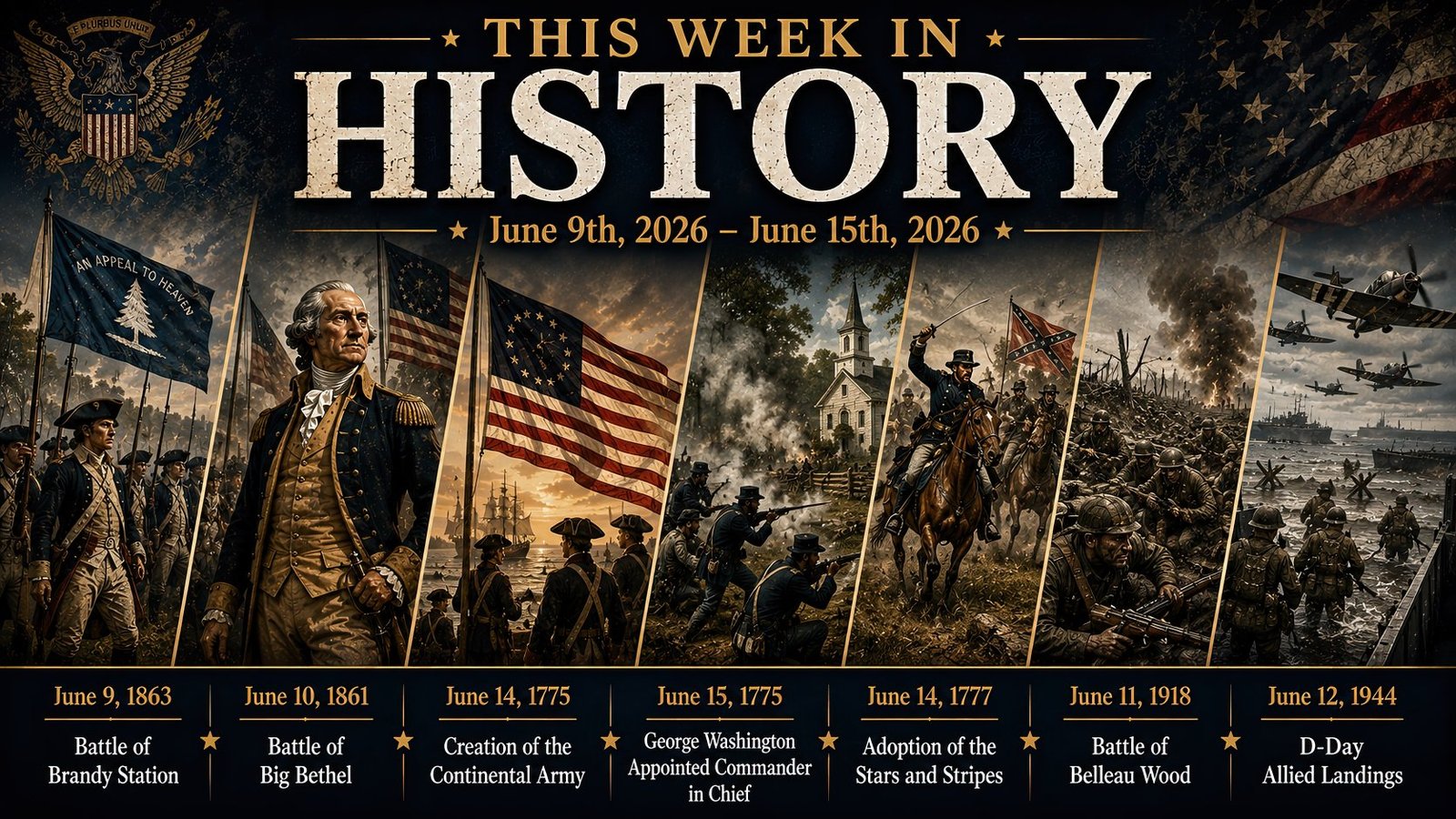
From June 9th, 2026 through June 15th, 2026, the calendar lines up with a set of anniversaries that span the full arc of United States military history. Within this single week we see the birth of a national army, the appointment of its first commander in chief, and the adoption of the flag that soldiers, sailors, airmen, and Marines would carry into battle. We also pass through hard-learned lessons in the Civil War, brutal fighting in France during the First World War, and decisive operations in Europe and the Pacific during the Second World War. Alongside these combat stories sit quieter but equally important changes in how the armed forces are organized and who is allowed to serve. This edition of “This Week in U.S. Military History” highlights how decisions made in June across different centuries shaped the institutions, traditions, and battlefields of American arms. Together, these episodes remind us that military history is built from both single days of crisis and long, deliberate reforms.
Creation of the Continental Army
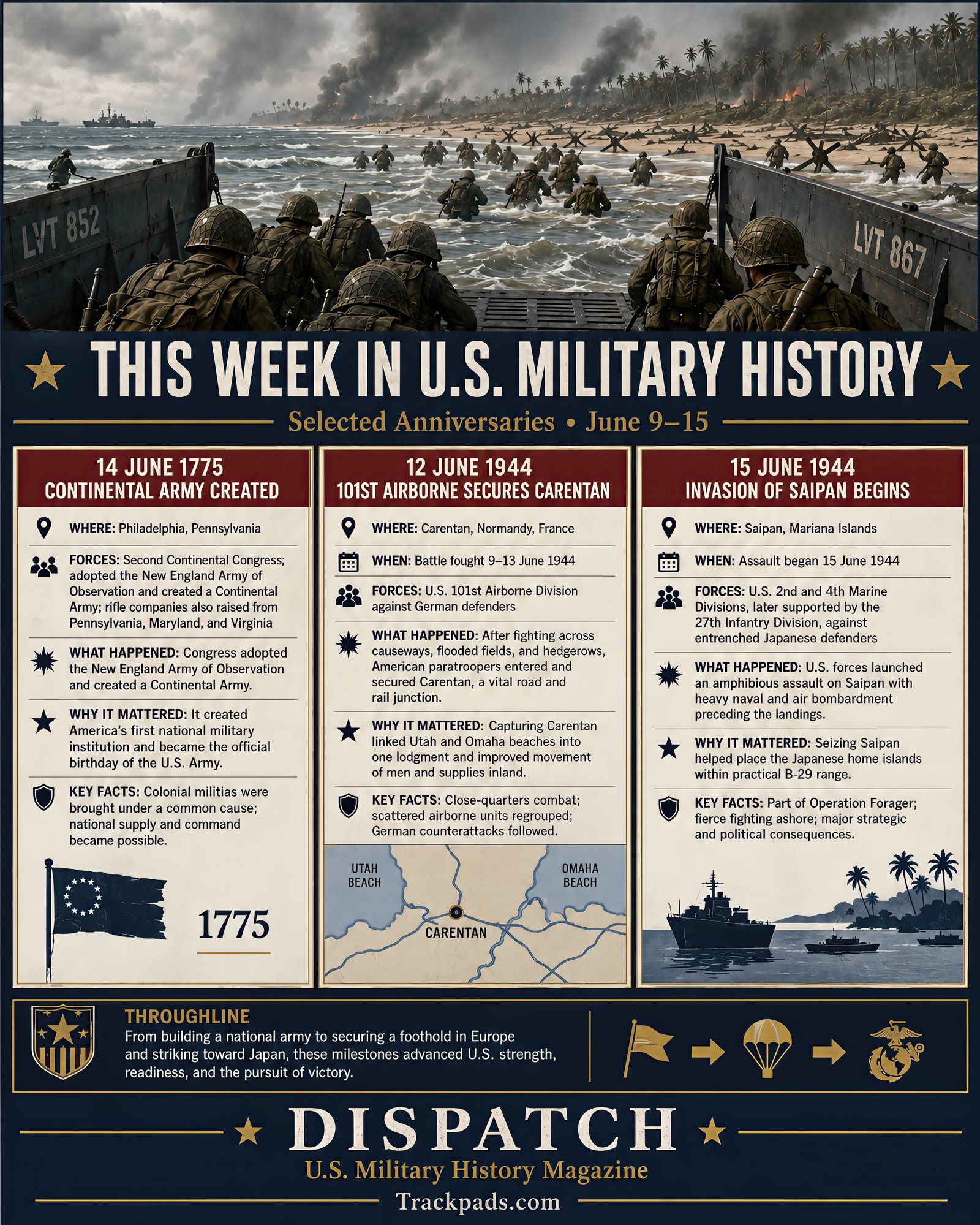
On this date, the Second Continental Congress voted to adopt the New England militia forces already besieging British-held Boston and to form them into a Continental Army. Before this decision, the men surrounding Boston answered primarily to their individual colonies, making coordination and supply uneven and uncertain. By creating a Continental Army, Congress signaled that the conflict with Britain was no longer simply a cluster of local uprisings but a common struggle that demanded a national force. The move also meant that questions of pay, clothing, weapons, and senior leadership would be handled for all the colonies together rather than separately. In later years, the United States Army would look back to June 14th, 1775 as its official birthday and trace its institutional lineage to that vote. The decision laid the foundation for the professional land force that would eventually fight on fronts from the Mississippi River to the Philippines and beyond.
Open the Wiki entryGeorge Washington appointed commander in chief
Just one day after creating a Continental Army, Congress turned to the problem of who should lead it and selected George Washington of Virginia as commander in chief. Washington had experience from the French and Indian War, a reputation for personal courage, and the political advantage of coming from a southern colony at a moment when most fighting was in New England. His appointment helped weld together regional interests by placing a Virginian at the head of largely New England troops. Washington accepted the role with a mixture of confidence and humility, insisting that he would serve without pay beyond his expenses. Over the next eight years he would shape the character of the emerging American officer corps through his expectations of discipline, perseverance, and respect for civilian authority. The choice made on June 15th, 1775 created not only a leader for the immediate war but also a model of military service in a republic that later generations studied closely.
Open the Wiki entryAdoption of the Stars and Stripes
Two years into the Revolution, Congress resolved that the flag of the thirteen United States would consist of thirteen stripes, alternating red and white, with thirteen stars on a blue field. This decision on June 14th, 1777 formalized a symbol that Continental soldiers and sailors could rally around as they marched and sailed under a single national standard. Before this, American forces had used a variety of flags that often reflected local or regional identities, which could confuse allies and adversaries alike. The Stars and Stripes soon appeared on regimental colors, naval ensigns, and fortifications, giving the young republic a visual identity in battle and diplomacy. Over time, the flag changed as new states joined the Union, but the core pattern set in 1777 remained. For the armed forces, the adopted design became a powerful emblem of both the unity they defended and the sacrifices they were asked to make. Later generations would mark June 14th as Flag Day, tying civic observance to a decision with direct meaning on the battlefield.
Open the Wiki entryBattle of Big Bethel
Early in the Civil War, Union and Confederate forces clashed near Big Bethel Church in southeastern Virginia in one of the first significant land battles of the conflict. On June 10th, 1861, mostly inexperienced Union volunteers attempted a night march and dawn attack against Confederate positions but suffered from confusing orders, difficult terrain, and misidentification of friendly units. The result was a small but painful setback, marked by episodes of friendly fire and failed coordination between converging columns. For the Union Army, the fight at Big Bethel underscored how unready many officers and men were for complex operations and how quickly battlefield confusion could turn into casualties. Confederate defenders, under more cohesive leadership, were able to repulse the attack and claim an early morale boost. While the engagement did not decide any campaign, it provided hard lessons about training, staff work, and reconnaissance that both sides would apply as the war escalated into far larger and bloodier confrontations.
Open the Wiki entryBattle of Brandy Station
Just two years later, cavalrymen of the Union and Confederacy collided near Brandy Station, Virginia in what became the largest mounted battle ever fought in North America. On June 9th, 1863, Union cavalry crossed the Rappahannock River in a surprise attack aimed at probing Confederate movements as Robert E. Lee’s army shifted north toward Pennsylvania. Throughout the day, sabers and carbines flashed across fields and ridges as Union troopers challenged the reputation of J. E. B. Stuart’s cavalry, which had long been viewed as superior. Although the Confederates ultimately held the field, the Union riders showed a new aggressiveness and skill that signaled a turning point in cavalry warfare in the Eastern Theater. The fight lifted Union morale and alerted Confederate commanders that their movements were being watched more closely than before. In the weeks that followed, both sides moved toward the showdown at Gettysburg, with Brandy Station remembered as the noisy, swirling prelude to that campaign.
Open the Wiki entryRenewed Marine Corps assaults at Belleau Wood
In June 1918, United States Marines and soldiers of the American Expeditionary Forces were committed to stopping a German drive toward Paris near a patch of forest called Belleau Wood. On June 11th, 1918, Marine units launched renewed assaults into the dense, shell-torn woods after earlier attacks had been thrown back with heavy losses. Fighting was at close range, with machine-gun nests hidden among shattered trees and rocky outcrops forcing small groups of Marines to advance by short rushes and hand grenades. The cost in casualties was severe, but the persistent attacks gradually pushed German forces out of key positions and helped stabilize a threatened sector of the Allied line. In later telling, Belleau Wood became a defining moment in Marine Corps history, associated with toughness under fire and an unwillingness to yield ground. The bitter combat on this June day contributed to a broader Allied effort that blunted the last major German offensive on the Western Front. It also signaled that American combat units were now fully engaged in the decisive battles of the First World War.
Open the Wiki entry101st Airborne captures Carentan
Less than a week after the D-Day landings in Normandy, paratroopers of the 101st Airborne Division fought their way into the town of Carentan. On June 12th, 1944, after days of brutal combat across causeways and among hedgerows, airborne infantry entered and secured the battered town, which sat at a vital road and rail junction between Utah and Omaha Beaches. The battle featured close-quarters fighting, German counterattacks supported by armor, and the difficulty of coordinating scattered airborne units dropped in darkness on June 6th. Capturing Carentan allowed American forces to link the Utah and Omaha beachheads into a continuous lodgment, easing the flow of supplies, vehicles, and reinforcements inland. It also denied the Germans a convenient axis for launching attacks that could split the Allied foothold. For the 101st, Carentan became one of the division’s signature actions, demonstrating how airborne infantry could hold and clear urban objectives after their initial parachute missions. The day’s success contributed directly to the expansion of the Normandy bridgehead, from which the Allies would eventually break out into France.
Open the Wiki entryInvasion of Saipan begins
In the Central Pacific, United States forces opened a new phase of the war against Japan with the amphibious assault on Saipan in the Mariana Islands. On June 15th, 1944, Marines of the 2nd and 4th Marine Divisions, supported later by soldiers of the 27th Infantry Division, hit the beaches under fire from well-prepared Japanese defenses dug into coral, caves, and ridges. The operation was part of a wider strategy to seize islands from which long-range bombers could reach the Japanese home islands and to cut key shipping routes. Fighting on Saipan quickly became intense and prolonged, with Japanese counterattacks, including night assaults, testing the stamina and coordination of American units. Naval support from battleships, cruisers, and carriers provided heavy gunfire and air strikes but could not eliminate every strongpoint. The decision to take Saipan committed the United States to a costly but decisive push across the Central Pacific. Its eventual capture would have major political and strategic consequences by bringing Japanese cities within range of new bombers and undermining confidence in the Tokyo government.
Open the Wiki entryFirst B-29 raid on Japan from China
The same date that Marines were struggling ashore on Saipan also saw the debut of a new weapon in the air war over Asia. On June 15th, 1944, Boeing B-29 Superfortress bombers of the United States Army Air Forces flew from forward bases in China to strike industrial targets in Japan in the first mission of its kind. The raid required extremely long flights over difficult terrain, complicated logistics to supply fuel and bombs across mountains and primitive roads, and careful navigation in hostile skies. Damage to the specific target was limited compared to later campaigns, but the mission proved that American heavy bombers could reach the Japanese home islands from land bases. It underscored the value of seizing island positions like the Marianas, which would later host B-29 units with shorter and more sustainable routes to their objectives. This first long-range strike marked the opening of a strategic bombing campaign that would become a central element of the final phase of the Pacific War. It also demonstrated the growing industrial and technological capacity the United States could bring to bear far from its own shores.
Open the Wiki entryWomen’s Armed Services Integration Act signed
After the experience of two world wars, during which women had served in large numbers in temporary or auxiliary roles, the United States took a major step toward making that service permanent. On June 12th, 1948, the Women’s Armed Services Integration Act was signed into law, granting women the right to serve as regular and reserve members of the Army, Navy, Marine Corps, and newly independent Air Force. The law did not create full equality, as caps on numbers and restrictions on certain roles remained, but it marked a historic change in how the armed forces viewed gender and military service. Women who had proven themselves as nurses, communications specialists, logisticians, and in many other positions were now recognized as long-term contributors rather than temporary wartime helpers. The act also meant that future mobilizations would start from a broader and more diverse pool of trained personnel. Over decades, this legal foundation would support later reforms that opened more specialties and leadership positions, reshaping the face of the United States military. The date stands as a reminder that institutional change can be as significant as any single battle in altering the character of the armed services.
Open the Wiki entryAcross the Week
Across this week in history, the United States military moves from creation to maturity, from continental skirmishes to global campaigns, and from a narrow definition of who may serve to a broader, more inclusive force. The decisions to form an army, choose a commander, and adopt a flag gave the early republic the tools and symbols it needed to survive its first test. Hard-fought engagements in Virginia, France, and the Pacific reveal how much trial and error, sacrifice, and adaptation lay behind later victories that sometimes appear inevitable in hindsight. Long-range bombers and airborne troops show how technology and new concepts of operation expanded the reach and complexity of warfare. Legislative change in 1948 reminds us that the composition of the force can evolve as dramatically as its equipment. Taken together, the events of June 9th through June 15th invite us to think about how today’s service members inherit not only tactics and traditions but also the enduring questions of leadership, identity, and shared purpose.