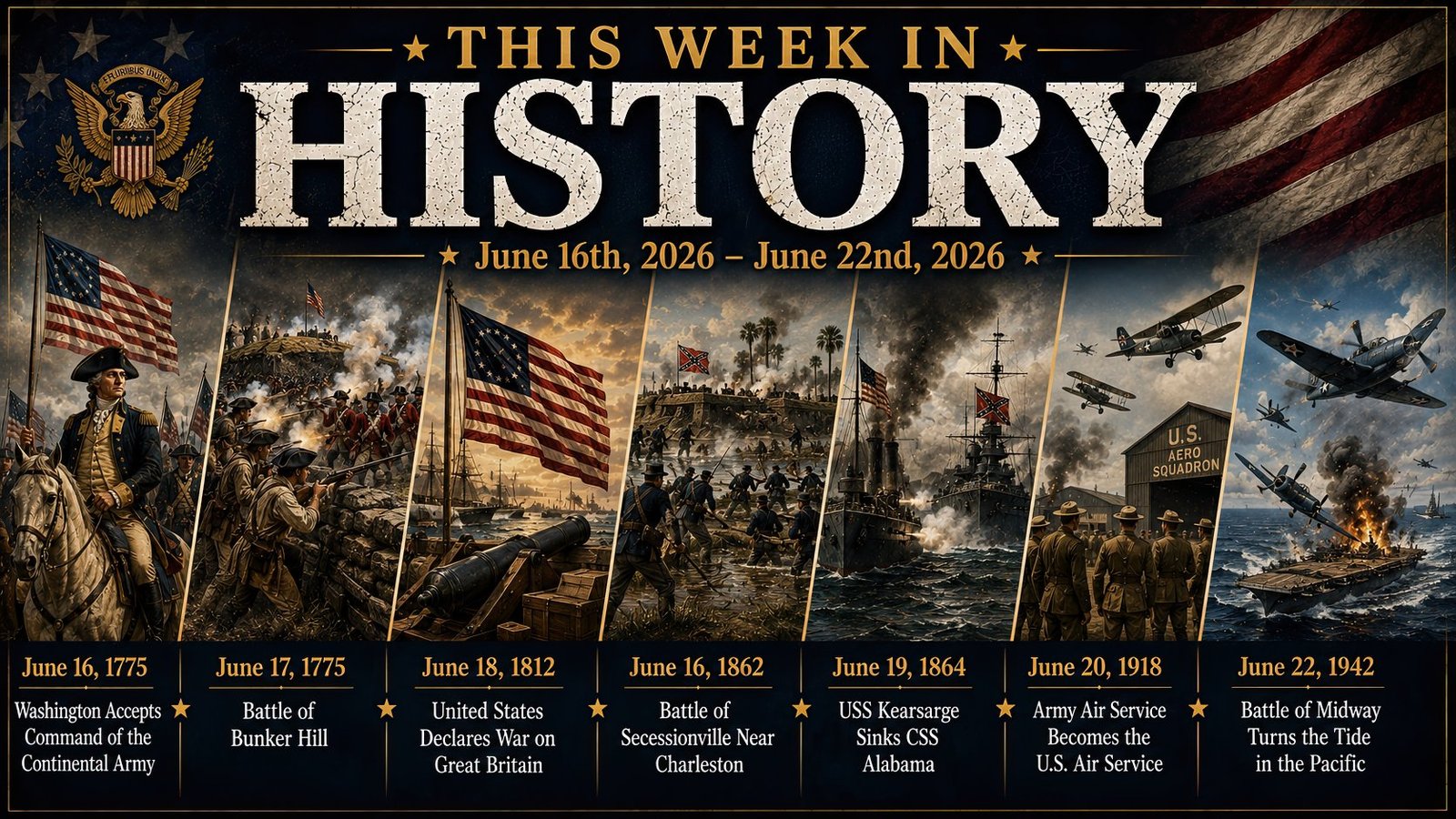
From June 16th, 2026 through June 22nd, 2026, the calendar lines up with a series of moments when American arms, policy, and principle all moved in new directions. Over these seven days we see the birth of a unified Continental Army, the declaration of a new war against a former imperial ruler, and bitter clashes along the marshes and coasts of the Civil War. The span also carries us to a cavalry skirmish on Mexican soil, the creation of a powerful new air arm, and a decisive carrier battle in the central Pacific. Alongside those combat stories, we meet orders and laws that reshaped the lives of millions of service members and their families. As always, This Week in U.S. Military History, the Tuesday feature of Dispatch: U.S. Military History Magazine developed by Trackpads dot com, follows these days across the centuries to ask what they meant at the time and what they still say about American service today.
Washington accepts command of the Continental Army
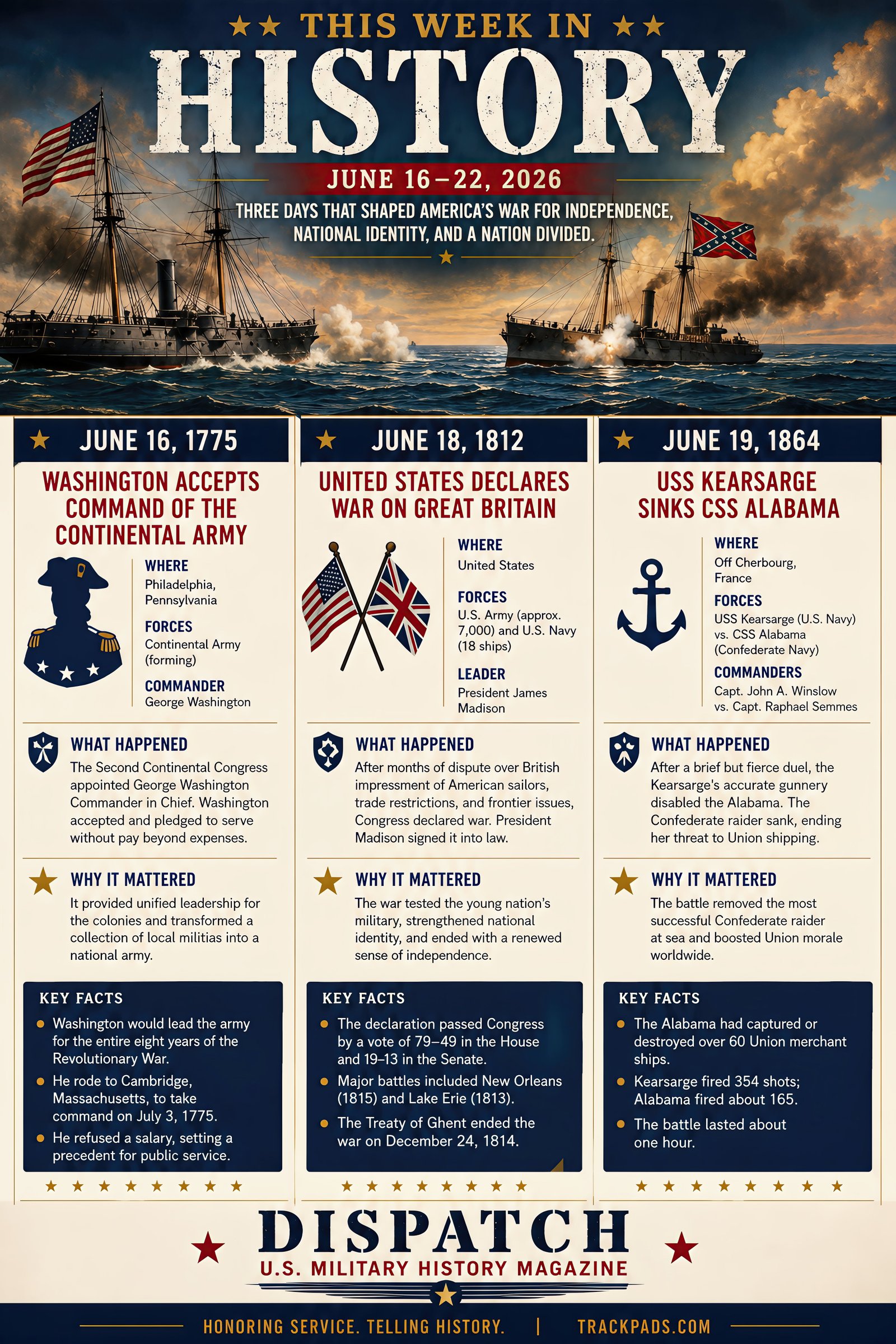
On this day, George Washington formally accepted the appointment that Congress had offered him to serve as commander in chief of the Continental Army. The colonies had already seen bloodshed at Lexington, Concord, and around Boston, but until this point there had been no single figure responsible for coordinating their military effort. Washington’s acceptance signaled that the rebellion would not be a loose collection of local uprisings but a united struggle with a common command. Wearing his Virginia colonel’s uniform, he pledged to serve without pay beyond his expenses, an important gesture in a war being fought against the idea of professional standing armies as tools of tyranny. His new role would take him north to Boston and then across the full sweep of the war, binding the disparate colonial forces into something closer to a national army.
Open the Wiki entryBattle of Bunker Hill
The day after Washington accepted his new burden, militiamen outside Boston met the British army in one of the Revolution’s most famous early battles. Though remembered as the Battle of Bunker Hill, most of the fighting raged on nearby Breed’s Hill, where colonial forces hastily fortified a position overlooking the harbor. British commanders, determined to break the rebel grip on the peninsulas around Boston, launched repeated frontal assaults up the slopes in tight formations. The defenders, short on powder and shot, held their fire until the attackers were close and then cut into the ranks with devastating volleys. Eventually the militia positions were overrun when their ammunition ran low, making the fight technically a British victory. The price, however, was staggering in officer and infantry casualties, and the battle convinced many in London that the war would be neither short nor easy, while in America it proved that citizen soldiers could stand toe to toe with professional regulars.
Open the Wiki entryUnited States declares war on Great Britain
Nearly four decades after independence, the United States again found itself in conflict with its old imperial rival. On June 18th, 1812, after months of debate over British interference with American trade, the impressment of American sailors into the Royal Navy, and tensions along the frontier, Congress passed and President James Madison signed a declaration of war. The decision divided American politics, with support strongest in the West and South and opposition concentrated in New England, where commerce with Britain mattered deeply. For the armed forces, the declaration opened a new contest on land and sea, despite the young republic’s limited navy and small peacetime army. Over the following years, American troops would clash with British forces and their Indigenous allies along the Canadian border and on the Atlantic coast, while American warships and privateers hunted British commerce. The war would bring setbacks, including the burning of Washington, but also victories at places like Lake Erie and New Orleans that helped cement a distinct American military identity.
Open the Wiki entryBattle of Secessionville near Charleston
During the early Civil War struggle for control of the South’s key ports, Union commanders targeted Charleston, South Carolina, both for its symbolic role in secession and its practical value as a harbor. On June 16th, 1862, Union forces launched a dawn assault on fortified Confederate positions at Secessionville, on James Island just outside the city. The terrain of marshes, creeks, and narrow causeways forced attacking troops into tight channels under concentrated artillery and musket fire. Despite bravery in the ranks, the Union attack broke apart against the defenses, suffering heavy casualties and failing to secure a foothold that might open the way to Charleston. For the Confederacy, the victory was a badly needed boost to morale and helped keep one of its most important cities in Southern hands for nearly three more years. For the Union, Secessionville was a reminder that even with naval superiority, coastal assaults demanded careful reconnaissance, coordination, and respect for local geography.
Open the Wiki entryUSS Kearsarge sinks CSS Alabama
Off the French port of Cherbourg, two warships met in a duel that captured worldwide attention and helped decide a quieter but crucial front in the Civil War. The Confederate commerce raider CSS Alabama had spent years attacking Union merchant shipping across the globe, forcing the United States to divert warships to hunt her and driving up insurance rates. On June 19th, 1864, the Union sloop of war USS Kearsarge, which had been blockading the harbor, accepted Alabama’s challenge to fight offshore. The two ships circled and exchanged broadsides, but Kearsarge’s gunnery was more accurate and her crew had hung chains over vital areas to absorb incoming shot. Alabama was battered, holed near the waterline, and eventually sank, though some of her crew were rescued by neutral observers. The victory removed one of the Confederacy’s most dangerous raiders from the seas and underscored the importance of commerce protection as a strategic mission for the Union Navy.
Open the Wiki entryUnion order of emancipation in Texas (Juneteenth)
Two years after the Emancipation Proclamation and months after the main Confederate armies had surrendered, Union military authority was still spreading across the far corners of the former Confederacy. On June 19th, 1865, Major General Gordon Granger landed in Galveston, Texas, at the head of Union troops and read General Order No. 3, announcing that enslaved people in Texas were free under federal law. The presence of Union soldiers gave force to words that had, in many places, remained unenforced during the war. For the newly freed, the day marked both an end and a beginning, closing one chapter of bondage and opening another of uncertain freedom, labor contracts, and political struggle. While the Army would soon be reduced in size, soldiers and officers in the Reconstruction era would continue to act as guardians, however imperfect, of new rights in the South. Juneteenth would later be commemorated as a holiday of emancipation, with its origins rooted in a specific moment when military power carried a promise into practice.
Open the Wiki entryBattle of Carrizal in Mexico
During the Punitive Expedition sent into Mexico after Pancho Villa’s raid on Columbus, New Mexico, American and Mexican forces found themselves in an increasingly tense standoff. On June 21st, 1916, a detachment of the 10th U.S. Cavalry, composed largely of African American “Buffalo Soldiers,” encountered Mexican federal troops loyal to President Carranza near the town of Carrizal. Orders, warnings, and counterorders led to confusion and escalation, and a firefight erupted in the desert. The cavalrymen fought fiercely but were outnumbered and eventually forced back, with several killed and others captured. The clash nearly pushed the United States and Mexico into a wider war, highlighting the risks inherent in cross-border operations and unclear political guidance. Diplomats ultimately worked out an arrangement that allowed the expedition to withdraw, but the men of Carrizal carried the memory of a hard, controversial fight on foreign soil.
Open the Wiki entryUnited States Army Air Forces established
As global war raged and American involvement drew nearer, leaders in Washington recognized that the Army’s air component needed a more robust structure. On June 20th, 1941, the War Department reorganized the existing Army Air Corps into the United States Army Air Forces, giving it a more unified command structure and increased authority over training, doctrine, and operations. This change did not create an independent air service yet, but it acknowledged that airpower had grown beyond a supporting arm for ground troops. Under the new arrangement, air units could be better prepared for long-range bombing, air defense, and close support missions that a world war would demand. The Army Air Forces would soon expand dramatically, sending bomber crews over Europe, fighter groups into every theater, and transport squadrons across the globe. The decisions taken that June laid the institutional groundwork for both wartime success and, after 1947, the birth of an independent United States Air Force.
Open the Wiki entryBattle of the Philippine Sea and the “Great Marianas Turkey Shoot”
In the central Pacific, American seaborne power reached a new height as carrier task forces covered the invasion of Saipan in the Mariana Islands. On June 19th, 1944, Japanese naval aviation mounted large waves of air attacks against the U.S. fleet in an attempt to blunt the landings and reclaim the initiative. Radar, fighter direction, and well-trained pilots flying modern carrier aircraft met those strikes far from the fleet, cutting down attacking formations in what American aviators later dubbed the “Great Marianas Turkey Shoot.” At the same time, American submarines and carrier aircraft struck at the Japanese fleet itself, sinking carriers and further eroding Japan’s ability to contest control of the ocean. By the end of the battle, Japan had lost a large share of its remaining carrier pilots, a loss that could not be made good quickly. The Philippine Sea fight ensured that American forces could press on toward the Philippines and ultimately Japan with overwhelming air superiority at sea.
Open the Wiki entryServicemen’s Readjustment Act (GI Bill) signed into law
Even as battles raged in Normandy and the Pacific, policymakers were looking ahead to the millions of service members who would one day come home. On June 22nd, 1944, President Franklin D. Roosevelt signed the Servicemen’s Readjustment Act, soon known simply as the GI Bill. The law offered a package of benefits including education assistance, home loan guarantees, and support for finding work, all intended to ease the transition from military to civilian life. For countless veterans, the bill made it possible to attend college or vocational school, buy a home, or start a business in ways that might otherwise have been out of reach. The policy had enormous long-term effects on American society, expanding the middle class and altering where families lived, worked, and studied. In military history, the GI Bill stands as a reminder that how a nation treats its veterans after war is as consequential as how it equips them during it.
Open the Wiki entryOkinawa declared secure
After nearly three brutal months of fighting, American commanders declared the island of Okinawa secure on June 22nd, 1945. The campaign had begun with amphibious landings in April, followed by a grinding advance against deeply dug-in Japanese defenses that relied on cave systems, reverse-slope positions, and determined infantry counterattacks. United States Army and Marine divisions fought side by side under the Tenth Army, enduring constant artillery, rain, mud, and some of the heaviest kamikaze attacks of the war on the supporting fleet offshore. The human cost was staggering for soldiers, Marines, sailors, and Okinawan civilians alike. Strategically, Okinawa offered airfields and anchorages within direct striking distance of the Japanese home islands, making it a key base for any planned invasion. At the same time, the casualties suffered there influenced American leaders’ thinking about how to end the war, including the consideration of atomic weapons and continued blockade rather than another amphibious assault on a defended shore.
Open the Wiki entryAcross the Week
Across this week in history, the stories range from hilltops outside Boston to coral reefs and ridges in the Pacific, from dusty Mexican crossroads to the docks of European ports. Together they show how American military power has always been more than battlefield maneuvers and weaponry; it is also about institutions, law, and the lives of people changed by orders they did not write. Washington’s acceptance of command, the declaration of new wars, and the reorganization of air forces reveal how leadership and structure shape outcomes long before the shooting starts. Battles like Secessionville, the Philippine Sea, and Okinawa underscore the cost paid when plans meet stubborn defenders. Moments like Juneteenth and the signing of the GI Bill remind us that uniforms and rifles are only part of the story, and that freedom and opportunity after war matter just as much. As we mark these dates from June 16th, 2026 through June 22nd, 2026, the echoes of those decisions and sacrifices can still be heard in today’s force and the society it serves.