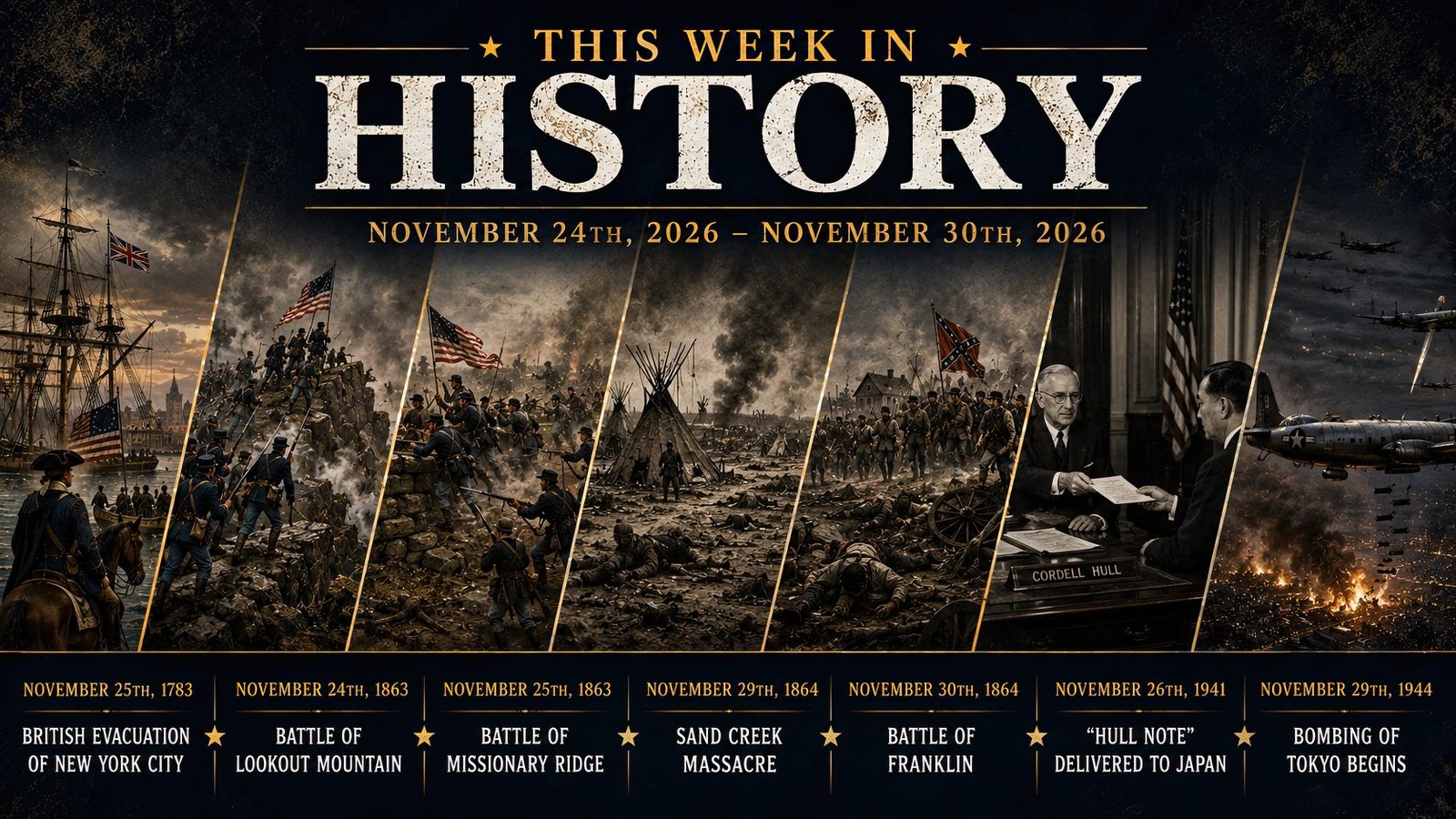
From November 24th, 2026 through November 30th, 2026, the calendar links a series of moments when United States arms, diplomacy, and conscience were all tested. In these seven days you can trace a line from the last British redcoats leaving New York Harbor to Marines carving a fighting withdrawal through the Korean mountains and diplomats arguing over how to expel an invader from Kuwait. The week includes high ground seized in Tennessee, a village on the Plains left in ashes, decisions in Washington and Tehran that helped set the course of world war, and a bomber stream reaching across the Pacific to Tokyo. Some of these stories are clear battlefield victories, others are cautionary tales that still trouble the national memory. Taken together, they show how military power, political choice, and human cost are always intertwined in United States history.
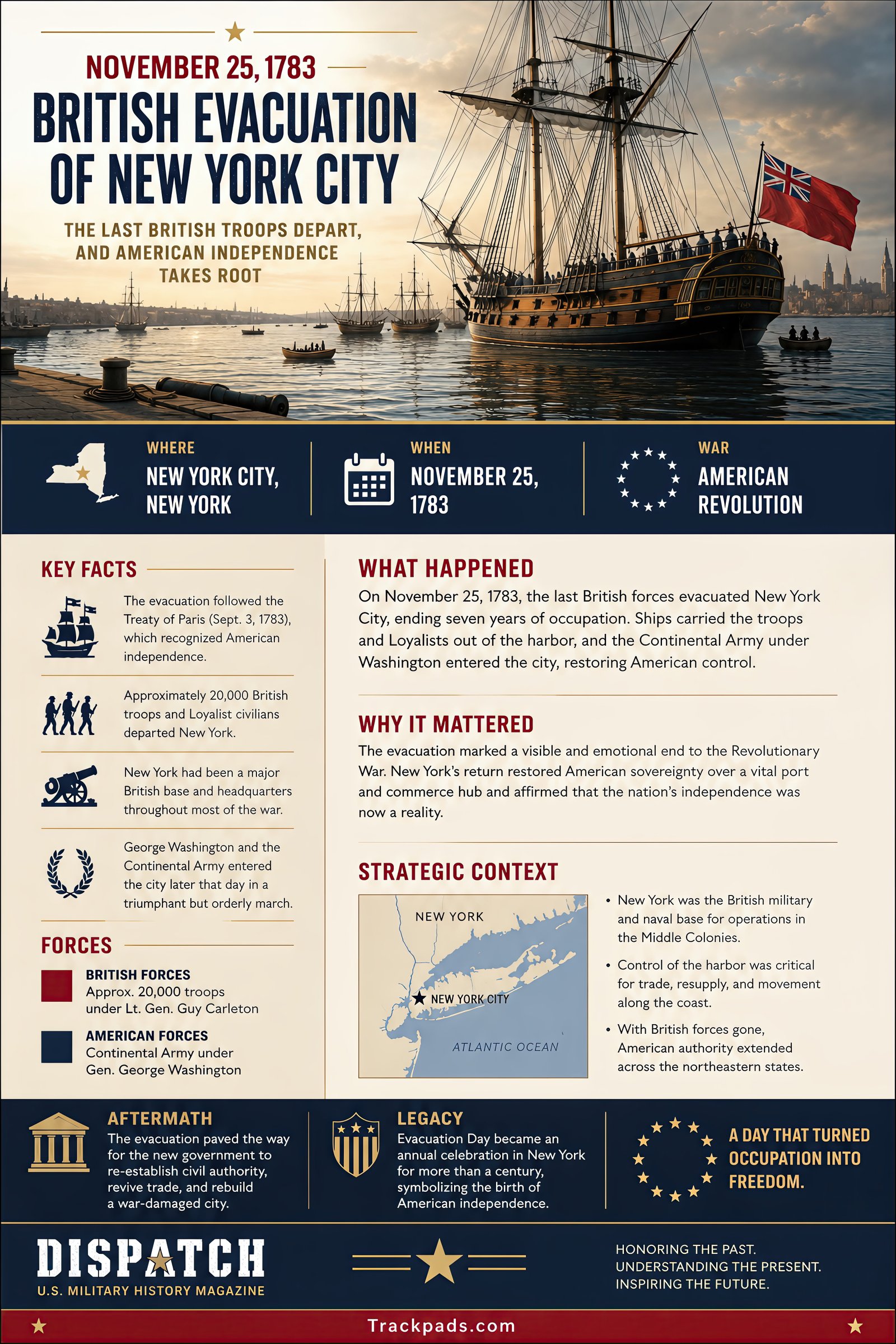
British Evacuation of New York City
On this late autumn day, the last British troops finally departed New York City, ending seven years of occupation of the largest port in North America. George Washington and Continental soldiers then marched into the city in a carefully choreographed entry that signaled that the Revolution’s hard-won independence had become a lived reality on the streets as well as on paper. For years, New York had served as a major British base, a hub for fleets, prisons, loyalist refugees, and military headquarters. Its return marked a critical step in reasserting American control over key harbors and trade routes. Evacuation Day would be celebrated locally for generations, a reminder that the close of a war can be measured not only in treaties, but in the departure of the last occupation troops from a nation’s soil.
Open the Wiki entryBattle of Lookout Mountain
In the Civil War, Union forces fighting to break the Confederate siege of Chattanooga turned toward a steep, fog-shrouded height locals called Lookout Mountain. Troops under Joseph Hooker climbed the slopes and fought what soldiers later remembered as the “Battle above the Clouds,” pushing Confederate defenders off positions that had dominated the Tennessee River valley. This success did more than secure an impressive trophy of terrain. By dislodging enemy guns and observers, the Union began to unhinge the entire Confederate line around Chattanooga. The victory improved morale after earlier setbacks in the Western Theater and signaled that the besieged city could be held and supplied. It set up the next day’s blow against Missionary Ridge and opened the way for deeper Union drives into the interior of the Confederacy.
Open the Wiki entryBattle of Missionary Ridge
The day after Lookout Mountain, Union forces turned against the main Confederate positions east of Chattanooga, dug in along Missionary Ridge. Under Ulysses S. Grant’s overall direction, Union troops initially received orders for a limited assault against the rifle pits at the base of the ridge. Once those forward positions were seized, however, momentum and exposure to enemy fire drove many units to continue climbing without waiting for fresh instructions. Against expectations in both armies, those uphill attacks broke through the Confederate line along much of the ridge. The collapse at Missionary Ridge ended the siege of Chattanooga and handed the Union control of a critical rail hub and river crossing. In strategic terms, it opened the gateway to Georgia and made possible the campaigns that would carry Union armies toward Atlanta and the sea.
Open the Wiki entrySand Creek Massacre
On the High Plains of the Colorado Territory, a column of Colorado volunteer cavalry descended on a Cheyenne and Arapaho encampment along Sand Creek. Many of the people in the village had sought a measure of safety near military posts and believed they were under some form of United States protection. Instead, at dawn, the troopers attacked, killing large numbers of men, women, and children and mutilating many of the bodies. In the months that followed, word of what had happened at Sand Creek spread, prompting investigations, bitter debates, and condemnation from some military and political leaders. The massacre inflamed conflict on the Plains, hardened attitudes on all sides, and became a lasting stain on the record of frontier warfare. For United States military history, Sand Creek stands as a stark reminder that the use of force can produce moral wounds that outlast any campaign.
Open the Wiki entryBattle of Franklin
Only a day after the horror at Sand Creek, another grim chapter unfolded in Tennessee when Confederate General John Bell Hood hurled his Army of Tennessee against fortified Union lines near Franklin. Union troops under John Schofield had prepared strong defenses, including earthworks and obstacles that forced attacking infantry into deadly fields of fire. Over several hours, wave after wave of Confederate formations pressed forward and were shattered at close range, leaving the ground in front of the Union works carpeted with casualties. Several Confederate generals were killed or mortally wounded in the assaults, and the army’s offensive power was badly crippled. Although the Union force would continue its withdrawal toward Nashville, the Battle of Franklin marked a devastating check to Confederate hopes in the Western Theater and foreshadowed final defeat in the region.
Open the Wiki entry“Hull note” delivered to Japan
In the tense weeks before open war in the Pacific, Japanese diplomats in Washington received a new written proposal from Secretary of State Cordell Hull. The document called for Japanese withdrawal from much of China and Southeast Asia and insisted on respect for territorial integrity in the region, terms that many leaders in Tokyo had no intention of accepting. By the time the note was delivered, Japanese forces and fleets had already been placed on the path toward offensive operations, including the carrier task force steaming toward Hawaii. Even so, this exchange is often remembered as the final, failed attempt at a diplomatic resolution between the two countries before hostilities erupted. For the United States, the note reflected a determination to resist further expansion by force; for hard-line figures in Japan, it reinforced the belief that war with the United States had become inevitable.
Open the Wiki entryTehran Conference begins
That same global war produced a very different sort of turning point when Franklin Roosevelt, Winston Churchill, and Joseph Stalin gathered in Tehran, Iran, for their first full wartime summit. Meeting in the shadow of ongoing campaigns in Italy and the Soviet Union, the three leaders wrestled with questions of timing and burden sharing for a massive cross-Channel invasion of Western Europe. At Tehran, they moved toward firm commitments for what would become Operation Overlord and coordinated plans for Soviet offensives that would align with Allied landings. The conference also touched on postwar questions, from borders to the fate of Germany, though many details remained unsettled. Even as fighting continued on distant fronts, the discussions in Tehran helped lock in a grand strategy that linked American industrial and military power to Allied plans for defeating Nazi Germany on a precise timetable.
Open the Wiki entryFirst B-29 raid on Tokyo from the Marianas
A year after Tehran, another kind of reach took shape when Boeing B-29 bombers lifted off from freshly built airfields in the Mariana Islands for the first raid on Tokyo from that direction. The mission required long over-water flights, careful navigation, and aircrews who had trained for high-altitude attacks on industrial targets deep inside Japan. The strike on the Musashino aircraft engine works was only the beginning of a sustained campaign, and early raids struggled with weather, mechanical issues, and the challenge of finding specific factories in sprawling urban landscapes. Nonetheless, this first mission signaled that Japanese home islands were now within regular range of American heavy bombers operating from newly captured bases. It marked a new phase of the Pacific war, in which strategic bombing would increasingly shape the pressure placed on Japan’s war economy and cities.
Open the Wiki entry“Home by Christmas” offensive in Korea
In the hills and valleys of North Korea, United Nations forces under General Douglas MacArthur pressed northward in an ambitious push toward the Yalu River. Many leaders hoped that this drive, often remembered under the phrase “Home by Christmas,” would break remaining resistance and end the war quickly. United States and allied units advanced on long, exposed routes in bitter cold, while intelligence estimates underestimated the scale and readiness of Chinese forces already filtering into the country. Around the Chongchon River and on other fronts, those Chinese formations soon launched powerful counterattacks that struck regiments and divisions in motion. Within days, the optimism of the offensive gave way to hard fighting withdrawals and broken road columns. The shift from advance to retreat highlighted the dangers of overextension, especially in harsh terrain against a determined opponent who had been misjudged.
Open the Wiki entryBattle of the Chosin Reservoir begins
As the wider front buckled, the crisis in Korea intensified around the frozen Chosin Reservoir, where United States Marines and attached Army units held positions along mountain roads and ridges. On the night of November 27th, large Chinese forces struck in coordinated attacks, seeking to encircle and destroy these scattered garrisons in temperatures that plunged far below freezing. Over the next days, Marines, soldiers, and support troops fought a defensive battle marked by close-quarters engagements, improvised perimeter defenses, and heroic efforts by engineers, aviators, and logisticians to keep roads open. Rather than collapsing, the surrounded forces formed a column and fought their way south toward the coast, bringing out their wounded and much of their equipment. The withdrawal from Chosin, costly as it was, became a defining story of discipline, small-unit leadership, and the ability to maintain cohesion under extreme pressure.
Open the Wiki entryU.N. Security Council Resolution 678
Decades later, questions of war and peace shifted to New York, where the United Nations Security Council voted on a resolution addressing Iraq’s invasion of Kuwait. Resolution 678 set a firm deadline for Iraqi withdrawal and authorized member states to use “all necessary means” if that withdrawal did not occur. For the United States, which had already deployed forces to the Gulf region and begun building a broad coalition, the vote provided a clear international legal foundation for potential offensive operations. Military planners could now refine timetables and options for what would become Operation Desert Storm, knowing that any use of force would rest on explicit authorization rather than informal understandings. The resolution also demonstrated how diplomacy, coalition building, and the threat of military action can intersect, shaping not just whether a war is fought but under what political conditions it is waged.
Open the Wiki entryAcross the Week
Across these seven calendar days, the stories range from triumphant marches into a liberated New York to brutal assaults at Franklin and an atrocity at Sand Creek that still challenges the conscience. They trace the evolution of United States power from contested river crossings and mountain ridges to bomber bases thousands of miles from home and summit tables where world leaders carved out global strategy. Along the way, they show how optimism in Korea turned into a bitter fight for survival and how later generations wrestled with the proper grounds for using force in the Gulf. Together, these episodes remind us that military history is more than a sequence of victories and defeats. It is a record of choices, risks, and consequences carried by individuals in uniform and by the nation that sends them into harm’s way, a record worth revisiting every week of the year.