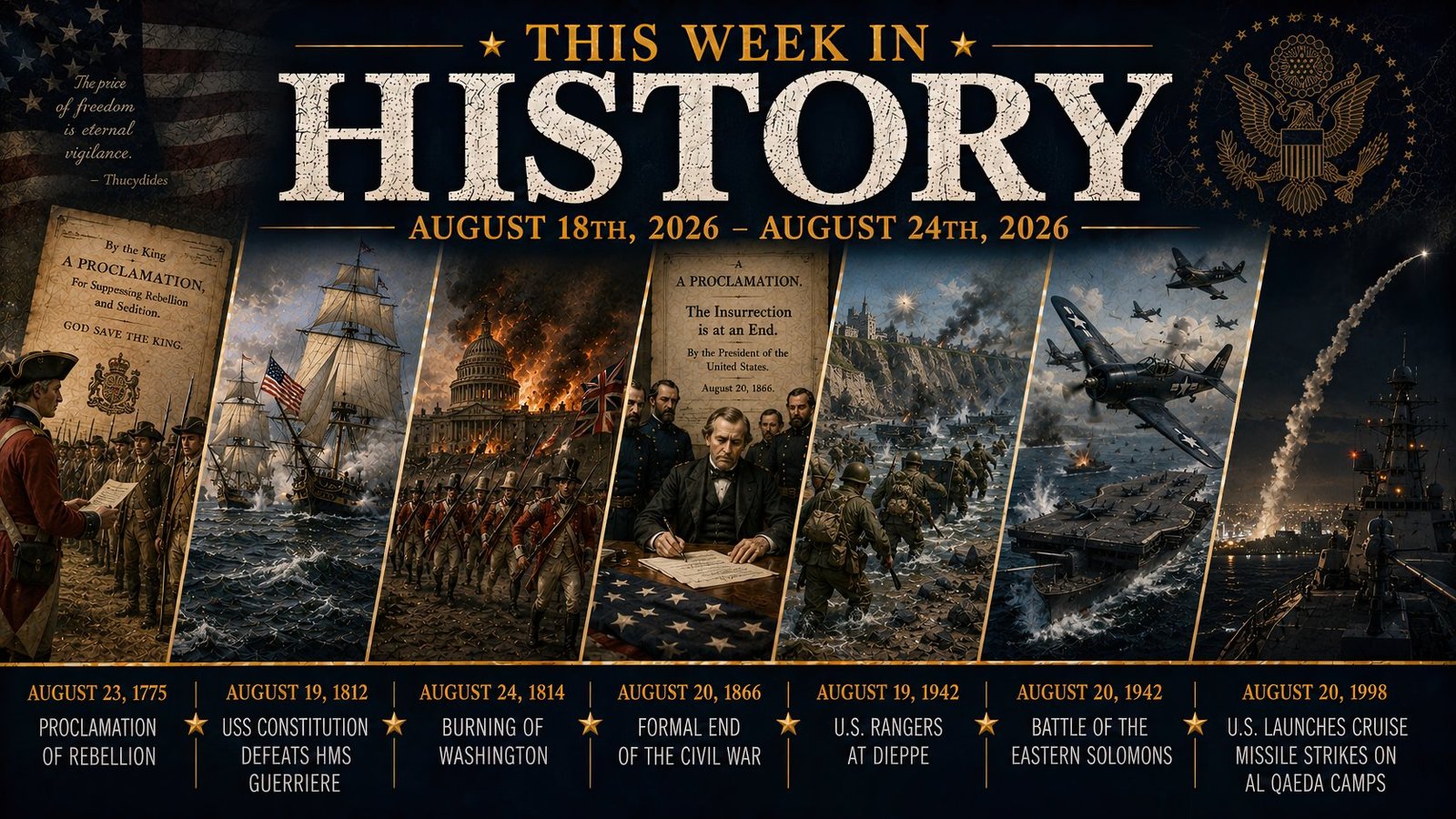
From August 18th, 2026 through August 24th, 2026, the calendar brings us back to moments when American arms, policy, and geography all shifted in important ways. Across these seven days we see colonies branded as rebels, a young republic’s capital set ablaze, and a hard-fought civil conflict finally declared at an end. We watch wooden-hulled frigates and steel warships fight for command of the sea, Marines digging in on a jungle island, and carrier pilots dueling for the fate of a distant airstrip. We also see how a distant archipelago became the nation’s fiftieth state and how, decades later, cruise missiles traced arcs across continents in response to terrorism. Each event belongs to its own war or era, yet together they trace a line of adaptation, hard lessons, and resolve. This week’s “This Week in U.S. Military History” for Dispatch: U.S. Military History Magazine highlights a handful of those turning points and what they meant for the United States and its armed forces.
Proclamation of Rebellion
In the summer of the Revolutionary crisis, King George III issued a formal proclamation declaring that the American colonies were in open and avowed rebellion. From London’s point of view, this order framed the fighting around Boston and the other flashpoints not as a political dispute but as treason to be suppressed. For colonial leaders who had still hoped for compromise within the empire, the document made clear that the Crown now saw them as enemies, not petitioning subjects. The proclamation helped push more Americans toward the idea that independence was the only viable path, because it signaled that reconciliation would come, if at all, only on British terms. For the Continental Army gathering around Boston, it meant facing not just local garrisons but the full weight of British military power. In the years since, historians have seen this week as one of the moments when a rebellion truly began turning into a revolution.
Open the Wiki entryUSS Constitution defeats HMS Guerriere
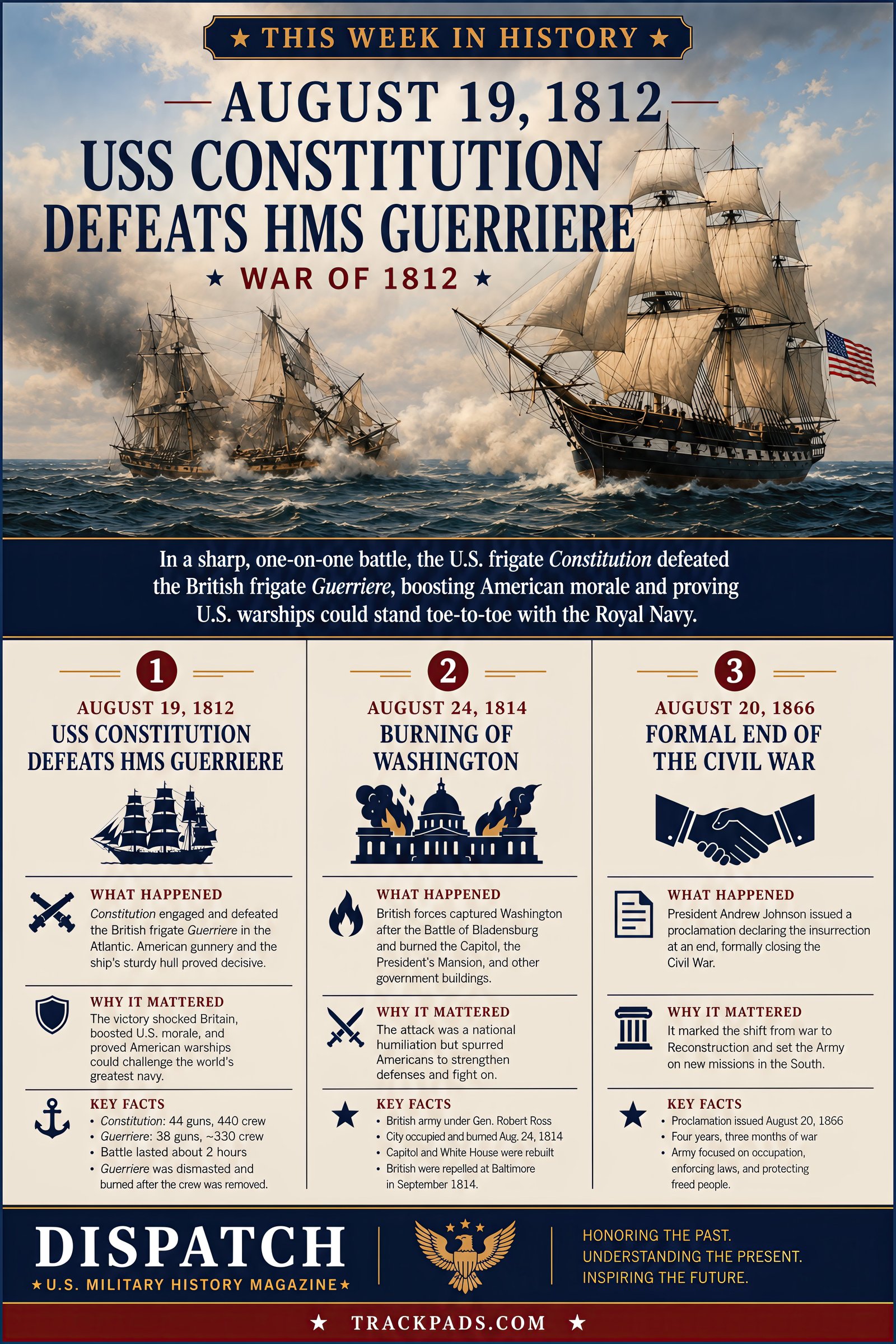
Early in the War of 1812, the United States Navy frigate Constitution intercepted the British frigate Guerriere in the Atlantic and accepted battle. In a sharp engagement marked by heavy gunnery and aggressive maneuvering, Constitution’s solid hull shrugged off many British round shot, giving rise to the famous nickname “Old Ironsides.” American broadsides dismasted Guerriere and left her so badly damaged that she had to be burned after the crew was removed. At a time when the Royal Navy was widely viewed as nearly unbeatable, this victory astonished observers on both sides of the ocean. For the young republic, the fight was a badly needed morale boost that suggested skillful crews and sturdy frigates could trade blows with the empire’s finest ships. It also encouraged Congress and the Navy Department to keep investing in blue-water warships, shaping the service’s identity long after this particular duel faded from living memory.
Open the Wiki entryBurning of Washington
Two years later, during the same war, British forces marched on Washington after defeating American troops at the Battle of Bladensburg. Poorly coordinated regulars and militia units could not stop the advance, and the road to the capital lay open. British troops entered the city and set fire to key government buildings, including the Capitol and the President’s Mansion, while many civilians fled or watched helplessly. The image of the nation’s capital in flames was a severe humiliation and exposed how thin America’s defenses could be when political quarrels and underprepared forces met experienced enemy troops. Yet the disaster also provoked a surge of determination to strengthen coastal fortifications, reorganize forces, and defend Baltimore more effectively in the weeks that followed. The burning of Washington during this August week has remained a stark reminder of the costs of neglecting readiness and the vulnerability of symbols when war reaches home.
Open the Wiki entryFormal end of the Civil War
More than half a century later, another presidency faced the task of closing a different conflict. On August 20th, 1866, President Andrew Johnson issued a formal proclamation declaring that the insurrection in the former Confederate states was at an end, effectively marking the official conclusion of the Civil War. The great campaigns and bloody battles were already over, but this act drew a legal line under four years of rebellion and set the context for Reconstruction. For the United States Army, the proclamation did not mean a return to peacetime routines so much as a new mission: occupation duties, protection of freed people, and enforcement of new federal laws in the South. Units that had once marched across battlefields now guarded courthouses, supervised elections, and tried to keep fragile peace. This date reminds us that wars do not end the moment the guns fall silent; they also end in paperwork, policy, and long, contested transitions.
Open the Wiki entryU.S. Rangers at Dieppe
During the Second World War, Allied planners launched a raid on the German-held French port of Dieppe to test defenses and gather experience in amphibious operations. Among the mostly Canadian and British troops who went ashore that August morning were several dozen members of the newly formed United States Army Rangers, making their first combat appearance in Europe. The raid unfolded under heavy German fire, with strong coastal batteries and well-sited machine guns inflicting severe casualties and preventing the attackers from holding the town. For the American Rangers, the day was a baptism of fire that underscored both their courage and the risks of attacking a defended port head-on. Although the operation failed to hold its objectives and cost many lives, the hard lessons about suppressing enemy defenses, timing air support, and planning withdrawals informed later landings in North Africa, Sicily, and Normandy. Dieppe’s grim outcome thus fed directly into the eventual success of much larger Allied invasions.
Open the Wiki entryBattle of the Tenaru on Guadalcanal
That same global war saw another crucial August fight half a world away on the island of Guadalcanal. United States Marines of the 1st Marine Division had seized a vital airstrip earlier in the month and were entrenching around it when a Japanese force under Colonel Kiyonao Ichiki was ordered to sweep them away. In the night of August 21st, 1942, Ichiki’s troops launched a frontal assault across the sandbar and shallow waters near the Tenaru, sometimes called Alligator Creek, driving directly into prepared Marine positions. The attackers showed fierce determination, but machine guns, artillery, and rifles cut them down in large numbers, and counterattacks at dawn broke the surviving pockets. Nearly the entire Japanese detachment was destroyed, marking a sharp shift from earlier enemy successes in the Pacific. For the Marines, Tenaru demonstrated that disciplined firepower and dug-in defenses could blunt the vaunted night attacks they had been warned about. It also showed both sides that the struggle for Guadalcanal would not be decided quickly or cheaply.
Open the Wiki entryBattle of the Eastern Solomons
Just three days later, another phase of the Guadalcanal campaign played out at sea. In the Battle of the Eastern Solomons, American carriers, including Enterprise and Saratoga, maneuvered against a Japanese task force seeking to reinforce and resupply their troops on the island. Aviators from both sides flew long-range searches and strikes in a complex pattern of blows and counterblows over the open ocean. United States aircraft managed to locate and sink the light carrier Ryūjō and damage other ships, while Japanese planes inflicted serious hits on Enterprise but failed to cripple the American carrier force. The result was a tactical American advantage that kept the sea lanes to Guadalcanal more secure and disrupted Japanese efforts to build up their position. In the broader Pacific war, Eastern Solomons marked another step in the shift from battleship-centered fleets to airpower deciding campaigns. It also underscored how closely the Marines on the island depended on sailors and aircrews far over the horizon.
Open the Wiki entryHawaii becomes the 50th state
After years as a United States territory and a key overseas outpost, Hawaii formally entered the Union as the fiftieth state on August 21st, 1959. Long before that date, the islands had already become central to American strategy in the Pacific, from the attack on Pearl Harbor to the vast network of airfields and naval bases that supported World War II operations. Statehood did not create those installations, but it bound them more tightly into the constitutional and political framework of the country they served. For the Army, Navy, Marine Corps, and later the Air Force and Space Force, Hawaii’s new status helped solidify long-term basing, families’ lives, and infrastructure planning. It also meant that citizens living at this strategic crossroads were fully represented in the government sending their sons and daughters to war. The week’s anniversary reminds us that geography, politics, and military posture are deeply intertwined.
Open the Wiki entryOperation Starlite begins
During the early buildup of American ground forces in Vietnam, United States Marines launched Operation Starlite, the first regimental-size offensive undertaken by American units in that war. Intelligence suggested a large Viet Cong force was preparing to strike the Marine base at Chu Lai, so commanders chose to attack first. On August 18th, 1965, Marines moved in by helicopter, amphibious landing craft, and overland routes to encircle enemy positions near the coast. Over the next several days, they fought a series of sharp engagements in villages, rice paddies, and scrub-covered hills, facing mortar fire, small-arms fire, and determined resistance. The operation inflicted heavy losses on the enemy unit and disrupted its plans, while also revealing the complexities of coordinating aviation, armor, and infantry in a landscape crisscrossed by dikes and hamlets. Starlite became both a celebrated early success and a preview of the demanding, attritional fighting that would characterize many later operations in Vietnam.
Open the Wiki entryOperation Infinite Reach
At the close of the twentieth century, another August date saw the United States respond to terrorist attacks with long-range strikes. Following the bombings of American embassies in East Africa, United States forces launched Operation Infinite Reach, firing cruise missiles at suspected terrorist training camps in Afghanistan and a facility in Sudan believed to be tied to chemical weapons. The missiles traveled vast distances from ships and submarines to hit their programmed coordinates, demonstrating how modern technology allowed Washington to project military power rapidly and with relatively small forces at risk. The strikes aimed to disrupt networks that had used distant, ungoverned spaces as safe havens, signaling that such sanctuaries could be targeted even without large ground deployments. At the same time, questions about intelligence, target selection, and long-term effectiveness followed in the operation’s wake. This week’s anniversary marks one of the moments when counterterrorism, precision weapons, and public expectations of quick response all came together in a single set of decisions.
Open the Wiki entryAcross the Week
Across the span from rebellious colonies to cruise missiles arcing across continents, the events that fall between August 18th and August 24th highlight how American power is exercised and tested in many forms. Wooden frigates, jungle foxholes, carrier decks, statehood proclamations, and distant strike orders all appear in this week’s story, each shaped by leaders making choices under pressure. These anniversaries show a military that must learn from failure as well as from success, whether in the burning of a capital, a bloody raid, or a hard-won stand on a Pacific island. They also remind us that legal declarations and political decisions can be as consequential as battlefield maneuvers. As we look back from our own moment, the thread running through this week is the enduring link between those who serve, the nation they protect, and the choices made in its name.