From August 25th, 2026 through August 31st, 2026, the calendar links moments that stretch from the Revolutionary War to the close of America’s longest conflict. Across these seven days, American forces have fought to hold ground on distant ridges, endured shock on the frontier, and adapted to new technologies that reshaped global strategy. Some of the events marked this week were clear-cut battles, with lines of infantry and artillery hammering at each other. Others unfolded in command posts, laboratories, and airfields, where decisions and tests quietly altered the balance of power. A few came in the form of disaster and sacrifice, where the cost fell heavily on individual service members and their families. Together they remind us that United States military history is not a straight line, but a long series of crises, experiments, and recoveries carried by people in uniform and those around them.
Battle of Long Island
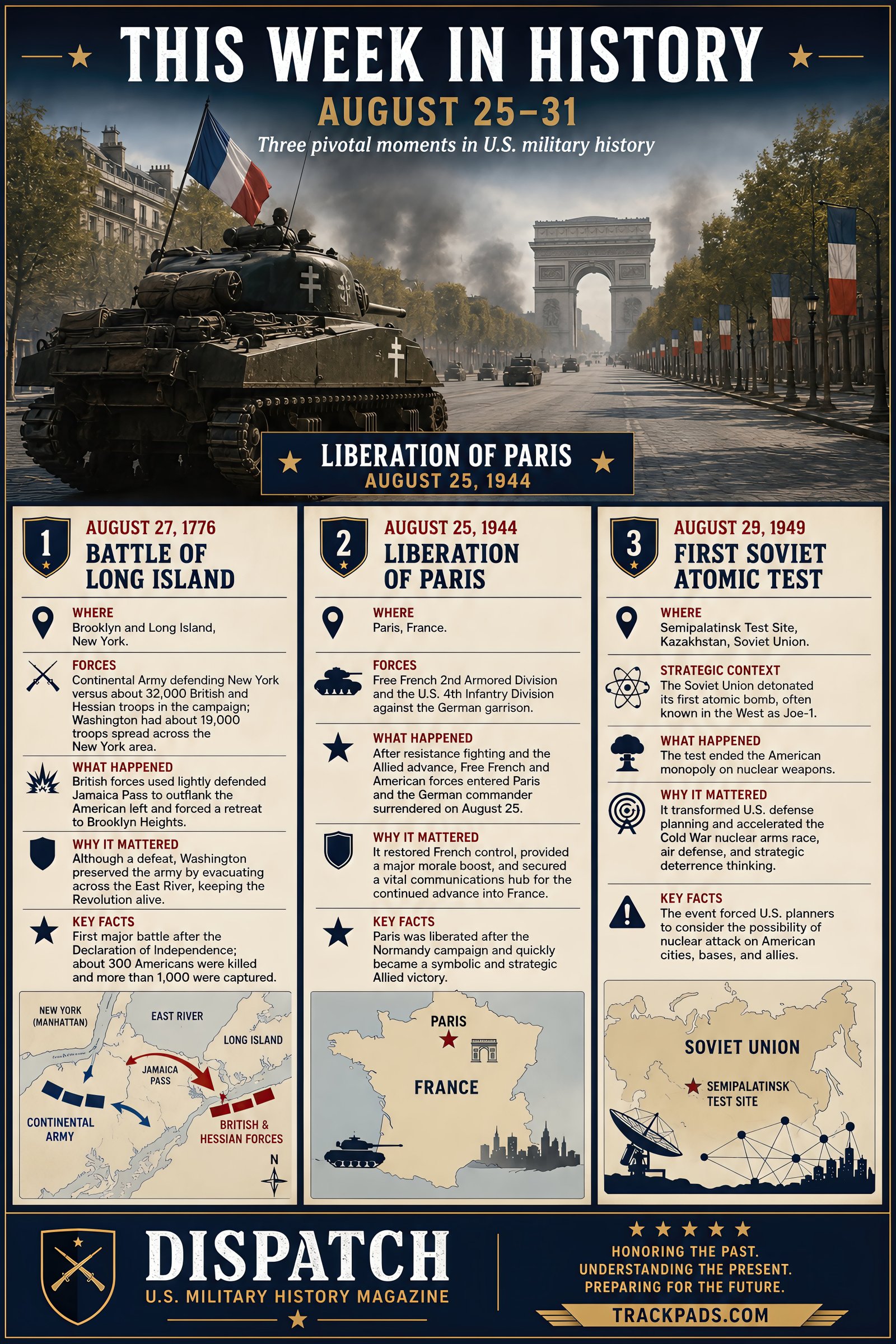
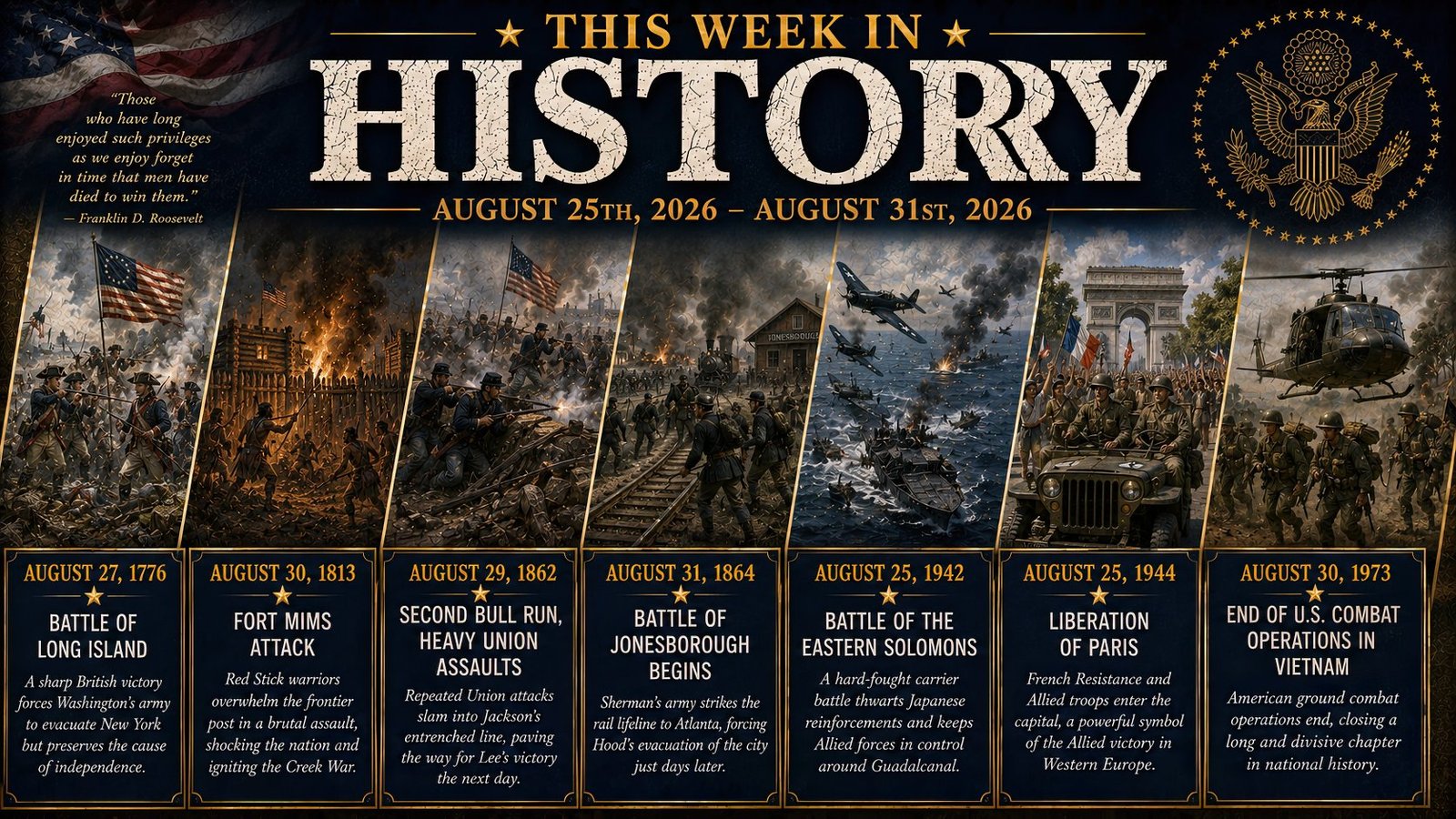
On August 27th, 1776, British forces struck the Continental Army positions on the heights and fields around Brooklyn in the first major battle after the Declaration of Independence. British commanders aimed to crush the rebellion quickly by seizing New York and its superb harbor. Using a night march through lightly guarded roads, they outflanked the American lines and slammed into Patriot units from an unexpected direction, turning the fight into a desperate retreat. Contingents like the Maryland troops who later became known for their stand near the Old Stone House fought stubbornly to buy time for others. The battle was a painful defeat, but George Washington’s subsequent evacuation of his army across the East River preserved the force that would continue the war. The day’s fighting showed that survival and endurance, not quick victories, would keep the American cause alive.
Open the Wiki entryFort Mims attack
On August 30th, 1813, in the pine woods of the Mississippi Territory, Red Stick Creek warriors tore into the poorly prepared post at Fort Mims. The frontier stockade was crammed with militia, mixed families, enslaved people, and allied Native Americans who had taken refuge from rising tensions. Warnings about nearby warriors had been discounted, and the fort’s gate reportedly stood open as the attackers surged forward. The defenders were overwhelmed in brutal close combat, and the loss of life was staggering for such a remote outpost. News of the disaster raced across the southern states, shocking citizens already on edge during the wider War of 1812. In response, American leaders mobilized larger militia and regular forces, setting in motion the Creek War campaign that would reshape control of the southeastern frontier.
Open the Wiki entrySecond Bull Run, heavy Union assaults
On August 29th, 1862, Union forces under Major General John Pope hurled repeated attacks against Confederate positions near an unfinished railroad grade outside Manassas, Virginia. Convinced he was facing a retreating enemy, Pope believed he could smash Thomas “Stonewall” Jackson’s wing before the rest of Robert E. Lee’s army arrived. Instead, Jackson’s veterans were dug in, using the cuts and embankments of the half-built railroad as ready-made breastworks. Federal brigades charged again and again through fields and woods, suffering heavy casualties as musketry and artillery tore the ranks. To the south, James Longstreet’s divisions were arriving and deploying for a massive counterblow that would fall the next day. The punishing struggle on August 29th helped set the stage for a major Confederate victory, opening the door to Lee’s first invasion of the North and deepening Union war weariness in the summer of eighteen sixty two.
Open the Wiki entryBattle of Jonesborough begins
On August 31st, 1864, after months of maneuver and fighting around Atlanta, William Tecumseh Sherman turned his army’s weight against the rail junction at Jonesborough. The Macon and Western Railroad passing through that town was the last major line feeding Confederate forces in Atlanta with supplies and reinforcements. Union corps swung south and east, smashing into Confederate defenders along fields, woods, and muddy roads as they tried to cut the tracks. The fighting was fierce and costly on both sides, but the pressure on the railroad line could not be ignored. Within days the loss of Jonesborough’s rail connection forced Confederate General John Bell Hood to evacuate Atlanta, giving the Union a long-sought victory. The fall of the city in early September transformed Northern morale and helped secure Abraham Lincoln’s political position at a critical moment in the Civil War.
Open the Wiki entryBattle of the Eastern Solomons
By August 25th, 1942, a swirling carrier battle northeast of Guadalcanal was drawing to a close, with American and Japanese naval air groups bloodied but still dangerous. The Battle of the Eastern Solomons grew out of Japan’s attempt to reinforce its troops and challenge the newly established American lodgment on the island. American codebreakers and patrols helped warn United States commanders that a major thrust was coming, and aircraft from carriers like Enterprise and Saratoga went in to meet it. After waves of strikes and counterstrikes, Japanese forces lost a light carrier and several other valuable ships and aircraft, while the Americans suffered serious damage but kept their carriers afloat. Most importantly, Japan’s effort to push strong reinforcements onto Guadalcanal was disrupted, leaving the Marines and sailors ashore still contested but not overwhelmed. The outcome reinforced that carrier battles and airpower would decide the campaign for the Solomons.
Open the Wiki entryLiberation of Paris
On August 25th, 1944, the long-occupied French capital erupted in celebration as Free French armored columns and American infantry rolled into Paris. Days of street fighting and an uprising by the French Resistance had weakened the German garrison, but it still possessed the firepower to devastate the city. Instead of obeying scorched-earth orders, the German commander chose to surrender, and soldiers of the French Second Armored Division and the United States Fourth Infantry Division accepted the capitulation. For Allied troops who had fought through the Normandy hedgerows and across the open country of France, entering the city symbolized how far they had come since the landings in June. The liberation of Paris also eased political tensions within the Allied coalition by restoring a French government on French soil. Strategically, it secured a vital communications hub as the drive toward the German border accelerated.
Open the Wiki entryMacArthur arrives in Japan
On August 30th, 1945, General Douglas MacArthur stepped off an aircraft at Atsugi Airfield near Tokyo as the designated Supreme Commander for the Allied occupation of Japan. American paratroopers had already landed to secure the area, their presence marking a dramatic change from the bitter island-by-island fighting of the previous years. MacArthur’s arrival signaled that the Pacific war’s brutal combat phase was ending and a complex period of military government and reconstruction was beginning. United States forces would soon oversee the disarmament of Japanese units, the repatriation of prisoners, and wide-ranging political and economic reforms. The occupation that followed reshaped Japan into a key partner in the emerging postwar order, and the American military presence in the Western Pacific became a central pillar of regional security. That moment on the tarmac in late August captured the transition from victory in battle to stewardship of the peace.
Open the Wiki entryFirst Soviet atomic test
On August 29th, 1949, far away on the Eurasian steppe, the Soviet Union detonated its first atomic device, abruptly ending the American monopoly on nuclear weapons. For the United States military, the confirmation that another power had crossed the nuclear threshold was a strategic shock. Nuclear planning could no longer assume that only American aircraft might deliver such weapons; instead, commanders had to consider the possibility of attacks on American cities, bases, and allies. The United States Air Force expanded bomber and reconnaissance forces and gave new urgency to the creation of early warning systems and air defense networks. Within a few years, both countries were pursuing even more destructive thermonuclear weapons, and nuclear strategy became a central concern of American war planning. The test underscored how scientific breakthroughs in a single week could alter the long-term trajectory of national defense.
Open the Wiki entryCrisis along the Pusan Perimeter
By August 31st, 1950, United States and South Korean troops clung to a shrinking defensive line around the port of Pusan, the last major foothold on the Korean Peninsula. That night, North Korean forces launched a renewed offensive, striking hard along the Naktong River and probing for gaps in the perimeter. American divisions, some newly arrived and still adjusting to the terrain and climate, scrambled to plug penetrations with artillery, tanks, and hastily assembled reserve companies. The fighting was close, confused, and often conducted in darkness, with units falling back to new positions and then counterattacking. Holding the Pusan Perimeter through this crisis bought time for planners to prepare the bold amphibious landing at Inchon that would soon change the war’s momentum. The stand in late August showed how fragile and yet how vital a perimeter defense could be in the early Cold War.
Open the Wiki entryKabul airport Abbey Gate bombing
On August 26th, 2021, as crowds of desperate Afghans pressed toward Kabul’s Hamid Karzai International Airport, a suicide bomber struck near Abbey Gate. American Marines, soldiers, and a Navy corpsman were working shoulder to shoulder with allied troops, trying to screen evacuees while guarding against threats. The explosion ripped through the dense throng, killing thirteen American service members and many Afghan men, women, and children. In the chaos that followed, troops rendered aid, organized evacuations of the wounded, and maintained security even as they mourned fallen comrades. For many in the American military community, the attack became one of the most searing memories of the Afghanistan withdrawal and a stark reminder of the risks carried until the final hours of a long war.
Open the Wiki entryFinal American flight leaves Kabul
On August 30th, 2021, the last American military transport lifted off from Kabul’s runway, ending nearly twenty years of continuous American combat operations in Afghanistan. The C–17 aircraft carried the final contingent of troops who had secured the airport during the intense evacuation of the preceding weeks. Behind them lay equipment destroyed or disabled, runways scarred by use, and countless Afghans who had worked alongside American units but could not be evacuated in time. The takeoff marked the formal close of a war that had begun in the aftermath of the attacks of September 11th, 2001, and had carried multiple generations of service members through repeated tours. Strategically, it raised hard questions about future counterterrorism posture, alliances, and the human cost of extended campaigns. The date now stands as a boundary between one long era of deployments and whatever comes next for American forces.
Open the Wiki entryAcross the Week
Across these seven days on the calendar, we see how American military history ranges from line infantry standing in smoky fields to pilots circling over blue Pacific waters, from frontier forts to nuclear laboratories, and from Korean hillsides to airport gates in Kabul. Each event reflects people under pressure making choices with incomplete information, carrying out orders, or improvising in the moment. Their actions shaped the survival of armies, the map of cities and countries, and the safety of families half a world away. The span from August 25th, 2026 through August 31st, 2026 invites us to reflect on continuity more than change: the enduring weight of responsibility borne by those in uniform. As we mark anniversaries this week, we can honor that service by remembering not just the victories but also the costs and the complicated endings that follow war.