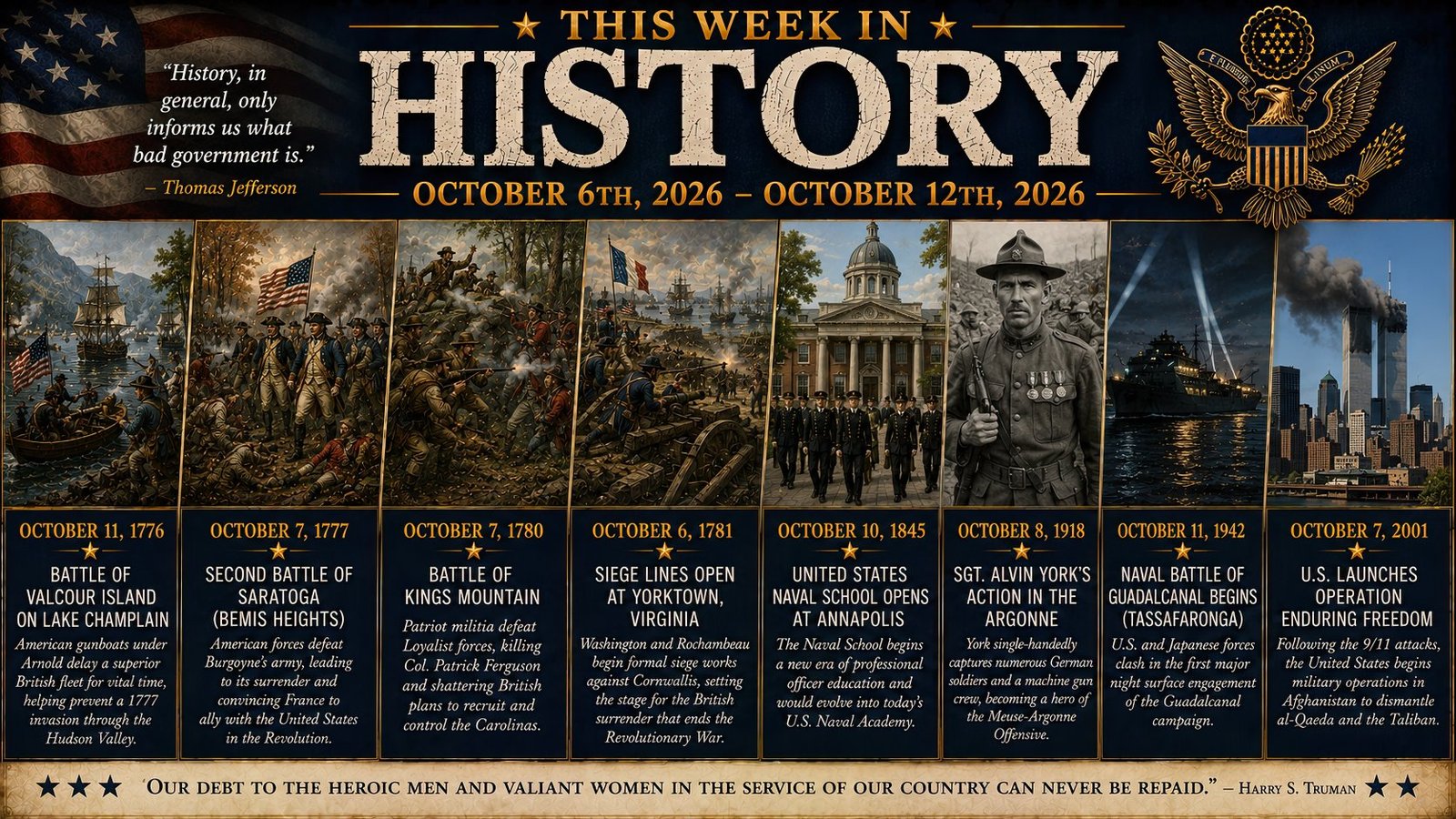
From October 6th, 2026 through October 12th, 2026, the calendar links us to moments when American sailors, soldiers, airmen, and Marines faced decisions that reshaped both campaigns and institutions. Across these seven days we see small wooden gunboats fighting towering fleets, frontier militiamen turning a war in the backcountry, and city streets and harbors far from home suddenly becoming front lines. Some of these dates belong to intense combat, others to quieter but still decisive acts like founding schools, signing treaties, or authorizing future conflicts. Together they trace how a group of revolutionaries’ forces evolved into a professional military and then into a global power wrestling with nuclear danger and terrorism. This week’s edition of “This Week in U.S. Military History” walks that arc, highlighting a handful of battles, reforms, and shocks that still echo for today’s service members and veterans.
Battle of Valcour Island on Lake Champlain
On a cold October morning, a makeshift American flotilla under Benedict Arnold waited behind Valcour Island on Lake Champlain for a much larger British squadron sailing south from Canada. The American vessels were hastily built and poorly armed, yet their commanders understood that time was as valuable as any broadside. By forcing the British to fight their way past this screen, the lake squadron turned a likely quick advance into a bruising, day-long engagement among islands, shoals, and shifting winds. Although most of the American ships were lost or scuttled, the action delayed the British campaign until winter closed the northern corridor. That precious pause helped prevent a coordinated British drive down the Hudson the following year and set the stage for the more famous victory at Saratoga.
Open the Wiki entrySecond Battle of Saratoga (Bemis Heights)
One year after Valcour Island, American forces under General Horatio Gates and field leaders like Benedict Arnold clashed with General John Burgoyne’s army near Bemis Heights, south of Saratoga. The British had pushed down from Canada intending to cut New England off from the rest of the rebellious colonies, but they were exhausted, short on supplies, and hemmed in by determined American troops. On October 7th, aggressive American counterattacks smashed British attempts to break out, overrunning key positions and capturing artillery. Within days Burgoyne accepted that further resistance was futile and agreed to surrender his army. The victory at Saratoga convinced France that the American cause could succeed, leading to open alliance and military support that transformed the Revolutionary War into a global conflict.
Open the Wiki entryBattle of Kings Mountain
Three years later and hundreds of miles to the south, another October 7th saw frontier riflemen climbing a steep Carolina ridge toward Loyalist breastworks on Kings Mountain. British strategy in the southern colonies depended heavily on raising Loyalist units to hold territory while regular regiments maneuvered elsewhere. At Kings Mountain, however, Loyalist Colonel Patrick Ferguson’s force found itself surrounded by patriot militia who knew the backcountry terrain and fought from tree to tree. The Americans attacked from all sides in waves, falling back when charged with bayonets and then returning to the assault. The Loyalist line collapsed under the pressure, Ferguson was killed, and his command surrendered. The defeat crippled British recruitment in the region and helped unravel their southern strategy, opening space for later victories such as Cowpens and leading toward Yorktown.
Open the Wiki entrySiege lines open at Yorktown, Virginia
As autumn settled over Virginia in 1781, combined American and French armies under George Washington and the Comte de Rochambeau began the methodical work of besieging Lord Cornwallis at Yorktown. On October 6th, allied troops dug the first formal siege parallels, a line of trenches and artillery positions that crept closer to British defenses each night. This kind of siege warfare demanded patient labor under fire, with soldiers and engineers reshaping the landscape by hand. The new lines allowed batteries to be emplaced that would soon dominate the town and its harbor. Once these positions were completed and reinforced, Cornwallis’s options narrowed from bad to worse. Within weeks, the relentless pressure forced his surrender, effectively ending major combat in the Revolutionary War and securing American independence.
Open the Wiki entryUnited States Naval School opens at Annapolis
Not every turning point comes with smoke and cannon fire. On October 10th, 1845, the United States Naval School opened at Annapolis, Maryland, beginning a new era of professional officer education. Before this date, most naval learning occurred informally at sea, passed from senior to junior officers on the quarterdeck and in cramped wardrooms. The establishment of a shore-based school meant that midshipmen could study mathematics, navigation, gunnery, and emerging sciences in a structured environment before assuming full responsibilities afloat. Over time the Naval School evolved into the United States Naval Academy, an institution that shaped generations of officers for sailing ships, battleships, aircraft carriers, and nuclear submarines alike. This shift from apprenticeship to formal schooling reflected a broader transformation toward a modern, technically adept naval service.
Open the Wiki entrySergeant Alvin York’s action in the Argonne
In the closing weeks of the First World War, American units were grinding forward in the Meuse-Argonne offensive against deeply entrenched German defenses. On October 8th, 1918, a small American patrol led by Corporal, later Sergeant, Alvin York found itself under heavy machine-gun fire after stumbling into a German position. With many of his comrades killed or wounded, York used his marksmanship and hunting experience from Tennessee’s hills to pick off the nearest gunners while dodging return fire. Accounts from the time describe him closing with the enemy, capturing prisoners, and silencing additional guns that threatened his battalion’s advance. By the end of the fight, York’s actions had neutralized a significant pocket of resistance and brought in a large group of prisoners. His Medal of Honor later made him one of the war’s most famous American soldiers, symbolizing individual courage amid industrial-scale battle.
Open the Wiki entryBattle of Cape Esperance off Guadalcanal
Two decades later, another critical October engagement unfolded at night near Cape Esperance, off the embattled island of Guadalcanal. The United States Navy had already suffered painful defeats in earlier night battles where Japanese crews excelled at torpedo attacks in darkness. On the night of October 11th, 1942, however, American cruisers and destroyers used radar to detect an approaching Japanese force attempting to reinforce their troops on the island. In the confused, close-range fighting that followed, American gunners scored telling hits that sank or damaged several Japanese ships, though not without losses of their own. The battle did not solve all the Navy’s problems in the Solomons, but it proved that radar-directed fire and improved tactics could blunt Japanese night advantages. That lesson would pay dividends in later engagements and helped sustain the hard-fought hold on Guadalcanal.
Open the Wiki entryUnited Nations forces cross the thirty-eighth parallel
Five years after the Second World War, the Korean Peninsula had become the center of a new conflict. United Nations forces, heavily led and supplied by the United States, had fought their way out of the Pusan Perimeter and executed the daring landing at Inchon. On October 7th, 1950, these forces crossed the thirty-eighth parallel, the prewar dividing line between North and South Korea. The move transformed a desperate defensive campaign into an offensive push aimed at unifying the peninsula under one government. At the time, many leaders believed victory was within reach, but advancing toward the Yalu River soon brought Chinese intervention and a far bloodier stalemate. The decision to cross the parallel remains a central moment in Korean War history and in debates over limited war and escalation.
Open the Wiki entryLimited Nuclear Test Ban Treaty enters into force
In the shadow of the Cuban Missile Crisis, another October date marked a different kind of strategic turning point. On October 10th, 1963, the Limited Nuclear Test Ban Treaty entered into force, prohibiting nuclear weapons tests in the atmosphere, outer space, and underwater. Though underground testing continued, this agreement reduced radioactive fallout that had affected civilians and service members alike during earlier test series. For the United States military, the treaty signaled a recognition that nuclear weapons had environmental and political costs beyond their deterrent value. It also showed that even bitter Cold War adversaries could find narrow areas of cooperation when mutual interests aligned. While modest compared to later arms control efforts, the treaty helped shape a world where nuclear competition had to be balanced with public health and global opinion.
Open the Wiki entryBombing of USS Cole in Aden Harbor
At the dawn of a new century, American forces operating far from home faced a different kind of threat. On October 12th, 2000, the destroyer USS Cole paused in Aden Harbor, Yemen, for refueling while en route to the Persian Gulf. As the crew went about routine tasks, a small boat packed with explosives pulled alongside and detonated against the ship’s hull. The blast tore a massive hole near the waterline, killing seventeen sailors and injuring many more, while damage control teams fought to save the ship from sinking. The attack shocked the Navy and the wider American public, underscoring how relatively simple tactics could inflict heavy casualties on sophisticated warships. In hindsight, the bombing is often seen as a grim warning of the larger struggle with transnational terrorism that was already building.
Open the Wiki entryOperation Enduring Freedom begins in Afghanistan
Less than a year after USS Cole, the attacks of September 11th, 2001 brought the war on terror fully into view. On October 7th, 2001, the United States and partners launched Operation Enduring Freedom with air and missile strikes against Al Qaeda training camps and Taliban military targets in Afghanistan. Navy ships, Air Force bombers, and allied aircraft delivered precision and conventional munitions while special operations forces prepared to link up with local resistance groups on the ground. The opening bombardment quickly degraded fixed targets and command centers, enabling rapid advances in the months that followed. At the same time, the operation marked the beginning of what would become a long, complex counterinsurgency and nation-building effort. Decisions taken in these early days shaped deployments, tactics, and burdens that would define a generation of American military service.
Open the Wiki entryAcross the Week
From wooden gunboats on northern lakes to destroyers in Middle Eastern ports, and from frontier ridgelines to the skies above Afghanistan, the events tied to this week show how American arms have constantly adapted to new challenges. Some dates on the calendar recall clear victories achieved through preparation, courage, and timely risk-taking. Others remind us of tragic surprises or choices whose consequences were far more complicated than leaders first imagined. Together they trace the long arc from a young republic fighting for survival to a global power managing alliances, technology, and new forms of conflict. As we reflect on these anniversaries between October 6th, 2026 and October 12th, 2026, we also acknowledge the service and sacrifice of those who lived them, and the continuing responsibility to learn from their experiences.