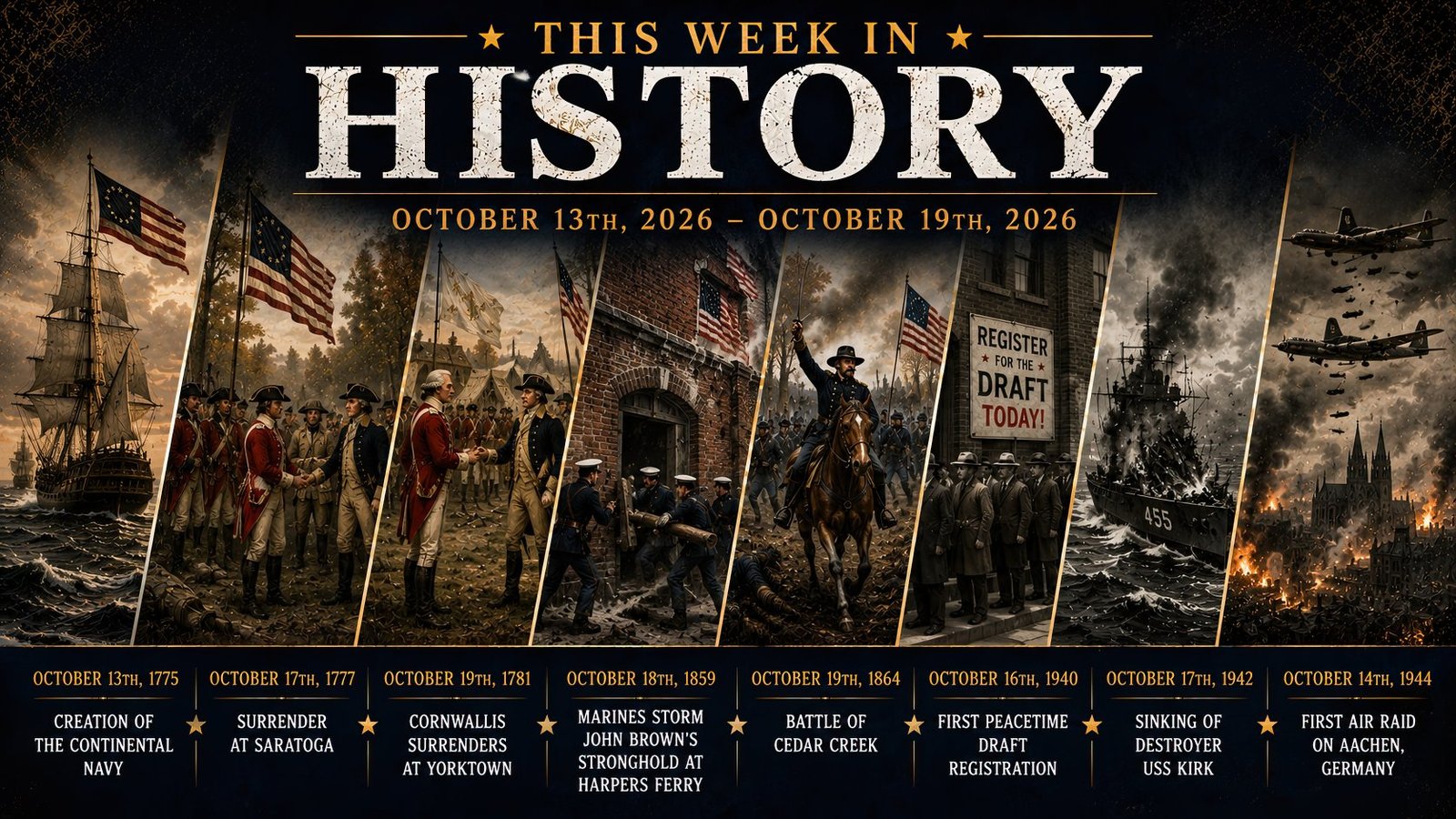
From October 13th, 2026 through October 19th, 2026, the calendar links today’s readers to moments when the United States military helped shape the course of a young republic, preserved a divided union, confronted global enemies, and managed the terrifying pressures of the nuclear age. In this week’s selection, the story begins with a handful of Continental congressmen ordering small sailing vessels into service and ends nearly two centuries later with leaders weighing how to respond to missiles aimed at American cities. Along the way we pass through surrender fields in New York and Virginia, a stone firehouse at Harpers Ferry, and a misty Shenandoah battlefield where defeat turned into victory. We also see crowded draft lines in 1940, the smashed hull of a torpedoed destroyer, and bomber crews crossing flak-filled skies over Germany. Taken together, these scenes show how decisions made in a single week of the calendar can echo for generations of service members and citizens.
Creation of the Continental Navy
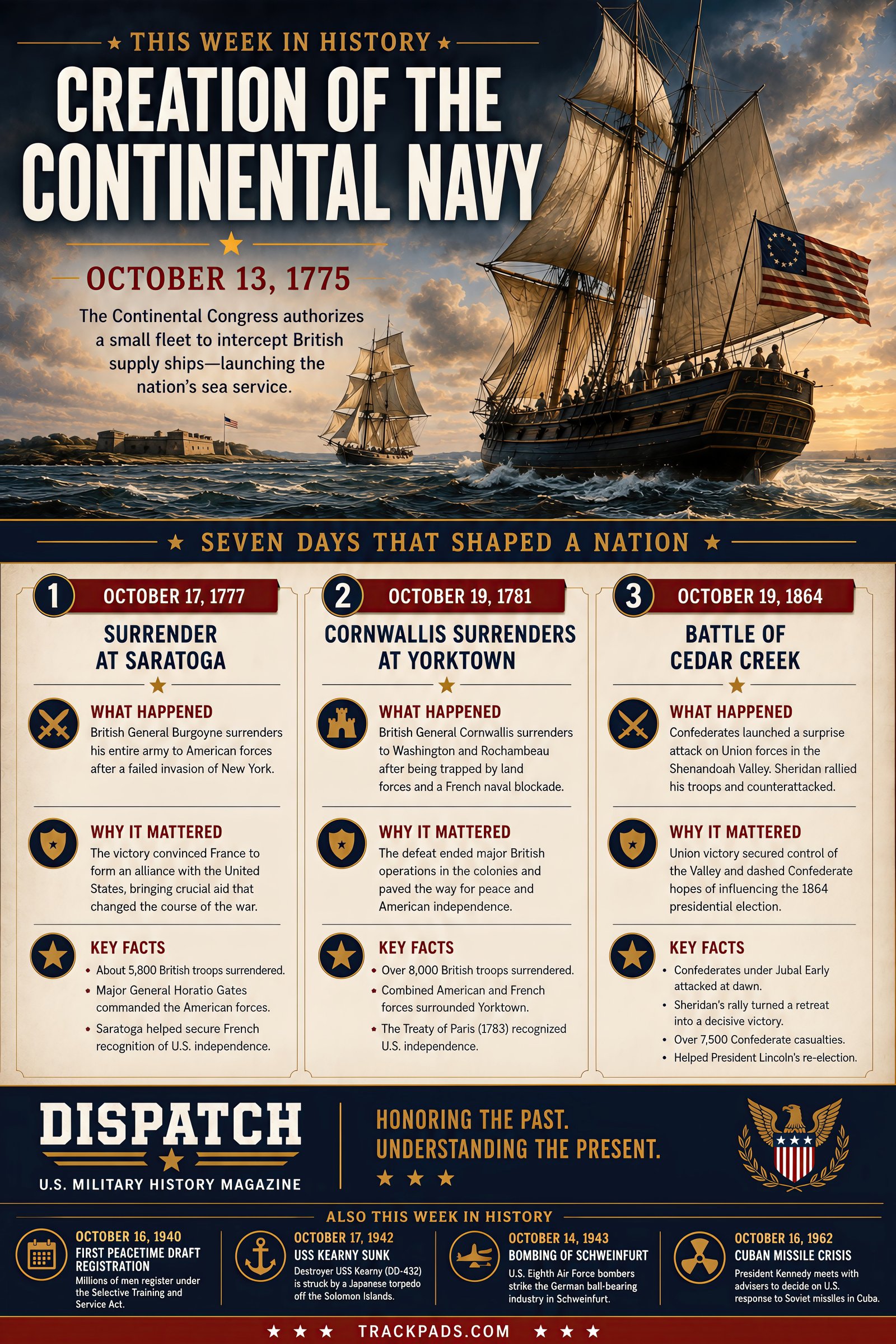
When the Continental Congress resolved on this date to outfit a small fleet to intercept British supply ships, it took a cautious but decisive step toward creating a national sea service. The colonies had relied largely on privateers and local vessels, but the war for independence demanded a more coordinated naval effort to challenge British logistics. The early Continental Navy was tiny and outmatched, yet its raids on enemy commerce helped stretch imperial resources and lifted American morale. Over time, that modest beginning grew into a permanent naval establishment after the Revolution, eventually evolving into the modern United States Navy. The anniversary reminds readers that institutions which seem permanent today often begin with improvised responses to very specific wartime needs.
Open the Wiki entrySurrender at Saratoga
On this day General John Burgoyne’s British army laid down its arms to American forces near Saratoga, New York, ending a failed campaign to cut New England off from the other colonies. Continental and militia units had fought a hard series of actions in the surrounding forests and ridges, gradually tightening the noose on the exhausted invaders. The capitulation was more than a battlefield success; it convinced the French court that the American cause had real prospects and made a formal alliance possible. French money, ships, and soldiers would soon follow, altering the balance of power across the Atlantic. For the United States military tradition, Saratoga stands as proof that disciplined campaigning, combined with patient political work, can turn a regional struggle into a broader coalition war.
Open the Wiki entryCornwallis surrenders at Yorktown
Four years later to the week, another British army marched out to surrender, this time at Yorktown, Virginia. United States and French forces had trapped General Charles Cornwallis on the Yorktown peninsula, hemming him in with siege lines on land while French warships blocked escape or relief by sea. After weeks of bombardment and failed attempts to break out, Cornwallis agreed to terms and his troops filed out to lay down their arms. Fighting would continue in outlying theaters, but Yorktown effectively broke British political will to keep investing in a costly North American war. For generations of American soldiers, sailors, and Marines, the scene at Yorktown has symbolized what joint and combined arms, carefully coordinated with allies, can achieve against a larger imperial power.
Open the Wiki entryMarines storm John Brown’s stronghold at Harpers Ferry
Before the Civil War formally began, the United States Marine Corps found itself at the center of a domestic crisis when abolitionist John Brown seized the federal armory at Harpers Ferry. After Brown and his followers were cornered in a brick engine house, a detachment of Marines under the temporary command of a United States Army officer, Robert E. Lee, was ordered to retake the facility. On October 18th, 1859, the Marines advanced with a battering ram, broke through the doors, and quickly overpowered the raiders in brutal close-quarters fighting. The assault freed remaining hostages and recovered government property, but it also sent shock waves through a nation already on edge over slavery and sectional power. In hindsight, the operation shows federal forces being used in a limited, targeted way even as the broader political dispute rushed toward full-scale civil war.
Open the Wiki entryBattle of Cedar Creek
In the Shenandoah Valley of Virginia, Union forces under General Philip Sheridan awoke on October 19th, 1864 to a surprise Confederate attack that drove many units from their camps and seemed to threaten a major defeat. As broken formations streamed north, Sheridan, who had been away from the front, famously rode back toward the sound of the guns, rallying soldiers along the road and pushing them back into line. By afternoon, reorganized Union troops counterattacked, reclaiming lost ground and smashing the Confederate army that had struck them at dawn. Cedar Creek secured Union control of the valley, undermined Confederate hopes of influencing the 1864 presidential election through dramatic battlefield success, and became a powerful story of recovery from near disaster. For today’s readers, it illustrates how leadership, cohesion, and the ability to absorb a shock can matter as much as initial plans.
Open the Wiki entryFirst peacetime draft registration
With war raging in Europe and Asia, but before the United States formally entered the conflict, the government took a historic step by registering millions of men for possible military service under a new Selective Service law. On October 16th, 1940, lines formed at schools, post offices, and other public buildings as eligible citizens filled out cards that would form the basis of the draft. The measure was controversial, yet it reflected a growing recognition that the nation might one day have to fight and would need a trained, organized force ready to expand. For the armed services, the registration became the foundation for the vast mobilization that followed Pearl Harbor, supplying the Army, Navy, Marine Corps, and Army Air Forces with the manpower needed for a global struggle. The date marks the moment when a traditionally small peacetime military began transforming into the mass force of the Second World War.
Open the Wiki entryDestroyer USS Kearny torpedoed near Iceland
Even before a formal declaration of war against Germany, the United States Navy was escorting convoys in the North Atlantic, confronting the realities of submarine warfare. On October 17th, 1941, the destroyer USS Kearny was hit by a German torpedo while responding to an attack on merchant ships near Iceland. The blast tore into the hull, killed sailors, and forced the crew into a desperate struggle to save their ship in cold, stormy seas. Kearny survived and managed to reach port, but the incident made clear to the American public that naval forces were already fighting and dying in defense of Atlantic supply lines. The attack helped harden attitudes toward Germany and foreshadowed the still more intense Battle of the Atlantic that would follow once the United States formally entered the war.
Open the Wiki entry“Black Thursday” over Schweinfurt
Strategic bombing over Europe reached a grim milestone on October 14th, 1943, when the United States Eighth Air Force sent hundreds of B-17 bombers against ball-bearing plants around Schweinfurt, Germany. The formations pressed on without long-range fighter cover for much of the route, and German defenses responded with coordinated fighter attacks and dense anti-aircraft fire. By the time the surviving aircraft limped back to English bases, losses were staggering, with many planes shot down and others so badly damaged that they barely made it home. The raid inflicted damage on German industry, but the cost forced planners to reconsider how to conduct daylight bombing without unsustainable casualties. “Black Thursday” thus became a turning point that underscored the need for better escort fighters, improved tactics, and more careful balancing of risk and effect in the air war.
Open the Wiki entryCuban Missile Crisis begins in the White House
On this date, the President was briefed on photographs taken two days earlier by a high-altitude reconnaissance flight, revealing that the Soviet Union was secretly installing medium-range nuclear missiles in Cuba. The images showed launch sites under construction within striking distance of American cities and key military bases, creating a new and urgent threat. In response, senior civilian and military leaders convened in a series of tense meetings to weigh options that ranged from air strikes and invasion to naval quarantine and diplomatic pressure. For the armed forces, the crisis meant rapid alerts, movements at sea, and preparations for the possibility of sudden escalation, all while civilian authorities sought a solution that avoided nuclear war. The decisions made in those days demonstrated how military readiness, intelligence, and restraint can operate together under extraordinary pressure, shaping a generation’s understanding of deterrence and crisis management.
Open the Wiki entryAcross the Week
In this week’s span of anniversaries, we see the United States military growing from improvised colonial forces into a global power asked to handle everything from local raids to world wars and nuclear showdowns. The founding of the Continental Navy and the twin victories at Saratoga and Yorktown highlight how fragile institutions and alliances can harden into lasting strength when leaders take calculated risks. The shock at Harpers Ferry and the hard-fought comeback at Cedar Creek show a nation wrestling with its own divisions while soldiers and Marines carry out their orders on unforgiving ground. The draft registration lines, Atlantic convoy battles, and “Black Thursday” bomb runs illustrate the scale and sacrifice demanded by industrialized war. Finally, the opening of the Cuban Missile Crisis reminds us that in the modern era, military posture is inseparable from choices about restraint and escalation. As readers look across these stories, they trace a continuous thread of service, adaptation, and responsibility that still shapes those who wear the uniform today.