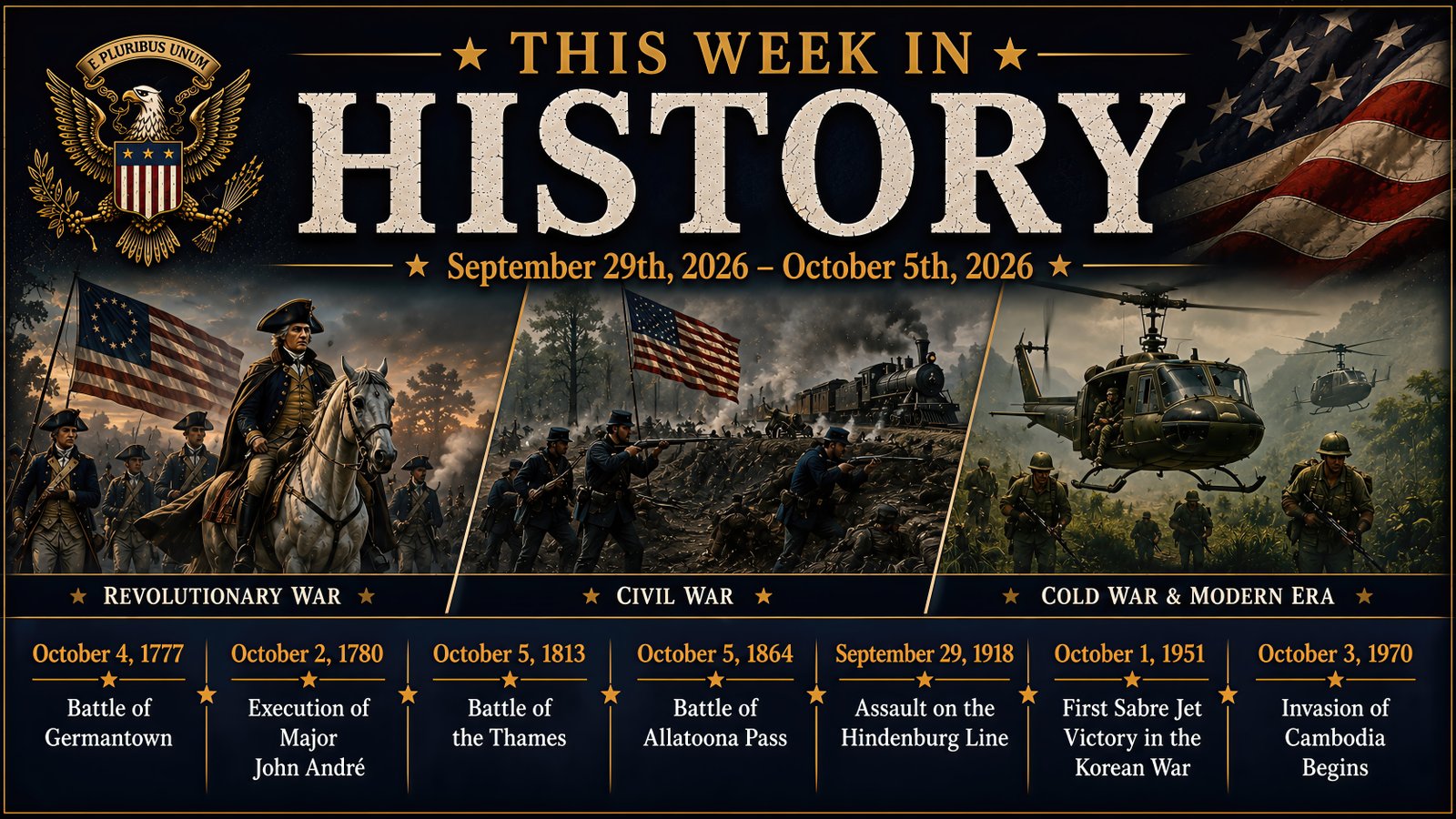
From September 29th, 2026 through October 5th, 2026, the calendar brings us back to battlefields, command posts, and city streets where American service members tested themselves in war and in uneasy peace. This edition of “This Week in U.S. Military History” traces those moments, from the fog-shrouded fields of the Revolutionary War to the helicopter-borne raids of the late twentieth century. Across these seven days we see a young republic learning to fight, a growing nation defending its frontiers, and a modern superpower adapting to nuclear deterrence, intelligence competition, and irregular warfare. Some of these events are famous, others quieter, but all of them changed how the United States fights, plans, and protects its people. Together they remind us that history is not only about final victories, but also about experiments, setbacks, and the hard lessons that shape the next generation in uniform.
Battle of Germantown
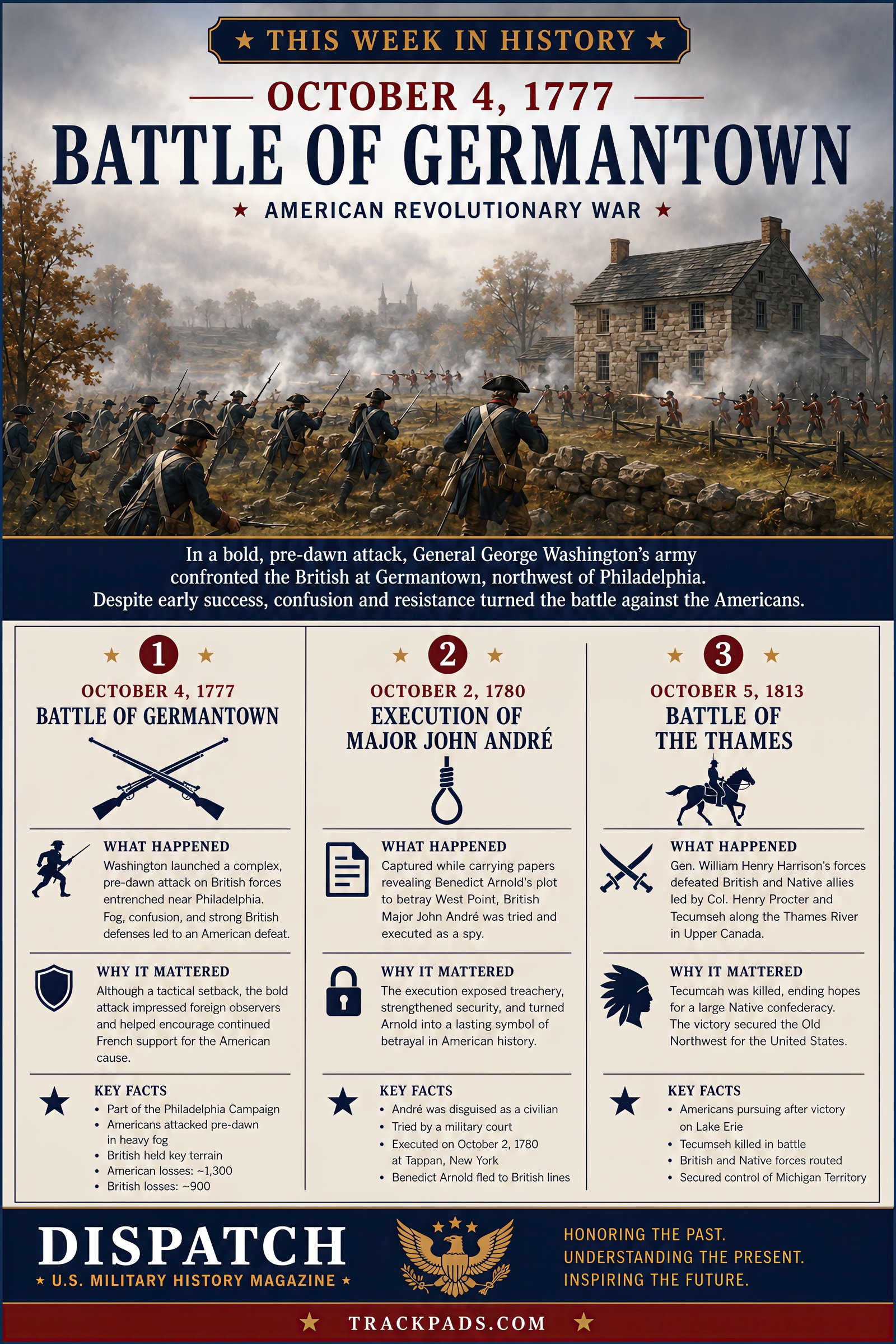
In the autumn of the Philadelphia campaign, George Washington gambled on a complex, pre-dawn attack against British forces encamped at Germantown, northwest of the occupied capital. Still bruised from defeat at Brandywine and the loss of Philadelphia, the Continental Army needed to show it could go on the offensive. Washington’s plan called for multiple converging columns advancing in darkness and heavy fog, a difficult maneuver even for seasoned professionals. Confusion, poor visibility, and a stubborn British defense around a stone house turned the battle against the Americans, and they were ultimately driven from the field. Yet the very fact that the Continental Army attacked with such energy impressed foreign observers, especially in Europe, where leaders watched for signs that the American cause remained viable. Germantown’s failure on the ground helped lay the diplomatic groundwork for deeper French support that would prove decisive later in the war.
Open the Wiki entryExecution of Major John André
Near the Hudson River, the Revolutionary War’s most famous betrayal came fully into view when British Major John André, captured behind American lines, was executed as a spy. André carried incriminating documents that exposed General Benedict Arnold’s plot to hand over the key fortress of West Point to the British. Arnold himself slipped away to British protection, but André fell into American hands disguised and out of uniform, which under the customs of the time marked him as a spy rather than a lawful prisoner of war. His court-martial and hanging at Tappan were conducted with a sense of grim duty, even as many American officers privately respected his courage. The episode shook the Continental Army, forcing commanders to reexamine security around critical positions like West Point. It also hardened patriot opinion, turning Arnold’s name into a lasting symbol of treason and reminding future generations how fragile trust and loyalty can be in wartime.
Open the Wiki entryBattle of the Thames
During the War of 1812, control of the Great Lakes and the Old Northwest hinged on both naval power and fast-moving land campaigns. After an American victory on Lake Erie forced British and Native forces to retreat from Detroit, General William Henry Harrison pursued them into Upper Canada along the Thames River. On October 5th, 1813, his troops caught the rearguard commanded by British Colonel Henry Procter, backed by a confederation of Native warriors led by the Shawnee leader Tecumseh. American mounted troops charged, breaking the British line and scattering much of the Native resistance. Tecumseh was killed in the fighting, and with his death the dream of a large Native confederacy able to resist American expansion in the region largely collapsed. The Battle of the Thames restored American control over Michigan Territory and raised Harrison’s national profile, while also marking a painful turning point in Native resistance to United States expansion in the interior.
Open the Wiki entryBattle of Allatoona Pass
In the aftermath of the fall of Atlanta during the Civil War, Confederate forces tried to strike back not by retaking the city, but by severing the Union army’s lifelines. On October 5th, 1864, Confederate Major General Samuel French attacked the Union garrison at Allatoona Pass in northern Georgia, where a fortified position guarded the Western and Atlantic Railroad that supplied General William T. Sherman’s army. Outnumbered Union soldiers under Brigadier General John Corse held a chain of earthworks and redoubts overlooking the cut through the hills. Before the fight, Sherman signaled his famous message that he was moving to support them and for them to “hold the fort,” words that later inspired a popular hymn. Despite fierce assaults and heavy casualties on both sides, the Union defenders refused to yield the position. The successful defense kept the vital rail line intact, helping Sherman sustain his army and paving the way for his later march across Georgia to the sea.
Open the Wiki entryAssault on the Hindenburg Line
As the First World War neared its end, Allied forces targeted the Hindenburg Line, Germany’s most formidable defensive system on the Western Front. On September 29th, 1918, British, Australian, and American troops attacked near the St. Quentin Canal, where German engineers had used a long canal tunnel as a buried strongpoint. American divisions, including National Guard units from the 27th and 30th Divisions operating under British command, were thrown into some of the hardest fighting. They struggled through belts of barbed wire, deep trenches, and interlocking machine-gun fire to reach their objectives. The assault cost many lives, but it successfully broke sections of the Hindenburg Line and contributed directly to the cascading German retreats that followed. For the United States, these operations were another proof that its citizen-soldiers could fight alongside veteran Allied units in the most demanding operations of industrial-age warfare, adding weight to American influence at the negotiating table.
Open the Wiki entryBerlin Airlift concludes
In the early Cold War, the contest for Berlin became a test of whether the Western Allies could sustain a free city deep inside the Soviet occupation zone without surrendering to pressure. After the Soviet Union imposed a land blockade in 1948, American and British air forces answered with an around-the-clock airlift carrying food, coal, and supplies into West Berlin. The blockade itself was lifted in May 1949, but flights continued through September 30th, 1949 to build up reserves and demonstrate reliability to the city’s residents. Over the course of the operation, crews flew hundreds of thousands of sorties and delivered millions of tons of cargo, sometimes in difficult weather and on tight landing schedules. The end of the airlift marked a clear political and logistical victory for the Allies, showing that aircraft could sustain an entire urban population. It also became a foundational story in how the United States used air mobility and alliances to contest Soviet pressure without triggering a wider war.
Open the Wiki entryCommissioning of USS Nautilus
At Groton, Connecticut, the United States Navy stepped into a new era when USS Nautilus, the world’s first nuclear-powered submarine, was commissioned on September 30th, 1954. Traditional diesel-electric submarines had to surface or snorkel regularly to run their engines, limiting their speed and endurance. Nautilus used a compact nuclear reactor to generate steam and electricity, allowing the boat to remain submerged for far longer distances and at much higher sustained speeds. Within months, her famous message “Underway on nuclear power” captured the imagination of sailors and civilians alike. The ship’s performance at sea proved that nuclear propulsion was not just a laboratory concept but a practical tool of war at sea. Nautilus paved the way for entire classes of attack and ballistic missile submarines that would become central to the United States nuclear deterrent and to its ability to monitor and, if needed, confront adversary fleets across the world’s oceans.
Open the Wiki entryDefense Intelligence Agency activates
In the early 1960s, as Cold War crises multiplied from Berlin to Southeast Asia, American leaders recognized that military intelligence needed more unified direction. On October 1st, 1961, the Defense Intelligence Agency officially began operations as a central body to coordinate intelligence work across the Army, Navy, and Air Force. Previously, each service had developed its own assessments, sometimes duplicating efforts or arriving at different conclusions about the same threat. By bringing analysts and collection programs under a single defense-wide agency, the United States sought to produce clearer, more consistent pictures of foreign militaries and the strategic environment. The new agency worked alongside civilian organizations while still focusing on the specific needs of combatant commanders and defense planners. Over time, the Defense Intelligence Agency became a core part of how the United States evaluates adversary capabilities, helping decision-makers weigh risks as they deploy forces and design new weapons and doctrines.
Open the Wiki entryBattle of Mogadishu begins
In the narrow streets of Mogadishu, Somalia, an American special operations raid on October 3rd, 1993 turned into one of the most intense urban fights United States forces had faced since Vietnam. Task Force Ranger, built around Army Rangers, special operations aviators, and operators from elite units, launched an afternoon mission to capture lieutenants of a powerful militia leader. The plan called for helicopters to insert assault teams, ground convoys to extract prisoners, and a quick return to base. When Somali fighters shot down two Black Hawk helicopters with rocket-propelled grenades, the operation changed instantly. Rangers and other soldiers established defensive positions around the crash sites and fought through the night to hold them, facing waves of militia gunfire at close range. Eighteen Americans were killed and many more wounded before armored relief columns broke through. The battle had an outsized effect on American public opinion and future policy, shaping debates about peacekeeping, urban warfare, and the risks of limited interventions.
Open the Wiki entryU.S. Northern Command stands up
In the wake of the September 11th attacks, defense planners reexamined how the United States organized its military commands to protect the homeland. On October 1st, 2002, United States Northern Command, often called NORTHCOM, became operational as a new unified command responsible for the defense of the continental United States, Alaska, Canada through a partnership, and surrounding waters. While the services had long supported civil authorities in disasters and guarded the country’s air and sea approaches, these responsibilities had often been spread across different commands. NORTHCOM brought them together, coordinating closely with the North American Aerospace Defense Command, civilian agencies, and state authorities. Its establishment formalized the idea that homeland defense is a theater of operations in its own right, requiring dedicated planning and command attention. In the years since, the command has been central to everything from air defense patrols and missile warning to military support during major natural disasters, reflecting how the post–Cold War era blurred the line between overseas and domestic security.
Open the Wiki entryAcross the Week
Across these seven days of the calendar, the stories range from foggy Revolutionary War fields to the neon glare of a modern city at war, from wooden sailing fleets to nuclear-powered submarines and continent-spanning airlifts. What ties them together is a pattern of adaptation: leaders and units reacting to new technologies, new threats, and new forms of conflict. Washington’s failed gamble at Germantown still signaled resilience, just as the painful lessons of Mogadishu reshaped training and doctrine for a later generation. Institutions like the Defense Intelligence Agency and Northern Command show that organization charts and headquarters can be as important as any weapon system in preparing for the future. As we mark these anniversaries, we remember the service members who stood their posts in each era and consider how today’s decisions will become tomorrow’s history.