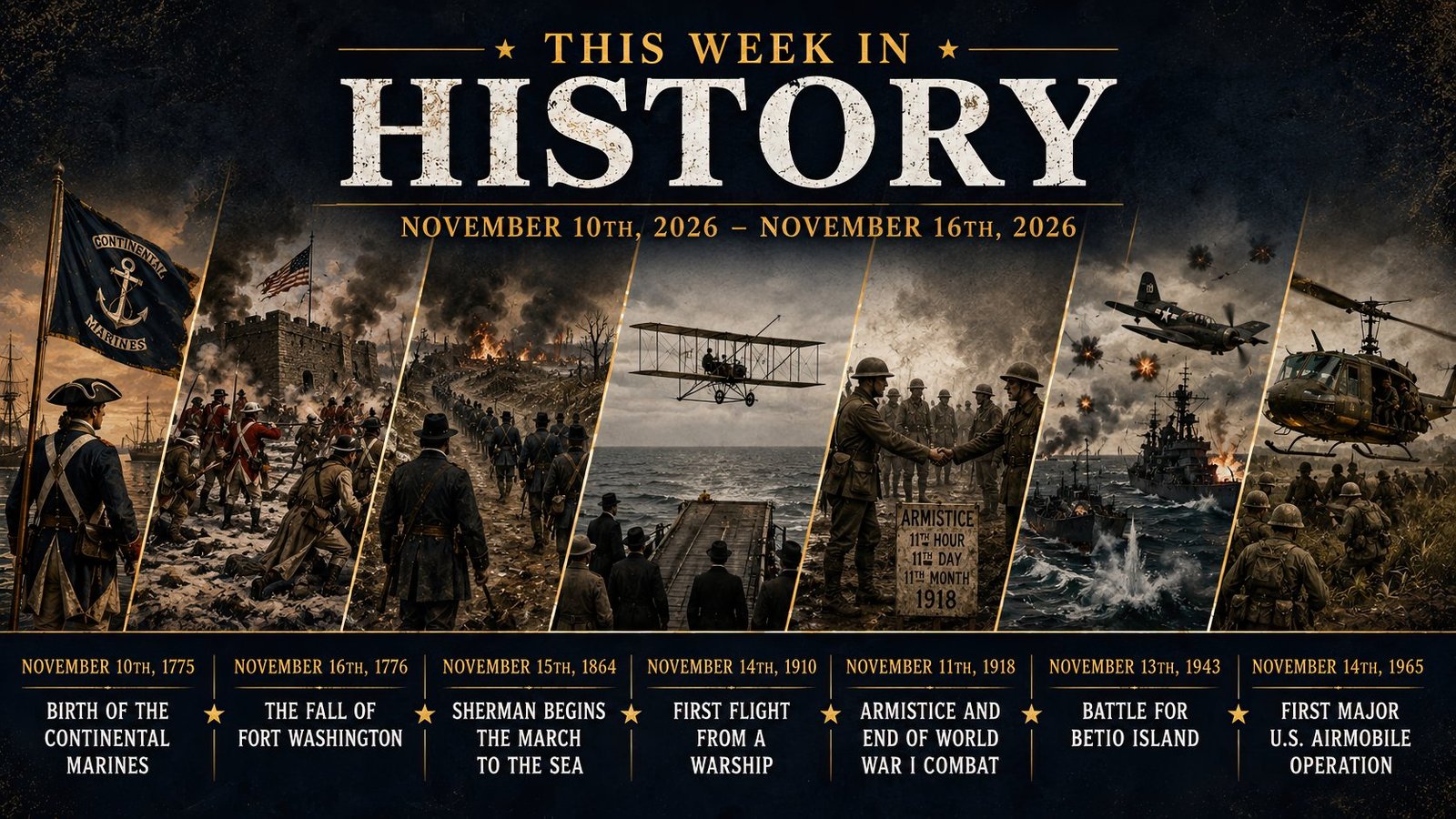
From November 10th, 2026 through November 16th, 2026, the calendar lines up with a series of anniversaries that trace the long arc of American arms. Across these seven days we see the Marine Corps come into being, the Continental Army endure a bitter defeat, and a Civil War general set out on a march that would burn its way into memory. The same week brings the dawn of naval aviation, the silence of the First World War armistice, and the creation of a national shrine to the unknown fallen. In the Pacific, ships and aircrews fight through fire and darkness to hold tiny islands that meant everything in a global war. Later decades add the harsh learning curve of airmobile warfare in Vietnam and the healing stone of a memorial in Washington. Together, these moments remind us that “this week in history” is not a single story but a set of echoes across time.
Birth of the Continental Marines
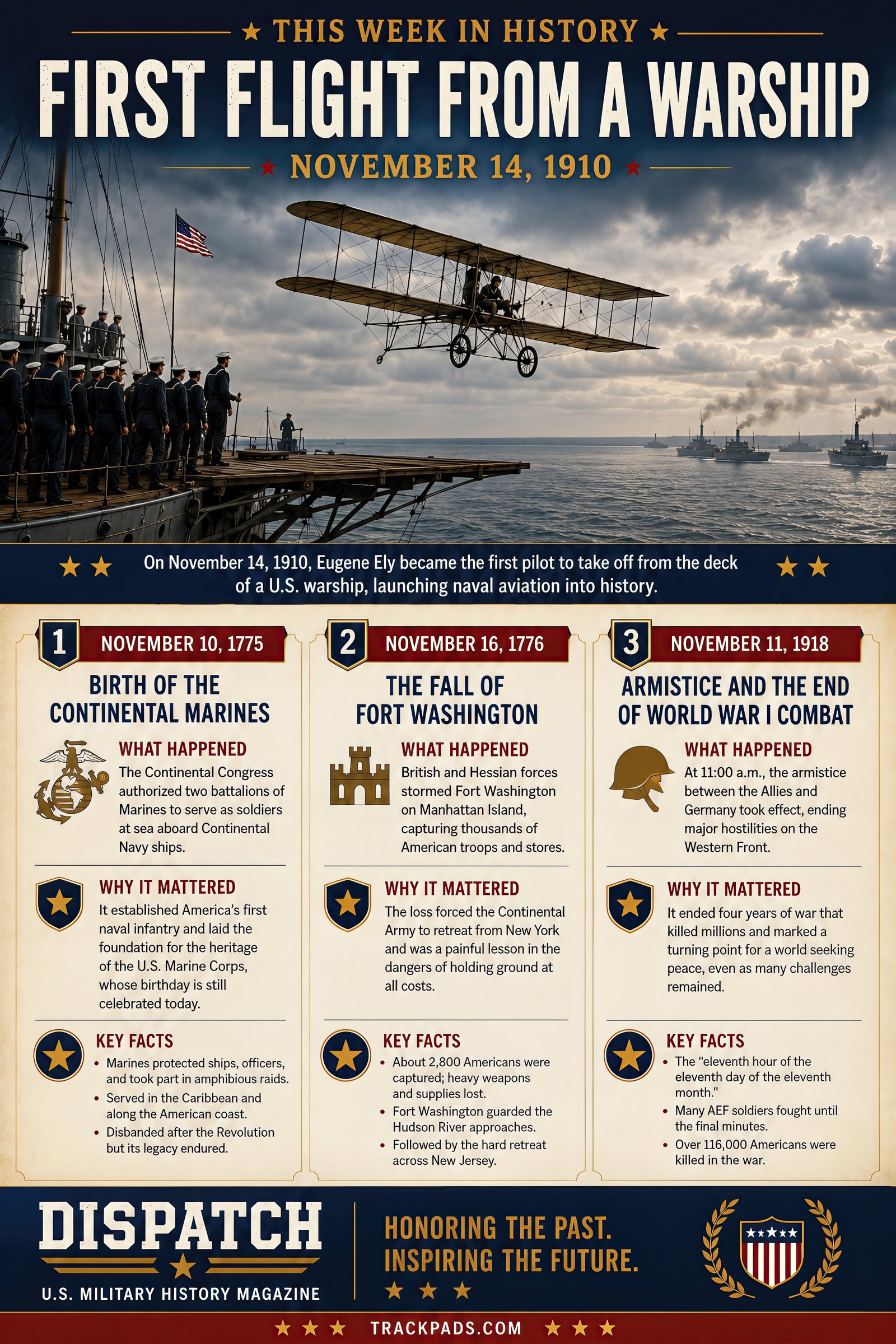
On November 10th, 1775, the Continental Congress authorized the raising of two battalions of Marines to serve as soldiers at sea. These Continental Marines were intended to fight aboard warships, protect naval officers, and land in small detachments for raids and amphibious operations. The decision reflected the colonies’ need for a flexible force that could bridge the gap between ship and shore in a way ordinary infantry could not. Early Marine detachments served on Continental Navy vessels and took part in actions in the Caribbean and along the American coast, building a tradition of close cooperation with sailors. Although the Continental Marines were disbanded after the Revolutionary War, their legacy and date of formation were later claimed by the United States Marine Corps. Every celebration of the Marine Corps birthday traces back to this November day, when Congress first put naval infantry into the American order of battle.
Open the Wiki entryThe Fall of Fort Washington
On November 16th, 1776, British and Hessian forces assaulted Fort Washington, the last major Continental stronghold on Manhattan Island. The fort guarded the Hudson River and, along with Fort Lee on the New Jersey side, was meant to block enemy ships from moving freely up the waterway. After a hard fight, multiple British columns overwhelmed the defenses, capturing thousands of American soldiers, valuable cannon, and large stores of equipment. George Washington had considered evacuating the position but left it in place, a decision that haunted him when the garrison fell. The loss of Fort Washington closed the book on the first phase of the New York campaign and forced the Continental Army into a long, cold retreat across New Jersey. It was a painful reminder that holding ground at all costs could be more dangerous than preserving a small, hard-won army for battles still to come.
Open the Wiki entrySherman Begins the March to the Sea
On November 15th, 1864, Major General William Tecumseh Sherman led his Union army columns out of a largely destroyed Atlanta and turned them toward the Georgia coast. Leaving his rail line behind, Sherman aimed to cut a swath through the Confederate heartland, wrecking infrastructure, seizing or destroying supplies, and demonstrating that the Confederacy could not shield its own territory. His troops tore up railroads, burned depots, and took food and livestock, leaving Southern civilians with an unmistakable sense of the war’s reach. The march was not uncontrolled chaos, but it was deliberately harsh, designed to erode Confederate will and ability to fight. By the time the columns reached Savannah in December, they had carved a deep psychological and material wound. For the United States Army, the March to the Sea became a case study in operational maneuver and in how targeting an enemy’s support system could hasten the end of a long, bloody conflict.
Open the Wiki entryFirst Flight from a Warship
On November 14th, 1910, civilian pilot Eugene Ely coaxed his fragile Curtiss pusher airplane down a narrow wooden platform built over the bow of the cruiser USS Birmingham off Hampton Roads, Virginia. In mist and rain, he roared forward, dipped toward the water, and barely cleared the waves before climbing into the air. The flight lasted only minutes, but it proved that aircraft could be launched from warships, turning theory into something every officer on deck could see. Naval leaders were still divided about the military value of airplanes, yet the demonstration sparked serious thinking about scouting, spotting, and even attacking from the air. Within a few years, navies would experiment with flying boats, seaplane tenders, and early flight decks. Looking back, Ely’s short, risky hop on that November day stands at the beginning of the long line that leads to modern carrier aviation, where floating airfields project power far beyond the horizon.
Open the Wiki entryArmistice and the End of World War I Combat
On November 11th, 1918, guns along the Western Front at last fell silent as the armistice between the Allies and Germany took effect at the eleventh hour of the eleventh day of the eleventh month. For American soldiers and Marines of the American Expeditionary Forces, it marked the end of a brutal year of major offensives at places like Cantigny, Belleau Wood, Saint-Mihiel, and the Meuse-Argonne. Many units spent the morning under orders to keep fighting until the deadline, and lives were still lost in the war’s final hours. When the clock reached the appointed time, men who had been in constant danger for months stepped out of trenches into an uncanny quiet. The armistice did not solve all of the political and social tensions that had led to the conflict, but it did stop the killing on a scale the world had never seen. In the United States, the date would become a day of remembrance for all who served, eventually known as Veterans Day.
Open the Wiki entryTomb of the Unknown Soldier Dedicated
On November 11th, 1921, three years to the day after the armistice, an unknown American soldier from the First World War was laid to rest at Arlington National Cemetery. The ceremony, attended by national leaders and grieving families, gave a face, or rather a place, to the thousands whose remains could not be identified. The Tomb of the Unknown Soldier became a symbol of all who had gone to war and never returned home in a way their loved ones could recognize. Guarded in later years by a dedicated honor guard, the site emphasizes unending vigilance and respect for sacrifice that cannot be repaid. Over time, additional unknowns from later wars would join the first, even as advances in identification changed how nations account for their dead. The November dedication fixed the Tomb in the country’s ritual calendar, linking the silence of the armistice to the enduring duty to remember.
Open the Wiki entryNight Battle off Guadalcanal
On the night of November 13th, 1942, American and Japanese surface forces slammed into each other in the dark waters near Guadalcanal in one of the Pacific War’s most chaotic clashes. United States cruisers and destroyers, many crewed by relatively inexperienced sailors, moved to block a Japanese bombardment force headed for Henderson Field, the vital airstrip on the island. In a swirling close-quarters fight marked by poor visibility, friendly fire, and sudden point-blank encounters, both sides suffered heavy losses. Two American admirals, Daniel Callaghan and Norman Scott, were killed while leading from the front. Yet despite the cost, the attack disrupted the Japanese plan to smash the airfield and opened the way for later actions that would sink or turn back enemy reinforcement ships. The blood-soaked victory helped secure Guadalcanal as the first major American offensive success in the Pacific, proving that the United States Navy could regroup after early setbacks and fight through the darkness.
Open the Wiki entryCarrier Strikes on Rabaul
On November 11th, 1943, carrier task forces of the United States Navy launched bold air strikes against the heavily defended Japanese naval base at Rabaul on New Britain. Rabaul had long been a stronghold bristling with anti-aircraft guns, airfields, and ships that threatened Allied operations throughout the Solomon Islands and New Guinea. Drawing on growing experience with coordinated carrier operations, American pilots swept in to hammer cruisers, destroyers, and installations, accepting significant risk in return for the chance to neutralize enemy power. The attacks damaged or drove off ships that might otherwise have opposed Allied landings further along the island chain. Just as importantly, they signaled that the initiative at sea and in the air had shifted decisively. After years in which Allied forces had to react to Japanese moves, this November raid demonstrated that American naval air power could reach into a fortress like Rabaul and make it less dangerous without a costly direct invasion.
Open the Wiki entryThe Battle of Ia Drang Begins
On November 14th, 1965, helicopters of the United States Army’s 1st Cavalry Division (Airmobile) began landing infantry battalions near the Chu Pong Massif in the Ia Drang Valley of South Vietnam. Their mission was to find and engage North Vietnamese Army units that had been slipping across the border to strike South Vietnamese forces. Instead of small contacts, American companies soon found themselves surrounded by determined regulars in intense close-range fighting. Over several days, air mobility, artillery, and close air support combined with infantry resilience to hold landing zones and blunt enemy attacks, at the cost of heavy casualties on both sides. For the Army, Ia Drang became a proving ground for the airmobile concept, showing both its promise and its vulnerabilities when units were inserted far from supporting forces. The November battle foreshadowed the grinding, high-intensity fights that would mark many later engagements in Vietnam, and it shaped how commanders thought about commitment of troops by helicopter.
Open the Wiki entryVietnam Veterans Memorial Dedicated
On November 13th, 1982, after years of debate over how to remember a difficult war, the Vietnam Veterans Memorial in Washington, D.C., was formally dedicated. The black granite walls, inscribed with the names of tens of thousands of American service members who died or went missing, offered a stark, personal record rather than a traditional heroic statue. Veterans, families, and citizens walked along the polished surface, seeing their own reflections mingling with the engraved names, an experience that many described as both painful and healing. The memorial did not settle arguments about the war itself, but it provided a place where service and loss could be honored without speeches about policy. Over time, leaving mementos and tracing names became part of the quiet rituals of remembrance on the National Mall. The dedication that November cemented the wall’s role as a central site of memory, influencing how the nation would commemorate later conflicts and their dead.
Open the Wiki entryAcross the Week
In a single week of the calendar, from the birth of the Continental Marines through a wall of names from Vietnam, we can trace the evolution of American arms and memory. Early defeats like Fort Washington sit alongside decisive campaigns such as Sherman’s march and Guadalcanal, showing how setbacks and bold maneuvers both shape outcomes. Innovations like Ely’s tentative flight and airmobile operations in Ia Drang remind us that new ways of fighting always carry risks, which soldiers and sailors bear first. The armistice of November 1918 and the creation of national memorials for unknown and named dead underline that the end of battle is never the end of the story. As readers of Dispatch: U.S. Military History Magazine follow these anniversaries, this week invites reflection on how today’s service members stand in a long line that runs through cold trenches, steamy jungles, and quiet stone.