From October 27th, 2026 through November 2nd, 2026, the calendar links trench lines outside Petersburg, destroyers in the North Atlantic, Marines wading ashore in the Solomons, and bomber crews orbiting on nuclear alert. In this edition of “This Week in U.S. Military History” from Dispatch: U.S. Military History Magazine, we follow United States soldiers, sailors, airmen, and Marines through moments when the stakes were anything but abstract. Some of these events unfolded in the last days of a world war, with exhausted troops fighting toward an armistice. Others came during the tense years before formal declarations, when American ships and aircraft were already in harm’s way. Still others took place in the shadow of nuclear weapons or in the political confusion of an insurgency. Together, they show how decisions made in a single week can echo for decades in strategy, memory, and the lives of those who wear the uniform.
Battle of Boydton Plank Road
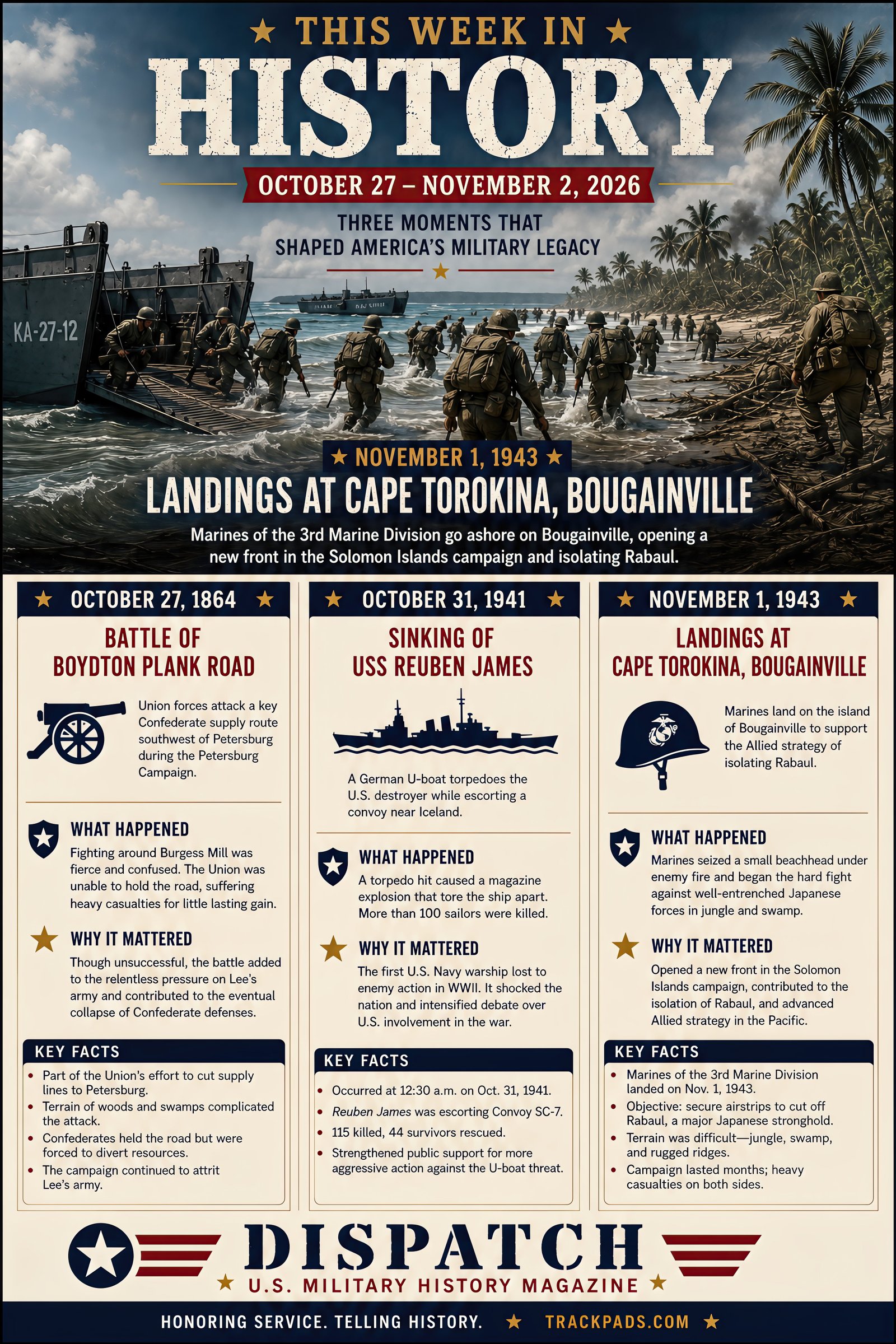
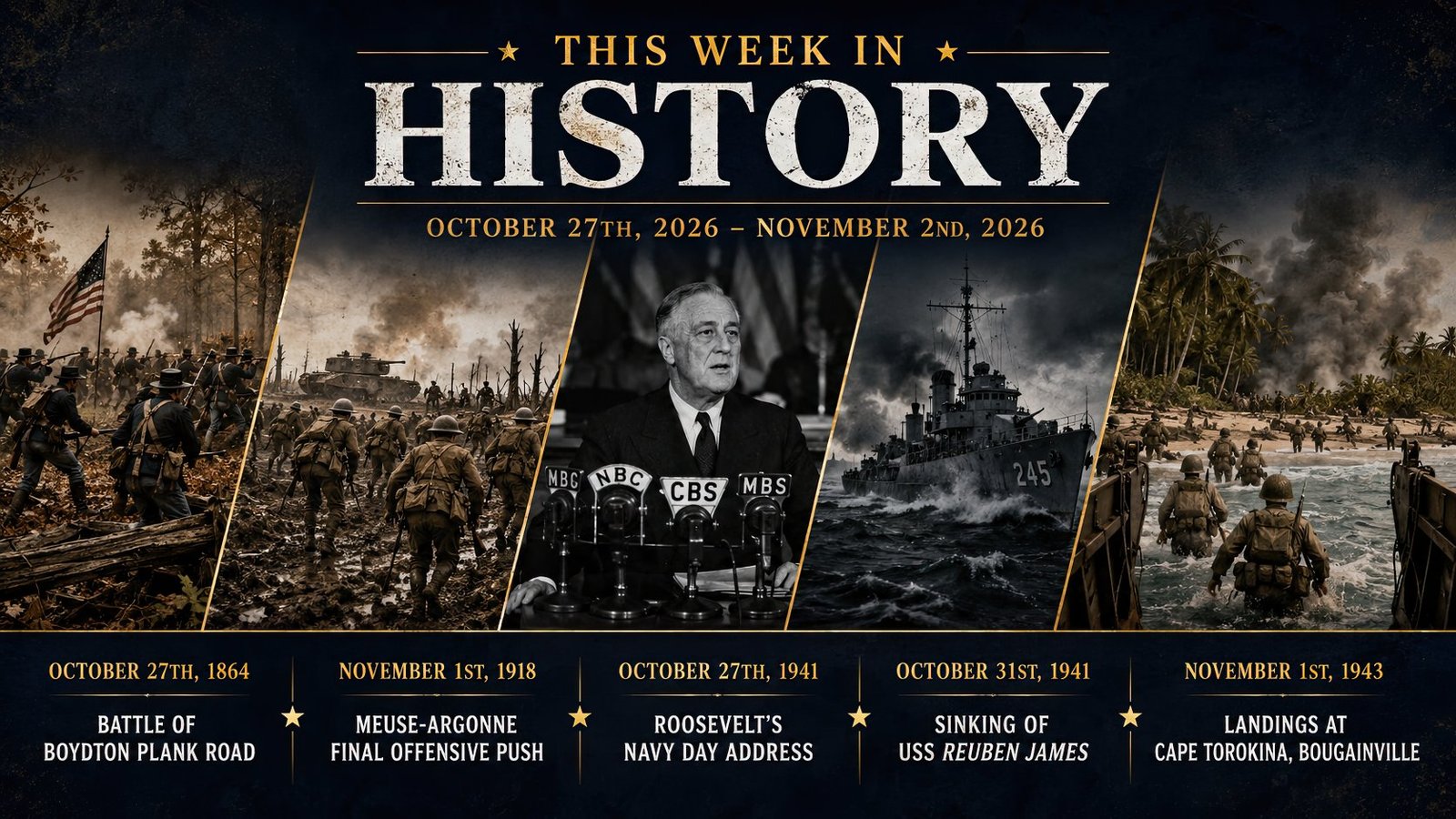
In the autumn of the Petersburg Campaign, Union commanders launched a series of flanking offensives aimed at severing the rail and wagon routes that kept Robert E. Lee’s army supplied. On October 27th, 1864, Federal troops advanced against the Boydton Plank Road, a key artery feeding Confederate positions southwest of Petersburg. The operation pushed elements of the Army of the Potomac into tangled woods and swampy ground, where coordination grew difficult and Confederate counterattacks slammed into exposed flanks. Fighting around Burgess Mill became sharp and confused as units lost contact and improvised new lines under fire. By the time the engagement ended, the Union army had failed to hold a permanent grip on the road, and casualties were heavy for gains that could not be sustained. Yet the battle still mattered, because it showed how relentless pressure around Petersburg was gradually stretching Confederate resources and setting conditions for the final campaigns of the war.
Open the Wiki entryMeuse-Argonne final offensive push
As the First World War neared its close, American forces in France were still locked in brutal combat. On November 1st, 1918, the United States First Army opened a major new phase of the Meuse-Argonne offensive, attacking along a broad front toward Barricourt Ridge and Sedan. Weeks of hard learning in earlier assaults had taught painful lessons about coordinating infantry, artillery, tanks, and air support. This time, American units moved forward behind better-planned barrages and more efficient traffic control on roads jammed with guns, ammunition, and ambulances. Soldiers pushed through battered villages and shell-torn woods, taking objectives that had resisted earlier efforts. The success of this advance helped break remaining German defensive systems in the region and forced enemy commanders to confront the reality that they could not hold out much longer. Ten days later, the armistice took effect, and many of the same men who had gone over the top on November 1st were standing in stunned silence as the guns finally fell quiet.
Open the Wiki entryRoosevelt’s Navy Day address
In the autumn before formal American entry into the Second World War, United States warships were already escorting convoys and trading shots with German submarines in the North Atlantic. On October 27th, 1941, President Franklin D. Roosevelt used the occasion of Navy Day to speak frankly to the nation about this undeclared naval war. He described attacks on American destroyers and merchantmen, framed the contest at sea as a defense of hemispheric security, and argued that the oceans no longer protected the United States from distant aggression. The speech was meant to stiffen public resolve and to justify the growing presence of American escort groups far from home waters. It also sent a clear signal to sailors steaming in gray seas under blackout conditions that their hazardous duty had the backing of the commander in chief. Within days, one of those destroyers would become the first United States warship lost to enemy action in the conflict, underscoring how close the country already was to full-scale war.
Open the Wiki entrySinking of USS Reuben James
In the early hours of October 31st, 1941, the Clemson-class destroyer USS Reuben James was escorting a convoy near Iceland when a German submarine fired a spread of torpedoes into the formation. One of the weapons struck the American ship, detonating a forward magazine and tearing the hull apart so quickly that many sailors never had a chance to reach the deck. More than one hundred men were killed, making Reuben James the first United States Navy warship sunk by hostile action in the Battle of the Atlantic. The loss hit home in a country that was still officially neutral, fueling debate about how far the United States should go in defending shipping lanes. For the families of the crew, the question was no longer abstract; their loved ones had already paid a wartime price. In naval circles, the sinking underscored the deadly nature of convoy duty and the need for better antisubmarine tactics, equipment, and coordination with Allied escorts.
Open the Wiki entryLandings at Cape Torokina, Bougainville
By late 1943, Allied planners focused on neutralizing the strong Japanese base at Rabaul without storming it head-on. The United States contribution to this strategy included amphibious landings on Bougainville, an island whose northern and southern ends were strongly held by Japanese forces. On November 1st, 1943, Marines of the Third Marine Division, backed by Army units and a powerful naval task force, came ashore at Cape Torokina on the island’s central west coast. The beachhead was cramped and backed by swamp and jungle, and early fighting saw confused clashes as troops pushed inland to secure ground for airfields. Engineers and Seabees worked under periodic shelling and air attack to carve runways from the jungle, while infantry units fought off Japanese probing attacks. Over time, the Torokina perimeter grew into a major Allied base, from which aircraft could strike Rabaul repeatedly. The operation demonstrated how landing at a limited point could bypass strongholds and slowly strangle them from the air.
Open the Wiki entryBattle of Empress Augusta Bay
The landings at Cape Torokina invited a swift Japanese response at sea. In the night of November 1st to 2nd, 1943, a Japanese surface force steamed toward Empress Augusta Bay, intending to bombard the American beachhead and land reinforcements. Waiting for them was a United States task force of cruisers and destroyers equipped with radar and trained in night fighting. In the confused darkness of the early hours of November 2nd, American ships detected the enemy, maneuvered aggressively, and opened fire. Torpedoes and shells ripped into Japanese vessels, while quick turns and disciplined radar-directed gunnery kept the United States formation from being overwhelmed. By dawn, the Japanese attack had been beaten back, several of their ships were sunk or damaged, and the beachhead at Torokina remained intact. The battle helped secure the foothold on Bougainville and showcased how technology, training, and bold handling of ships could change the balance in nighttime naval combat.
Open the Wiki entryCuban Missile Crisis de-escalates
In October 1962, the discovery of Soviet nuclear missiles in Cuba put United States forces on some of the highest alert levels in their history. Strategic bombers sat loaded on runways, ballistic missile submarines slipped to sea, and naval vessels formed a ring to intercept Soviet ships bound for the island. On October 28th, 1962, the world learned that Moscow had agreed to remove its missiles from Cuba in return for American assurances and quiet reciprocal steps elsewhere. For the crews who had spent days expecting orders that might start a nuclear war, the announcement brought intense relief mixed with the sobering knowledge of how close disaster had come. The crisis left a deep mark on military planning, encouraging new channels of communication and refined procedures to manage future confrontations. It also reminded the public that decisions made in distant command centers carried immediate consequences for airmen in cockpits, sailors on watch, and soldiers guarding bases around the globe.
Open the Wiki entryCoup against Ngo Dinh Diem
In South Vietnam, the war that involved American advisers and support was as political as it was military. On November 2nd, 1963, South Vietnamese generals carried out a coup that removed President Ngo Dinh Diem and his brother from power, ending in their deaths. American advisers in the country watched as longtime partners in the government were replaced, while Vietnamese units in the field tried to understand what the change meant for their fight. For the United States, the coup created both a new opportunity and a new uncertainty, as Washington now had to deal with shifting leadership in Saigon while communist forces continued their own campaigns. The event highlighted how fragile political structures could complicate military efforts on the ground. In the years that followed, American involvement deepened, and many veterans would look back on the fall of Diem as a moment when the nature of the conflict, and the United States role in it, became even more tangled.
Open the Wiki entryBombing halt over North Vietnam
As the Vietnam War dragged on, the sustained air campaign against North Vietnam weighed heavily on pilots, ground crews, and the civilians beneath the bombs. On October 31st, 1968, President Lyndon B. Johnson announced that the United States would halt bombing of North Vietnam in hopes of advancing peace talks. For airmen who had flown repeated missions into dense air defenses, the decision marked at least a temporary end to one of the war’s most dangerous assignments. Units that had spent months operating at a relentless tempo now shifted focus to other theaters and missions, even as the ground war continued. Strategically, the halt signaled that military pressure and political negotiation were becoming tightly intertwined. It also left lasting debates over the effectiveness of the air campaign, the costs borne by those who flew and maintained the aircraft, and the relationship between battlefield action and diplomatic bargaining in modern limited wars.
Open the Wiki entryAcross the Week
Across these seven days on the calendar, we see soldiers probing muddy roads outside Petersburg, doughboys pushing through the Argonne, sailors fighting to keep convoy lanes open, and Marines carving a new base from jungle and mangrove. We also see aircrews and ship crews standing at the edge of nuclear conflict, and advisers and commanders grappling with the political storms of Southeast Asia. Each episode carries its own tactics, weapons, and geography, yet together they show a constant thread of adaptation and resolve under pressure. The men and women who served in these moments did not know how their week would look in a history book; they knew only the orders in front of them and the comrades at their side. As we read back across their actions from October 27th, 1864 through October 31st, 1968, we are reminded that the character of American arms is shaped as much by decisions in crisis as by long campaigns. Their experiences still echo for today’s service members who stand watch in a different but no less uncertain world.