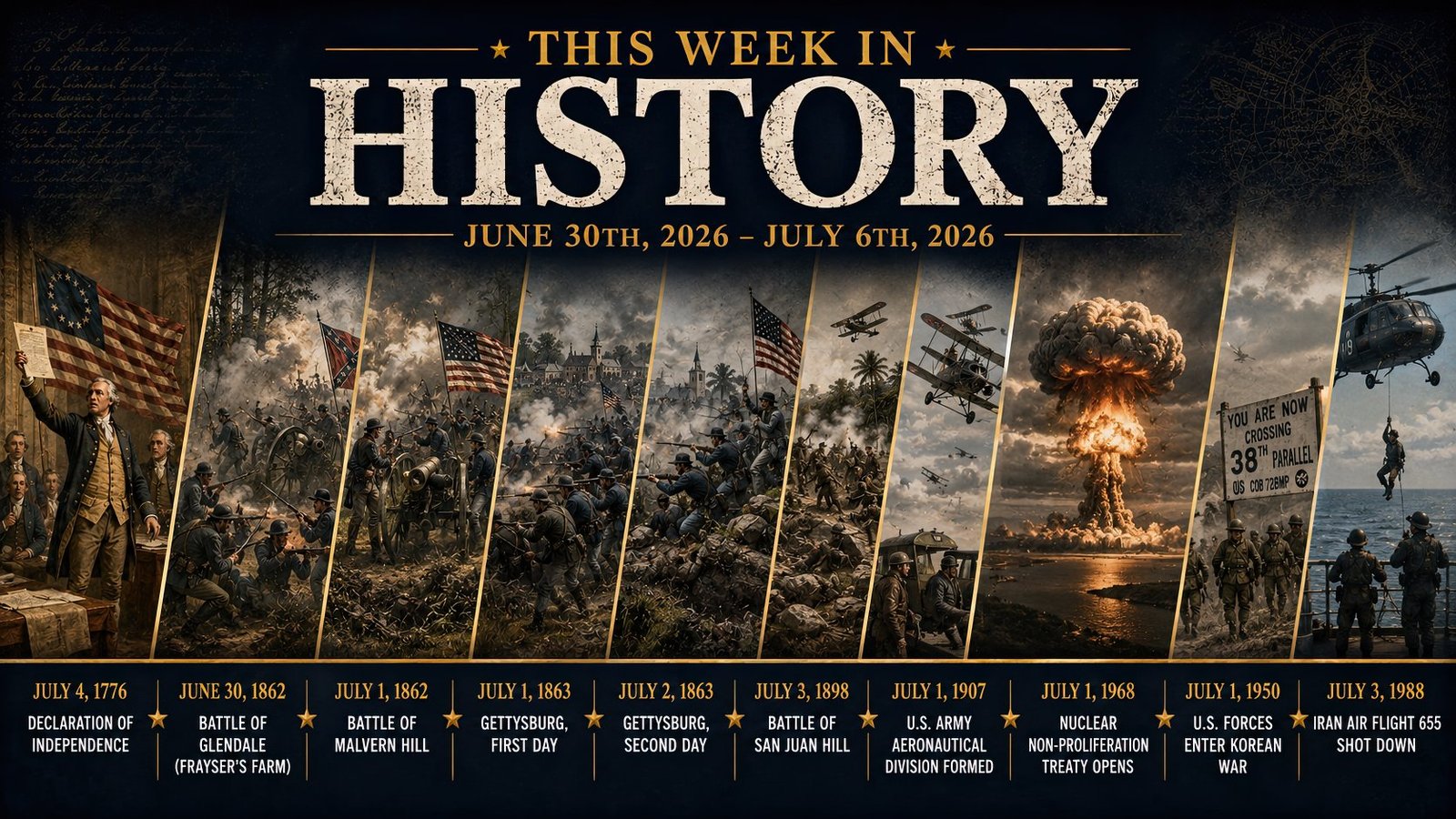
The days from June 30th, 2026 through July 6th, 2026 trace a powerful arc through United States military history, from the birth of the nation to the hard lessons of modern warfare. Across these same calendar dates in earlier years, Continental soldiers fought under a brand-new flag, Union and Confederate armies clashed in desperate Civil War campaigns, and American forces stepped onto the world stage in Cuba and the Pacific. In the twentieth century, pilots gained their own combat arm, an island nation gained independence, nuclear weapons were placed under new constraints, and United States soldiers were sent to fight in Korea. The week also holds a sobering tragedy over the Persian Gulf, a reminder that military power always carries human risk. Taken together, these anniversaries show how strategy, technology, and national purpose evolve, while the burdens of service remain very real for those in uniform.
Declaration of Independence
On this day in Philadelphia, delegates of the Continental Congress formally adopted the Declaration of Independence, transforming an armed rebellion into a war for national survival. Fighting had already broken out at Lexington and Concord, Bunker Hill, and along the Canadian frontier, but now the Continental Army, Navy, and Marine forces served an independent United States rather than protesting colonies. The declaration announced to foreign powers that a new nation intended to stand on its own, opening the door to alliances and vital military aid, especially from France. For American soldiers and sailors, it clarified that defeat could mean not just political disappointment but the destruction of a new republic. The words agreed to on July 4th, 1776 have echoed across parade grounds, re-enlistment ceremonies, and memorial services ever since, shaping how Americans understand the purposes of their armed forces.
Open the Wiki entryBattle of Glendale (Frayser’s Farm)
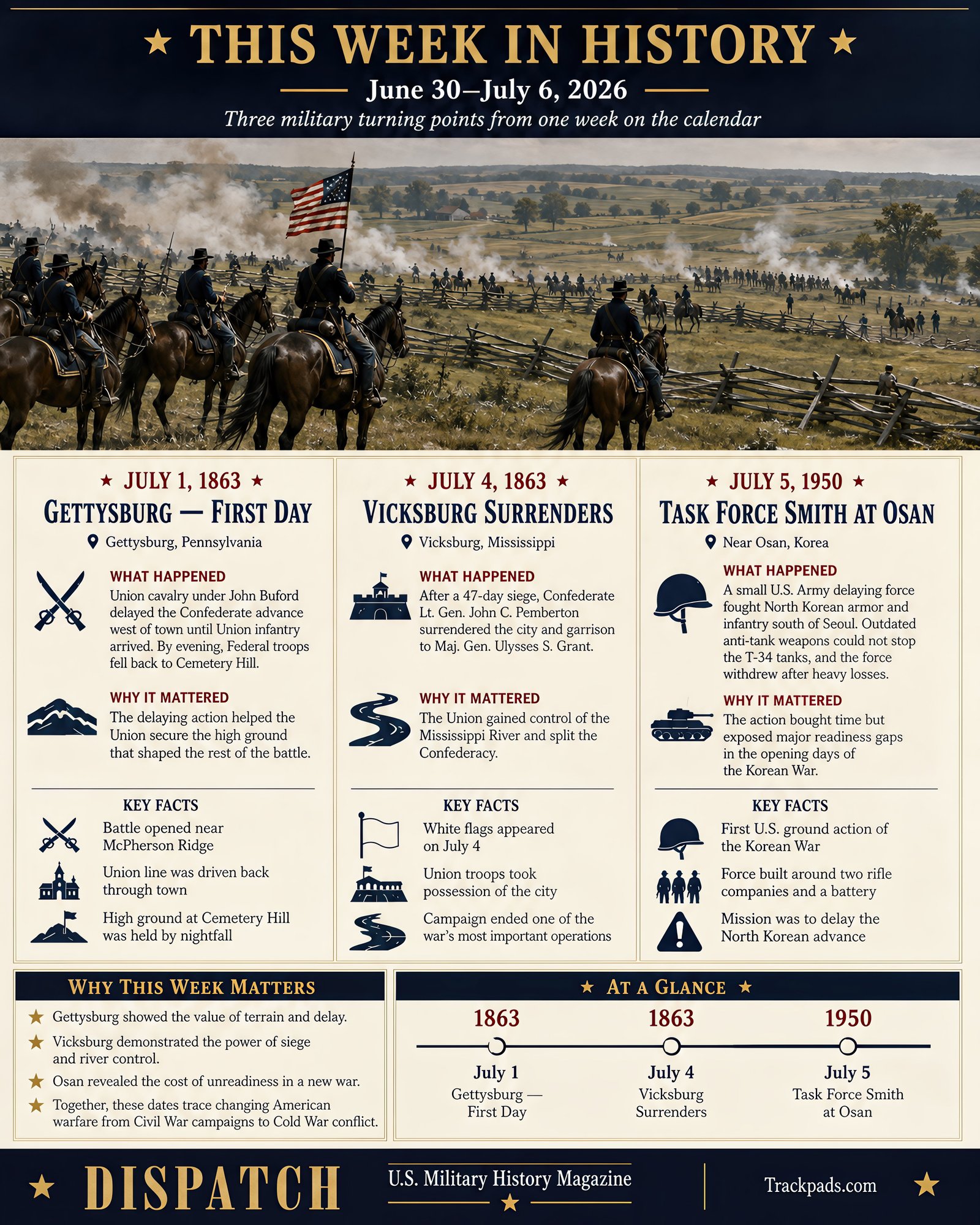
As the Peninsula Campaign turned sour for the Union in the summer of 1862, the Army of the Potomac tried to slip away toward the James River, its supply line and safety. On June 30th, 1862, near the crossroads at Glendale and the woods around Frayser’s Farm, Confederate forces under Robert E. Lee launched a complex attack meant to cut the retreating Union column in two. Miscommunication and difficult terrain kept Confederate divisions from striking in perfect coordination, but several Union brigades fought desperate, seesaw actions to hold key roads and bridges. Casualties were heavy on both sides, with artillery duels and close-range infantry clashes leaving fields littered with dead and wounded. Tactically, the battle ended without a clear decision, yet it kept the Union army under pressure and set up the last major clash of the Seven Days. Glendale showed how fragile large Civil War armies could be when moving under fire, and how much campaigns could hinge on orders misunderstood or delivered too late.
Open the Wiki entryBattle of Malvern Hill
The next day, on July 1st, 1862, the Union army took a strong defensive position on Malvern Hill, a rise of ground supported by powerful concentrations of artillery and nearby naval gunfire from the James River. Confederate commanders believed they had an opportunity to crush George McClellan’s retreating forces, but turning that belief into a coordinated assault proved disastrous. Brigades went forward piecemeal across open fields and ravines, often without adequate reconnaissance or support, into carefully sighted Union cannon and musketry. Time after time, attacking lines were shattered, leaving officers and men alike stunned by the intensity of fire. The Union victory at Malvern Hill did not lead to a renewed advance on Richmond, but it preserved the army and ended the immediate Confederate attempt to destroy it. The battle became a case study in how terrain and well-handled artillery could negate numerical advantages and how costly frontal assaults could be when doctrine lagged behind firepower.
Open the Wiki entryGettysburg, first day
A year later to the day, July 1st, 1863, the opening clash at Gettysburg began almost by chance as Confederate troops moving into Pennsylvania met Union cavalry west of town. Brigadier General John Buford’s troopers used dismounted tactics and carbines to delay the advance, buying time for Union infantry of the First Corps to arrive. As more Confederate divisions came onto the field from the north and west, fighting surged along ridges, farms, and the town’s outskirts. Union Major General John Reynolds was killed early while bringing his men into line, a sign of how personal Civil War leadership could be. By afternoon, Union forces were overwhelmed north of town and fell back through the streets to stronger ground on Cemetery Hill and Cemetery Ridge. The Confederates held the town, but the Union army now occupied the high ground that would define the fighting over the next two days.
Open the Wiki entryGettysburg, second day
On July 2nd, 1863, both armies were now largely concentrated, and the second day at Gettysburg turned into a brutal struggle for the flanks of the Union position. Confederates under James Longstreet pushed against the Union left, targeting places that would become famous: Devil’s Den, the Wheatfield, the Peach Orchard, and Little Round Top. Union units shifted under intense pressure, some arriving just in time to plug gaps and counterattack up rocky slopes. On the Union right, attacks against Culp’s Hill and East Cemetery Hill threatened vital ground overlooking the main line. The result was a bloody stalemate in which neither side achieved a decisive breakthrough, but the cost fell heavily on regiments that were shattered or nearly destroyed. For the Union, holding the line on July 2nd, 1863 meant that the defensive arc around Cemetery Ridge remained intact, setting the stage for whatever Lee would attempt on the third day.
Open the Wiki entryGettysburg, third day
The climactic third day, July 3rd, 1863, is best remembered for the Confederate infantry assault later called Pickett’s Charge. After an intense artillery bombardment meant to weaken Union positions on Cemetery Ridge, several Confederate divisions stepped off from the tree line on Seminary Ridge and marched across open fields under heavy fire. Union cannon and rifles tore into their ranks, yet the attackers closed to the stone wall in places, fighting hand to hand before being driven back. The assault failed, leaving thousands of casualties and ending Lee’s final attempt to win a decisive victory on Northern soil. That night and the next day, the Army of Northern Virginia began its withdrawal toward Virginia, burdened by wounded and battered morale. Gettysburg did not end the Civil War, but July 3rd, 1863 marked a turning point in the Eastern Theater, after which Confederate offensives would never again reach as far into the North.
Open the Wiki entrySurrender of Vicksburg
While the guns still cooled at Gettysburg, another decisive event unfolded on the Mississippi River. On July 4th, 1863, after weeks of siege, Confederate Lieutenant General John Pemberton surrendered the fortress city of Vicksburg and its garrison to Union Major General Ulysses S. Grant. The fall of Vicksburg gave the Union complete control of the Mississippi River, severing the Confederacy’s trans-Mississippi region from the rest of its territory. The surrender included tens of thousands of Confederate soldiers, many of whom were paroled, and a vast haul of artillery and supplies. President Abraham Lincoln reportedly saw Vicksburg’s capture, together with the victory at Gettysburg, as a sign that the tide of war had shifted. For soldiers and civilians alike along the river’s banks, July 4th, 1863 symbolized the tightening of the Union’s strategic grip and the growing inevitability of Confederate defeat. The city’s Independence Day traditions would be shaped by that memory for generations.
Open the Wiki entryBattle of San Juan Hill and El Caney
The Spanish-American War brought United States forces into Cuba, and on July 1st, 1898, American troops attacked fortified Spanish positions at El Caney and along the San Juan Heights outside Santiago. At El Caney, infantry fought for hours to take a stone blockhouse and surrounding works, while other regiments prepared to advance on Kettle Hill and San Juan Hill. The famous charge of Theodore Roosevelt’s Rough Riders has often dominated popular memory, but African American Buffalo Soldiers and regular Army units carried much of the weight, pressing forward under rifle and artillery fire. By day’s end, the heights overlooking Santiago had fallen, at heavy cost. The victory forced Spanish commanders to consider the city’s untenable position and demonstrated that the United States could project combined arms power overseas. For many officers, the day’s lessons in logistics, disease, and firepower would shape reforms in the small but growing United States Army.
Open the Wiki entryBattle of Santiago de Cuba
Two days later, on July 3rd, 1898, the Spanish Caribbean Squadron attempted a breakout from Santiago’s harbor, hoping to escape the blockading United States Navy. As the Spanish cruisers and destroyers emerged, American battleships and armored cruisers moved to intercept, opening fire in a running engagement along the coast. Superior gunnery, armor, and speed allowed the United States ships to rake their opponents, driving them ashore or sinking them one by one. The destruction of the Spanish squadron eliminated the last serious naval threat in the theater and made the fall of Santiago all but inevitable. News of the victory spread quickly, boosting public enthusiasm and reinforcing the image of the United States as an emerging sea power. For sailors who had drilled for years in peacetime, July 3rd, 1898 was proof that training, discipline, and industrial might could decide a war in a single morning.
Open the Wiki entryCreation of the U.S. Army Air Corps
On July 2nd, 1926, the Air Corps Act transformed the Army’s air arm from the Air Service into the United States Army Air Corps, giving aviation a more formal place in the nation’s defense structure. The law did not create an independent air force overnight, but it acknowledged that aircraft had become essential for reconnaissance, bombing, and support of ground troops. New schools, doctrine, and procurement programs began to take shape around the idea that airpower could influence campaigns far beyond the front lines. Pilots and ground crews gained a clearer career path and a stronger institutional identity, even as they continued to serve under Army command. The act also signaled to other nations that the United States intended to keep pace in military aviation after the First World War. The Air Corps would later evolve into the United States Army Air Forces in the Second World War and, ultimately, the independent United States Air Force after 1947.
Open the Wiki entryPhilippine independence proclaimed
On July 4th, 1946, in Manila, the United States formally recognized the independence of the Republic of the Philippines, ending decades of colonial rule that had begun after the Spanish-American War. The ceremony marked a major shift in America’s role in the western Pacific, as a territory that had seen fierce fighting during the Second World War now stood as a sovereign partner. United States military bases and advisory missions did not vanish overnight, but their presence was reframed by treaties and agreements between two governments rather than imposed authority. For Filipino veterans who had fought alongside American troops against Japanese occupation, the day carried both pride and complex memories of sacrifice. Strategically, Philippine independence reshaped basing, logistics, and alliance planning during the early Cold War years. The decision underscored how American military commitments could outlast formal empire while still adapting to new political realities.
Open the Wiki entryTruman orders United States ground troops to Korea
Five days after North Korean forces crossed the 38th parallel and invaded South Korea, President Harry Truman took a decisive step. On June 30th, 1950, he authorized the deployment of United States ground combat units to support South Korean forces already reeling under the assault. Air and naval power had been committed earlier, but this order meant American soldiers would again fight on the ground in Asia. Units from the occupation forces in Japan, including elements of the 24th Infantry Division, began moving rapidly toward the Korean Peninsula with limited equipment and training for full-scale war. The decision framed the conflict as an early test of postwar collective security and containment policies. For the troops boarding transports, it meant leaving garrison duty for a campaign whose length and cost were unknown, in terrain and conditions that would prove harsh and unforgiving.
Open the Wiki entryTask Force Smith fights at Osan
The first significant ground clash between United States and North Korean forces occurred at Osan on July 5th, 1950, when a small blocking force known as Task Force Smith took up positions south of Seoul. Comprised mainly of infantry from the 21st Infantry Regiment, supported by limited artillery and outdated anti-tank weapons, the force was ordered to delay the North Korean advance. As enemy T-34 tanks and infantry columns appeared, American shells and rockets inflicted some damage but could not stop the armor. Under mounting pressure and with communications strained, Task Force Smith was eventually overrun and forced into a disorganized retreat, suffering heavy casualties and losses of equipment. The action did delay the North Koreans and provided valuable intelligence, but it also exposed dangerous gaps in readiness after years of peacetime budgets and occupation duties. Osan became a cautionary story taught to later generations about the costs of sending understrength, under-equipped units against a prepared foe.
Open the Wiki entryUnited States signs the Nuclear Non-Proliferation Treaty
On July 1st, 1968, the United States joined other major powers in signing the Treaty on the Non-Proliferation of Nuclear Weapons, commonly known as the Nuclear Non-Proliferation Treaty. For the military, this agreement did not remove existing nuclear forces, but it committed the country to limiting the spread of nuclear weapons technology and pursuing arms control talks over time. The treaty created a framework under which non-nuclear states pledged not to develop nuclear arms, in exchange for peaceful nuclear technology and assurances from nuclear powers. Strategists and planners in the United States services now had to think about deterrence, alliance commitments, and arms control obligations together. Over the decades, this framework would influence basing decisions, modernization programs, and the way officers studied potential crises. July 1st, 1968 thus marks a moment when military power and diplomatic restraint were woven more tightly together in American policy.
Open the Wiki entryIran Air Flight 655 shot down
On July 3rd, 1988, during tense operations in the Persian Gulf, the guided-missile cruiser USS Vincennes mistook a civilian Iran Air Airbus ascending along a commercial route for a hostile military aircraft. Believing the plane to be an attacking fighter and amid conflicting reports about altitude and identification, the ship fired surface-to-air missiles that destroyed the airliner, killing all passengers and crew. The tragedy shocked observers around the world and brought immediate scrutiny to rules of engagement, sensor interpretation, and command decision-making under pressure. For the United States Navy, it led to reviews of training, procedures, and the human factors involved in operating advanced combat systems. The incident also affected diplomatic relations and remains a painful example of how misjudgments in a complex threat environment can have devastating consequences for civilians. Remembering July 3rd, 1988 means acknowledging both the stresses on those standing watch and the obligation to minimize the risk of such errors.
Open the Wiki entryAcross the Week
The events that share this week’s calendar dates stretch from the signing halls of Philadelphia to muddy Civil War fields, tropical ridgelines, Cold War treaty tables, and a radar-lit combat information center in the Gulf. Together they show how United States military history is not a simple march of victories but a tapestry of bold decisions, hard-learned lessons, and moments of tragic loss. Tactical fights at places like Glendale, Gettysburg, and Osan sit alongside institutional changes such as the creation of the Army Air Corps and the embrace of nuclear arms control. Independence for the Philippines and the founding declaration of 1776 remind us that questions of sovereignty and self-rule are never far from military affairs. As readers look back on these anniversaries from June 30th, 2026 through July 6th, 2026, they also look forward, considering how today’s service members inherit both the achievements and the cautions written into this week’s history.