From July 7th, 2026 through July 13th, 2026, this week’s Dispatch takes us from the first days of American independence to the early Cold War. On these dates, Continental soldiers heard the Declaration of Independence read aloud in a dusty New York parade ground, Marines received a new legal foundation as the young republic built a navy, and warships and infantrymen carried the flag into California and the Caribbean. Civil War battles and riots tested the Union both at the front and in the streets at home, while later generations stormed ashore in Sicily and fought bitterly for islands in the central Pacific. Along the way, a president came under enemy fire, new territories reshaped American strategy, and coalition command in Korea took form. Together, these episodes show how much can change in a single week on the calendar, across very different centuries of United States military experience.
Declaration Read to the Continental Army in New York
On a July evening in New York, Continental soldiers assembled to hear the newly adopted Declaration of Independence read aloud. Many of these men had been fighting British regulars for more than a year, but this moment tied their service to a clear political break with the Crown. The words about unalienable rights and government by consent took on a sharper meaning for troops who faced invasion from the sea as British forces massed around the city. In the excitement that followed, New Yorkers pulled down a gilded statue of King George, an act that symbolized the end of royal authority in the colonies. For the army, the reading helped transform a rebellion into a war for independence in the minds of ordinary soldiers. The date reminds us that military campaigns and political decisions are often joined at the level of morale and purpose in the ranks.
Open the Wiki entryReestablishment of the United States Marine Corps
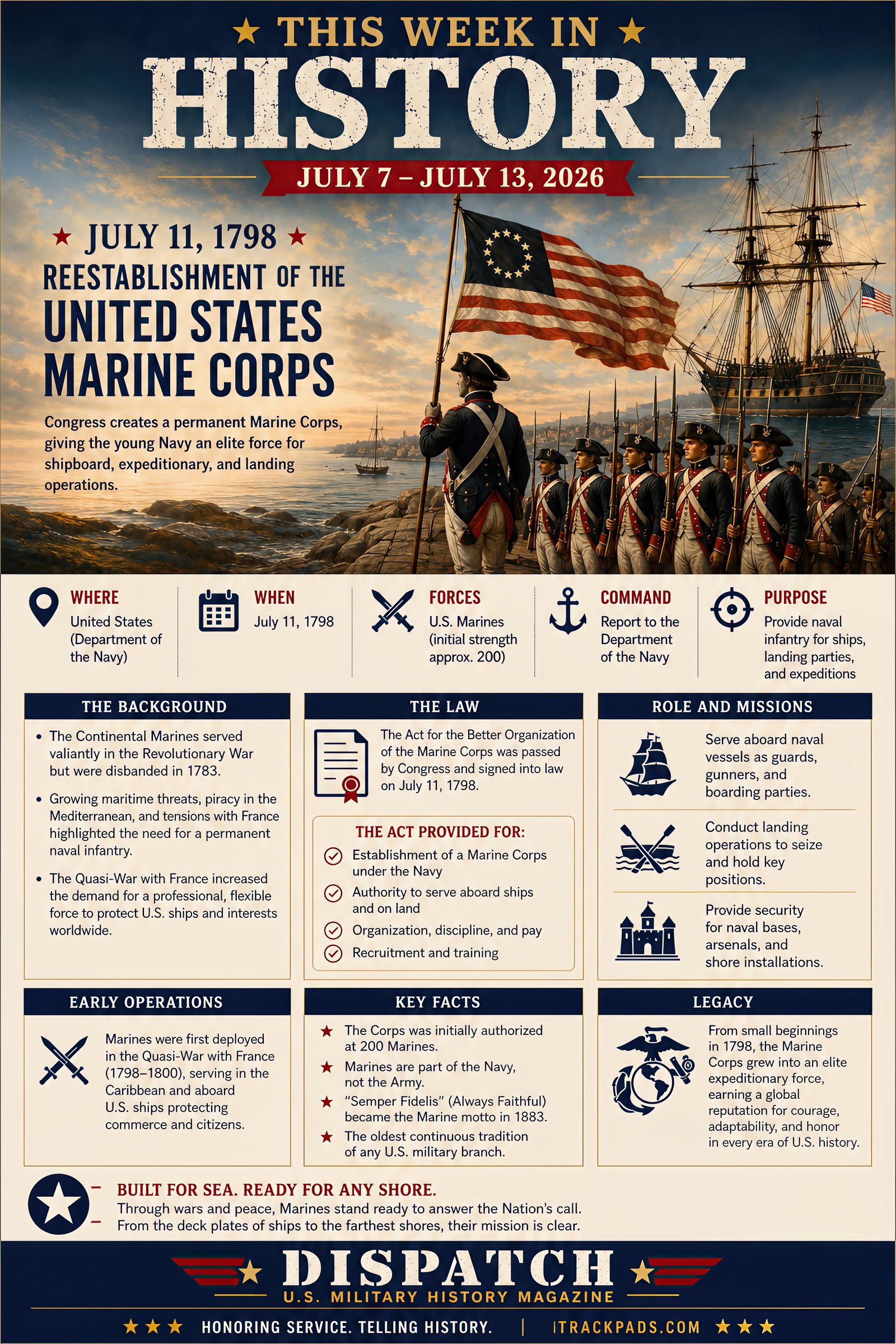
When Congress passed legislation on July 11th, 1798 to create a Marine Corps under the Department of the Navy, it gave the new republic a permanent naval infantry force. The Continental Marines of the Revolution had been disbanded after the war, but the growing threat of conflict at sea with European powers pushed leaders to rebuild that capability. The act provided for Marines to serve aboard warships as guards, boarding parties, and landing forces, linking them tightly to the nation’s emerging blue-water navy. This legal foundation came during the Quasi-War with France, when American commerce and seamen needed protection across the Atlantic. Over time, the Marine Corps would grow into an expeditionary force with a reputation for hard fighting from Tripoli to the Pacific. Yet the roots of that story lie in this summer day in 1798, when legislators decided the young United States needed Marines as a standing part of its sea power.
Open the Wiki entryUnited States Seizes Monterey, California
In the early phase of the Mexican–American War, United States Navy ships under Commodore John D. Sloat arrived off Monterey, the principal Mexican port in Alta California. On July 7th, 1846, sailors and Marines landed, raised the American flag over the customs house, and proclaimed United States control of the town. The operation met no serious resistance, but it had enormous strategic weight, denying Mexico a major Pacific harbor and signaling to Britain and other powers that the United States intended to hold California. The capture of Monterey helped secure the coastline while Army and volunteer forces advanced overland into the interior. It also foreshadowed the long-term importance of West Coast ports to American naval strategy in the Pacific. Looking back, this quiet occupation stands as a reminder that some of the most consequential military moves are not dramatic battles but the deliberate seizure of key geographic positions.
Open the Wiki entryNew York City Draft Riots Begin
On July 13th, 1863, anger over the first federal conscription law boiled over in New York City, just days after Union victory at Gettysburg. Crowds gathered to attack draft offices, and the violence quickly turned against African American residents, soldiers on leave, and anyone seen as supporting the Lincoln administration. Local authorities struggled to regain control as fires, assaults, and looting spread across neighborhoods. Federal troops, including units rushed north from the Gettysburg battlefield, were eventually deployed to restore order and reopen the streets. The draft riots exposed deep divisions over class, race, and the price of preserving the Union, even while armies fought in Pennsylvania and along the Mississippi. For military leaders, the episode underscored that sustaining a war effort requires not only victories at the front but also managing unrest and resentment among citizens asked to bear the human cost.
Open the Wiki entryThe Battle of Monocacy, “The Battle That Saved Washington”
South of Frederick, Maryland, on July 9th, 1864, Union Major General Lew Wallace assembled a scratch force to block Confederate Lieutenant General Jubal Early’s corps moving toward Washington. Wallace’s men, including fresh militia and detachments from the veteran Sixth Corps, took up positions along the Monocacy River, knowing they were significantly outnumbered. The Confederates eventually outflanked and drove the Union troops from the field, making the day a tactical Southern victory. Yet Wallace’s stand delayed Early’s advance by nearly a full day, buying precious time for more Union reinforcements to reach the capital’s defenses. When Confederate skirmishers later appeared before the forts ringing Washington, they faced a far stronger garrison than they would have without Monocacy. That is why the fight earned the nickname “the battle that saved Washington,” a reminder that sometimes a controlled defeat can serve a larger strategic purpose.
Open the Wiki entryLincoln Under Fire at Fort Stevens
Just days after Monocacy, on July 12th, 1864, Confederate forces under Jubal Early probed the northern defenses of Washington near Fort Stevens. As skirmishers traded fire and Union troops manned the earthworks, President Abraham Lincoln came to the front lines to see the situation for himself, standing on the parapet within range of enemy rifles. Officers reportedly urged him to take cover as bullets snapped overhead, an extraordinary scene in which the commander in chief personally risked his life while observing the capital’s defenses. The Union troops, stiffened by fresh veterans from the Eastern theater, held their ground and convinced Early that an assault on Washington would be too costly. The Confederate force withdrew, ending the last serious Confederate threat to the city. Fort Stevens stands in memory as a rare moment when a sitting president physically shared the dangers of the soldiers guarding the nation’s capital.
Open the Wiki entryAnnexation of Hawaii Approved
On July 7th, 1898, as the United States waged war against Spain, Congress approved a joint resolution to annex the Hawaiian Islands. American sugar interests and political figures in Hawaii had pushed for closer ties for years, but the Spanish–American War threw the strategic value of the islands into sharp relief. Pearl Harbor and other Hawaiian ports promised a vital coaling and repair station roughly midway between the West Coast and Asia, allowing United States warships and transports greater reach in the Pacific. The annexation, formalized in the midst of wartime, linked economic interests with emerging naval strategy built around steam power and long-range operations. In the decades that followed, Hawaii became central to American Pacific defense, culminating in its role during the Second World War and the later development of major air and naval bases. The date marks a turning point in how far from the mainland American military planning routinely looked.
Open the Wiki entryOperation Husky Landings in Sicily
In the early hours of July 10th, 1943, waves of Allied troops, including the United States Seventh Army and the British Eighth Army, began landing along the southern coast of Sicily in Operation Husky. Rough seas scattered many landing craft and airborne units, turning the opening hours into a confused struggle to get ashore and organize. American infantry fought to secure beaches near Gela and Licata while engineers cleared obstacles and naval gunfire silenced enemy batteries overlooking the approaches. Despite the difficulties, the Allies carved out a foothold and pushed inland, challenging Axis control of the central Mediterranean. The campaign that followed led to the fall of Mussolini’s regime and opened Italy itself to invasion. For United States forces, the Sicilian landings were a major test of large-scale amphibious and joint operations in the European theater, setting the stage for later assaults on the Italian mainland and eventually on Normandy.
Open the Wiki entryBanzai Charge on Saipan
On Saipan in the Mariana Islands, July 7th, 1944 witnessed one of the largest Japanese infantry charges of the Pacific War. In a desperate attempt to break American lines, thousands of Japanese soldiers, along with wounded men and support personnel formed into improvised units, launched a massive banzai attack against positions held by United States Army troops, notably elements of the 27th Infantry Division. The assault crashed through forward outposts and even swept over medical and support areas, inflicting heavy casualties on soldiers, medics, and patients. American defenders, including artillery crews and rear-echelon troops, rallied to form new defensive lines and ultimately halted the attack with small-arms fire, machine guns, and direct-fire artillery. The carnage effectively destroyed organized Japanese resistance on the island, though isolated pockets fought on. Saipan’s eventual securement gave the United States airfields within range of the Japanese home islands, shifting the strategic balance of the Pacific campaign.
Open the Wiki entryMacArthur Named United Nations Commander in Korea
Less than three weeks after North Korean forces crossed the 38th parallel, President Harry Truman moved to unify the international response under a single commander. On July 8th, 1950, General Douglas MacArthur, already commanding United States forces in the Far East, was designated to lead United Nations military operations in Korea. This decision placed soldiers, Marines, sailors, and airmen from multiple nations under an overarching headquarters, tasked with stabilizing the front and preventing the fall of the Republic of Korea. MacArthur’s command structure organized the defense of the Pusan perimeter and later the daring amphibious landing at Incheon, even as debates about limited war and civil-military relations sharpened back in Washington. The appointment set an early example of coalition command in the Cold War, where United States officers often coordinated multinational forces under international mandates. It also framed later debates over how far such commanders should go in pursuing victory under political constraints.
Open the Wiki entryAcross the Week
The events that share this July week span the full arc from revolution to Cold War, but they are tied together by themes of commitment, risk, and geographic reach. Continental soldiers listened as words on a parchment gave their struggle a new name, while Marines and sailors secured harbors that would project American power across oceans for generations. Civil War commanders chose where to stand and what to risk to protect the capital, even as violence in New York showed the strain war placed on the home front. Later, troops fought their way ashore in Sicily and across the ridges of Saipan, proving that control of key islands and coastlines could reshape entire campaigns. Decisions about annexation and coalition command in Korea remind us that laws, treaties, and appointments can be as decisive as gunfire in steering military history. As we look back on these days, we also look at the long chain of choices and sacrifices that still shape how the United States defends itself and its allies today.