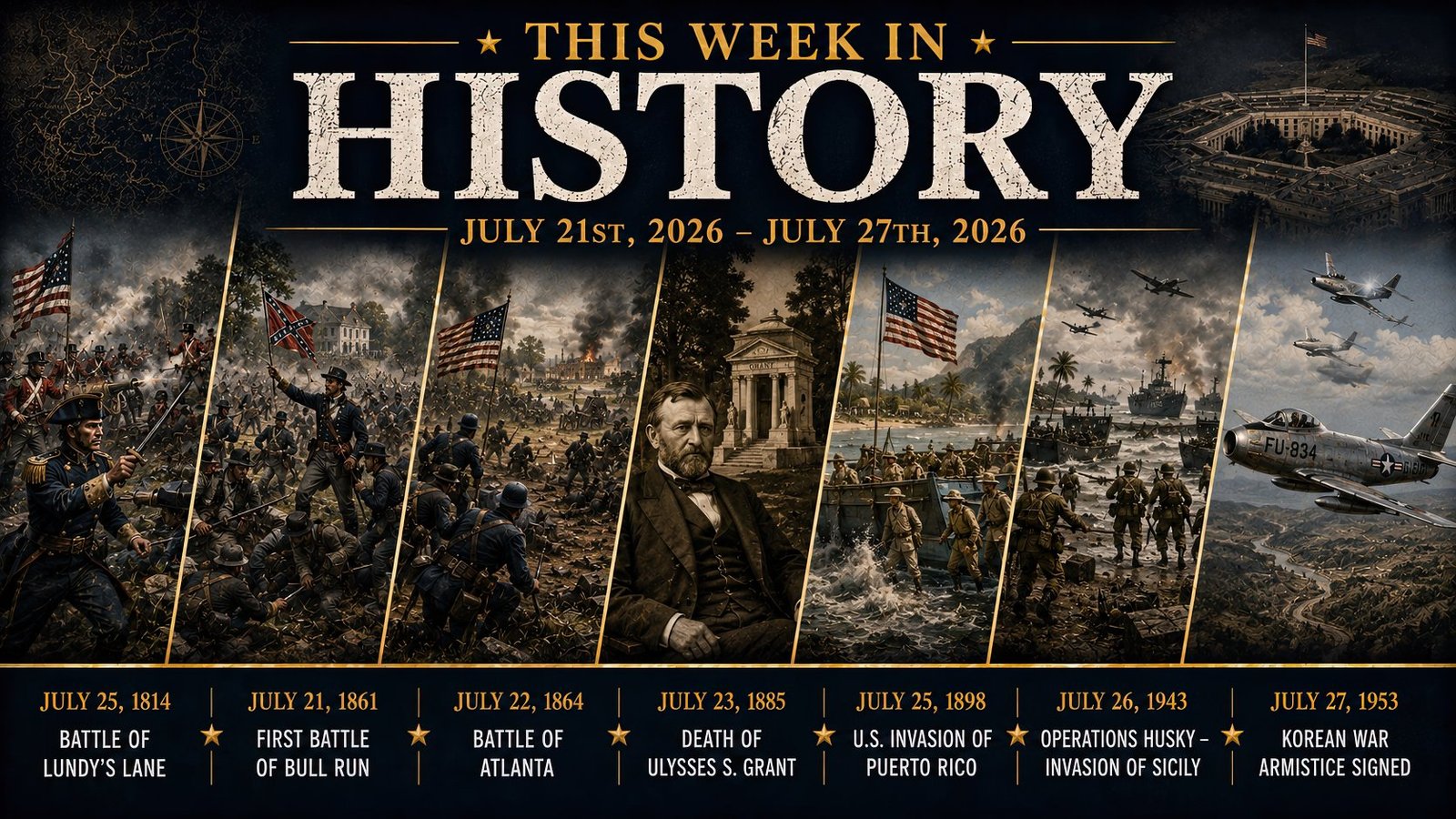
From July 21st, 2026 through July 27th, 2026, the United States military calendar brings together a striking range of anniversaries. In these seven days you can trace a line from musket volleys on a Canadian ridge to jet fighters circling over the Korean Demilitarized Zone. The week includes early nineteenth-century clashes as the young republic pushed back against a global empire, brutal Civil War battles that decided the fate of the Union, and overseas campaigns that signaled the arrival of the United States as a world power. Later entries in the week highlight amphibious assaults across the Pacific, armored thrusts in France, and high-level decisions that built the modern Department of Defense and shaped the Cold War. Along the way we see commanders learning from hard experience, institutions adapting to new technology, and ordinary soldiers and Marines bearing the cost of national strategy. This edition of Dispatch follows those threads across more than a century of conflict and change.
Battle of Lundy’s Lane
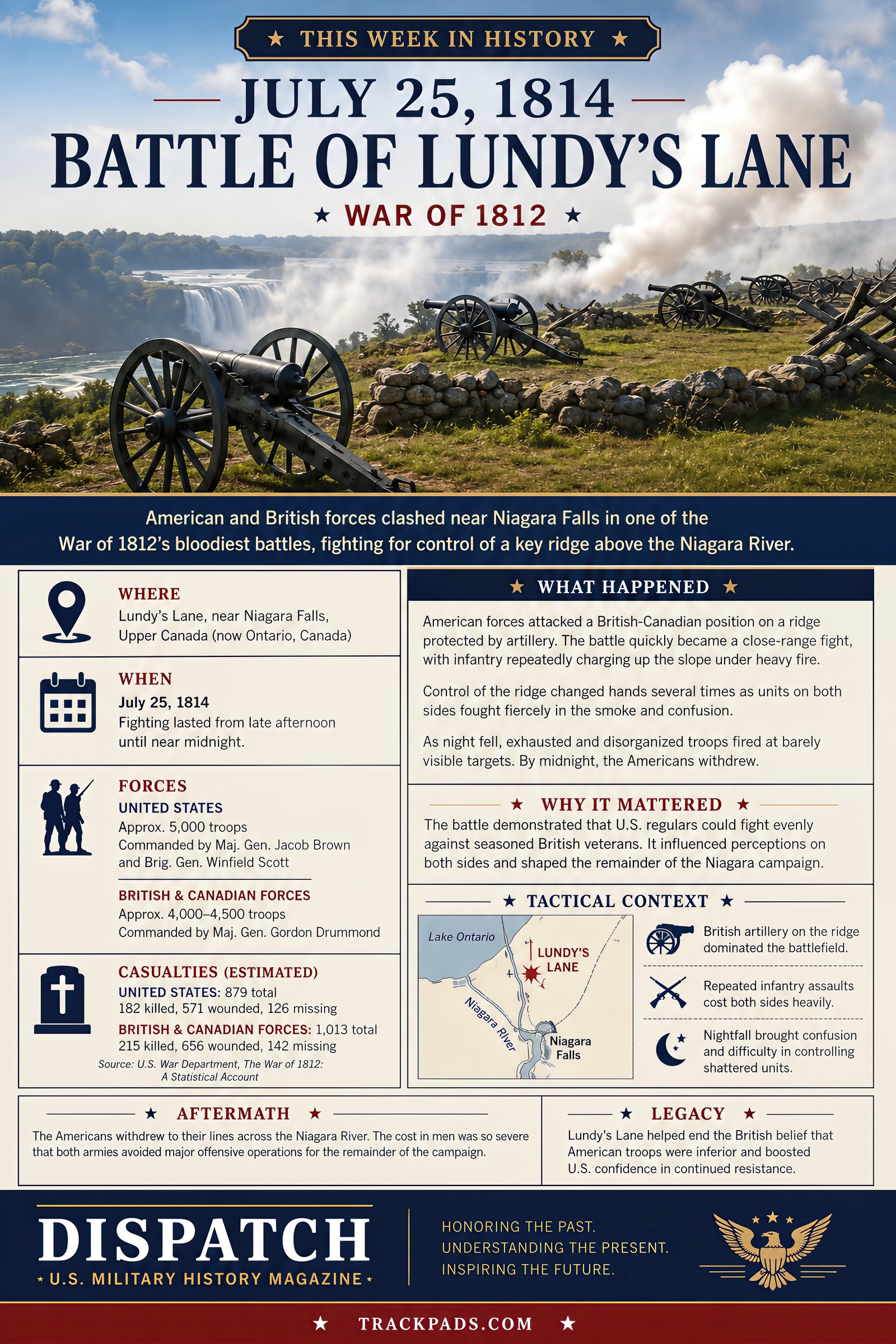
On a summer evening near Niagara Falls, American and British forces collided in one of the War of 1812’s bloodiest battles. United States troops under Major General Jacob Brown and Brigadier General Winfield Scott assaulted a British-Canadian position anchored on a ridge lined with artillery. The fighting quickly turned into a close-range slugging match, with infantry charges going in against loaded guns and both sides trading control of the crest several times. As darkness fell, units sometimes fired at shapes they could barely see, and officers struggled to control shattered regiments. By the time the guns fell silent near midnight, casualties were staggering on both sides and the Americans ultimately withdrew. Tactical results were muddy, but the battle showed that United States regulars, once derided as second-rate, could stand toe-to-toe with combat-tested British veterans, shaping how both sides viewed the rest of the Niagara campaign.
Open the Wiki entryFirst Battle of Bull Run
Just outside Manassas, Virginia, the first major land battle of the Civil War tore away any illusion of a quick, clean victory. Union forces under Brigadier General Irvin McDowell marched out from Washington hoping to strike inexperienced Confederate troops and end the rebellion in a single blow. Instead they found determined opposition and a battlefield that quickly grew chaotic, with brigades feeding in piecemeal and terrain that broke up neat formations. On Henry House Hill, a Virginia brigade under Thomas Jackson earned him the nickname “Stonewall” as they held firm against repeated Union attacks. In the afternoon, coordinated Confederate counterattacks broke the Union line and turned retreat into a panicked rout, even as civilians who had come to watch fled back toward Washington. The defeat shocked the North, convinced leaders that a long, brutal struggle lay ahead, and set both sides on the path of mass mobilization and harder-edged war.
Open the Wiki entryBattle of Atlanta
Three years later and hundreds of miles to the west, another July battle marked a turning point in the struggle to save the Union. Outside Atlanta, Confederate General John Bell Hood launched a bold, flanking assault against Major General William T. Sherman’s forces, hoping to catch Union troops off balance and drive them away from the city. The attack slammed into parts of the Army of the Tennessee, and in the confusion Union commander James McPherson was killed while riding forward to check his lines. Even so, Union infantry and artillery held their ground in savage fighting that raged through woods, fields, and the outskirts of Atlanta itself. By day’s end, Hood’s army had suffered heavy losses it could not replace, while the Union grip around the city tightened. The battle helped set conditions for the eventual fall of Atlanta, a victory that boosted Northern morale and fed directly into Abraham Lincoln’s reelection and the Union’s determination to fight the war through to victory.
Open the Wiki entryDeath of Ulysses S. Grant
Decades after Appomattox, the nation marked the passing of the general who had borne so much of the Union’s burden in the Civil War. Ulysses S. Grant died at a mountaintop cottage in New York after a long illness, having raced the clock to complete his memoirs and provide for his family. The former lieutenant general and eighteenth president had guided the Union armies through the brutal Overland Campaign, siege of Petersburg, and final pursuit of Robert E. Lee. His presidency wrestled with Reconstruction, corruption scandals, and the unfinished work of securing rights for formerly enslaved people, leaving a legacy that historians continue to debate. When news of his death spread, veterans’ groups, civic organizations, and ordinary citizens across the country held memorial services and draped towns in mourning. Grant’s funeral procession in New York City and his grand tomb on the Hudson became enduring reminders of how the United States remembers its military leaders long after the guns fall silent.
Open the Wiki entryUnited States invasion of Puerto Rico
During the Spanish–American War, American forces stepped ashore on the southern coast of Puerto Rico and opened a new front in the conflict with Spain. Troops under Major General Nelson Miles landed near the small harbor of Guánica, taking advantage of surprise and local currents to avoid heavier defenses elsewhere. Initial resistance was limited, but skirmishes soon broke out as Spanish and Puerto Rican troops probed the landings and tried to rally a defense. Over the following days, United States units pushed inland toward key towns and transportation routes, often greeted by mixed reactions from the island’s population. Strategically, the move aimed to knock another Spanish colony out of the war and secure a foothold in the Caribbean at a time when naval bases and coaling stations were vital. The campaign was relatively brief, but it led to Puerto Rico becoming a United States territory, a status that continues to shape debates about identity, citizenship, and service today.
Open the Wiki entrySeventh United States Army captures Palermo
In the middle of the Sicily campaign of the Second World War, Lieutenant General George S. Patton’s Seventh United States Army drove into Palermo and seized one of the island’s most important ports. The advance came after a rapid push along Sicily’s northern coast, with American armored and infantry columns racing over mountain roads and through towns battered by previous fighting. Taking Palermo gave the Allies a deep-water harbor, airfields, and road networks that dramatically improved their ability to feed, fuel, and reinforce troops on the island. It also signaled to both Sicilians and Italians on the mainland that Axis control was crumbling, adding political pressure to an already stressed regime in Rome. The capture sparked some friction with British commanders over priorities and credit, but from a military standpoint it was a major logistical victory. Palermo’s fall helped set the stage for the later crossing to mainland Italy and the long, grinding campaign up the peninsula.
Open the Wiki entryLandings on Guam begin
Three weeks after seizing Saipan, American forces returned to Guam, reclaiming a prewar United States possession that had been lost in the dark days of 1941. Marines and soldiers from the Third Marine Division, the First Provisional Marine Brigade, and the Seventy-Seventh Infantry Division went ashore under heavy fire, forced to slog through surf, coral, and fortified jungle slopes. Japanese defenders had spent months digging in along ridges and ravines, turning the terrain into a layered defensive zone that had to be cleared ridge by ridge. Fighting for beachheads near Asan and Agat was brutal, with counterattacks coming at night and artillery duels echoing across the island. As United States units pushed inland and linked up their lodgments, they slowly crushed organized resistance and began the long process of rooting out remaining pockets. Regaining Guam not only restored a piece of American soil but also provided another key base in the Marianas for airfields, logistics hubs, and naval anchorages supporting the drive toward Japan.
Open the Wiki entryMarine landings on Tinian
Just days after Guam, another carefully planned amphibious assault unfolded on the nearby island of Tinian. American planners studied Japanese defenses and concluded that a direct assault on the obvious beaches would be too costly, so they chose two much smaller, less expected landing sites on Tinian’s northwest coast. Marines went ashore across those narrow strips of sand using specialized landing craft and intense naval gunfire to suppress enemy positions above the cliffs. Once established, they quickly expanded the beachhead and began rolling up Japanese defenses, using combined arms tactics honed in earlier Pacific campaigns. Within days, organized resistance collapsed, and engineers turned to the larger purpose of the operation: building enormous airfields across Tinian’s flat coral plain. Those runways would soon host B-29 bombers conducting long-range raids on the Japanese home islands, including the aircraft that carried the first atomic bombs, making Tinian a quiet but decisive piece of the strategic bombing campaign’s backbone.
Open the Wiki entryOperation Cobra begins
On the far side of the world, the same date saw the United States First Army launch a long-awaited breakout from the Normandy hedgerows. After weeks of slow, attritional fighting among the bocage lanes, Operation Cobra aimed to shatter German defenses west of Saint-Lô with a massive aerial bombardment followed by concentrated armored and infantry thrusts. The opening air attack inflicted terrible damage on German positions but also caused tragic friendly fire casualties among American troops when bombs fell short. Despite this, units regrouped, punched through weakened enemy lines, and exploited the breach with tank and mechanized columns rolling south. German forces, already strained and short of reserves, began to collapse under the pressure, leading to encirclements and rapid advances across Brittany and toward the Seine. Cobra transformed the Normandy campaign from a slog into a war of movement and opened the door to the liberation of Paris and the drive toward Germany’s western borders.
Open the Wiki entryPotsdam Declaration issued
As fighting still raged in the Pacific, leaders of the United States, Britain, and China issued a stark ultimatum to Japan from their conference outside Berlin. The Potsdam Declaration called on Japan to surrender unconditionally or face “prompt and utter destruction,” while also sketching the outlines of postwar occupation, disarmament, and the rebuilding of Japanese society. For American military planners, the declaration framed the choices ahead: continue conventional bombing and blockade, prepare for a costly invasion of the home islands, or introduce newly tested atomic weapons. Japanese leaders responded cautiously, with some hoping to secure better terms and others wary of complete capitulation, a delay that would prove fateful. In the weeks that followed, the language of Potsdam was woven into public statements and military orders as the United States sought to justify its approach to ending the war. The declaration thus stands as both a diplomatic document and a milestone on the road to the nuclear age.
Open the Wiki entryNational Security Act signed
Two years later to the day, President Harry S. Truman signed legislation that fundamentally reshaped how the United States organizes for war and peace. The National Security Act merged the Department of War and Department of the Navy into a unified National Military Establishment under a Secretary of Defense, later renamed the Department of Defense. It created the United States Air Force as a separate service, formalizing the central role of air power that had been proven in the Second World War. The act also established the National Security Council to coordinate strategy across military, diplomatic, and domestic lines, and created the Central Intelligence Agency to gather and analyze information worldwide. For officers and civil servants, this meant new chains of command, new staff processes, and a more permanent, peacetime structure for managing global commitments. The framework born on that July day remains the backbone of American defense and intelligence organization into the twenty-first century.
Open the Wiki entryKorean War armistice signed
On the Korean peninsula, three years of brutal fighting ended with signatures on a document at Panmunjom, not with a victory parade. Delegates representing the United Nations Command, North Korea, and China agreed to a cease-fire that froze front lines near where they had started, around the Thirty-Eighth Parallel. The agreement established the Demilitarized Zone, a fortified strip of land that remains one of the most heavily guarded borders in the world. For American soldiers, Marines, airmen, and sailors who had fought their way from the Pusan Perimeter to the Yalu and back again, the armistice meant an end to open combat but not a clear sense of triumph. Families at home welcomed the news that casualties would no longer mount, even as many wondered what lasting peace would look like. The Korean armistice became a template for limited war in the nuclear age, showing how the United States might fight hard, negotiate, and then stand watch for decades along a tense frontier.
Open the Wiki entryAcross the Week
Across these seven days on the calendar, the anniversaries trace a journey from fragile young republic to global power wrestling with the responsibilities of alliances, deterrence, and long-term commitments. They show American forces learning to fight in line and column, in trenches, from the sea, and through the air, while political leaders reshape institutions to meet new dangers. Some moments are clearly triumphant, others are ambiguous, and many involve costs that are easiest to see in the lives of those who served and the communities that received them home. Yet taken together, they remind us that military history is not just a list of battles won and lost, but a record of adaptation, sacrifice, and the constant tension between war’s violence and the desire for stability. As you look at this week’s dates, it is worth considering how decisions made in fields, conference rooms, and cabinet meetings long ago still shape the uniforms, missions, and alliances of today’s force.