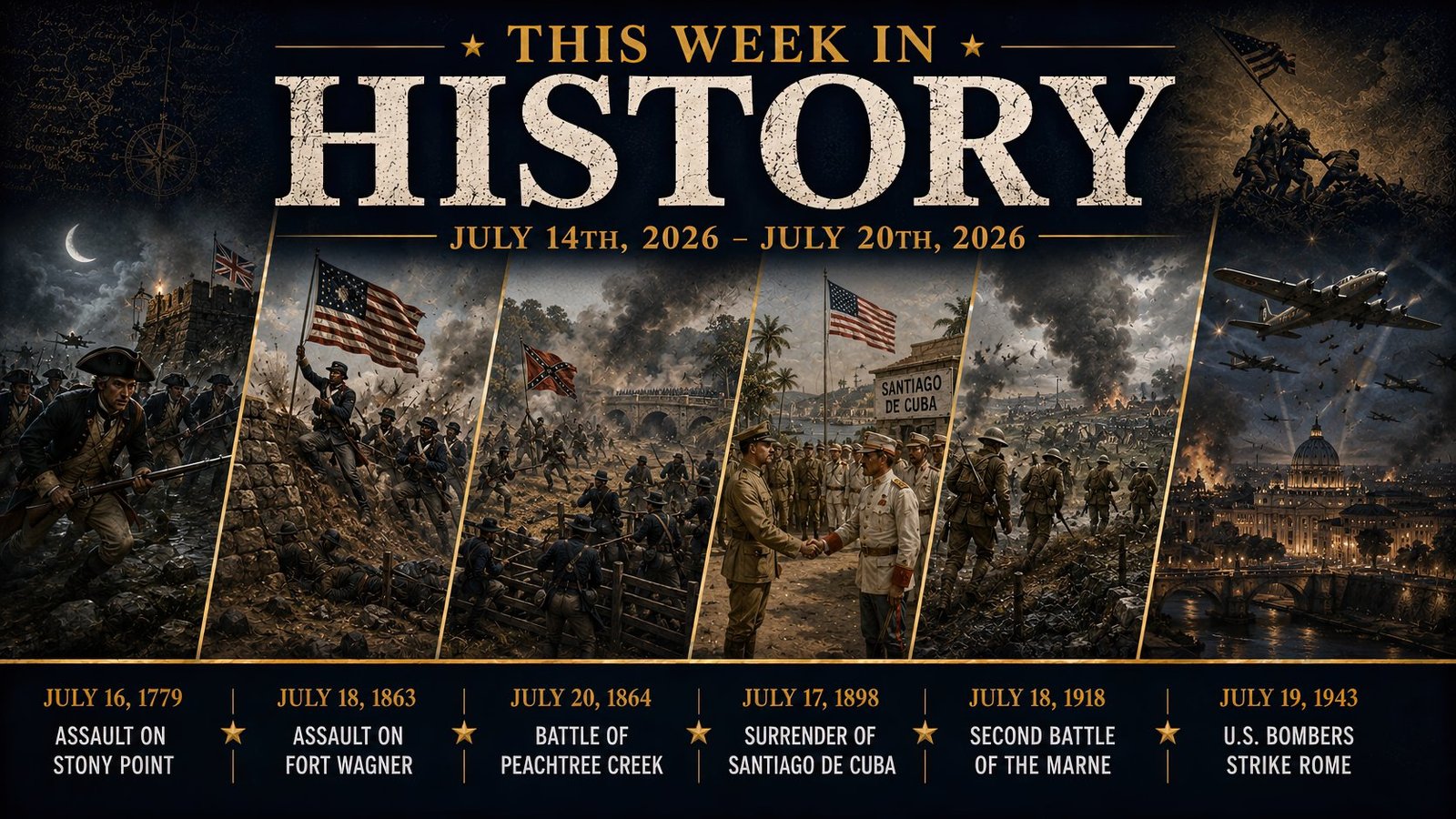
The calendar week from July 14th, 2026 through July 20th, 2026 connects some of the most daring, tragic, and transformative moments in United States military history. Across these dates, we see night attacks led with bayonets and quiet calculations in a desert that opened the nuclear age. We follow soldiers advancing through Civil War earthworks and along hedgerow-lined roads in Normandy, sailors loading munitions on a California pier, and aircrews guiding heavy bombers toward one of Europe’s oldest cities. The stories range from battlefield victories that shifted campaigns to disasters that forced hard conversations about race, safety, and leadership in uniform. Together, they remind us that military history is not just a sequence of battles, but a record of choices, risks, and consequences that still echo in strategy, technology, and the lives of service members today.
Assault on Stony Point
In the summer of the Revolutionary War, British forces held a fortified outpost at Stony Point on the Hudson River, threatening American communications and morale. General George Washington approved a bold plan for a nighttime assault led by General Anthony Wayne and a specially selected light infantry corps. With unloaded muskets and fixed bayonets, Wayne’s men advanced in silence, relying on discipline and surprise to overwhelm the British defenses. After fierce close-quarters fighting in the dark, the Americans captured the position in a matter of minutes, suffering relatively light casualties for such a risky operation. The victory at Stony Point did not permanently change the strategic balance along the Hudson, but it proved that the Continental Army could execute complex assaults as well as any European force. It became a symbol of resilience at a moment when the struggle for independence remained uncertain.
Open the Wiki entryAssault on Fort Wagner
Outside Charleston, South Carolina, a sand and earth fortification called Fort Wagner guarded the approaches to the harbor and symbolized Confederate defiance. On the evening of July 18th, 1863, the 54th Massachusetts Volunteer Infantry, one of the first African American regiments raised in the Union Army, led a frontal assault across a narrow strip of beach under heavy artillery and rifle fire. Their colonel, Robert Gould Shaw, fell at the head of his men as they reached the enemy parapet, and the regiment suffered devastating casualties in brutal hand-to-hand combat. The attack failed to seize the fort, but the courage displayed by the 54th Massachusetts challenged prejudices about Black soldiers and their place in combat units. In the months that followed, their example helped spur wider enlistment of African American troops, giving the Union Army a crucial infusion of manpower that would shape the remainder of the war.
Open the Wiki entryBattle of Peachtree Creek
As Union forces closed in on Atlanta during the summer of the Civil War, Confederate leadership underwent a dramatic change. General John Bell Hood replaced Joseph E. Johnston and immediately sought to seize the initiative with aggressive attacks. On July 20th, 1864, Hood hurled his troops against the Army of the Cumberland as it crossed Peachtree Creek north of the city, hoping to catch Union units strung out and vulnerable. Instead, Union soldiers quickly formed defensive lines, repelled repeated assaults, and inflicted heavy casualties on the attacking Confederates. The failure at Peachtree Creek weakened Hood’s army just as it needed to conserve strength for the battles still to come around Atlanta. The engagement became one of several costly Confederate gambles that ultimately could not prevent the city’s fall, a blow with major political and military consequences for the wider war.
Open the Wiki entrySurrender of Santiago de Cuba
During the Spanish–American War, the Cuban city of Santiago became the focal point of United States operations on land and sea. After the destruction of the Spanish fleet outside the harbor and hard fighting on heights like San Juan and Kettle Hill, Spanish forces inside Santiago found themselves isolated and outgunned. On July 17th, 1898, they formally surrendered the city to United States forces, ending organized resistance in that sector of the campaign. The fall of Santiago effectively broke Spanish military power in Cuba and accelerated negotiations that would end the war. Beyond the immediate battlefield, the surrender signaled the arrival of the United States as a significant overseas power, with new responsibilities and debates over empire, occupation, and the future of territories such as Cuba, Puerto Rico, and the Philippines.
Open the Wiki entrySecond Battle of the Marne counteroffensive
By mid-1918, German armies in France had driven a dangerous salient across the Marne River, threatening Paris and hoping to win the war before American troops could arrive in strength. In the early hours of July 18th, French and American forces launched a coordinated counteroffensive, striking the exposed flanks of the German position near Soissons and along the Marne. American divisions, including units such as the 1st and 2nd Divisions, advanced through woods and wheat fields under heavy fire, learning modern combined-arms warfare in some of the toughest conditions of the Great War. Their attacks helped blunt the German offensive and began the steady push that would drive the enemy back toward the Rhine over the months ahead. For the United States, this was one of the first operations where its forces played a central role in turning the tide on the Western Front, demonstrating that the American Expeditionary Forces could fight alongside seasoned Allied armies as equals.
Open the Wiki entryU.S. bombers strike Rome
By the summer of the Second World War, Allied forces were fighting their way up the Italian boot while strategic air forces targeted the infrastructure that kept Axis armies supplied. On July 19th, 1943, hundreds of bombers from the United States Army Air Forces and the Royal Air Force attacked rail yards and communications nodes in and around Rome. The strikes aimed to disrupt German logistics and pressure Italy’s leaders at a moment when the regime of Benito Mussolini was already wobbling. The bombing inflicted serious damage to transportation networks but also caused heavy civilian casualties, sparking outrage and sorrow in a city sacred to many faiths. The raid underscored the growing power of Allied air forces and their ability to reach deep into Axis territory, even as it raised enduring questions about the human cost of strategic bombing in modern war.
Open the Wiki entryPort Chicago explosion
While soldiers and sailors fought overseas, the home front carried its own risks. At Port Chicago Naval Magazine in California, largely African American enlisted sailors worked dangerous shifts loading ammunition onto ships bound for the Pacific. Shortly before midnight on July 17th, 1944, a massive explosion tore through the pier and two munitions-laden ships, killing three hundred twenty men and injuring many more in one of the deadliest home-front disasters of the war. In the aftermath, surviving sailors raised concerns about unsafe practices and unequal treatment, and a significant number refused to resume loading under the same conditions. The ensuing court-martials, often referred to as the Port Chicago mutiny cases, highlighted racial inequities within the Navy and contributed to later debates over desegregation and fair treatment in the armed forces. The tragedy stands as a reminder that issues of leadership, training, and justice matter as much in supporting roles as they do on the front lines.
Open the Wiki entryCapture of Saint-Lô
In Normandy, weeks after the D-Day landings, American forces found themselves locked in a grinding struggle through hedgerow country that favored the German defenders. The town of Saint-Lô, a key road junction, became a vital objective for United States units trying to break out of the constricted beachhead. After days of intense fighting, artillery barrages, and house-to-house clearing, American troops finally secured the shattered town on July 18th, 1944. The capture of Saint-Lô opened crucial routes for armor and infantry, setting the stage for the larger breakout operation that would follow to the west. Though the town itself lay in ruins, its seizure marked a turning point in the Normandy campaign, showing that United States forces could overcome difficult terrain, tenacious resistance, and heavy casualties to push the front line decisively forward.
Open the Wiki entryTrinity nuclear test
In a remote stretch of New Mexico desert, the United States Army’s Manhattan Engineer District prepared to test a weapon unlike any used before. In the early hours of July 16th, 1945, scientists and soldiers watched as the “Gadget,” an experimental plutonium device, detonated atop a tower at the Trinity site. The explosion produced an intense flash, a rising fireball, and a towering mushroom cloud that confirmed the destructive potential of nuclear fission weapons. For the officers overseeing the project, the test meant that similar bombs could soon be delivered against Japan, with consequences they could only partially imagine. Trinity ushered in a new era in military strategy, one in which the United States and, later, other nations would grapple with weapons capable of annihilating cities in a single strike and reshaping the balance of power for generations.
Open the Wiki entryFall of Taejon
In the early weeks of the Korean War, United States forces rushed to slow a North Korean advance that threatened to overrun the entire peninsula. Around the city of Taejon, elements of the 24th Infantry Division fought a desperate delaying action, outnumbered and facing tanks and artillery in unfamiliar terrain. Over several days of close combat and street fighting, American troops inflicted significant losses but gradually found themselves cut off and forced to withdraw. On July 20th, 1950, Taejon fell, and the division commander, Major General William Dean, was captured while trying to regroup his men. Despite the defeat, the stand at Taejon bought precious time for additional United States and United Nations units to assemble farther south. That breathing room helped make possible the defense of the Pusan Perimeter, a last-ditch line that would hold long enough for a successful counterstroke at Inchon later that year.
Open the Wiki entryApollo 11 lunar landing
Although conducted by a civilian space agency, the Apollo program drew heavily on rocket, guidance, and communications technology developed alongside the United States military during the Cold War. On July 20th, 1969, the lunar module Eagle descended to the Moon’s surface while the command module Columbia orbited overhead, all under the watchful eyes of controllers on Earth. When Neil Armstrong and Buzz Aldrin stepped onto the lunar surface, they fulfilled a national goal set earlier in the decade in direct competition with a strategic rival. The landing showcased American engineering, navigation, and systems management skills that had clear implications for satellites, missiles, and global communications. It also offered a rare moment of shared pride during a turbulent period, reminding service members and civilians alike of what sustained effort, investment, and teamwork could achieve. The mission became a defining milestone in both space history and the broader story of American power and possibility.
Open the Wiki entryAcross the Week
Over this single set of dates, we see American arms at Stony Point and Saint-Lô, on Cuban hillsides and Korean streets, and even in the silent vacuum of space. Some of these episodes brought clear battlefield victories, while others revealed hidden fractures at home or opened doors to technologies whose consequences are still unfolding. Taken together, they show a military that learns, adapts, and sometimes pays dearly as it moves from bayonet charges to strategic bombing, nuclear deterrence, and spaceflight. For readers of Dispatch: U.S. Military History Magazine and followers of “This Week in U.S. Military History,” these stories offer more than anniversaries; they invite reflection on service, sacrifice, and the responsibilities that come with power. As we mark this week’s dates, we also honor the people behind the headlines, from infantrymen in the dark at Stony Point to sailors on a munitions pier and aircrew guiding a spacecraft toward the Moon.