Dawn Launch Over an Empty Horizon
It is early morning in May 1942 in the Coral Sea, and the flight deck of an American carrier thrums like a living thing. Sailors in colored shirts race between parked aircraft, chocking wheels, tugging on tie-downs, and peeling back covers as engines cough, sputter, and finally roar into steady life. The smell of fuel and hot oil mixes with salt spray and wind, while on the bridge above, officers stare out over an empty horizon that hides a powerful Japanese force somewhere beyond the curve of the earth. Below decks, signalmen stand by radios, straining to catch the latest fragment of contact reports from scouts that have yet to find their prey.
Pilots climb into cockpits, strap in, and glance once more at the hand-sketched maps taped near their knees. There is no silhouette of a battleship or cruiser in sight, no enemy mast to aim at, only bearings, distances, and the promise that somewhere out there, Japanese carriers and invasion ships are pushing toward Port Moresby and the approaches to Australia. The order finally comes, and one after another, bombers and fighters lunge forward, wheels rattling on the planks before leaping into the gray sky. As they climb and fan out, the carrier that launched them shrinks to a speck behind their shoulders.
The Battle of the Coral Sea is about to become something new in naval history: a clash where the main striking arms are aircraft that will hunt enemy ships they may never see until the final seconds of a bombing run, and where the opposing surface fleets remain ghosts to one another. In that moment, as the first waves head off toward uncertain targets, the men on those decks and in those cockpits stand on the edge of a fight that will test not just courage and skill, but the very idea of how wars at sea are fought.
If Port Moresby Falls, a Door Opens South
To understand why this empty stretch of ocean matters, you have to pull the camera back from the flight decks to the map of the entire Southwest Pacific. It is spring 1942, and Japan has already swept across much of the western Pacific, taking strongholds from Hong Kong and Singapore to the Philippines. The next step in that advance is aimed at tightening the noose around Australia, cutting its lifelines, and pushing the front line ever closer to the continent’s northern shores. The immediate objective is Port Moresby on the southeastern coast of New Guinea, a key Allied base guarding the approaches to northeastern Australia and the vital sea lanes that feed it.
If the Japanese invasion force gets safely down the Solomon Sea and places troops ashore near Port Moresby, they gain airfields and staging points that extend their reach far to the south. From there, land-based bombers can threaten shipping routes and bases that support American and Australian forces. The Allies know that once those airfields are in enemy hands, pushing the line back will come at a terrible price in ships, aircraft, and lives. For Australia, still reeling from the fall of nearby territories and Japanese raids, the psychological blow of another major outpost falling would ripple through politics and public confidence.
On the Japanese side, the plan promises to lock in a protective shield for their wider Pacific perimeter, giving their navy freedom to look east toward other objectives. On the American and Allied side, the carriers in the Coral Sea—centered around the United States Navy’s Yorktown and Lexington, alongside Australian cruisers and destroyers—are the only tools available to strike at the invasion without major bases nearby. The surface fleets will maneuver and feint, but the outcome will hinge on pilots flying deep over open water with only rough coordinates and courage, trying to smash a convoy and its carrier cover before it can close with New Guinea. That is why this quiet-looking sea, days away from any big port, earns a headline: because what happens here will decide whether a door toward Australia swings open or stays barred.
Codes, Convoys, and Carriers Converge
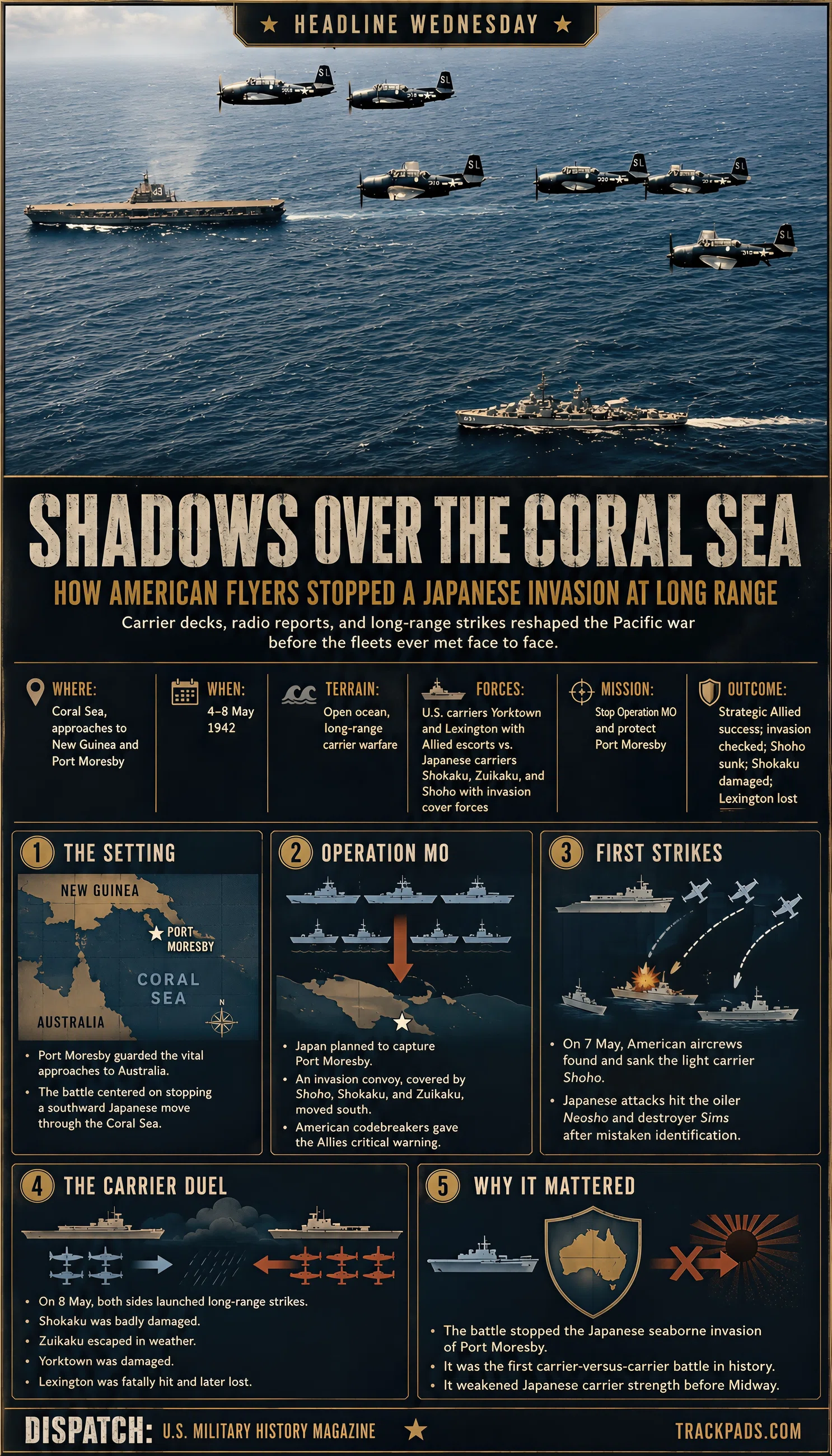
The road to the Coral Sea begins months earlier, as Japanese planners sketch out Operation MO, a thrust to capture Port Moresby and isolate Australia. Their blueprint combines a convoy of transports with covering forces built around the fleet carriers Shokaku and Zuikaku and the light carrier Shoho, plus cruisers and destroyers. On the other side of the Pacific, American codebreakers in Hawaii grind through intercepted signals and, piece by piece, realize that something large is taking shape aimed at New Guinea and the approaches to Australia. The picture is blurry and full of gaps, but one thing is clear enough: if the Allies do not meet this move at sea, they may not get another clean shot at stopping it before it reaches land.
Admiral Chester Nimitz sends what he can. The carriers Yorktown and Lexington, veterans of earlier hit-and-run raids, are pushed into the Coral Sea with a mixed escort of cruisers and destroyers, joined by Australian warships that know these waters better than anyone. The crews are still learning the art of modern carrier warfare on the fly, moving from the old idea of battleship lines toward a new world where the main blow comes from aircraft hundreds of miles away. Pilots train in long overwater navigation and coordinated strikes, but they have limited real combat experience against a well-organized enemy carrier force. Fuel, spare parts, and replacement aircraft are all finite and must be husbanded carefully.
Both sides set up complex search plans, sending out patrol planes to sweep the sea in great arcs, hoping to catch a glimpse of masts or wakes before the enemy does the same to them. Weather, long distances, and the sheer size of the ocean create gaps large enough for entire task forces to hide in plain sight. Early in May, Yorktown makes a swift strike against Japanese positions at Tulagi, signaling that the Americans are willing to hit hard even as they grope for the main body. Misidentifications, garbled contact reports, and the constant fear of stumbling into a trap haunt every staff table and ready room. By the time the Japanese invasion convoy and the American-Allied carrier force close in on the same patch of sea, both sides are keyed up, partially informed, and committed to a battle whose shape no one has seen before.
Misreads, First Strikes, and Flame
When the shooting finally begins in earnest, it does not look like the classic fleet actions of earlier decades. Instead, it unfolds as a series of long-range air strikes launched on fragmentary sightings, each side convinced they have found the other’s main force. On 7 May, American scouts report what they believe to be enemy carriers near the convoy. In reality, they have located the light carrier Shoho and her escorts covering the approach to the Jomard Passage. That distinction matters little to the aircrews ordered into the sky. Waves of dive-bombers and torpedo planes from Lexington and Yorktown punch through the defending fighters and anti-aircraft fire, peeling off into steep dives that end with explosions and towering columns of smoke as bombs and torpedoes tear into Shoho.
From the vantage point of the American pilots, the light carrier becomes a burning, twisting target amid flak bursts and frantic ship maneuvers. Some crews later remember seeing the flight deck ripped open, aircraft tossed like toys, and the carrier slowing under the hammer blows. On the Japanese side, sailors fight to bring hoses to bear and launch defensive fire while the ship lists and flames spread across fuel-soaked surfaces. Within a short span of time, Shoho is mortally wounded and going down, a shocking loss for a navy that has grown used to rapid, almost effortless victories. The sinking marks the first Japanese carrier lost in the Pacific war and a proof that American carrier aviation can strike decisively when it finds its mark.
Yet even as Shoho dies, Japanese aircrews are hunting targets of their own on the strength of their own misread reports. Their fliers locate and savage the oiler Neosho and the destroyer Sims, believing they have hit a carrier and a major escort. The American crews on those smaller ships endure their own ordeal of bomb blasts, flames, and sinking metal, but the main carriers remain untouched for the moment. The battle is already a contest of mistaken identities and partial victories. The next day, 8 May, both sides at last get something closer to the clash they have been bracing for. Strikes launch almost simultaneously: American bombers and torpedo planes claw their way toward Shokaku and Zuikaku through bad weather and aggressive fighters, while Japanese attack groups home in on Lexington and Yorktown.
Over the Japanese carrier force, American dive-bombers punch through the clouds and seize fleeting chances. Bombs slam into Shokaku, shredding her flight deck and making flight operations nearly impossible, while Zuikaku slips away into worsening weather, shielded as much by nature as by escorting ships. On the American side, attack alarms sound aboard Lexington and Yorktown as incoming raids are reported. Fighters scramble, anti-aircraft guns open up, and crews brace for impact as torpedoes and bombs come slashing in. By the end of that day, Lexington is fatally damaged, wracked by explosions and fires that cannot be contained, and must be abandoned to the sea. Yorktown is battered but still afloat and able to steam. As smoke drifts across the waves and damaged ships limp away, neither side can yet be sure who has truly won. The shape of the fight’s turning point is there in the wreckage and damage reports, but its meaning will only come into full focus in the hours and days ahead.
Damaged Decks and Broken Timetables
The fight’s true turning point lies less in a single dramatic explosion than in the state of the surviving carriers and their calendars. On paper, losing Lexington is a heavy blow for the United States, stripping the Pacific Fleet of a big deck and many aircraft in one afternoon. But look across the water at the Japanese task force in the hours after the strikes of 8 May, and another picture emerges. Shokaku’s flight deck is torn up by bomb hits, her ability to launch and recover large air groups crippled until she can reach a major yard. Zuikaku’s hull is intact, but her air group is mauled, scattered, and low on experienced pilots after two days of combat in bad weather and heavy opposition.
The Japanese plan for Operation MO depended on having strong carrier cover to shield the invasion convoy moving toward Port Moresby and to fend off Allied surface forces. With one light carrier sunk, one fleet carrier badly damaged, and the other short of aircraft and still shadowed by American forces, the neat lines and timing in the operation order begin to fray. Commanders must weigh whether to push ahead with a landing under uncertain cover or preserve their carriers for future operations that are already on the Imperial Navy’s horizon. Every delay increases the risk that the Allies will shift more air and sea power into the region.
On the American side, the loss of Lexington hurts in ships and men, but Yorktown’s survival matters more than it may appear to sailors standing among her patched plates and spattered paint. She can still steam, still launch aircraft, and, crucially, still be turned around for the next major operation once emergency repairs are complete. Intelligence officers and planners, looking at damage reports and fuel states, see that while the ledger of sunk and damaged hulls may be argued over, the net effect is that Japanese carrier strength in the South Pacific is too compromised to protect the Port Moresby convoy. In that sense, the battle’s turning point is not a single torpedo or bomb, but the cumulative effect of many hits and losses that make the original Japanese timetable impossible to keep. What began as a clash over one invasion now feeds directly into the balance of carrier power for the next, even larger fight to come.
From a Remote Sea to a Wider War
In the immediate aftermath, the Coral Sea looks like a bloody draw. Lexington lies on the bottom, along with Neosho, Sims, and Shoho. Shokaku limps away wounded, Zuikaku’s air group is thinned, and Yorktown steams out with scars that will need quick work in port. Both sides issue communiqués that emphasize enemy losses and claim success. But the deeper measure is not how many ships sank in that patch of ocean; it is what happened to the invasion of Port Moresby and to the broader Japanese plan. With carrier cover compromised and the risk of further American strikes rising, Japanese leaders call off the seaborne assault on Port Moresby. The convoy turns away. The airfields and harbor that were supposed to become a forward base for threatening Australia remain in Allied hands.
That single decision reshapes the map of the Southwest Pacific. From Port Moresby, Allied forces will later push over the Owen Stanley Mountains along the Kokoda Track, turning New Guinea into a grinding, costly campaign rather than a quick stepping stone for Japanese power. The Coral Sea also marks the first time in the Pacific war that a major Japanese advance is stopped before it reaches its objective. It is not the clean, crushing victory that later stories sometimes crave, but it is the moment when the seemingly one-way tide of expansion meets a hard edge at sea and gives way.
Even more important, the battle teaches both navies hard lessons about carrier warfare. Admirals and air group leaders pore over reports and realize just how much long-range scouting, coordination between dive-bombers and torpedo planes, weather, radar, and codebreaking shape outcomes before the first bomb falls. For the Japanese, the damage to Shokaku and the depletion of Zuikaku’s air group will help keep both carriers out of the next great carrier showdown at Midway, narrowing their margin of strength. For the United States, the battered but surviving Yorktown will be hurried into that same fight, giving the Pacific Fleet just enough deck space to seize the initiative.
For modern readers, staff-ride planners, and museum visitors, the Coral Sea still matters because it marks the moment when naval war became a contest of information, reach, and airpower over the horizon. It shows how decisions made with incomplete contact reports in a far-off sea can change the fate of cities, allies, and entire campaigns. And it reminds us that sometimes a battle’s most important result is not who sails away looking stronger, but whose plans are quietly broken beneath the waves.