Morning Raids Over the Marianas
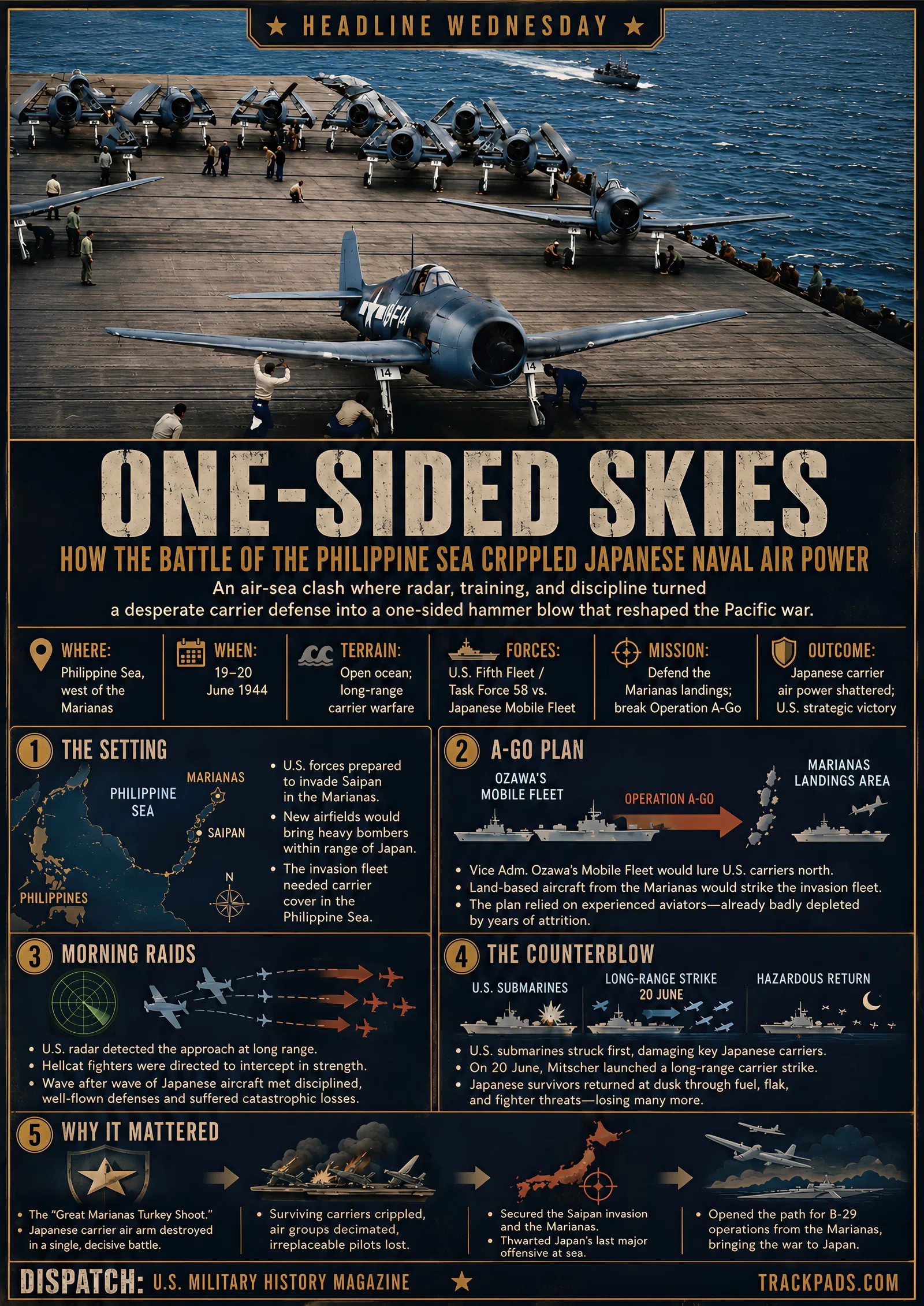
The morning sun over the Philippine Sea turned the tops of the swells into bright, hard plates of light as the American carriers cut their way west of the newly invaded Marianas. On the flight decks, yellow, blue, red, and green jerseys moved in practiced patterns around rows of F6F Hellcats, while the smell of high-octane fuel and hot oil hung over the ships. Inside the flag plots, the first radar contacts began to bloom on the screens: distant specks of energy far out to the west, a sign that Japan’s carrier air arm was reaching for the invasion fleet around Saipan. Controllers began to vector fighters toward the incoming formations, and young pilots strapped in, throttles forward, wheels rolling toward the catwalk edge.
Moments later, the sky above the deep blue sea filled with noise and motion. Hellcats clawed into the air in long, staggered lines, climbing toward the sun as they followed calm, clipped directions from fighter-control officers who could see the raid long before human eyes could. Far ahead, Japanese bombers and torpedo planes droned eastward, many flown by men with far fewer hours in the cockpit than the Americans racing to meet them. As the range closed, the first dogfights erupted: contrails twisting, tracers arcing, aircraft dropping out of formation trailing smoke or fire.
What followed felt, to many American pilots, brutally lopsided. Experienced fighter leaders rolled their sections into attack runs with textbook precision, cutting through disorganized Japanese formations, breaking up torpedo attacks before they ever reached the screening destroyers and cruisers. Below, gunners on the ships stood ready at their stations, eyes scanning for the few attackers that slipped through the airborne gauntlet. By late morning, the waters around the Fifth Fleet were littered with wreckage and oil slicks, and the air over the Marianas belonged overwhelmingly to the United States. Yet these swirling dogfights were only one part of a much larger gamble, on a day when the future of carrier warfare in the Pacific hung in the balance.
If the Fleet Breaks Here
Behind that violent meeting in the sky stood a campaign with enormous stakes. American troops had gone ashore in the Marianas to seize Saipan, Tinian, and Guam, islands whose airfields could bring four-engine bombers within direct reach of Japan’s home islands. Holding those beaches required more than courage on the sand. It depended on the shield of the United States Fifth Fleet and its fast carrier striking force, Task Force 58, keeping Japanese naval air power from smashing the transports, supply lines, and fire support ships clustered around the islands. If that shield cracked, the landings could be isolated and starved, and the entire Pacific advance would slow or even stall.
Japan’s high command understood this and threw its remaining carrier strength into a major effort to break the American offensive. Admiral Jisaburo Ozawa’s Mobile Fleet sailed with an impressive list of carriers still afloat on paper, but years of attrition had drained its reservoir of trained aviators. Across the horizon, facing him, stood Admiral Raymond Spruance’s Fifth Fleet and Vice Admiral Marc Mitscher’s fast carriers, forces that had been blooded and refined in earlier carrier battles and raids. The skies over the Philippine Sea would reveal whether Japanese carriers could still project decisive power, or whether they had already been hollowed out by losses that could not be replaced.
For Washington, success promised more than just another island group on the map. Secure bases in the Marianas meant a new phase of the war, with strategic bombing campaigns made possible and the Japanese Navy pushed further back toward its home waters. For Tokyo, a disaster at sea risked more than ships and aircraft. It threatened prestige, the ability to protect distant garrisons, and any remaining hope of stopping the American drive across the Central Pacific. The Battle of the Philippine Sea therefore became more than a series of air raids and interceptions. It was a test of two systems of training, doctrine, and industrial strength, compressed into a single clash of fleets in the wide, deceptively calm waters west of the Marianas.
From Attrition to “A-Go”
The road to the Philippine Sea ran through years of grinding attrition in the Pacific. Japan entered the war with a tight core of highly trained naval aviators and a doctrine that prized aggressive, long-range strikes from fast carriers. Battles like Coral Sea and Midway, followed by the long struggle around Guadalcanal, burned through that core. Every downed pilot was hard to replace, and training pipelines could not keep up with the pace of loss. By 1944, Japanese carrier decks were often filled with younger, less experienced aircrews who had seen far more classrooms than combat. The hulls were still there, but the talent inside the cockpits had thinned dangerously.
On the American side, carrier warfare had grown into a system that linked radar, fighter direction, mass production, and training into a single machine. The United States could not bring back pilots lost early in the war, but it could produce wave after wave of new ones and give them extensive carrier landing practice, gunnery training, and time in the air before combat. Earlier carrier clashes had exposed flaws in communications, coordination, and doctrine; by the time Task Force 58 moved to cover the Marianas landings, many of those lessons had been absorbed. Fast carriers, modern fighters, and a dense screen of cruisers and destroyers formed a mobile shield that could absorb blows and strike back rapidly.
In Tokyo, a new plan tried to turn these trends back. Operation A-Go envisioned using land-based aircraft from the Marianas and other island fields together with the Mobile Fleet’s carriers to smash the advancing American forces in one decisive engagement. Admiral Ozawa would bring his carriers forward, hoping to lure the American fast carriers into a killing zone where Japanese land-based air units could join the fight. In Washington and Pearl Harbor, American codebreakers and reconnaissance had already given hints of a coming major operation. As American troops waded ashore on Saipan in June 1944, Spruance and Mitscher knew a fleet battle was likely. They chose to keep the fast carriers close enough to shield the invasion force, even if it meant sacrificing some freedom to roam in search of the enemy, setting the stage for a clash decided primarily in the air.
Raids, Submarines, and a Long Return Home
When the shooting started in earnest on 19 June, it came in waves. Japanese search planes located the American carriers at long range, and Ozawa committed his carrier air groups to a series of large raids. On the American side, radar picket ships and combat information centers began to track the inbound formations while they were still far out over the water. Controllers on board the carriers and cruisers directed Hellcat squadrons into position, sending them climbing to intercept before the enemy could reach the fleet. Each raid broke against layered defenses: first the combat air patrols, then heavy anti-aircraft fire from the outer screen, and finally the dense flak walls around the carriers themselves.
The results reflected the imbalance in training, equipment, and coordination. Many Japanese formations arrived over the American screen already scattered and depleted by fighter attacks. Bombs fell, torpedoes were dropped, and individual pilots pressed home brave runs, but only a handful of weapons found their mark. One battleship suffered damage from a bomb, and some ships took near misses and splinter hits, yet the fleet as a whole remained intact. By contrast, the sky and sea filled with downed Japanese aircraft and survivors in the water, proof of how costly each raid had become. It was during this same day that American submarines stalking the Japanese fleet struck their own blows, torpedoes ripping into key carriers and removing them from the fight even as the air battle raged above.
For the Americans, the question quickly shifted from survival to exploitation. After spending most of the day on the defensive, Mitscher’s carriers sought chances to strike back at long range. The Japanese fleet had pulled back, but radar plots, sighting reports, and submarine contacts outlined a general bearing. On 20 June, Mitscher approved a late-afternoon launch of a large strike force, pushing his pilots to the limits of fuel and daylight to get at the retreating carriers. The raid found its targets, and bombs and torpedoes tore into Japanese decks and hulls, setting fires and sending ships down or out of action. As the sun dipped toward the horizon, American aircrews faced a new danger: the long flight back over darkening seas to their own task force, low on fuel, trying to pick out carrier deck lights in the night. Those perilous recoveries, with some pilots ditching near the fleet and others barely making it onto the decks, underscored that even a one-sided victory in the sky came with its own costs and risks.
Radar, Training, and One-Sided Skies
Several forces combined to turn the Battle of the Philippine Sea into a lopsided contest that pilots later called a “turkey shoot.” On the American side, radar and fighter direction provided an invisible early-warning shield, spotting raids far beyond visual range and guiding Hellcats into ideal intercept positions. Instead of scrambling blindly toward a vague threat, fighter squadrons flew under the steady voices of controllers who could see altitude, bearing, and strength of incoming formations. That meant American pilots often arrived above and ahead of the Japanese, with time to choose when and how to dive into their attacks.
The aircraft themselves reflected deep differences in industrial and training foundations. The F6F Hellcat was rugged, heavily armed, and forgiving, backed by a pipeline that produced pilots with many hours of carrier practice before they saw combat. Japanese pilots flew capable machines, but many of the veterans who had once wrung every advantage from them were gone. Newer fliers, pressed into action by the demands of Operation A-Go, often lacked night-landing practice, formation discipline, and the combat experience needed to survive against a well-coordinated defense. In the Philippine Sea, those gaps showed up in scattered formations, missed rendezvous, and attacks that arrived piecemeal instead of as concentrated hammer blows.
Submarines added another turn in the screw. While the air battle raged, American boats slipped through the screen and found major Japanese carriers, putting torpedoes into ships that still carried large numbers of aircraft and personnel. Each carrier lost to underwater attack removed not just flight decks but maintenance crews, support staff, and any surviving experienced aviators. By the time Mitscher’s late-afternoon strike tore into the retreating fleet on 20 June, the damage was already layered: shattered air groups, burning or sinking carriers, and a command structure grappling with losses that could not be made good. The battle’s turning points were not a single dramatic moment but a series of reinforcing advantages—radar, training, doctrine, and undersea warfare—stacked together until the outcome became impossible to reverse.
Empty Flight Decks and a Changed War
In the immediate aftermath, the results were stark. Japanese carriers and their escorts withdrew westward, leaving behind oil slicks, wreckage, and hundreds of downed airmen. Several fleet carriers were sunk or badly damaged, but the most crippling blow was invisible at a glance: the destruction of Japan’s remaining pool of trained naval aviators. Flight decks that had once launched the carefully choreographed strikes of the war’s early years would never again host large, well-trained air groups. Even when hulls survived and were repaired, their crews could not be rebuilt to the same standard in time to affect the course of the war.
For the United States, the battle locked in the security of the Marianas landings. Saipan, Tinian, and Guam could now be developed into major forward bases, bringing heavy bombers within range of Japan’s industrial and political heartland. At the operational level, the Philippine Sea removed any realistic prospect that Japanese carriers could contest American control of the Central Pacific in later campaigns like Leyte Gulf. They might still sortie and fight, but increasingly they would serve as decoys or token participants rather than the decisive striking arm they had once been.
The legacy reached beyond the charts and after-action reports. The Battle of the Philippine Sea underscored how quickly a force built around elite specialists could be ground down if its training pipeline and doctrine did not keep pace with losses and changing technology. It highlighted the value of tight integration between sensors, weapons, and people, from radar screens in darkened flag plots to pilots lining up their gunsights in the sun. For students of military history and professionals today, the “Great Marianas Turkey Shoot” is more than a nickname. It is a case study in how preparation, adaptation, and industrial depth can quietly shape a battlefield long before the first shots are fired.