Convoy Rolling Past the Market
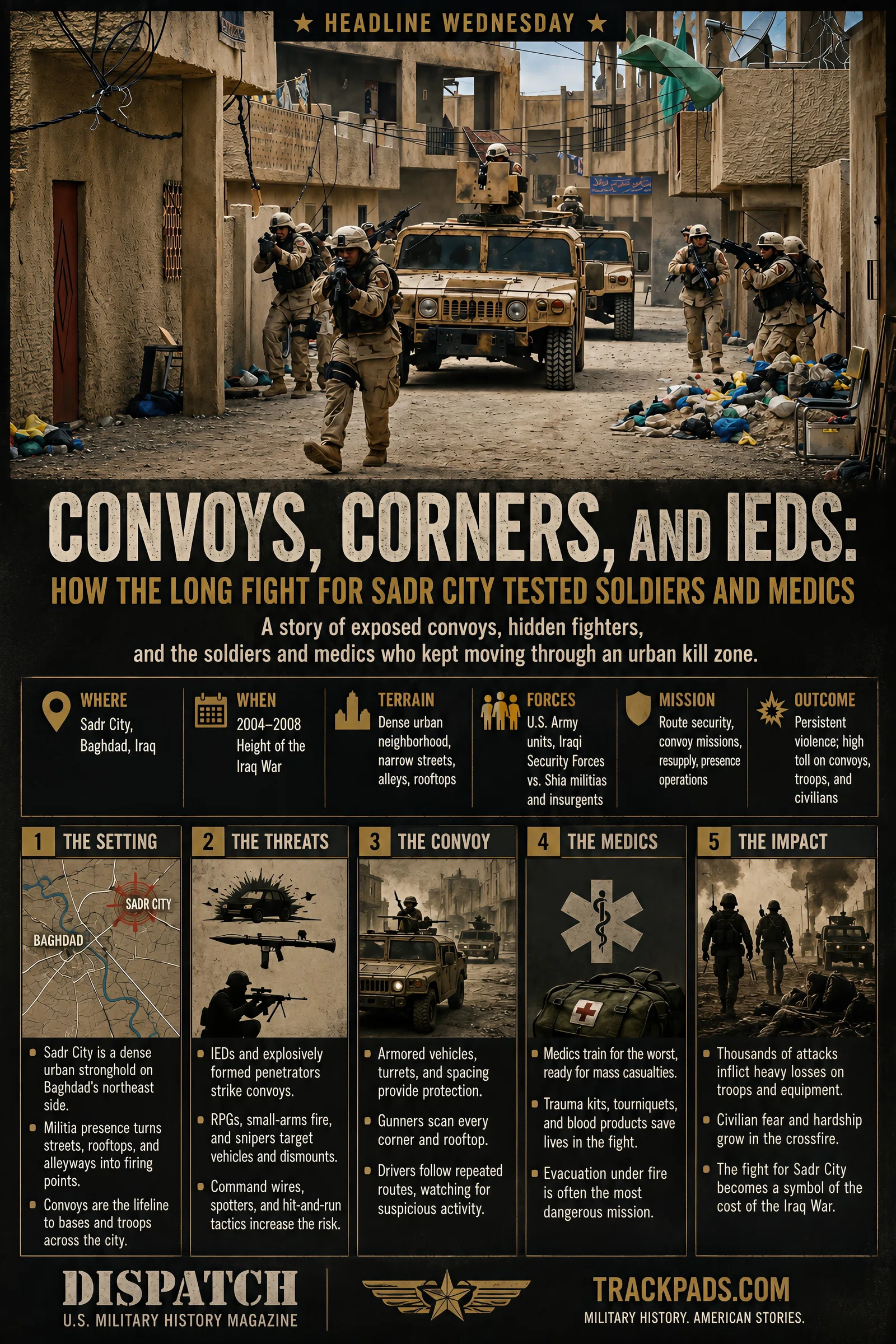
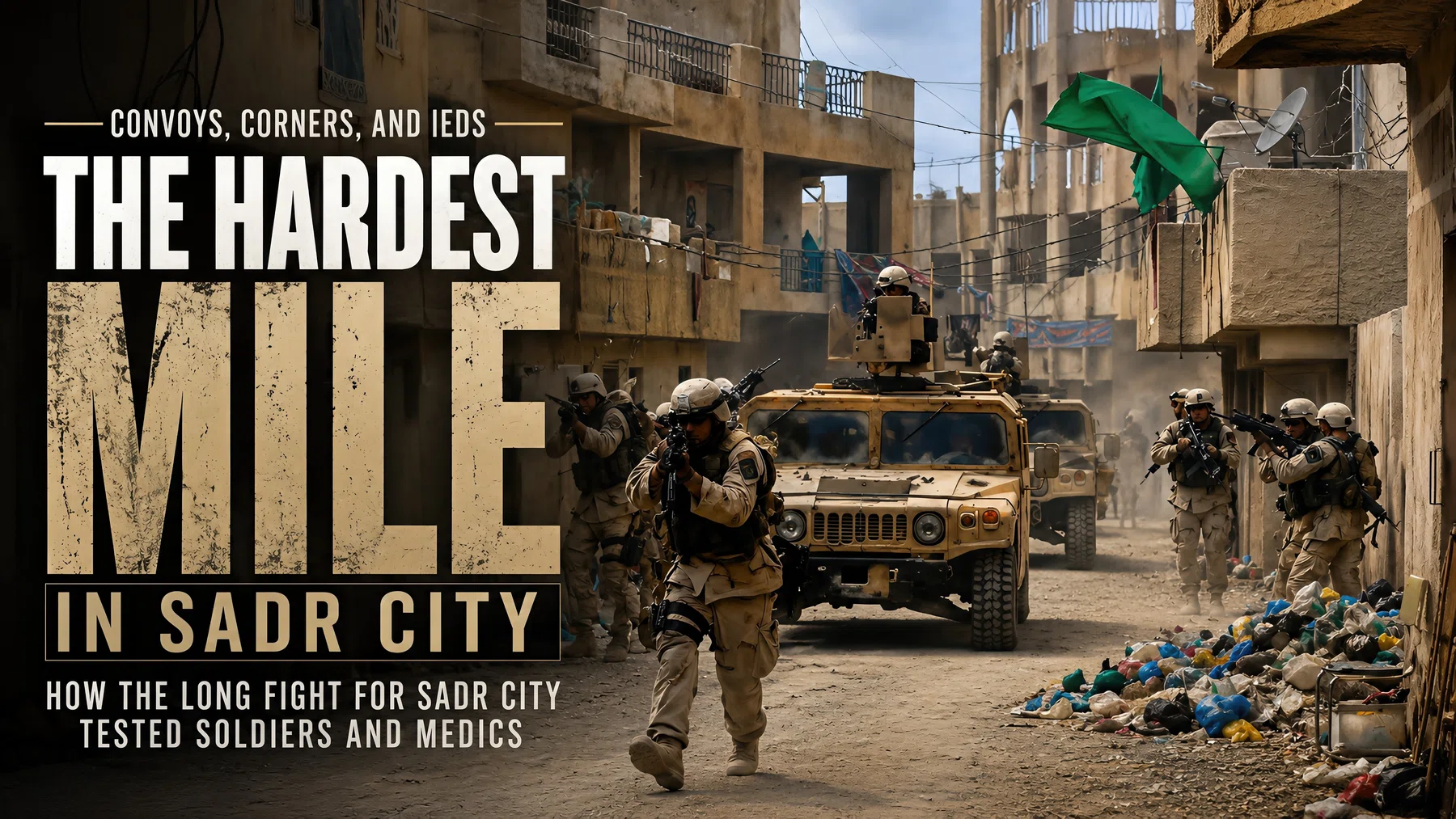
The armored trucks roll out past the blast walls one more time, engines growling as they nose onto the narrow streets edging Sadr City. The morning light is already harsh, flattening the concrete and dust into a haze of tan and gray. Gunners stand in the turrets behind thick glass plates, scanning across satellite dishes, laundry lines, and the tangled web of power cables that sag over the road. Below, the drivers tap their brakes through traffic circles, trying to keep proper spacing even as battered taxis and scooters squeeze too close. Every alley mouth looks like a firing point. Every pile of trash might hide a buried charge.
On the sidewalks, shopkeepers lift metal shutters and sweep away dust while children stare at the passing line of armored vehicles. Some wave. Others just watch, expressionless, used to the sight of convoys weaving between fruit stands and mechanic stalls. The patrol’s radios crackle with call signs and position reports, a low background murmur under the thump of tires on broken pavement. Soldiers count the corners, remember where shots came from last week, where an improvised explosive device tore through a truck last month. They know which stretches of road go abruptly quiet, when the chatter in the neighborhood dies just before trouble.
Out of sight, fighters in side streets and on rooftops track the same convoy from different angles. Some wait with cell phones and command wires. Others press rocket-propelled grenade launchers against their shoulders and measure the distance to the kill zone in cracked concrete blocks. Medics inside the convoy rehearse trauma drills in their heads, glancing at bags of bandages, tourniquets, and morphine tucked beside their seats. The patrol’s mission might be routine, just another movement to a combat outpost or government building, but every meter inside the orbit of Sadr City feels like a bet placed against a hidden enemy. This is a single drive on a single day, one loop inside a long, grinding fight that turned ordinary streets into a battlefield.
An Urban Stronghold That Bled Logistics
Sadr City sat like a dense concrete island on the northeast side of Baghdad, a sprawling district of tight streets and crowded apartment blocks that never stopped challenging the forces that had to move around it and through it. In the years after the fall of Saddam Hussein, it became both a home base and a symbol for militias that opposed the new order and the foreign troops backing it. From there, fighters could strike at convoys on main supply routes, mortar nearby bases, and disappear back into alleys and courtyards where family life and politics mixed with armed resistance. For units responsible for keeping fuel, food, and ammunition flowing, that neighborhood was not just another patch of city. It was a stronghold that could reach out and burn trucks miles away.
The stakes were larger than any single convoy ambush or sniper shot. Every damaged vehicle meant supplies delayed to another unit already stretched across Baghdad and beyond. Every medic working frantically in the back of a truck meant another squad down one rifle while a wounded soldier fought for life. Commanders had to decide how much armor to dedicate to route security, how many patrols to send into hostile streets, and when to risk dismounted presence inside neighborhoods where fighters blended easily with civilians. They weighed those decisions while pressure built at higher levels to show progress, reduce casualties, and prove that key lines of communication were under control.
On the other side, militia leaders understood the political value of a burning convoy on international news and the psychological weight a single powerful roadside bomb could carry. Improvised explosive devices, explosively formed penetrators, small-arms fire, and indirect fire all became tools to chip away at the image of safe movement. Iraqi security forces, still growing into their roles, moved in the same streets, sometimes partners, sometimes targets themselves. For the soldiers and medics whose names never appeared in headlines, the stakes were measured in simple terms: whether the convoy cleared the danger area, whether their patients lived to reach the aid station, and whether the long contest around Sadr City would be defined by fear or by persistence.
From Regime Collapse to Roadside Bombs
The story of those convoys under fire began in the chaotic months after the old regime fell. United States units pushed into Baghdad in 2003 expecting a short occupation and a quick handoff, but the city did not settle into anything like peace. In the northeast, the vast district that became widely known as Sadr City swelled with new arrivals from the countryside, families looking for work, safety, and influence in the new order. Streets that had been neglected for decades now carried both political slogans and sewage; power lines were improvised, water ran intermittently, and resentment at broken promises grew alongside hope for change. Into this mix came clerics, militia organizers, and young men willing to carry rifles in the name of faith, community, or simple resistance.
For the battalions rotating through the sector, Sadr City quickly shifted from an unknown neighborhood on a map to a daily fact of life. Early patrols were heavy on presence and light on armor, Humvees with canvas doors rolling through markets in an attempt to show accessibility. As the insurgency took shape, that balance shifted. Patrols gained thicker armor, extra machine guns, and jammers meant to disrupt remote detonations. Commanders redrew their route plans, avoiding predictable patterns and learning which intersections could turn deadly without warning. Convoy briefs began to include not just mission objectives but reminders of the last ambush on that stretch of road and the last casualty taken at that roundabout.
Medics adapted as quickly as anyone. They rehearsed mass-casualty drills in cramped aid stations and in the backs of trucks, building muscle memory for when a tourniquet had to go on in seconds. Units learned to keep combat lifesavers scattered through the formation so that first aid could start even before a medic reached a wounded soldier. When new brigades rotated in, they inherited not just buildings and equipment but binders of route photos, hand-drawn maps, and stories passed across plywood tables about “that corner,” “that alley,” and the clinic where a patrol had once taken small-arms fire from a rooftop while children huddled inside. Long before any single famous firefight, the path to Sadr City’s convoys under fire was laid by months and years of this steady, grinding adaptation.
Ambushes Measured in City Blocks
When the fight unfolded on a given day, it rarely looked like the sweeping arrows on a briefing slide. A typical convoy left a forward operating base behind blast walls, moved out past Iraqi police checkpoints, and merged into Baghdad traffic that did not stop simply because armored trucks appeared. The lead vehicle’s gunner scanned for wires drooping where they should not, for fresh patches of disturbed earth in the median, for a parked car that suddenly sat heavy on its springs. Drivers kept their eyes on both the truck in front and the mirrors behind, knowing that closing the gap too much or leaving it too wide could be equally dangerous. Each city block had its own rhythm, and soldiers felt it in their bones.
The first sign of trouble might be a small pop and a plume of dust from the roadside, a test shot from a home-made bomb. Other times it began with a sharper blast, the kind that slapped the chest and shook the steering wheel, followed by the crack of rifles and the thump of heavier weapons from windows and rooftops. In those seconds, the convoy’s careful spacing turned into a series of snap decisions. Gunners rotated shields and swung weapons toward muzzle flashes. Truck commanders shouted over the radio, calling out contact left or right, ordering vehicles to push through the kill zone or halt to return fire depending on the mission and the damage. Inside one vehicle, a medic might already be leaning over a wounded driver, cutting away a uniform sleeve while the truck still rolled.
On other days, the fight was slower and meaner. Convoys crept along main supply routes that skirted Sadr City while indirect fire landed on distant bases, a reminder that even when the streets looked quiet, the district’s armed groups could still reach out. Patrols dismounted near checkpoints to talk with Iraqi soldiers and police, trying to read which local forces were genuinely committed partners and which were nervous, overstretched, or infiltrated. From the roof of a nearby building, a platoon leader watched traffic patterns change, noting the way certain alleys emptied just before dusk, and how crowds thickened or thinned in response to rumor. Ambushes in this environment were measured not in sweeping maneuvers but in corners turned, alleys cleared, and stairwells climbed.
On yet another day, a company might push deeper toward the edge of Sadr City itself, combining armored trucks with dismounted infantry thread through alleyways too narrow for heavy vehicles. The trucks provided overwatch and rapid evacuation if things went wrong; the soldiers on foot tried to separate ordinary life from hostile intent in a place where the two continually overlapped. One rooftop team watched for the telltale flash of a rocket-propelled grenade from a balcony while a squad down on the street knocked on a metal gate to speak with a family who had called in a tip about an improvised explosive device buried near their corner. The fight unfolded here in conversations, in split-second reactions to a man raising a cell phone, in decisions about when to return fire and when to hold it.
Throughout these phases, medics moved where the danger was thickest, often stepping out into exposed intersections to pull a wounded soldier back behind a vehicle or into a doorway. They worked on cracked sidewalks with crowds pressing close, trying to maintain a small circle of space in which to breathe for a casualty who had just been hit by shrapnel or a sniper’s round. At the same time, other soldiers pulled security in full view of the buildings that lined the street, aware that the same windows where families watched from behind curtains could also hide the next shooter. The unfolding fight in and around Sadr City was less a single climactic battle than a series of overlapping engagements, each one separated by a few blocks, a few minutes, or a few days, but all part of the same long contest for control of the roads.
Walls, Cease-Fires, and New Tactics
The long grind around Sadr City did not flip with one dramatic assault, but there were clear points where the pattern began to change. One of the most visible came when engineers and infantry built and held barrier lines, concrete walls that pinched key routes and limited how easily fighters could move out to strike convoys and then slip back into the neighborhood. Sections of tall barriers along major roads looked ugly and divisive, but they also turned some intersections from exposed free-fire zones into more controllable choke points. Checkpoints grew more deliberate, with joint manning and better overwatch, and convoy commanders could plan around specific gate times and cleared lanes rather than simply hoping a road would be open.
Alongside the physical barriers came political decisions and cease-fires that altered the tempo of attacks. When militia leaders announced pauses or shifted focus under pressure from Iraqi politics, some stretches of road went from daily contact to tense quiet. That quiet did not erase the danger, but it gave units breathing space to refine their tactics and refit. Route-clearance teams with specialized vehicles, metal detectors, and robots pushed ahead of convoys to hunt for buried charges. Intelligence cells stitched together patterns from previous attacks, identifying which areas spiked in activity on certain days and what signatures preceded the most lethal bombs. Medics gained new protocols and better equipment, from tourniquets and hemostatic dressings to training that spread battlefield trauma skills wider across the force.
The turning point for many soldiers and medics was not a sudden victory announcement but the realization that they now had more tools than fear. Convoys still took fire, and improvised explosive devices did not disappear, but vehicles were more survivable, patrols more practiced, and communication with Iraqi partners more structured. Local leaders in some blocks chose to lean against militia influence, quietly passing information about bomb emplacers or pointing out houses where weapons were stored. In some sectors, joint Iraqi and coalition patrols on foot began to replace the sense that routes around Sadr City were owned only from the turret of an armored truck. The contest continued, but the odds for each convoy improved compared to the early years when every corner felt like a complete unknown.
From One District to a Generation’s War
By the later stages of the war, the immediate shape of the fight around Sadr City had shifted. Some routes that once carried a steady drumbeat of attacks saw fewer blasts. Convoys still rolled with guns up and medics prepared, but the combination of barriers, political deals, more capable Iraqi security forces, and hardened vehicles reduced the daily casualty lists. Units responsible for those roads rotated home and new ones arrived, inheriting not just maps but a body of hard-won knowledge about how to move through a dense city under the eyes of both enemies and ordinary families. For many veterans, memories of Baghdad are forever tied to specific stretches of pavement near that district: a traffic circle where a friend was hit, a checkpoint where an Iraqi sergeant stood his ground, a market where a child waved at a passing truck.
At the campaign level, Sadr City’s convoys under fire became one case study in a larger war where improvised explosive devices, urban cover, and contested politics defined daily operations. Lessons from those streets fed into new doctrine for route security, combined arms in cities, and trauma care at the point of injury. Training ranges back home added mock urban villages, cluttered with wires, trash, and tight alleys that looked less like traditional battlefields and more like the neighborhoods where soldiers actually fought. Medical courses emphasized rapid bleeding control and airway management in the back of vehicles and in doorways, not just in tidy aid stations. Leaders who had once been junior officers or sergeants in Baghdad carried those experiences into higher command and instruction roles.
For readers today, the story of Sadr City is not just about one district in one war. It underscores how logistics, patrol routes, and seemingly small daily decisions can shape an entire campaign. It reminds us that medics and drivers, gunners and interpreters, lived on the edge of danger even when they were not storming a building or seizing a bridge. In a world where future conflicts are likely to unfold in sprawling cities and contested neighborhoods, the experience of convoys, corners, and improvised explosive devices in and around Sadr City remains a warning and a guide. It shows how long it can take to turn the tide in a hostile urban stronghold, and how much depends on the quiet professionalism of those who keep driving when the streets ahead are never truly safe.