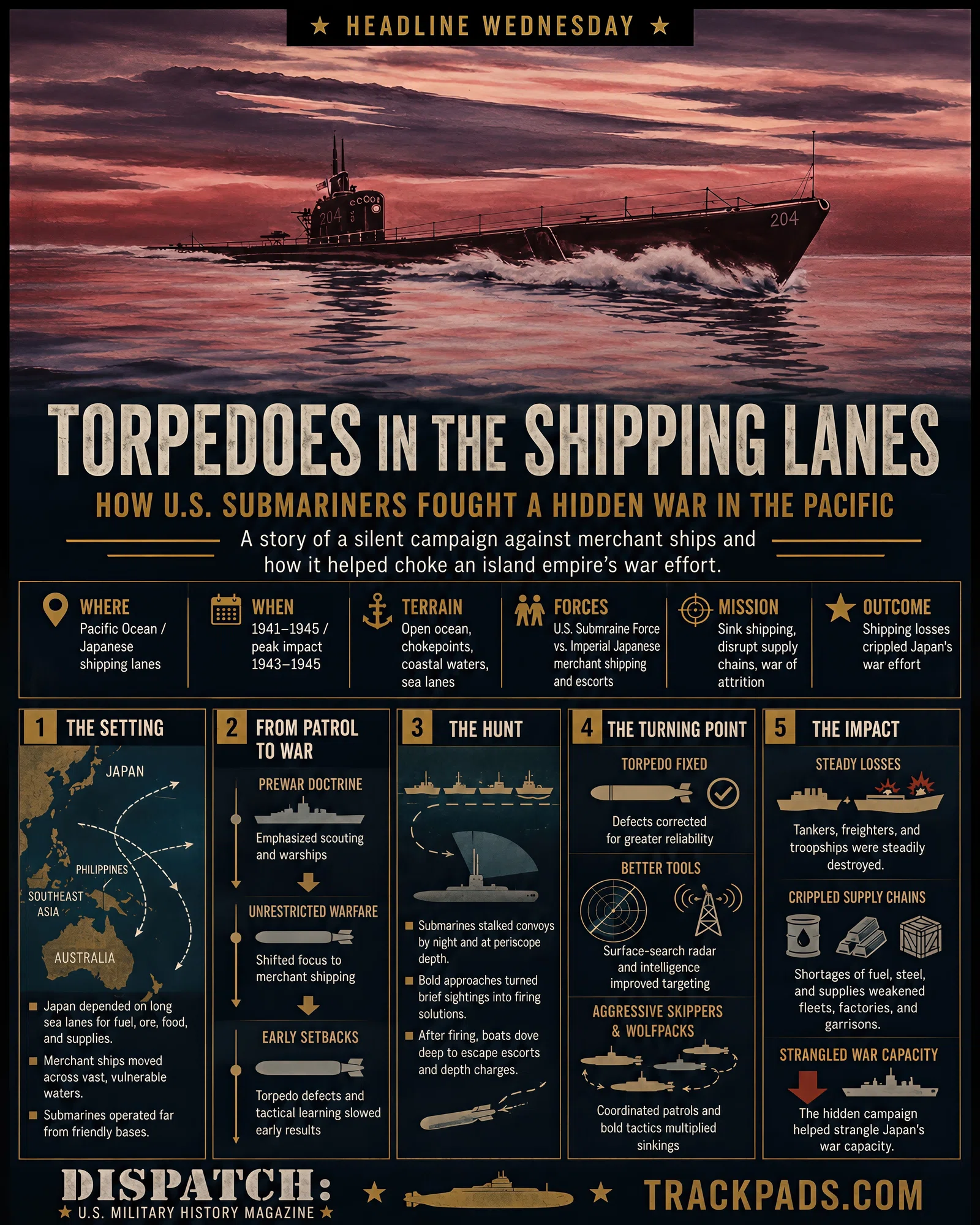
Periscope Crosshairs on a Lonely Freighter
The sea around the freighter looks empty, just gray Pacific swells rolling under a low morning sky. Beneath that surface, though, a steel shadow slides forward at periscope depth, electric motors humming, crewmen moving in tight, rehearsed motions through cramped passageways. In the control room of a United States Navy submarine, red lights glow over plotting tables as the officer of the deck calls out bearing changes, range estimates, and speed. The periscope rises for only a few seconds at a time, just enough to catch the freighter’s silhouette, her masthead, and the faint trace of a wake that gives away her course through the shipping lanes that feed Japan’s war machine.
The moment is tense but almost quiet. There is no gunfire, no screaming engines overhead, only the clipped commands of the fire control party and the hiss of valves as torpedoes slide into their tubes. The men who will launch them have spent weeks hunting without being seen, threading through minefields and listening for the distant beat of enemy screws on sonar. On the surface, the target crew likely thinks this is another uneventful leg of a long voyage. Below, every man in the submarine understands that sinking this one ship means coal not delivered, fuel not burned, ammunition not arriving at the front.
When the order to fire finally comes, it is almost routine. Numbers are read off, “fire one,” “fire two,” and then the waiting begins as the submarine turns away to clear its own torpedo tracks. No one on board will see the impact. They will listen for it, count off the seconds, and feel the shudder in the water when steel and explosives meet a hull. This single ambush, far from any famous beachhead, looks like a small action. Yet across the Pacific, dozens of similar moments are unfolding, adding up to a campaign that will become one of the most decisive and least visible fronts of the war.
Choking an Island Empire’s Arteries
Japan went to war in the Pacific as an island empire built on sea lanes. Its armies in China, its garrisons scattered across Pacific islands, and its factories in the home islands all depended on a constant flow of oil, iron ore, coal, rubber, and food. The tankers and freighters that carried those lifelines had to cross vast stretches of ocean that could not be fully patrolled by even the most powerful navy. On paper, the Imperial Japanese Navy possessed fearsome battleships and skilled carrier air groups, but they could not be everywhere at once, shepherding every cargo ship from port to port.
For the United States, submarines offered a way to reach into the heart of that system. At the start of the war, they were a relatively small arm, overshadowed by battleships and carriers in public attention. Their mission, however, was brutally clear: sink enemy shipping, starve Japan of the materials it needed, and force the empire to fight on shorter rations of fuel, steel, and time. Each submarine might only carry a limited number of torpedoes and a few dozen men, but together they could operate deep inside enemy-controlled waters, far beyond the reach of most surface forces.
The stakes were enormous and ran both ways. For Japan, every ship lost meant factories slowing down, aircraft grounded, and troops undersupplied in distant jungles and islands. For American submariners, the campaign meant high risk and isolation, with long patrols, mechanical problems, and an enemy that grew more alert and ruthless as the war went on. Commanders in theater understood that if the submarine force succeeded, it could do what no single battle line could guarantee: steadily weaken Japan’s ability to wage war at all. That quiet pressure, applied voyage by voyage, is what makes this undersea effort worthy of headline treatment alongside the better-known battles fought in the open air and on the beaches.
From Peacetime Patrols to Unrestricted War
Before the war exploded across the Pacific, American submarines were a small community inside the larger fleet, often used for scouting and exercises rather than the brutal work of hunting merchant ships. Treaty limits and interwar doctrine pushed planners to think of submarines as eyes and ambush weapons against enemy warships, not as a tool for strangling trade. Crews drilled hard, machinery was refined, and new long-range boats were built, but most of the officers who would lead the undersea campaign came into 1941 with peacetime habits and peacetime expectations. They knew their boats and their crews, but they did not yet know what a long, grinding commerce war would demand of them.
That changed almost overnight. When Japan struck at Pearl Harbor and drove deep into Southeast Asia, American leaders responded with a declaration that submarines would conduct unrestricted warfare against Japanese shipping. Overnight, freighters and tankers became primary targets, not just warships. Submarines based at Pearl Harbor, the Philippines, and later Australia were ordered to slip into contested waters and attack anything that kept Japan’s economy and armies moving. It was a bold decision, and it put a huge burden on a force still learning its craft in combat. They would discover, painfully, that many of their torpedoes ran too deep, failed to explode, or behaved unpredictably.
Early patrols were often frustrating. Submarines risked everything to line up perfect shots, only to watch torpedoes leave clean wake lines and then pass under targets or hit with dull thuds. Some commanding officers were cautious, holding back rather than pressing in close under enemy guns and aircraft. Others pushed harder but had little to show on their patrol reports. Within the force, tempers and doubts grew. New leaders, especially in the Pacific submarine command, pushed hard to fix the technical failures, test torpedoes under real conditions, and encourage aggressive tactics. At the same time, Japanese commanders, focused on decisive surface battles, invested little in escorts, radar, or convoy organization in the early years. That neglect, matched with a learning American submarine arm, set the conditions for a very different undersea war by the middle of the conflict.
Periscope Hunters and Desperate Escorts
By 1943, the undersea campaign in the Pacific had taken on a new shape. Submarines were now sailing from a growing network of forward bases, with better intelligence on enemy routes and more confident commanders in their control rooms. Torpedo defects, while not completely banished, had been identified and steadily corrected. Patrol reports began to include more solid sinkings and fewer bitter accounts of missed chances. Crews who had once struggled through fruitless months at sea now found Japanese shipping lanes where tankers, freighters, and troopships moved in predictable patterns between the home islands, Southeast Asia, and the far-flung garrisons that held Japan’s perimeter.
The fights themselves were usually short and brutal, and they unfolded in tight, tense sequences. A submarine lying in wait on the surface at night might catch the silhouette of a convoy against the horizon, then slide down to periscope depth as dawn approached. In the dim light, the captain and his periscope watch would pick out the fat shapes of cargo ships in the center, leaner escort vessels on the edges, and sometimes a single converted merchant ship pretending to be a warship. Fire control parties worked in cramped, hot spaces to turn those flickering glimpses into firing solutions: angles on the bow, estimated speeds, ranges that could be wrong by hundreds of yards yet still good enough if the approach was bold.
When torpedoes hit, chaos erupted on the surface. Stricken ships listed and burned, crews rushed to lifeboats, and escorts wheeled in to drop depth charges on the invisible attacker. That is when the other side of the fight began for the submariners. The same steel hull that had been a weapon now became a fragile refuge as they dove deep, rigging for silent running, every man listening for the whine of screws overhead and the telltale ping of active sonar. Depth charges roared and hammered the water, lights flickered, and fittings rattled loose as pressure climbed. Survival depended on quiet hands on valves, careful trimming, and the captain’s sense of how far he could push his boat without losing it.
As American submariners grew more experienced, they shifted from lone ambushes to more coordinated efforts. Wolfpack tactics, influenced by developments in other theaters, saw multiple boats working along key routes so that if one submarine was driven off, another could pick up the hunt. Intelligence from codebreakers and aerial reconnaissance refined patrol areas even further. Meanwhile, Japan scrambled belatedly to protect its lifelines, organizing convoys, adding more escorts, and deploying aircraft to patrol chokepoints and approaches to the home islands. Even so, there were never enough escorts, never enough trained crews, and never enough radar or sonar sets to watch the whole ocean.
By late in the war, the pattern had become grimly consistent. Convoys ventured out through waters where submarines already waited, and each successful patrol chipped away at the shipping that kept Japan alive. Submarines also took on additional duties, such as rescuing downed airmen near enemy coasts and laying mines in harbor approaches, but the core work remained the same: stalk, strike, survive, and return to do it again. The undersea campaign, once uncertain and uneven, had turned into a steady, grinding pressure that Japanese commanders could feel in empty fuel tanks, delayed troop movements, and factories starved of raw material. That mounting pressure, and the choices that sharpened it, set the stage for the turning points and long-term consequences that followed.
Radar, Codebreakers, and Hard Lessons
What finally turned the undersea war in the Pacific was not a single battle, but a pile of hard lessons, technical fixes, and sharper leadership. The early decision to wage unrestricted warfare against Japanese shipping set the mission, but it took years of trial and painful error to make that mission effective. Submarine commanders in the field pushed relentlessly to prove that their torpedoes were malfunctioning, even when some senior officers doubted them. Live-fire tests against cliffs and old hulks, demanded by angry skippers, exposed flaws in depth settings and exploders that had quietly sabotaged countless attacks. When those defects were at last corrected, a torpedo tube’s roar meant something very different: hits that broke backs, not just wakes that passed under hulls.
At the same time, technology tilted the odds underwater. Surface search radar gave submarines eyes in the dark, letting captains pick up convoys at ranges that once would have been impossible, then slip in to attack before dawn. On shore, codebreakers and analysts pieced together patterns of Japanese shipping, turning scattered reports into maps of fuel runs, troop convoys, and vital ore routes. Patrol orders became more focused, sending submarines to likely choke points instead of broad, blind patrol zones. This combination of better torpedoes, better sensing, and better intelligence meant that when a boat found an enemy column, it arrived with both the tools and the confidence to strike hard.
Leadership in the boats changed, too. Cautious skippers who consistently came home with light results were replaced by those who pressed attacks closer, took calculated risks on the surface at night, and stayed in contact even under heavy escort pressure. These aggressive commanders were not reckless; they simply understood that the only safe patrol in a war like this was one that hurt the enemy badly enough to shorten the conflict. On the Japanese side, the delayed shift to convoys and the chronic shortage of escorts meant that even improved defenses could not fully blunt this new, sharper American undersea force. The result was a tipping point: by the later war years, Japanese shipping losses mounted faster than new ships could be built, and each patrol log from a returning submarine marked another step toward economic collapse.