Before Dawn at Point Salines
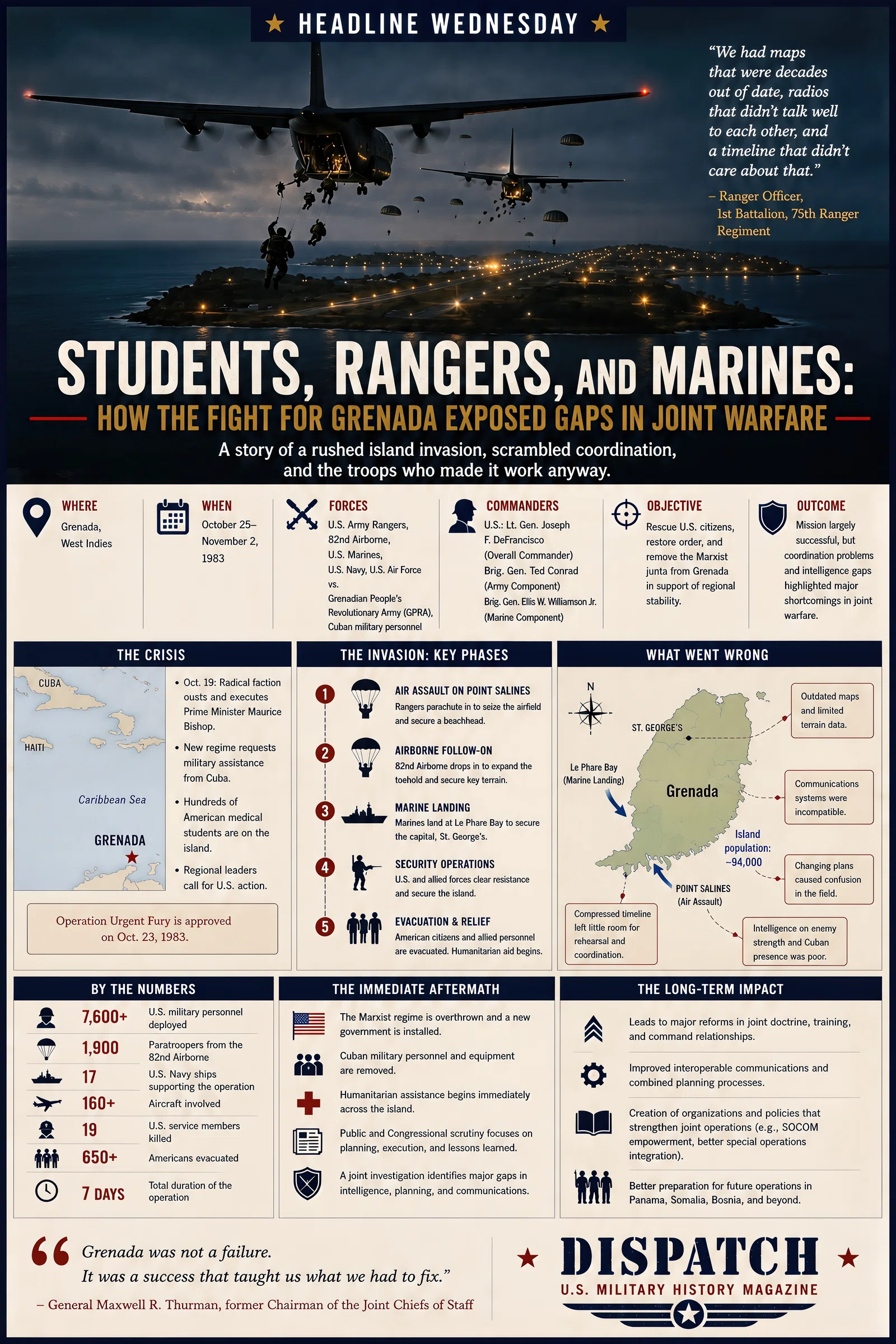
The night over Grenada in late October 1983 was thick and humid, the kind of coastal darkness where runway lights and muzzle flashes appear without warning. Far out over the water, C-130 transports droned toward Point Salines, the new airfield jutting from the island’s southern tip. Inside, United States Army Rangers checked parachute harnesses by feel and shouted over the engines, running through a plan that had changed more than once on the way in. Maps were thin, radio frequencies were still being sorted out, and even the exact positions of American medical students on the island were not fully clear.
Below them, on scattered campuses of St. George’s University, those students tried to make sense of rumors and snatches of news. Some had heard of a Marxist coup and street arrests. Others knew only that the airport lights burned late and that unfamiliar patrols moved along the roads. The island was small, but it felt suddenly very far from home. When the first sounds of approaching aircraft rolled over the shoreline, some students thought of a storm, some of an evacuation, and some of a fight they hoped would never reach their dorms.
As the transports turned toward the blacked-out airfield, Rangers peered through open doors for any sign of tracers or runway fires. Point Salines was not just another strip of concrete. It was the key to getting heavier forces and relief flights onto Grenada at all. Yet the runway still held construction equipment and obstacles, and the plan now called for parachute assaults rather than a simple landing. Men who had practiced jumps in training areas across the United States now faced the real thing over an unknown beach and an uncertain enemy.
In those last minutes before the green jump light, confusion mixed with training. Some aircraft struggled with navigation and timing. Communications between different elements were not as smooth as they appeared on planning charts. Still, when the doors opened and the light changed, Rangers stepped into the darkness, trusting their gear, their rehearsals, and each other. Their job was simple in concept and hard in practice: seize that airfield, find the students, and start turning chaos into something like order.
A Tiny Island with Outsized Consequences
From a distance, Grenada was a speck on the Caribbean map, roughly the size of a small American county and better known for nutmeg than for warfare. Yet in October 1983 it sat at the intersection of Cold War anxiety, regional instability, and the shadow of a recent disaster in Beirut. A Marxist faction had overthrown and executed the island’s former leader, erected roadblocks, and declared curfews. Cuban military engineers and advisers worked on the same Point Salines airfield now in the Rangers’ sights, fueling concern in Washington that Grenada might become another foothold for Soviet influence in the hemisphere.
For the United States, the stakes went beyond geopolitics on a map. Hundreds of American medical students were scattered across the island, unarmed and vulnerable to any regime that decided to use them as bargaining chips. Images of hostages had haunted American politics since Iran. The prospect of another prolonged hostage crisis, or worse, weighed heavily on decision makers who remembered how quickly diplomacy can be overtaken by violence and propaganda. Every hour of uncertainty increased the risk that those students could be rounded up or moved to hidden locations.
There was also the matter of credibility with regional partners. Caribbean governments worried that the coup in Grenada might inspire copycats or invite outside meddling if it went unanswered. Leaders from nearby states pushed for action and signaled their willingness to lend small contingents to any operation. At the same time, American military leaders knew that any intervention would be judged not only by whether it rescued the students, but by how well their services worked together in the field. The memory of Vietnam-era coordination problems still lingered.
Behind the immediate headlines, the Grenada crisis became an unwelcome test of joint warfare at a time when communications gear, map coverage, and planning frameworks were still uneven across services. The Rangers, Marines, airborne units, aviators, and special operations forces heading toward the island would be the ones to live with the consequences of that friction. If they could pull it off, Washington would chalk up a short, sharp success that reassured allies and calmed families back home. If they failed, a small island fight could quickly grow into a symbol of something much larger going wrong.
Plans on a Compressed Clock
The crisis on Grenada moved from troubling to urgent in a matter of days. After years of watching the island’s revolutionary government tilt toward Cuba, American officials suddenly faced reports of a violent split among the leaders, the arrest of Prime Minister Maurice Bishop, and then his execution at a fort overlooking the capital. Communications from the island grew confused and tense. Families of American students called stateside offices, regional partners warned of wider instability, and intelligence painted only a partial picture of who controlled what on the ground. The decision to intervene came under that pressure, with a clear mission statement but remarkably little time to turn it into a detailed, shared plan.
What followed was a crash effort to assemble a joint task force that included Rangers, airborne infantry, Marines, special operations forces, and naval power offshore, along with small contingents from Caribbean neighbors. Each service brought its own strengths and its own systems. Radios were not always compatible across units. Mapping coverage was thin enough that some officers turned to commercial tourist maps and hand-marked sketches. Aircrews and ground commanders had to align call signs, frequencies, and fire support procedures in hours instead of weeks. On paper, the operation’s objectives were straightforward. In practice, the glue that holds a joint force together was being mixed on the fly.
Assumptions also had to be made quickly about the likely resistance. Grenada’s own forces were not large, but they held strong positions, including fortified high ground and the new airfield under construction at Point Salines. Cuban military and engineering personnel on the island added another layer of uncertainty. Some planners expected them to fight hard; others expected a quick collapse once American troops appeared. Those differences mattered when estimating how much firepower and how many troops would be needed on the first days, and where to place limited transport aircraft and helicopter lift.
Specific tasks were parceled out in overlapping circles. Rangers would seize Point Salines and open it for follow-on forces. Marines would come ashore on the northeast and secure the older airfield at Pearls and nearby towns. Special operations teams would attempt to secure the island’s governor-general, key radio and communications sites, and other sensitive locations. The 82nd Airborne Division stood ready to flow into Point Salines as soon as it could receive larger transports. Somewhere inside that patchwork lay the medical students, scattered across multiple campuses that not every unit had correctly plotted. With ships already sailing and aircraft launching, there was no time left to align every detail. Those gaps would appear in the most unforgiving way once the first boots hit Grenada’s soil.
Firefights from Runway to Ridge
When the first Rangers dropped over Point Salines, the rushed planning became real in the shape of the ground beneath them. The airfield was longer than anything else on the island, but still cluttered with construction gear and obstacles that had to be cleared under fire. Small arms and anti-aircraft fire probed the incoming aircraft and parachutes. Once on the ground, Rangers pushed quickly to secure the runway edges and nearby high points, fighting from berms, half-finished buildings, and ditches cut for future taxiways. Every cleared segment of pavement meant more room for transports to land and bring in reinforcements from the 82nd Airborne Division, but progress came at the pace of men dragging barriers aside and pushing defensive lines outward.
Just beyond the perimeter lay the first human objective that had driven the whole operation: the medical students at the True Blue campus and other sites. Patrols moved out along roads that looked different from the maps, passing houses, fields, and roadblocks that had been marked only in pencil, if at all. Some convoys took fire from positions that overlooked key junctions. Others advanced cautiously through areas where defenders had already slipped away. When Rangers finally linked up with groups of students, the relief was immediate, but so was the realization that not every campus was accounted for and that evacuation would take time. Radios crackled with calls for helicopters, trucks, and more precise directions in a landscape that still felt unfamiliar.
Far to the north, Marines from the amphibious task force came ashore near Pearls Airfield. Their approach met lighter resistance than feared, but they still had to contend with anti-aircraft guns, bunkers, and the ever-present problem of sorting civilians from combatants in villages that had woken up to find foreign troops on their beaches. Marine infantry and armored vehicles moved along narrow roads and ridges, securing the airstrip and pushing toward towns that formed the northern half of the island’s defensive network. Overhead, helicopters ferried reconnaissance teams and provided eyes on positions that ground units could not yet see.
Special operations teams faced some of the sharpest early tests of the planning gaps. Navy special warfare operators tasked with reconnaissance and securing key sites contended with rough seas, poor visibility, and enemy fire. One mission to secure the governor-general’s residence turned into a prolonged fight as Grenadian forces fired from surrounding high ground. The defenders had the advantage of prepared positions and familiarity with the terrain. The team on the ground relied on disciplined fire, careful use of cover, and repeated calls for supporting fires that sometimes took longer to coordinate than anyone wanted, thanks to mismatched radios and command chains stretched over air, sea, and land.
As the first day turned into the second, more paratroopers from the 82nd Airborne Division began to arrive at Point Salines. Their presence added depth and staying power but also increased the complexity of coordinating movements across the island. Columns of light infantry and vehicles pushed inland toward the capital and other student locations, navigating checkpoints, ambush sites, and confusing place names. Firefights broke out near barracks, at road junctions, and along approaches to fortified positions. The men on the ground learned quickly which hilltops funneled fire into their routes and which buildings hid heavier weapons.
The defenders, including Cuban personnel at construction camps and Grenadian units at forts and barracks, did not melt away. At positions like Fort Frederick and other commanding heights, they used mortars, machine guns, and direct fire to harass advancing units and strike at assembly areas and headquarters. American commanders turned to naval gunfire, close air support, and gunships to pound these strongpoints, but each call for fire depended on accurate spotting, clear communications, and maps that did not always match what troops saw through their sights. Where those elements lined up, defenders were forced to retreat or surrender. Where they did not, units found themselves trading fire longer than expected.
Later assaults, such as the helicopter-borne attack on a key barracks near the capital, showed both the daring of the troops and the edge of the planning envelope. Aircraft flew low over ridges and water, threading routes between known gun positions and suspected ones. Any mistake in timing or navigation could be costly. By the time those troops hit the ground, smoke, misdirected fire, and the tangle of overlapping objectives made it clear that the fight for Grenada would not be a neat sequence of checkmarks on a staff officer’s board. It was a series of hard local fights, joined together by radios, courage, and improvisation that still had to catch up to the design of joint warfare on paper.
Radios, Maps, and Leadership Under Fire
On the ground, what turned the fight on Grenada was not a flawless plan, but the way small-unit leaders and crews bridged its gaps. At Point Salines, Rangers and paratroopers did more than seize concrete. They turned a half-finished construction site into a functioning hub, clearing wreckage and building ad hoc defenses even as more aircraft arrived. Signal soldiers strung antennas wherever they could and improvised connections between incompatible radios, sometimes relaying fire missions or situation reports through multiple nets or even through aircraft overhead. Those makeshift links kept naval gunfire and close air support in the fight long enough to crack strongpoints that might otherwise have stalled the advance.
Elsewhere, commanders and noncommissioned officers made key choices with incomplete information. Company leaders diverted along unplanned routes when roads turned out to be blocked or misplotted. Patrols adjusted objectives when they found unlisted student housing or unexpected concentrations of defenders. At the governor-general’s residence and other contested sites, small teams held out under fire until supporting arms could be brought to bear. Those stands were not just acts of courage. They bought time for the rest of the force to sort out who was where and which frequencies actually worked between ships, aircraft, and ground units.
Naval and air power, once effectively tied in, helped break the backbone of organized resistance. Precision by the standards of the day still meant risk, and there were painful near misses and tragic errors that later investigations would study in detail. Yet when spotters could see the target, talk to the guns, and correct fall of shot, positions on commanding heights and around barracks were smashed or shaken into surrender. Helicopter assaults that might have ended in disaster if defenders had enjoyed unchallenged fields of fire instead achieved their objectives, though not without losses, because suppression fires reached in ahead of the rotors.
The defenders’ own limitations also played a role. Grenadian units and Cuban personnel were brave in pockets, but they were not unified by a clear, island-wide battle plan. Some fought hard, others surrendered once cut off, and some melted away when faced with the sight of overwhelming American numbers. That uneven resistance gave American commanders room to recover from early missteps. By the time the last major strongpoints were reduced, the combination of individual initiative, overwhelming firepower, and a gradually improving communications picture had turned a risky gamble into a completed mission: students gathered, airports held, and the island’s armed forces effectively broken.
From Island Crisis to Joint Reform
In the immediate aftermath, Operation Urgent Fury looked like a clear success to many Americans. The students were flown out, the coup leaders were swept aside, and a new government began taking shape under the watchful eyes of regional partners. Families saw their sons and daughters step off transports back home. Units chalked another operation onto their histories, proud of what their soldiers, Marines, sailors, and airmen had done under pressure. The images of rescued students and captured weapons seemed to prove that a small island crisis could be handled swiftly and decisively, in sharp contrast to the helplessness many remembered from earlier hostage dramas.
Yet inside the military and in the wider world, the operation sparked sharp questions. Reports circulated of units using tourist maps, of aircraft and ground forces struggling to talk to each other, of fire missions delayed or misdirected because of incompatible radios and unclear procedures. Allies and adversaries alike criticized the intervention’s legality and timing. Congressional hearings and internal reviews focused not on whether American forces had fought bravely—they had—but on why communications, intelligence, and joint planning had lagged so far behind the courage of the people sent into harm’s way. Grenada became a case study in how victory can still reveal uncomfortable truths.
Those lessons fed into a broader push to reform how the services planned and fought together. Over the following years, joint doctrine hardened from aspiration into more binding guidance. Training exercises placed new emphasis on interoperable communications, common maps and data, and clear chains of authority in joint task forces. Professional military education used Grenada as an example of the risks of assuming that separate service systems would simply mesh in the first hours of a crisis. The operation’s success gave reformers political space; its flaws gave them urgency and concrete talking points.
Today, when planners discuss joint operations, rapid interventions, or noncombatant evacuations, Grenada still appears in the background. It is a reminder that even “small” wars can expose big seams, that radios and maps can be as decisive as rifles and rockets, and that the bravery of Rangers, Marines, paratroopers, aviators, and special operators should be matched by the tools they need to work as one. For readers of military history, for veterans who remember those days, and for students preparing for staff rides or classrooms, the fight for Grenada offers both a story of courage and a caution about the cost of making the glue of joint warfare on the move.