Ghost Contacts in Black Water
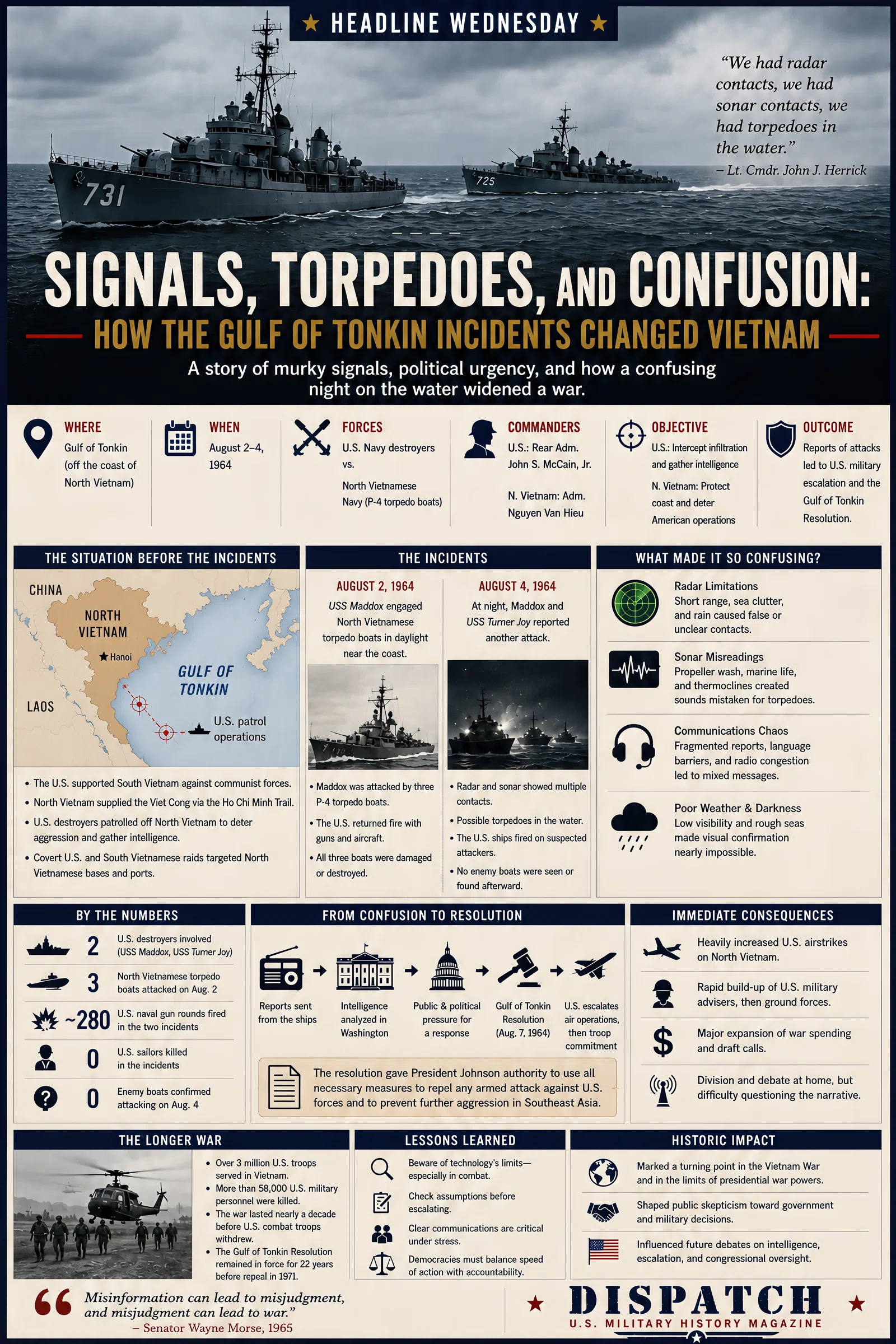
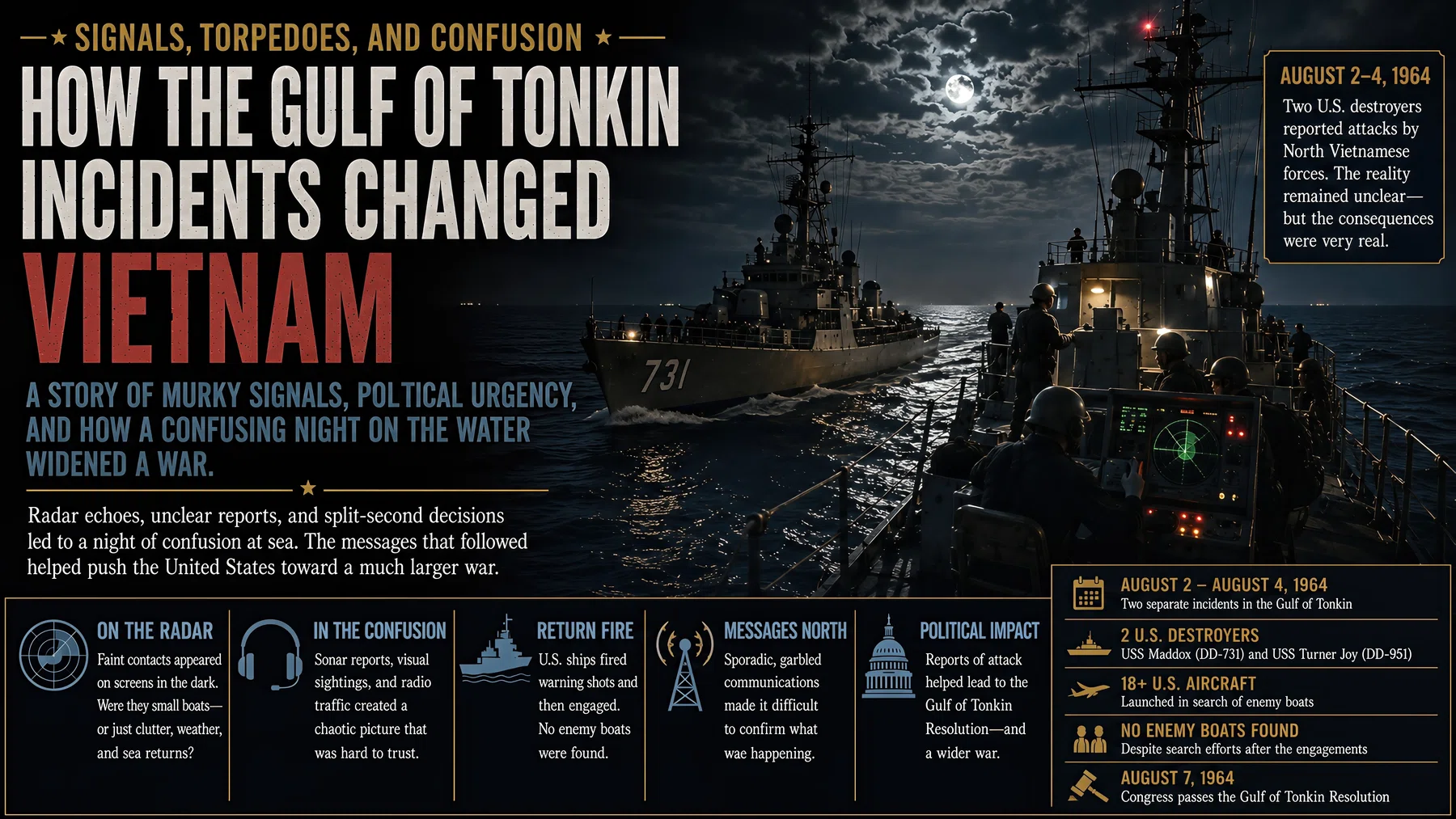
The Gulf of Tonkin was blacked out that August night, the sea broken only by the white flash of waves and the running lights of two American destroyers pushing through humid air. Inside the steel skin of the ships, radar scopes glowed green, sonar screens flickered, and men leaned forward in the dim light, trying to make sense of faint returns and half-heard reports. On the bridge of a destroyer, officers peered into rain and haze, straining to see what the instruments said was out there: fast-moving contacts, closing in at high speed, possible torpedo tracks. Somewhere beyond the edge of visibility, North Vietnamese patrol boats were believed to be hunting too.
Hours earlier, the crew had been briefed about the possibility of attacks. The ship had already exchanged fire in these same waters days before, driving off real torpedo boats with guns and aircraft. That memory hung over the watch sections now, sharpening every flicker on a screen and every ambiguous call over the radio. When a sonar operator reported what sounded like torpedoes in the water, the calm cadence of the ship shifted in an instant. Orders snapped down passageways, gun crews rushed to their stations, and the destroyers maneuvered hard, turning and accelerating on shouted bearings.
The night became a tangle of star shells, churning wakes, and shouted ranges. Gunners fired at muzzle flashes and radar echoes, seeing shapes where there might have been only spray and shadow. Pilots overhead searched for targets in darkness and bad weather, reporting wakes and flashes that might have been boats or might have been reflections. On the plotting tables, lines and symbols showed a fast-moving enemy torpedo attack. Down in the spaces where the radios hummed and headphones pressed against sweaty ears, intercept operators strained to catch North Vietnamese voices that could confirm what the sailors thought they were seeing.
By the time the firing eased and the ships steadied on new courses, the men aboard were left with ringing ears, empty shell casings on deck, and a nagging uncertainty about what had actually happened. Yet the messages that went out from that black stretch of water did not carry uncertainty. They described attacks, evasive maneuvers, and torpedoes in the water, converting confusion into apparently solid facts. Those facts were about to move far beyond the cramped compartments of two destroyers and into the highest levels of the United States government.
When a Skirmish Becomes a Doorway
To understand why that confused night in the Gulf of Tonkin mattered so much, you have to pull back from the radar scopes and look at the larger board. In the summer of 1964, the United States presence in Vietnam was still officially limited to advisers, support units, and a growing but not yet massive commitment of airpower and logistics. Washington was trying to hold a precarious line: supporting South Vietnam against communist insurgency and pressure from the North, while avoiding a formal declaration of full-scale war in Southeast Asia. The situation was already tense enough that any clash at sea risked becoming more than a routine incident.
American destroyers on patrol off the North Vietnamese coast were not just out for a casual cruise. They were part of a pattern of intelligence-gathering missions, mapping radar coverage, listening to communications, and tracking coastal defenses. In parallel, South Vietnamese forces backed by United States planning were striking targets along the same shoreline in covert raids. For North Vietnamese commanders watching their coast, the line between spying and active military pressure was thin. For American leaders, the line between “limited involvement” and major escalation was just as fragile.
In this context, the question of whether United States warships had been attacked was not simply tactical; it was political and strategic. President Lyndon Johnson and his advisers were under pressure to show resolve in the Cold War, to reassure allies that the United States would stand firm against communist advances in Asia. At the same time, they were wary of being dragged into an open-ended ground war. A clear-cut attack on American ships in international waters would offer a compelling justification for retaliation, a way to respond forcefully without appearing to start a new war.
This is why the radio traffic and situation reports from the Gulf of Tonkin mattered so intensely in those hours and days. What the officers and sailors believed they saw on a stormy night could be translated into the language of aggression and self-defense on the floors of Congress. From there, it could become a resolution granting broad authority to use force in Vietnam, effectively opening the door to a much larger conflict. A night of shots in the dark was about to become the headline and hinge point for a decade of war.
Patrols, Raids, and Rising Pressure
The story of the Gulf of Tonkin incidents begins long before that August night, in a slow tightening of decisions and assumptions. By 1964, the United States had already invested heavily in South Vietnam with advisers, equipment, and air support, trying to prop up a government shaken by coups and insurgency. In Washington, leaders viewed the conflict through a Cold War lens, seeing North Vietnam as part of a larger communist advance that needed to be checked. That lens made any challenge at sea or on land look like another test of American credibility. It also encouraged a gradual expansion of military activities that blurred lines between reconnaissance and active pressure.
Against this backdrop, the United States Navy ran so-called “patrol” missions along the North Vietnamese coast. Destroyers like USS Maddox and later USS Turner Joy cruised near shore, officially gathering intelligence on radar sites, coastal batteries, and communications. At the same time, South Vietnamese commandos, backed and guided by American planners, were launching small raids against targets on that same coastline. These operations were separate on paper, but to North Vietnamese officers watching radar plots and hearing explosions ashore, they could easily look like parts of one coordinated campaign. The presence of American warships just over the horizon raised the stakes of every coastal clash.
Inside the American chain of command, the risks were understood, but so were the perceived benefits. Intelligence from these patrols promised to map enemy capabilities and test reactions, while the coastal raids were meant to keep North Vietnamese forces off balance. The assumption was that any hostile move against American ships would be limited and could be handled by superior firepower and air support. The danger was that a small contact might be misread, or a local skirmish might provide the spark for something far larger than the officers on the scene intended.
On 2 August 1964, that danger showed itself clearly. North Vietnamese patrol boats approached and attacked Maddox, and the destroyer responded with guns, assisted by aircraft from a nearby carrier. The fight was short and real, leaving damaged patrol craft and raising immediate questions about what would happen next. Instead of pulling back, higher command chose to reinforce the patrol with a second destroyer and continue operations in the same tense waters. This decision set the stage for the even more confusing reports that came two nights later, when radar echoes and sonar noises would be interpreted in light of a fresh, recent clash.
Two Night Fights in a Narrow Sea
The first clash, on 2 August, unfolded in daylight, where eyes could confirm what instruments showed. Maddox operated near the North Vietnamese coast when radar picked up fast-moving surface contacts closing in. The crew went to general quarters, guns were manned, and the destroyer altered course as patrol boats approached. When the boats came within range, Maddox opened fire, and the North Vietnamese craft responded with torpedoes and guns of their own. The destroyer’s firepower, combined with timely air strikes from carrier-based aircraft, quickly turned the encounter. By the time it ended, Maddox was largely unharmed, while at least one of the attacking boats was badly damaged and others were forced to break off.
From the perspective of the sailors on Maddox, this engagement confirmed what they had been warned about: the North Vietnamese were willing to challenge United States ships. For commanders in Hanoi, the same brief fight could be seen as a necessary pushback against a foreign warship operating close to their shores while raids struck their coastline. Each side came away more convinced of its narrative, and both sides adjusted. On the American side, Maddox was soon joined by Turner Joy, giving the patrol more firepower and a greater sense of security. On the North Vietnamese side, coastal defenses and patrol craft remained on alert for further intrusions.
Two nights later, the scene was very different. The sea was dark, the weather unsettled, and visibility poor as the two destroyers cut through the Gulf of Tonkin. Radar operators watched their screens as faint contacts appeared and vanished. Sonar operators reported possible torpedo noises, then retracted or qualified their calls as conditions changed. The ships maneuvered repeatedly, turning hard and changing speed in response to what their instruments seemed to show. In the confined mental space of a small combat information center, each new blip or echo could feel like confirmation that another attack, even a more serious one, was underway.
As the sense of threat built, the destroyers responded as they had been trained to do. Guns barked into the darkness, tracers reaching toward uncertain targets. Patterns of fire walked across patches of sea where fast-moving contacts were believed to be. Overhead, pilots flew through bad weather trying to spot wakes, muzzle flashes, or silhouettes of attacking boats, relaying fragmentary impressions back to the ships. Some reported possible wakes and shapes; others saw nothing solid. On the plotting boards, officers tried to turn this swirl of partial reports into a coherent picture showing torpedo boats attacking from different bearings. In the moment, the pattern felt real enough to justify high-speed evasive maneuvers and heavy fire.
What made this second incident so consequential was not just what happened on the water, but how it was reported and interpreted as the night went on. In the early hours, messages from the destroyers spoke of multiple attacks, torpedoes in the water, and prolonged engagements with hostile craft. As officers later reviewed their own data, doubts began to surface about whether the contacts had been real or the product of weather, nervous interpretation, and the afterimage of the earlier clash. But those doubts did not travel as fast as the first urgent reports. By the time uncertainty gained voice aboard the ships, the initial story of a clear second attack had already landed on desks in Washington and was being folded into rapid decisions about how and when to strike back.
From Uncertain Contacts to Certain Orders
What turned a confusing night in a narrow sea into a hinge point of the Vietnam War was not a dramatic battlefield victory or a decisive ship-to-ship duel. It was the way uncertainty at the tactical level hardened into certainty at the political level. On the destroyers, as officers and operators reviewed their logs and replayed the night’s events, doubts began to creep in. Some sonar reports no longer seemed as solid as they had in the moment. Radar tracks that once looked like attacking boats could also be explained by weather, maneuvering, and the limits of the equipment. Messages went back up the chain noting these doubts and asking whether an attack had truly taken place.
In Washington, however, the first wave of reports had already done their work. Leaders had been briefed that American warships in international waters had again come under deliberate attack, this time in darkness and poor weather. The narrative that emerged from those early messages framed the situation as a pattern: a first clear daylight attack on 2 August, followed by a second, more complex assault on 4 August. Within that frame, hesitation risked looking like weakness, and swift retaliation offered a chance to show resolve without immediately sending ground divisions into combat. Target lists for North Vietnamese facilities were already being prepared and refined.
The turning point, then, lay in how the doubts from the field were handled. Instead of pausing to reconcile conflicting reports, senior decision-makers treated the initial, more confident descriptions as the baseline and treated later corrections as secondary. The sense of threat, the Cold War context, and the desire to respond firmly combined to outweigh caution about what the destroyers had actually encountered. Air strikes were ordered against North Vietnamese patrol boat bases and supporting infrastructure, described to the American public as measured retaliation for unprovoked attacks on United States ships.
Almost in parallel, the administration moved to secure political backing. The Gulf of Tonkin Resolution, quickly drafted and passed with broad support, granted the president sweeping authority to use military force in Southeast Asia without a formal declaration of war. What turned the incident was not a single shot or maneuver at sea, but the decision to treat a murky night action as settled fact and to anchor far-reaching authority to that narrative.
A Narrow Gulf and a Wide War
In strictly tactical terms, the Gulf of Tonkin incidents were limited. One daylight clash damaged North Vietnamese patrol boats, and subsequent air strikes hit coastal facilities and fuel depots. No American ship was sunk, and the second, nighttime “battle” left even the participants unsure what, if anything, they had actually fought. Yet the political and strategic consequences were vast. With the Gulf of Tonkin Resolution in hand, the administration now had a standing authorization to expand the war in Vietnam when it judged circumstances required. Within months, sustained bombing campaigns and major ground deployments would follow, justified in part by the need to respond to aggression in the Gulf and defend South Vietnam.
Over time, the incidents became a case study in how the fog of war and the pressures of high-level decision-making interact. Reviews of logs, intercepts, and recollections cast increasing doubt on the reality of the second attack, raising hard questions about how much uncertainty had been acknowledged, shared, or set aside in the rush to act. For military professionals, the story highlights the responsibility of commanders and staff officers to qualify their reports, to highlight confidence levels, and to make sure that doubts are as clearly communicated as initial impressions. For civilians in leadership roles, it underscores how quickly early narratives can harden into policy.
The Gulf of Tonkin episodes also left a deep mark on American political culture. They became a touchstone in later debates about how presidents seek authority for the use of force, how Congress evaluates claims of attacks or imminent threats, and how intelligence is presented to the public. Veterans who served in Vietnam carried their own memories of what that authority eventually meant on the ground, in jungles, villages, and base camps far from the black water where the first shots were fired. For many, the phrase “Gulf of Tonkin” came to symbolize not just a place, but a moment when ambiguity tipped into escalation.
For students of military history, staff-ride groups, and citizens trying to understand how wars grow, the lessons are lasting. A radar echo or radio intercept does not just shape a captain’s next turn of the rudder; it can shape speeches, resolutions, and the deployment of entire divisions. The Gulf of Tonkin reminds us that small engagements at the edge of an empire’s reach can become gateways to conflicts that define a generation, especially when darkness at sea is matched by uncertainty in the councils of power.