Fire on the Road to Basra
The night sky over the desert north of Kuwait City does not go dark. It flickers and pulses instead, orange and white against the low cloud of smoke that hangs over Highway 80. Below that glow, a long column of Iraqi vehicles is jammed nose to tail along the pavement and onto the shoulders: tanks, trucks, buses, command cars, trailers piled high with looted cargo and personal kit. Some engines still idle, some are abandoned with doors hanging open, and many are already burning, their fuel tanks feeding tall, whipping flames that turn steel hulls into silhouettes.
Coalition aircraft work the line in passes, their navigation lights blacked out, pilots talking calmly over radios as they mark targets and call one another off and in. Bombs and rockets strike clusters of vehicles, and secondary explosions ripple down the road as ammunition cooks off in sudden chains of white flash and crack. On the ground, Iraqi soldiers dive into roadside ditches, huddle behind their own vehicles, or simply run out into the open desert, trying to put distance between themselves and the blazing highway. Some carry rifles, some carry nothing at all.
Wind pushes the burning smoke sideways, revealing wrecks that are still hot enough to shimmer. The smell is a mix of diesel, burning rubber, and explosives that would sting the back of the throat even through a sealed canopy. In the dark, it is hard to tell where the column ends, because clusters of headlights are still visible farther up the road, stuck in place and waiting their turn. This is not a set-piece battle line or a planned ambush. It is a retreat that has turned into a killing ground, and by the time the night is over, the images from this stretch of asphalt will echo far beyond the desert.
When an Army Tries to Escape
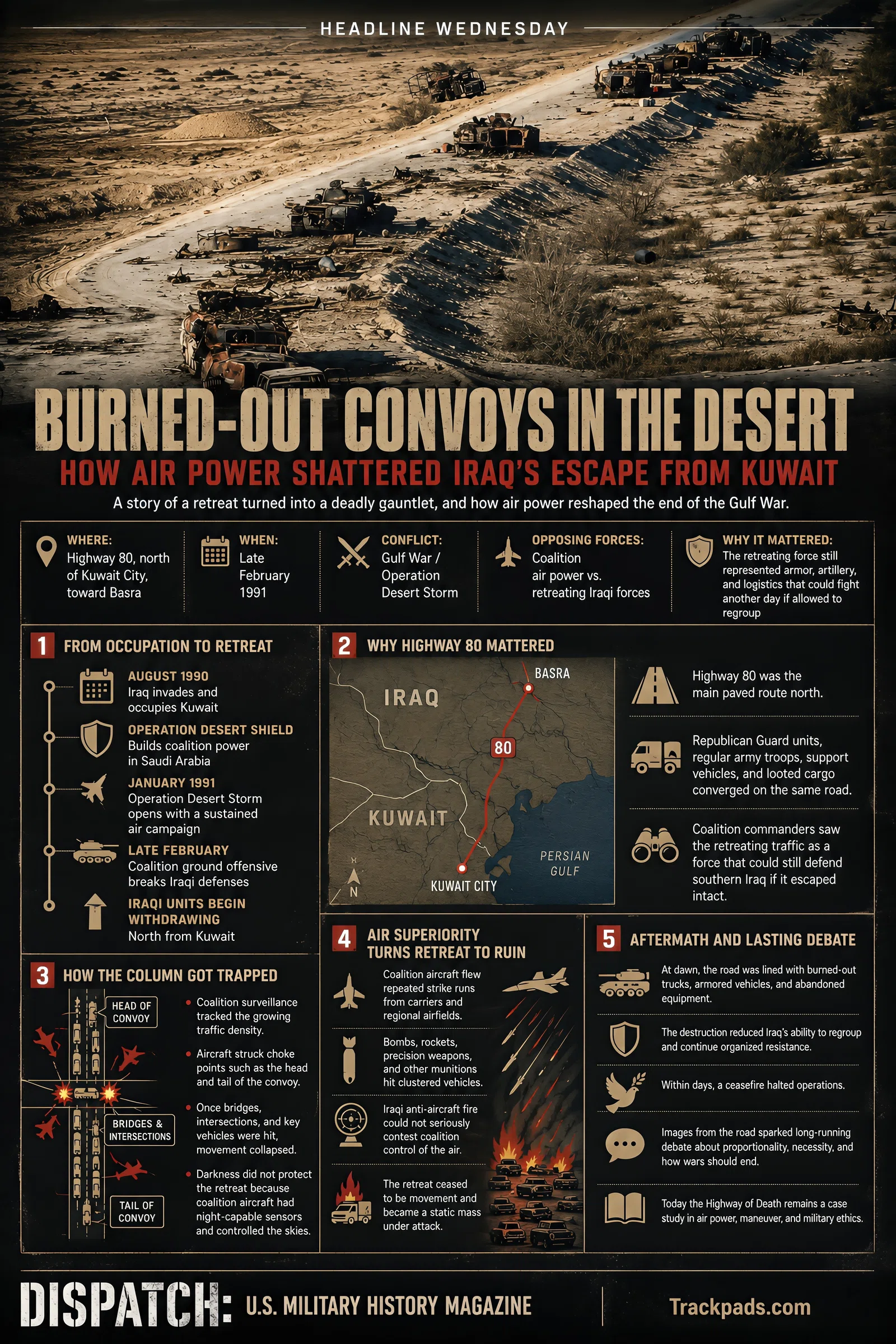
To understand why this highway matters, you have to pull back from the fires and look at the map of early 1991. Iraqi forces had invaded and occupied Kuwait the previous August, triggering a massive coalition build-up under United States leadership. Operation Desert Shield brought troops, armor, and aircraft into the region; Operation Desert Storm opened with a long air campaign that pounded Iraqi infrastructure and frontline units. By late February, the coalition ground offensive was in motion, cutting through Iraqi defenses in Kuwait and sweeping into southern Iraq.
As coalition armored forces advanced, units of the Iraqi army began to pull out of Kuwait under pressure. Some were ordered to withdraw; others simply broke contact and tried to save what they could. The main paved route north toward Basra, the multi-lane Highway 80 across flat desert, became the obvious escape route for clogged formations of Republican Guard units, regular army divisions, and support troops. Vehicles of every type mixed together in an undisciplined stream, carrying soldiers, officers, and in many cases looted goods taken from Kuwait City and smaller towns.
For coalition commanders, the sight of that traffic jam was more than an image of a beaten army heading home. It represented the core of the force that had occupied Kuwait, a mass of armor, artillery, and logistics that could still be used to defend southern Iraq or fight another day if allowed to re-form in the rear. Destroying that column meant reducing future resistance, protecting coalition troops pushing forward, and sending a clear signal about the cost of aggression. At the same time, the decision to keep striking retreating forces, and the scale of the destruction that would follow on that road, would raise uncomfortable questions about proportionality and necessity that would linger long after the fires burned out. That tension is part of what makes this night’s attack headline material, even decades later.
From Occupation to a Trapped Retreat
The story of that burning column begins months earlier, when Iraqi forces rolled into Kuwait in August 1990. The invasion was swift. Kuwaiti units were outmatched, and within days Iraqi armor and mechanized infantry controlled key government buildings, oil facilities, and the capital. What Saddam Hussein expected to be a quick expansion of territory and oil reserves instead triggered a global backlash. The United Nations condemned the invasion and imposed sanctions, and the United States began building a multi-national coalition that brought Arab partners, European allies, and other contributors into the Gulf region under a single banner.
Operation Desert Shield was the initial shield against further Iraqi moves. Coalition forces poured into Saudi Arabia, dug fighting positions, offloaded tanks and artillery from ships, and built airfields and logistics hubs across the desert. As the months passed, Iraqi units in Kuwait built bunkers and trench lines, laid minefields, and dug vehicles into revetments. Saddam’s planners believed that dense defenses, chemical threats, and the memory of bloody Iran–Iraq fighting would deter a ground assault or at least inflict heavy losses if one came. They underestimated the coalition’s ability to assemble overwhelming air power and to coordinate a large, fast ground maneuver.
In January 1991, Operation Desert Storm opened with a sustained air campaign. Coalition aircraft struck Iraqi command and control sites, air defenses, bridges, supply depots, and frontline positions. By the time the ground offensive began in late February, many Iraqi units were cut off, short on reliable communications, and already battered. Coalition ground forces did not attack straight up the most obvious roads alone. Armored corps executed wide sweeps across the western desert, turning Iraqi flanks and threatening to encircle large forces. When it became clear that defensive lines were cracking and that coalition armor might cut behind them, Iraqi commanders began to pull back from Kuwait, some under orders and some on their own initiative.
The result was an improvised retreat instead of an orderly withdrawal. Lacking firm traffic control, Iraqi column leaders funneled everything onto the best hard surface route north. Highway 80, with its multiple lanes and direct line toward Basra, became the spine of this escape. Along it flowed Republican Guard vehicles, regular army transports, security units, and looters. They left at different times but converged on the same asphalt, in a desert where coalition aircraft still ruled the sky and where coalition commanders were intent on preventing those forces from regrouping to fight another day.
Jets and Gunships Over a Jammed Road
Once Iraqi vehicles began to stream out of Kuwait City in large numbers, coalition surveillance and strike systems quickly focused on the highway. Airborne radar and reconnaissance aircraft identified the density of traffic. Ground units closer to the city reported long lines of headlights and dust plumes moving north. For planners who had spent weeks watching Iraqi units dig into static lines, the sight of a major portion of that force exposed on open desert roads presented both an opportunity and a set of hard questions. Strike tasking orders began to assign aircraft to hit the retreating columns.
Attack aircraft and bombers flew in from carriers in the Gulf, from Saudi airfields, and from other coalition bases. They worked in coordinated blocks of airspace, deconflicting altitudes and timing as they rolled in on segments of the highway. Some aircraft dropped bombs on choke points like intersections and bridges, intending to stop the lead and rear of the convoy so that vehicles would bunch up. Others used precision guided munitions or cluster weapons on parked tanks, armored personnel carriers, and ammunition trucks. After those first hits, the column lost any sense of slow forward movement and became a series of immobilized clusters, easy to spot from altitude by their fires and explosions.
As the night deepened, attack runs continued. Pilots flying lower and slower platforms, such as dedicated ground attack aircraft and gunships, worked over smaller groups of vehicles on the shoulders and in the sand beside the road. They used cannons, rockets, and guided weapons to pick off targets that larger bombs had missed. Iraqi soldiers abandoned vehicles or dug into the sand near the road, but any attempt to form organized defensive positions was hampered by shock, noise, and a lack of clear orders. Occasional bursts of anti-aircraft fire climbed into the sky, tracers arcing upward, but coalition air crews were well outside the envelope of most of those weapons or used speed and altitude to reduce the risk.
On nearby routes, including parallel desert tracks and another major highway farther west, similar scenes were unfolding, though not always with the same intensity that Highway 80 would become known for. The scale of the attacks, and the mix of targets that included combat vehicles, supply trucks, and looted civilian goods, created a complex picture. From the cockpits and command posts, this was still a battlefield, with enemy units retreating under pressure. From the ground along the highway, for many Iraqi soldiers and drivers, it felt less like a fighting withdrawal and more like being pinned in place while blasts marched down the line. By the time dawn approached, the fight along this road had shifted from moving contact to a grisly pattern of isolated survivors among smoking wreckage, and the consequences of what had happened here were only beginning to take shape.
Air Superiority Turns Retreat to Ruin
What turned a column of vehicles trying to get out of Kuwait into the Highway of Death was not a single dramatic charge or last-minute stand. It was the combination of absolute coalition control of the air, the cramped geography of the road network, and Iraqi decisions made under pressure. Iraqi commanders chose to move large formations at night, betting that darkness and the urgency of withdrawal would give them some protection. They underestimated how thoroughly coalition forces had wired the battlespace with radar, airborne warning aircraft, and night-capable strike platforms that could see headlights and hot engines against the cold desert background.
The first key blows were not the spectacular strings of burning trucks later shown on television, but the attacks that stopped the column from behaving like a moving force at all. Once bridges, intersections, and key vehicles at the head and tail of the convoy were hit, the highway turned into a static target. Vehicles jammed together, drivers tried to turn around in the sand and got stuck, and the natural reflex to close up in tight formation under stress made things worse. A column that might have been hard to hit cleanly while in motion became, in effect, a line of parked targets stretching over the horizon.
Coalition planners and aircrews also brought weeks of experience to this moment. They had spent the air campaign learning how Iraqi air defenses responded, where radar threats were strongest, and which altitudes and attack profiles gave them the advantage. By late February, many of the Iraqi systems that might have contested airspace over Highway 80 were suppressed or destroyed. That meant pilots could fly repeated runs with lower risk than earlier in the campaign, adjusting patterns and weapons to hit surviving vehicles one pocket at a time. The imbalance of training and technology that had been present from the first day of Desert Storm now fell on a force that was both exposed and in retreat.
Ground maneuver played a quieter but important role in sealing this fate. Coalition armored thrusts and blocking positions made it clear there were only so many routes out of Kuwait, and that lingering too long risked encirclement or capture. That pressure helped push more units toward the same pavement even as smoke from earlier strikes was already visible. By the time the last Iraqi vehicles entered the line of fire, the outcome on that road was no longer in doubt. The turning point was not a single bomb but the moment when retreat ceased to be movement and became a trapped mass under skies the coalition fully owned.
Blackened Road, Lasting Debate
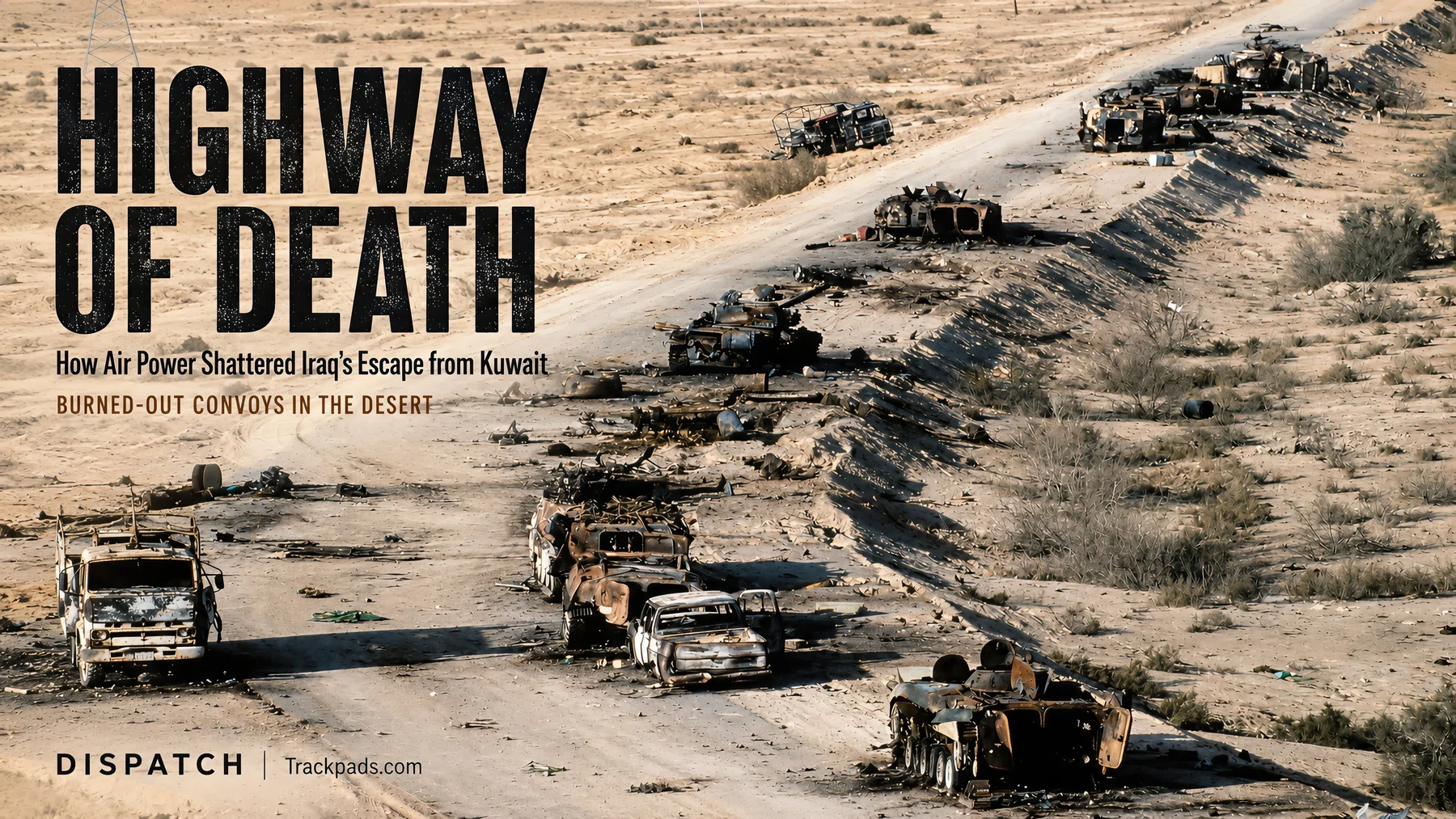
At first light, the tactical outcome on Highway 80 and the nearby routes was brutally clear. Rows of charred trucks, armored personnel carriers, and tanks lay burned out along the pavement and in the sand. Some vehicles were twisted by internal explosions, their turrets thrown askew or their cargo scattered across the roadside. Iraqi soldiers who survived the night emerged to surrender to advancing coalition ground forces, dazed and exhausted, or tried to make their way on foot toward the north. The equipment destroyed there would never reach defensive positions in southern Iraq, and the formations that had once crewed it were shattered into small, disorganized groups.
In campaign terms, the destruction along the Highway of Death underlined how little room Iraq had left to maneuver. The coalition had not only broken the occupation of Kuwait but had also smashed a significant portion of the force that might have contested any deeper push. Within days, a ceasefire would halt operations, leaving the regime in Baghdad still in power but with a battered army and a clear demonstration of coalition dominance in conventional warfare. For many in uniform, the wreckage on that road was a stark proof of what happens when a modern, integrated air and ground campaign pins an opponent in the open.
Beyond the immediate military effect, the images that leaked out of the desert began to shape public perception. Photographs and video of long lines of burned vehicles, some with civilian-style buses and trucks mixed among military targets, sparked arguments about whether continued attacks on retreating forces were necessary to achieve the war’s aims. Critics pointed to the imbalance of power and the appearance of a one-sided pounding of troops trying to get away. Supporters argued that these were armed units, still under orders, and that letting them slip away intact would have meant more fighting later. Those questions about proportionality and restraint did not change the fact of what happened on the ground, but they ensured that the Highway of Death would be remembered not only as a tactical episode but as a moral case study.
Today, staff rides, professional military education courses, and museum exhibits still revisit this stretch of desert. They use it to talk about air power and ground maneuver, about how decisions to strike or hold fire ripple outward, and about the gap between how a battle looks from a cockpit and how it feels on the receiving end. For readers and listeners who came of age after the Gulf War, the Highway of Death offers a window into the moment when satellite-era targeting, coalition politics, and an aging mechanized army collided on a single road. It stands as a warning that the last night of a campaign can be as decisive, and as contested in memory, as its opening shot.