Morning Guns in the Argonne
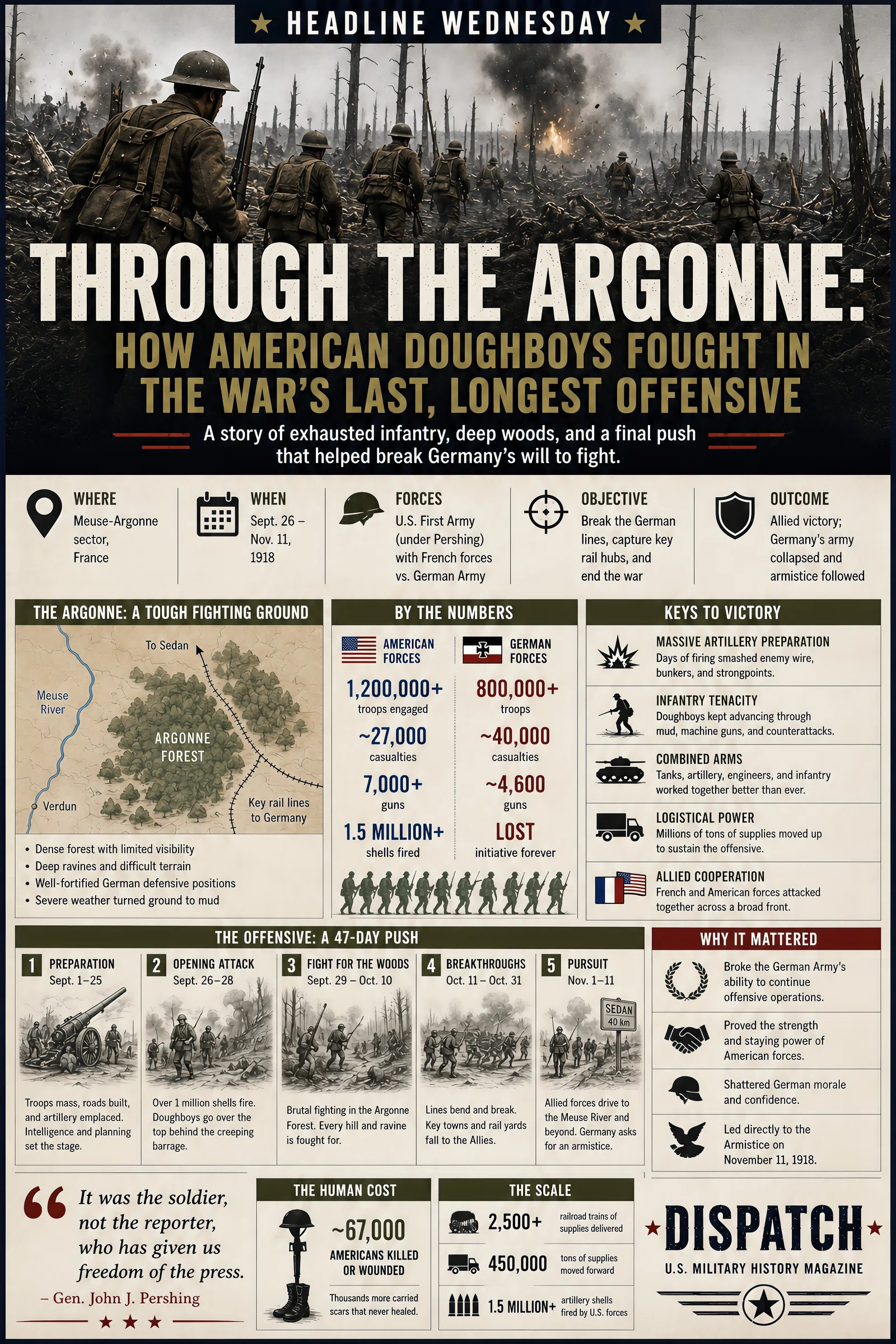
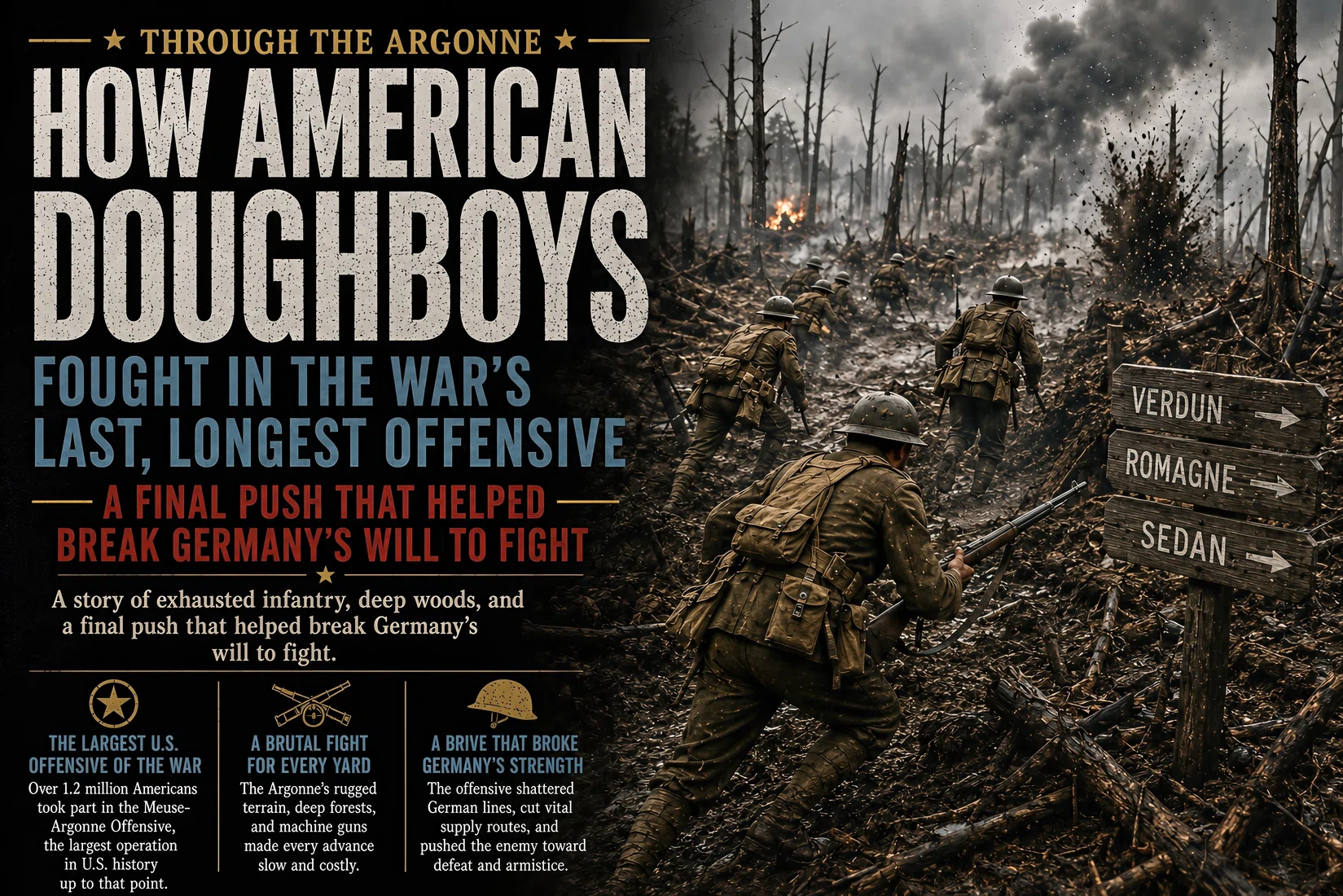
The barrage began in the dark, somewhere between night and dawn, with the Argonne hills answering in flashes. Along a crowded trench line north of Verdun, American doughboys stood on firing steps, packs biting into their shoulders, watching the sky turn from black to a dirty gray that smelled of cordite and wet leaves. Behind them, guns pounded out a rolling curtain of shells toward the German lines. In front of them, past the ragged wire and churned mud, the Argonne Forest waited: a tangle of ravines, shattered trees, and dug-in machine guns that had already chewed up better-trained armies earlier in the war.
Men from Midwestern farms and New York streets checked rifle bolts with gloved hands, pulled gas masks closer on their chests, and tried not to think about what waited beyond the parapet. Some had been in France only a few months; others had already seen the Meuse heights or Saint-Mihiel. None had ever been part of anything this large. Orders were simple and brutal: move out when the barrage lifts, keep up with the creeping fire, do not let it outrun you. Somewhere ahead, French units would be pushing, too, and British forces farther north.
Whistles blew. Officers shouted over the artillery’s roar, and the line climbed out of the trenches into ground they knew had been surveyed by German observers for years. The forest absorbed sound and light, turning the advance into a slow stumble through shell holes, broken branches, and sudden bursts of machine-gun fire from positions that seemed to be everywhere at once. The first morning of the Meuse-Argonne Offensive felt less like a clean advance and more like a blind shove into a maze. Yet every platoon that pushed forward knew this was more than just another attack. It was the opening move in what was meant to be the final drive of the war.
If the Forest Holds, War Drags On
To understand the weight on those shoulders, you have to pull back from the fog and splinters of the Argonne and look at the Western Front in late 1918. For four years, Germany and the Allies had traded lives for yards of ground, building a fortified world of trenches, wire, concrete bunkers, and interlocking fields of fire. By early autumn, the German Army was reeling from months of Allied offensives, but it was not yet beaten. Its commanders still hoped to trade space for time, falling back to shorter, stronger lines and forcing the war into 1919 on terms they might be able to survive.
The Meuse-Argonne sector was the hinge of that plan. Between the Meuse River and the Argonne Forest lay high ground, deep woods, and a network of rail lines leading east to Sedan and beyond. Those rails fed German divisions along the front. If the Allies could punch through here, they would threaten the main supply arteries of the entire German position in France. If they failed, German forces could steady themselves, regroup behind yet another defensive belt, and bargain for a peace that left them in control of occupied territory.
Into this decisive sector marched the new American First Army, commanded by General John J. Pershing. The offensive would be the largest operation the United States had ever attempted, with hundreds of thousands of American troops committed alongside French units. Success would prove that the American Expeditionary Forces were not just filling gaps but capable of carrying a major front. Failure would cost staggering numbers of lives and might weaken the Allies’ resolve just as Germany’s leaders were beginning to waver. Every ravine in the Argonne and every ridge along the Meuse became a test not only of tactics and logistics but of whether fresh American armies could help force an end to a war that had already devoured a generation.
Orders, Deadlines, and a Crowded Front
The Meuse-Argonne Offensive did not appear out of nowhere in that gray September dawn. It was the product of months of pressure, promises, and hard bargaining among the Allies. Earlier in 1918, German offensives had punched deep into Allied lines, threatening to split British and French armies. Those attacks had burned through German reserves and opened the door for a series of Allied offensives that pushed the front slowly back. Behind those lines, American troops had been arriving in growing numbers, training in quieter sectors and then proving themselves at places like Cantigny, Château-Thierry, and Saint-Mihiel. By late summer, American manpower had become a central piece of the Allied plan to end the war.
General John J. Pershing had insisted that American forces fight as a unified American army rather than being fed piecemeal into French and British units. The creation of the First Army answered that demand but also created a huge challenge. Staff officers had to knit together divisions from all over the United States, many with limited combat experience, onto a cramped front with poor roads and overtaxed railheads. Artillery had to be moved up through mud and traffic jams, ammunition dumps carved out of ravines, and field hospitals set up close enough to receive casualties from an attack on a scale the United States had never attempted.
Allied high command wanted simultaneous blows up and down the line to keep Germany off balance and deny its leaders any chance to shift reserves. That meant the Meuse-Argonne would begin just days after the American victory at Saint-Mihiel, giving First Army limited time to regroup and redeploy. Divisions that had just come out of one offensive were shifted at night, often with incomplete maps and hurried briefings about an enemy dug into the forest for years. The terrain itself worked against neat planning. The Argonne was a maze of ravines and ridges that cut communications, swallowed units, and made it hard for officers to see what was happening even a few hundred yards away. The decision to attack here accepted all those difficulties in the hope that a breakthrough would crack Germany’s ability to continue the war.
Into the Woods and Up the Ridges
When the guns lifted on the first morning of the offensive, American infantry moved forward across a broad front, their lines staggered by the broken ground. In the opening hours, there were real gains. German forward positions were overrun, prisoners began trickling back, and reports from some sectors suggested that the enemy was falling back faster than expected. But as the day wore on and the troops pushed deeper into the Argonne, the easy gains faded. Units lost contact with neighboring regiments as ravines and dense stands of trees broke their lines into isolated pieces. Runners struggled to find headquarters, telephone lines were cut by shellfire, and maps that looked clear in the planning tents turned out to be rough guesses when translated to the forest floor.
On the heights, German machine-gun teams and artillery observers took advantage of every spur and knoll. Positions that had been carefully sited for overlapping fire turned narrow draws into killing zones. Doughboys trying to follow the creeping barrage sometimes found themselves either lagging behind, exposed to rifles and machine guns that had survived the shelling, or too far forward, caught under their own artillery. At places like Montfaucon, an important hill that dominated nearby ground, attacks bogged down under interlocked fire and counterattacks that showed the German Army was battered but still capable of stiff resistance. Each delay meant that artillery schedules, set on optimistic assumptions of progress, became less useful as guides.
Farther inside the forest, companies and battalions fought their own private battles. Some divisions clawed ahead yard by yard, knocking out machine-gun nests with grenades and rifle fire, improvising flank attacks through the undergrowth. Others stalled, exhausted officers trying to reorganize shattered units in clearings that might be shelled at any moment. In sectors like the one later associated with the “Lost Battalion,” American troops pushed so far into the Argonne that they outpaced neighboring formations and found themselves surrounded, holding on in ravines under constant fire while higher headquarters struggled even to pin down their location.
From behind the lines, Pershing and his staff saw only fragments of the fight through scattered reports and delayed messages. The initial plan’s neat boundaries blurred as divisions overlapped or left gaps, and French forces to the left and right moved at uneven speeds. What was supposed to be a relentless drive began to look like a series of disconnected pushes, each one costly and slow. Yet the instructions from above did not change in any simple way: keep pressing, keep drawing German reserves into this sector, keep grinding forward toward the rail lines and heights that anchored the enemy’s defense. By the end of the first phase of the offensive, American forces had advanced, but nowhere near as far or as fast as the planners had hoped, setting up a grinding, extended campaign in the Argonne that was still far from its decisive turn.
Learning Under Fire, Day After Day
The Meuse-Argonne did not flip from stalemate to breakthrough in a single dramatic charge. The turn came slowly, over weeks, as American units bled, adapted, and reorganized while German strength ebbed away. After the first phase bogged down in the forest and on the ridges, the American command structure shifted. General Pershing, still overall commander, turned more of the day-to-day control of First Army’s operations over to officers like General Hunter Liggett, who had a calmer eye for what tired divisions and clogged roads could realistically do. Objectives were shortened, timetables adjusted, and the offensive was broken into more carefully staged phases that matched the reality on the ground rather than the optimism of the planning maps.
On the line, divisions that had been mauled in the opening days were pulled back and replaced by fresher units, creating a painful but necessary rotation in the front ranks. Artillery planners improved the coordination between guns and infantry, paying closer attention to the forested terrain and the need to knock out machine-gun nests hidden in ravines and copses rather than assuming a rolling barrage could simply sweep them away. Air units, still primitive by later standards, flew more reconnaissance, helping to locate strongpoints and observe German movements as their commanders cobbled together new positions under pressure. Each adjustment was small, but together they made the American push steadier and less wasteful.
On the German side, every day of fighting in the Meuse-Argonne drained reserves that no longer existed in depth. Units were thrown into the line understrength, sometimes arriving without time to properly dig in before they were hit by another American push. German commanders still used the terrain well and launched sharp counterattacks, but the pattern gradually shifted from confident defense to reluctant delay. Reports from other parts of the front made it clear that this was not an isolated struggle. Allied attacks to the north were cracking sections of the Hindenburg Line, and there was no prospect of pulling divisions away from those crises to shore up the Argonne.
As October wore on, the cumulative effect of relentless pressure and better Allied coordination began to show. American divisions pushed past earlier sticking points, took key heights along the Meuse, and drove toward the vital rail hub at Sedan. Positions that had held for years were abandoned under the threat of encirclement rather than overrun in neat frontal attacks. The “turning” of the Meuse-Argonne was not a single moment of heroism, though there were many. It was the point at which American forces, once green and disjointed, became a functioning heavy weight on the Western Front just as Germany was running out of time, men, and room to maneuver.
From Forest Drive to Armistice
By early November, the battlefield that had seemed immovable in September was transformed. American and French forces stood deeper into the German defensive system, with captured heights, shattered strongpoints, and abandoned trenches marking the path of the Meuse-Argonne drive. The rail lines that fed German armies in northern France were under direct threat, and some were effectively cut as Allied guns and advancing infantry closed in on critical junctions. German units still fought hard, and the casualty lists on both sides remained grim, but the direction of the campaign was no longer in doubt. The German Army was being forced into a retreat whose pace and scale left little hope of stabilizing a new line.
In the German high command and in Berlin, the pressure from Meuse-Argonne and other Allied offensives combined with internal unrest to bring matters to a breaking point. Political leaders faced food shortages, strikes, and growing war weariness at home even as reports from the front made clear that no miracle counterstroke was coming. The loss of ground in the Meuse-Argonne sector and the danger to vital communications helped convince Germany’s leaders that holding out into 1919 would not bring better terms, only more ruin. Within days of American troops pressing toward Sedan, German negotiators were seeking an armistice, and on November 11, the guns finally fell silent.
For the United States, the Meuse-Argonne Offensive became a defining test and a harsh teacher. It showcased the potential of American industrial power and manpower when mobilized on a modern battlefield, but it also exposed shortcomings in staff work, logistics, and training that would haunt planners for decades. Many officers and noncommissioned officers who endured the Argonne carried its lessons into the interwar years and into the Second World War, shaping doctrine on how to coordinate artillery, infantry, armor, and air power in complex terrain. Staff rides and field exercises later returned to the region, walking the same ridges and ravines to study what had worked and what had gone terribly wrong.
Today, the Meuse-Argonne stands as more than just the largest American battle of the First World War. It is a reminder of how costly it can be to learn on the job in a modern, industrial conflict, and how momentum in war often turns not on a single dramatic blow but on sustained, disciplined pressure applied after brutal early setbacks. For students of military history, visiting the cemeteries and preserved positions in the Argonne brings the scale of that final push into sharp focus: row after row of white crosses and stars marking the price of driving a determined enemy to the peace table. When we trace the road from those early morning guns in the forest to the armistice trains, we see how that long, grinding offensive helped close one of the bloodiest chapters in modern history.