Columns of Silk Over Holland
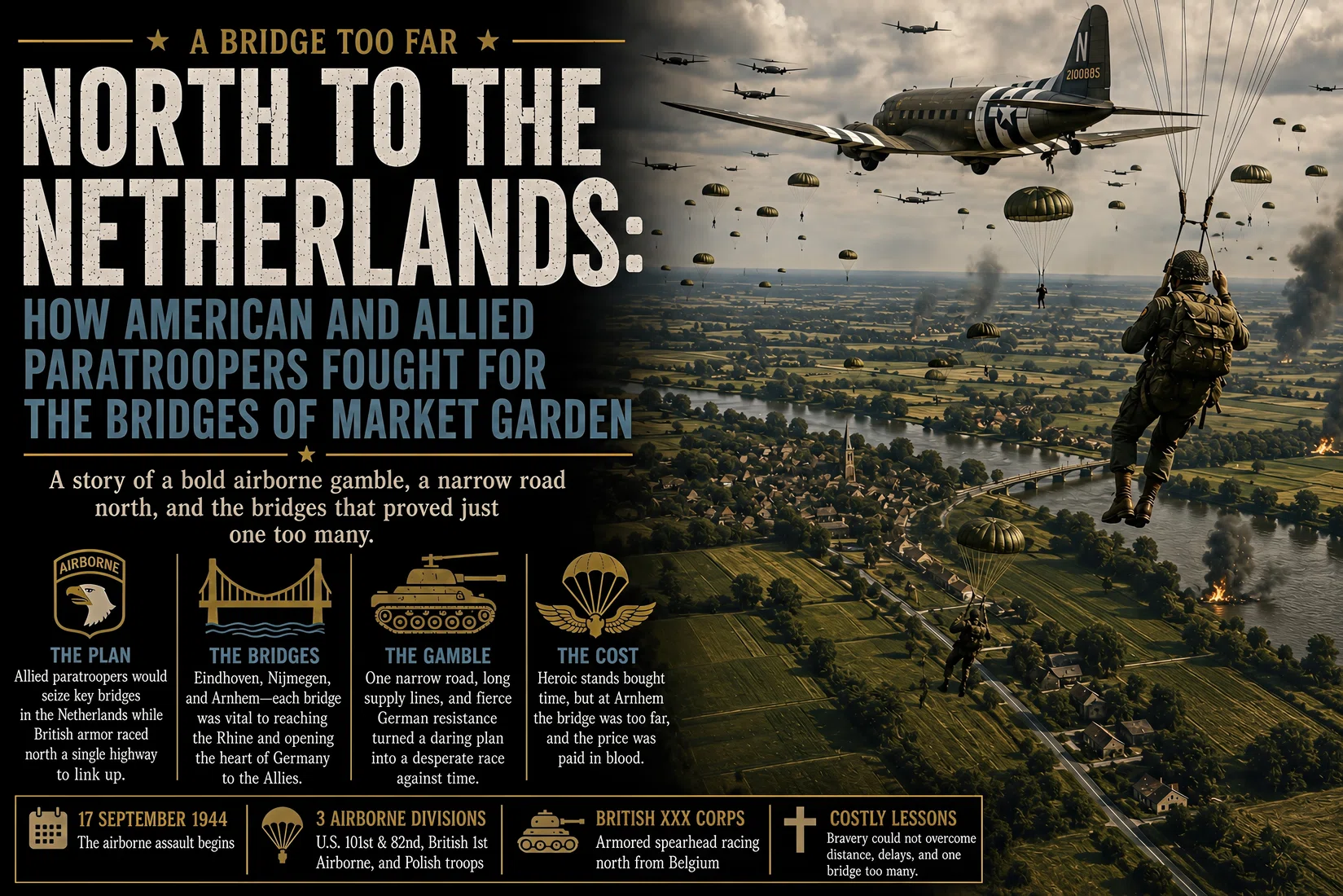
The morning sky over the Netherlands was thick with engines. From horizon to horizon, droning transport aircraft crossed the flat Dutch landscape, their wings glinting in the September light. Inside the cramped fuselages, paratroopers from the United States 101st and 82nd Airborne Divisions, along with British and Polish airborne troops in other serials, checked each other’s gear and listened for the shouted commands they had practiced countless times. Below them lay patchwork fields, canals, and the towns whose bridges would decide whether the war in Europe might be shortened by months or even years.
When the jump lights turned green, the doors filled with figures in helmets and heavy packs, stepping out into the slipstream in rapid succession. Chutes snapped open, canopies blossomed, and suddenly the sky above Eindhoven, Nijmegen, and the surrounding countryside was filled with drifting men and equipment bundles. From the ground, Dutch civilians stared up in shock and hope, waving and pointing as the airborne armada descended. From the air, paratroopers saw church spires, smoke from scattered fires, and the dark lines of rail embankments and rivers they had studied on maps.
As boots hit the ground, the neat order of the drop zones quickly turned into the confusion of combat. Units had to gather up scattered sticks, dodge sporadic German fire, and begin moving toward roads and bridges that could not be allowed to fall or be blown. The operation’s planners had envisioned a swift linkup between these lightly armed airborne forces and a British armored column racing north from the Belgian border. But in these first minutes and hours on Dutch soil, that future was still uncertain. The men on the ground only knew that they had been dropped deep behind enemy lines, and that every hour they held out would matter.
Somewhere to the north, beyond the reach of most of these American paratroopers, another airborne division was fighting for a single bridge at Arnhem. The entire chain of crossings, from the Belgian border through Eindhoven and Nijmegen and finally to Arnhem, formed one fragile artery. The paratroopers who had just fallen from the sky were the first links in that chain. Whether they could seize and hold their assigned bridges would determine if the daring plan unfolding over Holland would remain a bold stroke or become a costly near-miss.
One Narrow Road to End the War Early
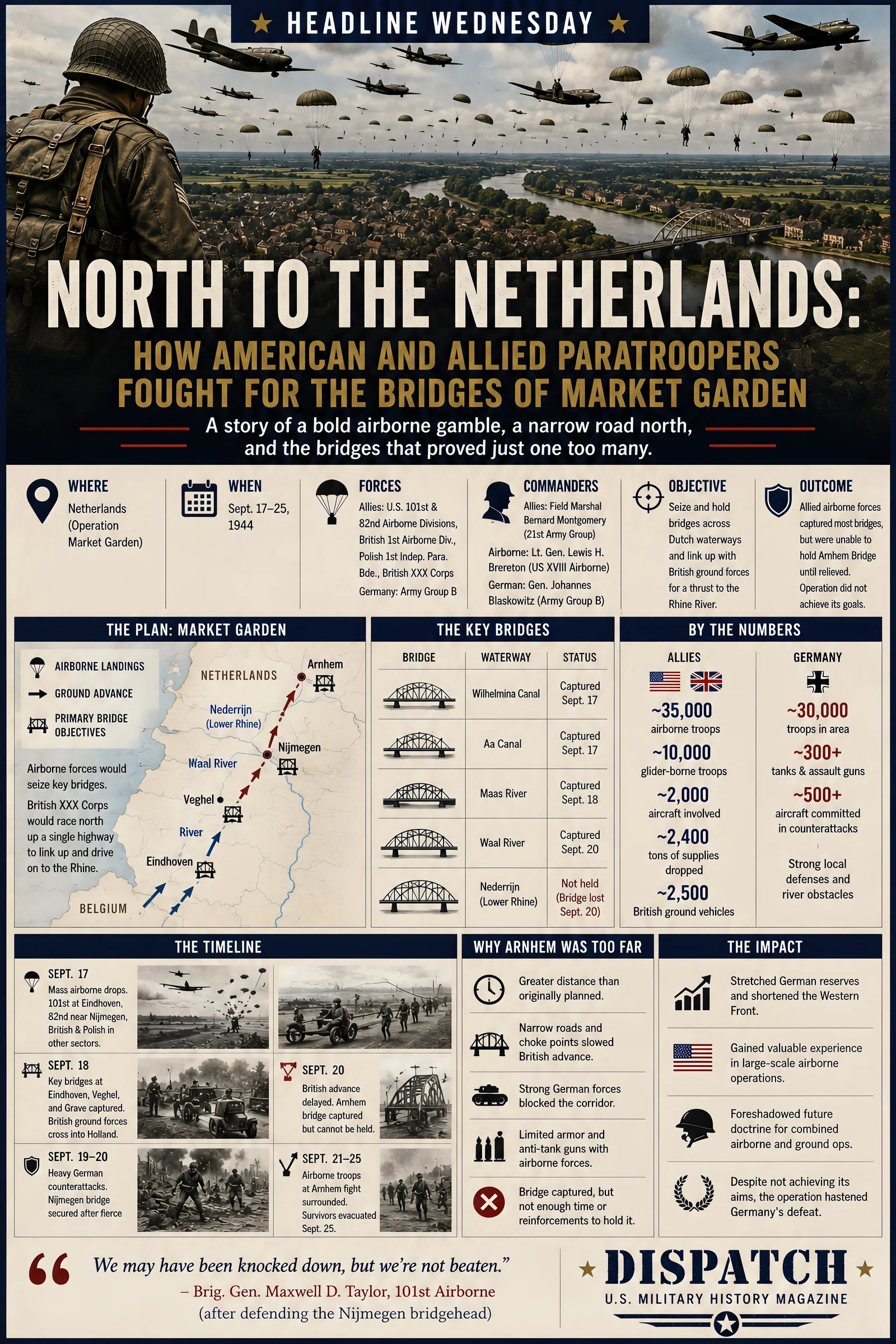
Market Garden was born out of a moment when Allied leaders believed they might be able to end the war in Europe in 1944. After the breakout from Normandy and the rapid advance across France, German forces in the west looked shaken and uneven. Instead of grinding forward along a broad front, British commander Bernard Montgomery argued for a concentrated thrust. His idea was to leap over the major rivers in the Netherlands with airborne troops, seize a corridor of bridges leading to the Rhine, and then send a single armored spearhead racing along that “airborne carpet” into Germany’s industrial heartland.
The “Market” part of the plan was the largest airborne operation yet attempted, with American, British, and Polish paratroopers and glider troops assigned to a series of drops along a northbound axis. The “Garden” part was a ground assault, centered on British XXX Corps, that would push up a single main highway from the Belgian border. If it worked, they would cross the Maas, the Waal, and finally the Lower Rhine, turning the German northern flank and opening a path into the Ruhr. The notion appealed to leaders who were tired of attritional fighting and searching for a way to break the enemy’s will in one decisive stroke.
The stakes could not have been higher. Success might have outflanked the German defenses on the Siegfried Line, eased pressure on other Allied armies, and shortened the war in the west. For the Dutch living under occupation, a rapid victory offered hope that they might be spared another winter of hunger and reprisals. For the airborne troops, it meant risking isolation far ahead of friendly lines, depending on their own rifles, limited heavy weapons, and the promise that tanks would arrive in time. If any key bridge, especially at Nijmegen or Arnhem, was destroyed or held too long by German defenders, the whole plan would unravel.
The risks were written into the geography. The corridor from the Belgian border to Arnhem ran through low, wet country, with dikes, canals, and only a few usable roads. A single highway would have to carry infantry, armor, artillery, and supply columns in a tight column vulnerable to ambush and counterattack. Any blown bridge or blocked village could halt the drive. That narrow road and its chain of bridges held the possibility of a quick end to the war in the west. They also held the possibility that, in trying to reach too far, the Allies would end up one bridge short.
From Breakout to Bold Proposal
The road to Market Garden began in the heady weeks after the breakout from Normandy. In late summer 1944, Allied forces surged across France, liberating Paris and driving German units back toward their own borders. Fuel trucks raced to keep up, supply depots leapfrogged forward, and the front stretched from the Channel coast to the Swiss border. Behind the optimism, though, lay serious strains. Trucks were worn, ports were still limited, and the pace of advance risked outrunning the logistics that made it possible. Commanders argued over how to use what strength they had.
At the center of that argument stood two competing visions. General Dwight Eisenhower favored a broad-front advance that would keep pressure on the German line everywhere, making it hard for the enemy to concentrate. Field Marshal Bernard Montgomery pushed instead for a focused thrust in the north, using his British forces as the tip of a spear aimed at the Ruhr, Germany’s industrial heart. Airborne forces, newly blooded in Normandy, offered a way to leap over natural obstacles and seize ground in advance of armor. The idea of dropping entire divisions to capture critical bridges fit both the moment’s confidence and the desire for something decisive.
Intelligence reports fed the sense that the time was ripe. Many German units were understrength and disorganized, and the Wehrmacht seemed to be reeling from defeats in France and Belgium. At the same time, there were worrisome signs that armored formations, including SS panzer units, were regrouping in the Netherlands. Those warnings were not ignored, but they were discounted in the rush to turn opportunity into victory. Air planners wrestled with the limits of range, weather, and available aircraft, while ground commanders worried about committing a single corps to a narrow road through constricting terrain.
The final plan represented both compromise and conviction. American airborne divisions would be dropped to secure the southern and central bridges around Eindhoven and Nijmegen. British airborne troops, joined later by Polish paratroopers, would jump near Arnhem to seize the last and most critical bridge over the Lower Rhine. British XXX Corps, with its tanks and mechanized infantry, would drive up a single main highway from the Belgian border to link these pockets together. It was a path that left little room for error. If any part of the chain broke, the others would be exposed and alone, fighting for time on Dutch roads and riverbanks.
A Highway of Fire Through Dutch Towns
When the operation began on 17 September 1944, the first phases unfolded much as the planners had hoped. American paratroopers from the 101st Airborne dropped near Eindhoven and nearby villages, fanning out to seize bridges over the Wilhelmina Canal and smaller waterways that fed the main highway north. Fighting through scattered German resistance and occasional flak on the way down, they rushed into towns like Son and Veghel, cutting wires, clearing roadblocks, and trying to capture spans before demolition charges could be detonated. At Son, they arrived just minutes too late, and the bridge over the canal went up in a spray of smoke and shattered steel.
To the north, the 82nd Airborne Division landed around Nijmegen and on the high ground of the Groesbeek Heights. Their mission mixed offense and defense: hold the ridge that overlooked the corridor and take the vital bridges over the Maas and the Waal. Initial efforts focused on securing the heights and nearby crossings, while German troops scrambled to organize a response. Inside Nijmegen itself, German units stiffened around the large road and rail bridges, turning them into strongpoints. The American paratroopers had arrived, but prying those bridges from German hands would prove harder and costlier than expected.
Farther up the line, British 1st Airborne Division dropped west of Arnhem, separated from their main objective by several miles of urban and semi-rural terrain. Glider-borne troops brought in jeeps and some light artillery, but the drop and landing zones lay farther from the town than many officers would have preferred. Communications quickly proved fragile as radio sets failed or struggled through interference. Despite that, elements under Lieutenant Colonel John Frost pushed into Arnhem and reached the northern end of the great bridge over the Rhine, digging in around nearby buildings and preparing to hold as long as possible. Other battalions met unexpected resistance, ambushes, and the troubling sight of German armored vehicles moving nearby.
On the ground between these airborne lodgments, British XXX Corps crossed the start line and began its northward push. Tanks and infantry rolled up the narrow highway that locals would come to call “Hell’s Highway,” passing cheering Dutch civilians and roadside ditches that could swallow a tracked vehicle that slipped off the pavement. Every village became a potential choke point, every destroyed vehicle a new obstacle on the one road that mattered. German units, recovering faster than many had assumed, began to launch local counterattacks against the column and the paratroopers holding its flanks.
As the hours turned into days, the smooth timeline on the planning maps started to fray. Engineers worked under fire to bridge the destroyed span at Son so armor could move forward. In Nijmegen, American paratroopers and British tanks fought through city streets and along riverbanks to get at the Waal bridges. At Arnhem, the small force at the bridge held firm against mounting pressure while other British units were pushed back or cut off in the woods and suburbs to the west. The corridor was open in places and under attack in others. The final, fragile miles to Arnhem were turning into a race that the men at the far end of the chain could feel in every shell and every shattered building.
River Crossings and Lost Hours
The turning of Market Garden came not in a single dramatic charge, but in the accumulation of delays and desperate improvisations along the corridor. At Son, British engineers threw a Bailey bridge across the canal under the threat of artillery and small-arms fire so that tanks could finally rumble north. Each hour spent waiting for that bridge was an hour the British airborne at Arnhem did not have. By the time armored spearheads were moving again, German commanders had begun to understand the scale of the Allied gamble and were shifting units to choke the narrow road and reinforce the key crossings still in their hands.
Around Nijmegen, the struggle for the Waal bridges became the operation’s defining test of nerve. American paratroopers were tasked with crossing the wide, fast-flowing river in flimsy assault boats to attack the northern ends of the bridges, while British armor pushed from the south. Men paddled through strong currents and enemy fire with little cover, some boats riddled and sinking before they reached the far bank. On the northern shore, paratroopers clawed their way through dikes and fields to knock out German positions, while tanks and infantry surged into Nijmegen’s streets to break the defenders holding the bridge approaches.
When the Nijmegen road bridge finally fell to the Allies, it felt like a breakthrough that might yet save the whole plan. Tanks roared across, headlights sometimes burning as they pushed into the night. But the lost hours at earlier obstacles, combined with fierce opposition and the constant need to secure the flanks of “Hell’s Highway,” meant that the British column reaching the far side was smaller and later than planners had hoped. The drive toward Arnhem resumed with urgency, but German forces had used the time well, reinforcing the approaches and tightening their ring around the isolated bridgehead.
In Arnhem itself, the men holding the northern end of the bridge were nearing the limits of endurance. They fought from house to house, using upper stories and cellars as firing positions while German tanks and self-propelled guns hammered the buildings to rubble. Ammunition and medical supplies dwindled, and communications with the rest of the division were sporadic. Attempts by other British units to break through to the bridge from the west ran into strong German counterattacks and the harsh reality of fighting across ditches, hedgerows, and built-up areas without sufficient armor support. The more hours that slipped away, the less likely it became that the column from the south could arrive in time.
Eventually, the dam could not hold. The small force at the Arnhem bridge was overwhelmed, its survivors killed, wounded, or taken prisoner after days of bitter resistance. South of the town, other airborne units clung to a shrinking perimeter on the north bank of the river, cut off from the main Allied armies by miles of contested ground and a corridor that could not be pushed farther. The Allies had seized many of their objectives and opened the road as far as Nijmegen. But Arnhem, the last crucial link in the chain, remained in German hands. The turning point of Market Garden lay in that gap between hard-won success at the Waal and the failure to secure the final bridge.
One Bridge Short and a Longer War
In the end, Market Garden closed with a night withdrawal across the Rhine rather than a triumphal crossing. British airborne survivors were ferried back over the river in small boats under cover of darkness and rain, leaving behind dead, wounded, and prisoners in and around Arnhem. The corridor south of Nijmegen remained in Allied hands, and several important Dutch towns and bridges were now under Allied control. Yet the central purpose of the operation—to force a crossing of the Rhine and open the way into Germany’s industrial heartland—had not been achieved. The phrase “a bridge too far” became a shorthand for the gap between the plan’s ambition and its outcome.
Strategically, the failure to secure Arnhem meant that the Allies would have to confront the German frontier defenses head-on over the following months. Operations shifted back to grinding assaults along a broader front, including costly fights in the Hürtgen Forest and the later German counteroffensive in the Ardennes. For the Dutch, the consequences were particularly harsh. Large parts of the country remained under occupation through the winter of 1944–1945, and German retaliation and economic disruption contributed to severe hardship and hunger in the months that followed. The hope of liberation that had flared with the sight of parachutes over Dutch fields had to endure a longer, colder wait.
Within the airborne and armored communities, Market Garden became a case study in the limits of daring. The courage of the paratroopers who seized and held bridges, the engineers who built under fire, and the tank crews who fought along the highway was never in doubt. The questions centered on assumptions, planning, and intelligence: the distance between drop zones and objectives, the underestimation of German strength, and the reliance on a single vulnerable road. After the war, officers and historians revisited the operation’s decisions, drawing lessons about logistics, command coordination, and the danger of letting optimism override warning signs.
For students of military history today, the story of Market Garden offers both inspiration and caution. It shows what airborne and armored forces can attempt when given a clear aim and the will to move quickly, and how small units can hold key ground against heavy odds. It also shows how geography, timing, and enemy resilience can turn a bold plan into a costly near-miss. Staff rides and museum exhibits that trace the route from the Belgian border to Arnhem invite visitors to think about maps, assumptions, and the human experience behind every bridge and road sign. The men who jumped, marched, and fought their way along that narrow Dutch corridor left a legacy that reaches beyond one failed gamble: a reminder that even in victory, armies must respect the limits of what can be forced by courage alone.