Abrams Columns Race into Baghdad
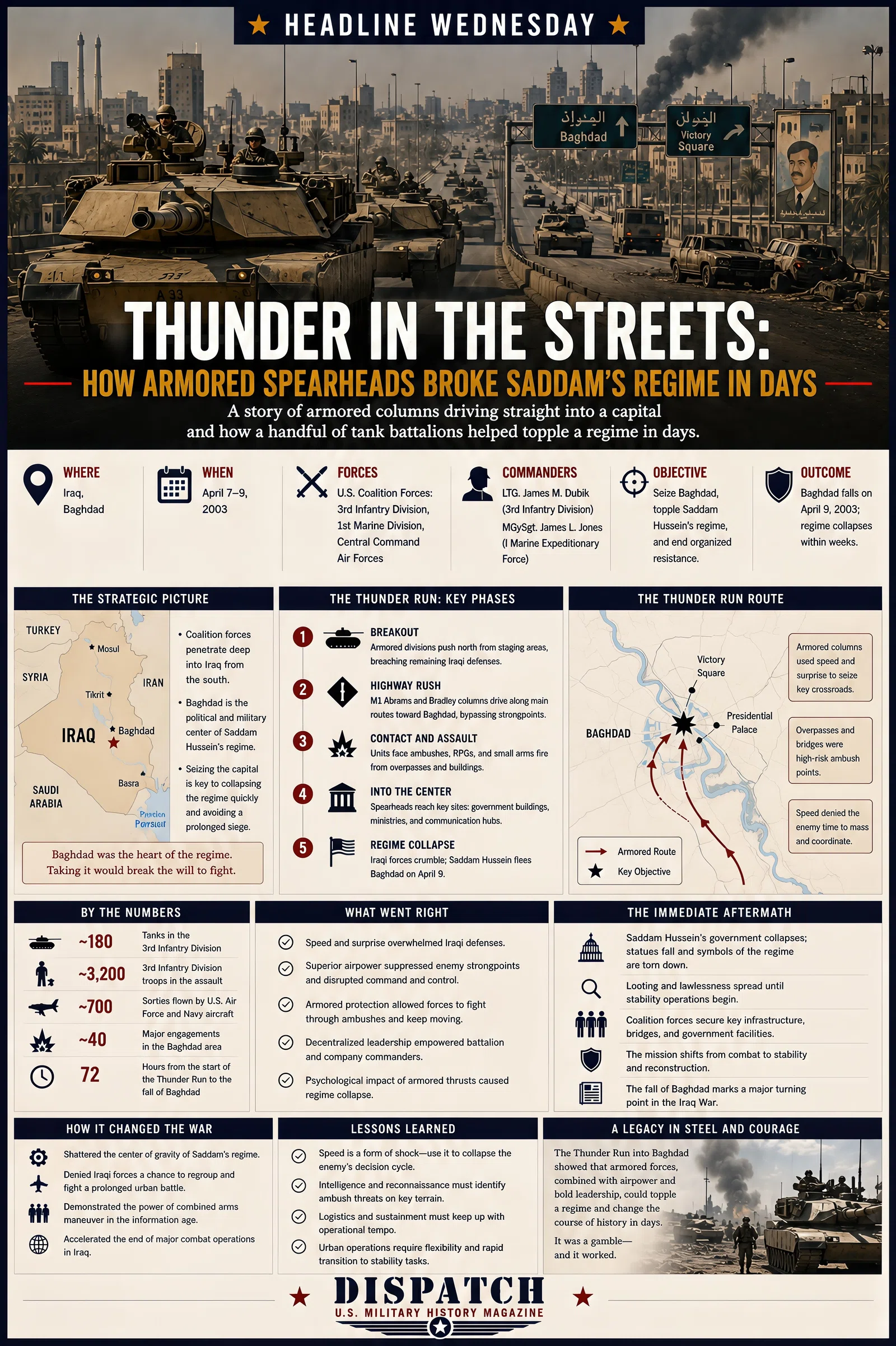
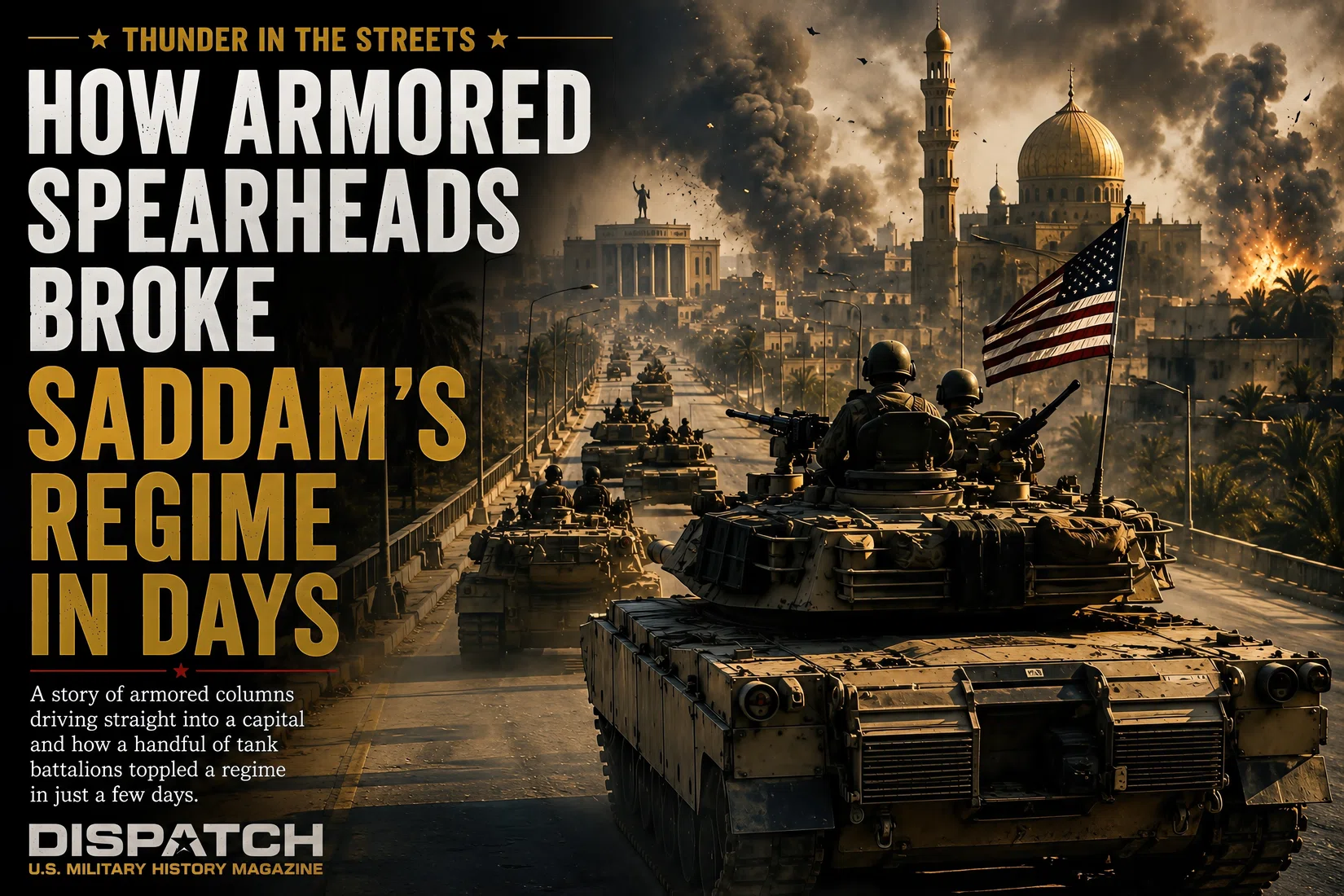
Just after first light, the highway lanes into Baghdad belong to the roar of tank engines more than to cars or trucks. M1 Abrams and Bradley fighting vehicles from the United States Army’s 3rd Infantry Division push north in tight columns, dust and exhaust hanging low over the asphalt. Crews peer through periscopes and thermal sights, trying to read a city skyline they have never seen in person, watching for telltale flashes from rocket-propelled grenades along overpasses and side streets. The radio nets are busy but controlled, company and battalion commanders calling out landmarks, battle damage, and threats spilling in from every direction.
This is not a cautious cordon of a capital. It is a deliberate armored raid, a “Thunder Run,” straight down major highways into the political heart of Saddam Hussein’s regime. As the lead tanks pass ruined cars and burning buses, small arms fire rattles from apartment blocks and highway ramps, quickly answered by coaxial machine guns and main gun rounds. Every overpass feels like a potential ambush point, every stalled vehicle a possible bomb. Yet the columns keep moving, because stopping in the middle of the city is far more dangerous than punching through it.
On some tanks, crewmen stand half exposed in their hatches, guiding drivers around debris, scanning with binoculars or night-vision gear even in daylight shadows under concrete spans. In the back of each man’s mind is the knowledge that they are dozens of kilometers inside hostile territory, ahead of most support and far from the relative safety of division lines. The idea is simple and brutal: drive so hard and so fast that defenders never organize a coherent response. As Baghdad’s government buildings, palaces, and television towers loom closer, the crews know this is more than a raid for a map square. It is a gamble aimed at the regime itself, and the day has only begun.
If the Capital Holds, the War Changes
To understand the risk these Thunder Runs carry, you have to zoom out from the highway and look at the war’s larger map. By early April 2003, coalition forces have already cut deep into Iraq from the south, seized key airfields, and swung around major cities like Karbala and Najaf. But Baghdad is still the regime’s nerve center, where command bunkers, ministries, and propaganda organs sit clustered along the Tigris River. As long as Saddam’s government can claim to control the capital, it can argue that the war is still undecided, no matter how many divisions have been shattered in the countryside.
Baghdad also anchors the Iraqi military’s remaining organized resistance. Republican Guard formations, paramilitary Fedayeen fighters, and regime security forces are all oriented on the capital, ready to turn dense neighborhoods and highway interchanges into kill zones. If the city holds, the campaign risks sliding into a drawn-out siege with street-by-street clearing, rising casualties, and political pressure on coalition leaders at home. Every extra week of heavy fighting would strain logistics, invite more international criticism, and give remaining Iraqi units time to adapt.
For the 3rd Infantry Division and the Marine units converging from other axes, the Thunder Runs offer a different path. By driving armored spearheads straight into the city center, division leaders hope to shatter the regime’s control in days instead of weeks. If tanks can reach major crossroads, government compounds, and symbolic sites like parade grounds and palaces, they can show ordinary Iraqis and Iraqi soldiers alike that the old order is crumbling. The gamble cuts both ways. A column trapped inside the city, cut off from resupply or extraction, could be chewed apart by close-range anti-armor fire and mobs of fighters. The stakes on that morning highway are not just the lives of a few battalions. They are the tempo of the entire war and the way the fall of Baghdad will be remembered.
From Desert Dash to City Gate
In the weeks before tanks rolled down Baghdad’s highways, the 3rd Infantry Division had already run a hard gauntlet. The division crossed the Kuwaiti border in a sandstorm of its own making, pushing north along long, exposed routes flanked by irrigation canals and villages. There were river crossings under threat of artillery, pauses to refuel under the glow of burning oil trenches, and sudden firefights with entrenched units that refused to melt away. Every stop to refuel or repair a track reminded commanders how thin their lines really were, stretched back across hundreds of kilometers of desert and road. Yet each day’s advance brought them closer to the bridges and airfields that formed the outer ring of Baghdad’s defenses.
Higher headquarters originally envisioned a more deliberate approach to the capital, with encirclement and methodical clearing. But as coalition air power hammered Iraqi regular formations and Republican Guard units struggled to reorganize, opportunities appeared. Reconnaissance and earlier pushes toward the city showed that armored columns could punch surprisingly deep before meeting truly coordinated resistance. Satellite and airborne surveillance hinted at confusion in the regime’s command system. Inside the division, brigade and battalion commanders weighed this intelligence against the reality of their own fuel, ammunition, and maintenance status.
The first limited thrusts toward Baghdad’s outskirts were, in effect, live-fire tests. Armored task forces probed interchanges and overpasses, gauging how quickly Iraqi fighters could mass rocket-propelled grenades and small arms along the routes. These early pushes were bloody and chaotic, but they also showed that aggressive movement and heavy firepower could unsettle defenders who lacked a unified response plan. Division leaders began to see that speed itself could be a weapon. What emerged from these experiences was the Thunder Run concept: concentrated armored raids deep into the city, designed not just to seize ground, but to shatter the regime’s grip on its own capital by shock and visibility.
Highways Turn Into Fire Lanes
When the order came to launch the Thunder Runs, the plan translated quickly into maps, call signs, and load plans. Tank and mechanized infantry companies were organized into spearhead task forces, each with clear objectives along major routes that snaked into the city. Some formations aimed for key interchanges and bridges; others were tasked with securing the approaches around Baghdad International Airport and the avenues leading to government complexes. Crews double-checked their ammunition mixes, favoring high explosive and anti-personnel rounds for urban targets, while still keeping armor-piercing shells on hand in case of heavier threats. Supply officers fought to push fuel and recovery assets as far forward as possible, knowing that a broken-down tank in the wrong place could block an entire column.
As the lead Abrams tanks crossed into the denser outskirts, the nature of the fight changed within minutes. Iraqi regulars and paramilitary fighters exploited every piece of cover the city offered. Rocket-propelled grenades streaked from alleys, windows, and the undersides of overpasses. Machine-gun fire stitched across road surfaces and vehicle armor. Tank commanders called out contact reports while gunners traversed turrets to swat down firing points with coaxial machine guns and main gun blasts. Bradleys and attached infantry elements scanned side streets and cloverleaf ramps, trying to spot ambush teams before they could close inside the tanks’ minimum ranges.
The battle unfolded in waves along the route. One moment, a task force would be racing through a relatively quiet stretch of highway, dust and smoke trailing behind. The next moment, it would be entering a knot of resistance where multiple intersections converged, and hostile fire poured in from three or four directions at once. Commanders at battalion and brigade level juggled reports of damaged vehicles, blocked lanes, and shifting enemy concentrations, all while trying to maintain momentum. If a column slowed too much at an interchange, defenders could swarm with small arms and rockets, turning the road itself into a kill zone.
Different vantage points inside the same Thunder Run told the same story in different tones. In the lead tanks, crews felt the pressure of being the first to see each new threat, knowing that their choices about speed and fire could decide whether the vehicles behind them made it through. In the middle of the column, support and command vehicles wrestled with visibility and congestion, trying to avoid collisions and keep radios functioning through layers of static and overlapping transmissions. Farther back, recovery crews and medics moved into areas that had just been fought over, working under the knowledge that any lull could shatter if enemy fighters regrouped nearby.
Each kilometer gained brought the columns closer to symbolic targets: palace districts, major crossroads, and the government quarter along the river. But each kilometer also lengthened the line of risk behind them, with bridges, fuel points, and previous contact sites all potential choke points for counterattacks. Reports filtered in of fresh enemy attempts to seal off the route, of vehicles knocked out or disabled, of neighborhoods erupting in fire as the columns pushed past. By the time the spearheads neared their downtown objectives, the question hanging over every radio net was whether they could hold what they had taken and fight their way back out, or whether the streets of Baghdad would close around them like a fist.
Speed, Shock, and a Collapsing Center
What turned the Thunder Runs from desperate raids into war-defining blows was the way speed and shock exposed the hollow center of Saddam’s defenses. Iraqi fighters could still mass fire at choke points and inflict damage, but they struggled to build a coherent wall of resistance across the city. Every time a tank company punched through a cluster of ambushes and emerged onto a new stretch of road, it sent a fresh signal that the regime’s control was more fragile than its slogans. The armored columns did not just survive the gauntlet; they were photographed and filmed deep inside the capital, their presence impossible to hide from Baghdad’s residents or from the wider world.
Key terrain amplified that effect. Seizing and holding Baghdad International Airport turned what might have been a fleeting raid into a lodgment on the city’s flank, a place where supplies, reinforcements, and aircraft could flow. Subsequent Thunder Runs pushed into the heart of the government district, surrounding and occupying palaces, ministries, and parade grounds that had anchored the regime’s image for decades. Each successful drive made it harder for Iraqi commanders to pretend they could regroup and counterattack. The very streets that were supposed to become traps for tanks instead became corridors that armored units used to slice apart remaining pockets of organized resistance.
Inside the American formations, the turning point felt less like a single cinematic moment and more like accumulating proof that the gamble was working. Crews saw fewer signs of disciplined, large-unit opposition and more scattered fighters acting without clear coordination. Commanders who had worried about being cut off began to think in terms of which objectives to secure next and how to relieve and reinforce forward spearheads. The risks remained real, and individual vehicles and soldiers paid a heavy price in close-range ambushes and chaotic firefights. But by the time tanks were parked inside palace compounds and along key intersections, it was clear that the Thunder Runs had done what they were designed to do: rip open the regime’s political heart and show that its hold on power could not survive armored columns in its streets.
From Lightning Advance to Long Shadow
The immediate aftermath of the Thunder Runs was visible in images that flashed around the world within days: statues pulled down, government buildings deserted or looted, and armored vehicles parked in places that had once hosted regime parades. Militarily, Baghdad’s fall meant that organized Iraqi army formations could no longer operate as a national force. Republican Guard units were scattered or destroyed, communications were broken, and command centers that had coordinated previous battles were either abandoned or under coalition control. For the soldiers and marines who had fought through the city’s highways and interchanges, the sight of civilians venturing out, some cheering and others simply staring, drove home that the conventional phase of the war had reached a decisive milestone.
At the campaign level, the Thunder Runs validated a particular vision of how armored forces could operate in and around major cities. They showed that heavy brigades, properly supported, could move rapidly through urban terrain, using speed and firepower to disorient defenders rather than being automatically bogged down. Planners and instructors would study these raids to refine ideas about columns, route clearance, and the balance between protection and tempo in city fights. At the same time, the days and months that followed revealed limits that the Thunder Runs could not address. Toppling a regime’s visible structures did not by itself solve the challenge of governing a country, securing neighborhoods, or managing the complex politics that followed.
For students of military history and professionals preparing staff rides or classroom discussions, the Baghdad Thunder Runs sit at the intersection of bold operational design and sobering strategic context. They offer a vivid case study in how a division-level commander can choose risk and speed to seize the initiative, and how armored crews can execute under intense pressure along narrow, fire-swept routes. They also remind us that the most dramatic victories on a map are only the beginning of longer stories that play out among civilians, in political capitals, and in the memories of those who lived through both the charge and what came after. When we look back on tanks racing down a capital’s highways, we see not just the end of one regime, but the start of years of hard questions about what follows a lightning advance.