Night Drops Over a Restless City
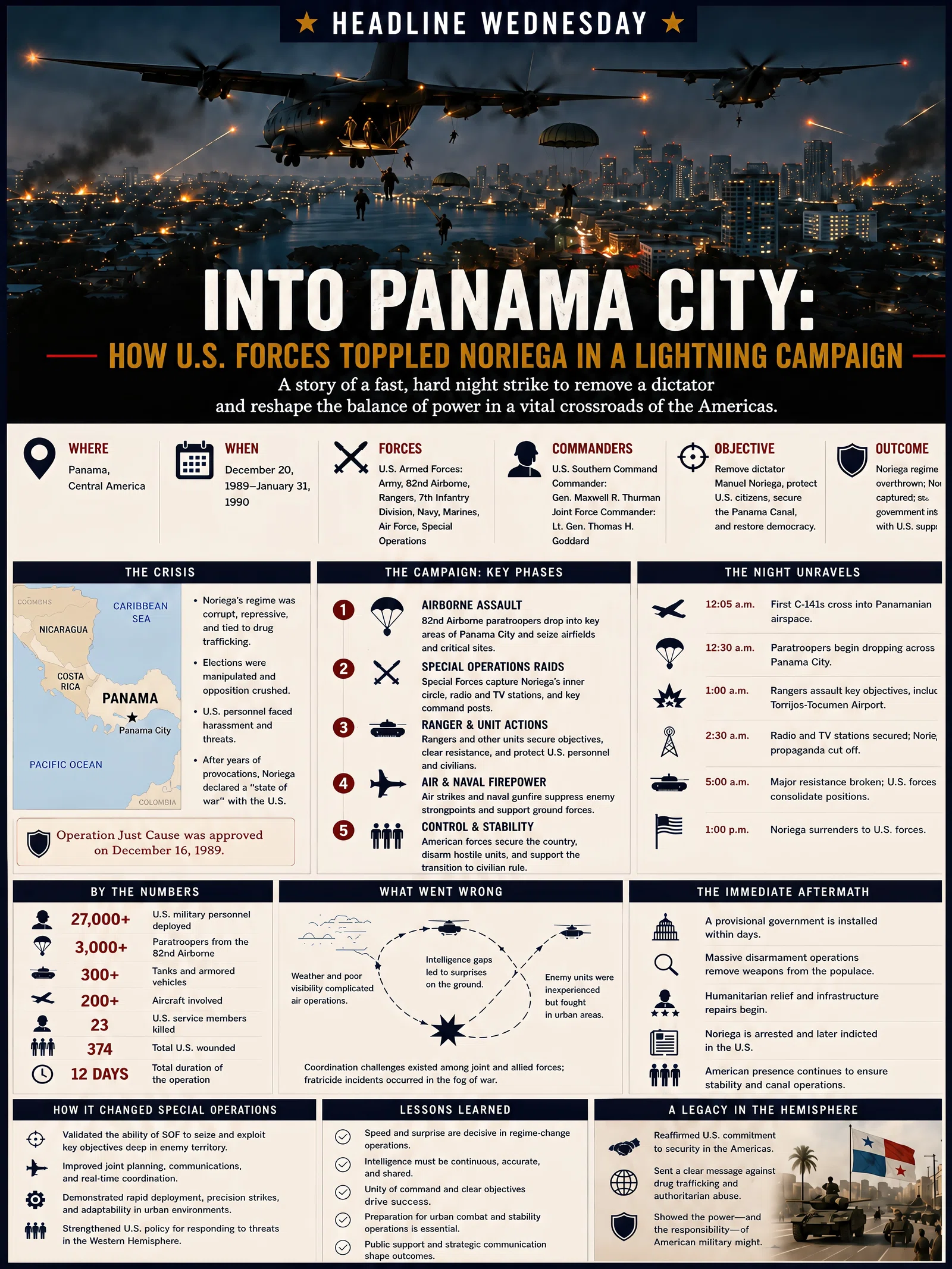
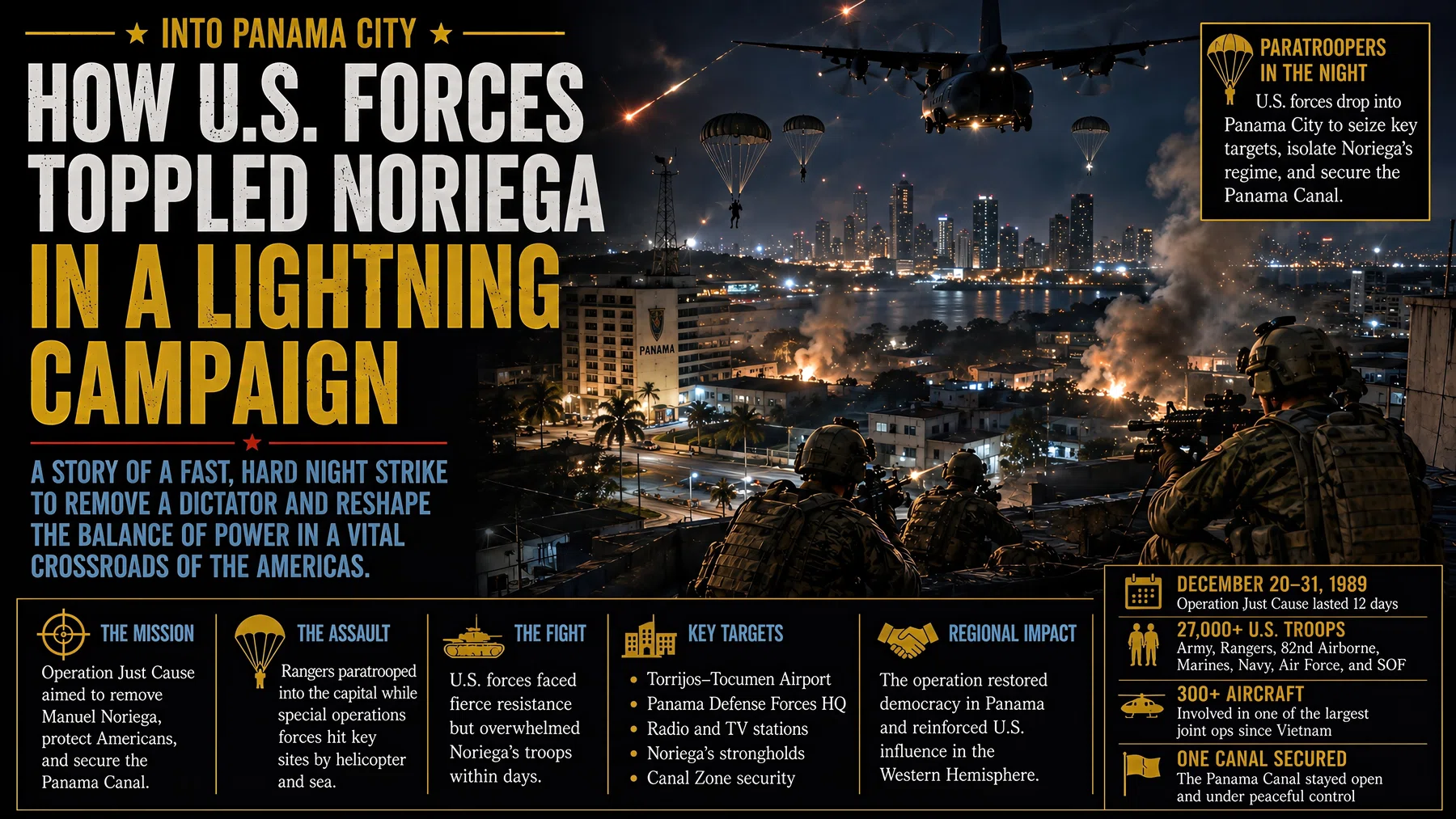
Just after midnight on a humid December night in 1989, the sky over Panama City filled with the deep, steady thrum of American transport aircraft. Inside the dim cargo bays, paratroopers stood shoulder to shoulder, loaded down with rucksacks, rifles, and harnesses, listening for the final green light that would send them out into enemy airspace. They had rehearsed the jump for weeks, but nothing in training could fully match the sight that waited below: a capital city on edge, lit by streetlights, burning flares, and the first arcs of tracer fire clawing upward toward the aircraft. This was not a remote drop zone in open fields. This was an airborne assault into the backyard of a sitting dictator.
Below them lay the dense neighborhoods and key nodes of Noriega’s regime: the headquarters of the Panamanian Defense Forces, critical barracks and airfields, road junctions, and the approaches to the canal zone where American families slept uneasily in guarded housing areas. On the ground, special operations teams were already moving, raiding command posts, securing radio and television stations, and trying to isolate Noriega’s inner circle before they could rally loyal units or slip away into safe houses. The opening volleys of gunfire flashed against concrete and corrugated roofs as American aircraft rolled into their runs.
When the green lights finally blinked on, paratroopers stepped into the warm night one after another, canopies snapping open above the city’s glow. Some landed hard on rough ground near airfields and roads, others near buildings and vehicles, immediately forming ad hoc groups in the confusion of darkness, noise, and sporadic fire. Their job was simple to state and difficult to carry out: seize key ground fast enough that the regime could not respond in an organized way. Within minutes, the first objectives were under assault, and the battle for Panama’s capital was underway, a tightly planned operation that would test how quickly American forces could topple a hostile government sitting astride one of the world’s most important waterways.
A Dictator, a Canal, and American Credibility
To understand why paratroopers were dropping into an urban capital, you have to step back from the flash of gunfire to the map and the calendar. Panama sits on the narrow isthmus that links North and South America, and for most of the twentieth century the Panama Canal was one of the central arteries of global trade and United States naval power. American bases, housing areas, and headquarters lined both ends of the canal, creating an unusual situation in which a major foreign leader ruled a country that also hosted thousands of American service members and their families. That leader, Manuel Noriega, was not just any head of state. He was an intelligence-trained strongman whose regime mixed military force, political repression, and deep involvement in the drug trade.
Throughout the 1980s, tension between the United States and Noriega’s government grew steadily. Elections were manipulated and then openly overturned when opposition candidates appeared to win. Protesters were beaten in the streets. Opposition figures were intimidated, exiled, or worse. At the same time, Noriega’s name appeared in drug trafficking investigations, and federal indictments in the United States turned a once-useful intelligence contact into a public example of a dictator who seemed to believe he could defy Washington with impunity. For Americans in uniform and their families on the ground, harassment by Panamanian forces and checkpoints became more frequent and more threatening, eroding any sense of routine peacetime duty.
By late 1989, the situation had moved beyond diplomatic notes and stern speeches. Noriega’s regime declared a “state of war” with the United States, and incidents involving American servicemembers, including one deadly clash, turned an already tense environment into something close to open hostility. The stakes were no longer just about one man’s corruption. They involved the safety of American citizens, the security of the canal, the credibility of treaty commitments, and the signal the United States would send about how it handled a hostile, violent regime on its doorstep as the Cold War era drew to a close. The decision to launch Operation Just Cause, and to send paratroopers into the heart of Panama City, grew from this combination of strategic geography, personal dictatorship, and a sense that time was running out to act on American terms.
From Intelligence Asset to Marked Man
Operation Just Cause did not appear suddenly out of thin air. For years before paratroopers stepped into the night over Panama City, Manuel Noriega had occupied an awkward place in American thinking: part intelligence contact, part regional power broker, part problem waiting to erupt. He had come up through the Panamanian Defense Forces, building a reputation in intelligence and internal security, and in the shadow of the canal his services were useful to American agencies during the Cold War. At the same time, his grip on power rested on uniformed loyalty, a tight control of political life, and a willingness to use force against opponents. That uneasy blend meant that every crisis in Panama rippled through American headquarters on both sides of the canal.
The turning point came as Noriega’s ambitions and methods grew more open and more violent. Elections that might have replaced him were bent and broken. Opposition leaders were attacked in public. The sense that he could be pushed toward a quieter, negotiated exit faded with each staged rally and each crackdown. Drug trafficking investigations and indictments in American courts transformed his image from difficult partner into wanted criminal, and it became harder for American leaders to explain why such a figure still controlled the country that hosted the canal and major American installations. Inside the Pentagon and Southern Command, planners began shaping options that ranged from pressure and shows of force to a full-scale removal of the regime.
By 1989, those options had narrowed. The Panamanian Defense Forces were not large, but they were embedded in the country’s daily life, with barracks, checkpoints, and intelligence networks scattered across key towns and the capital. Any move against Noriega would have to neutralize those forces quickly enough to protect American families, secure the canal, and prevent a drawn-out urban war. That reality drove the design of Just Cause. The plan combined airborne assaults, special operations raids, Marine and Army ground thrusts, and psychological pressure into a tightly timed sequence meant to break the regime’s ability to command and control in the first hours. When Noriega declared a “state of war” and American servicemembers were killed in an incident in Panama City, the final political restraint snapped. The planning sheets became execution orders, and aircraft began to load.
Raids, Roadblocks, and a Regime Unraveling
When the first blows of Operation Just Cause landed, they did so almost simultaneously at dozens of points across a small country. In Panama City, special operations forces moved on the Comandancia, Noriega’s main military headquarters, and other command posts, using speed and surprise to shatter the familiar rhythms of the Panamanian Defense Forces. The night lit up with explosions and small-arms fire as strongpoints were hit, road intersections were seized, and units loyal to the regime tried to understand where the main threat was coming from. In the confusion, some defenders fought hard, others fell back, and some simply melted into the city streets. The aim was not to grind forward block by block, but to break the spine of the regime’s command in a single, violent rush.
At key airfields, American paratroopers and Rangers dropped or landed under fire to seize runways and surrounding ground. At one major complex, aircraft roared overhead while jumpers spilled out into the dark, forming up as they hit the ground and moving quickly on hangars, control towers, and nearby barracks. By controlling the airfields, American commanders could bring in additional troops and equipment, turn Panama’s own infrastructure into a bridge for follow-on forces, and close the exits for any senior officers who might try to escape by air. Firefights flared around perimeter fences and buildings as defenders tried to hold on, but the weight of well-rehearsed assault teams, armored vehicles flown in, and overwhelming fire support tipped the balance.
Beyond the capital, Marines and Army units surged from canal zone bases toward coastal and interior objectives. Their columns moved along familiar roads that now carried combat vehicles instead of daily traffic, racing to secure ports, bridges, and radio facilities before loyalist forces could regroup. Checkpoints that had once been sources of harassment for American families suddenly found themselves facing organized, heavily armed convoys. Some surrendered quickly when confronted with that force. Others resisted and were overrun in sharp engagements that blended armored firepower with dismounted infantry clearing. Every seized intersection tightened the net around Noriega’s core supporters.
Inside the city, the human cost of the fighting was painfully clear. Civilians tried to shelter in place as gunfire echoed down streets and around apartment blocks. American commanders had built the plan around precision and speed to limit damage, but any use of heavy weapons in dense neighborhoods carried risks, and fire and smoke marked more than one contact point. Still, by compressing the most intense combat into the opening hours, the operation avoided the weeks-long urban siege that could have followed a slower approach. As dawn and then full daylight came, the pattern was visible: shattered strongpoints, columns of American vehicles at key nodes, scattered loyalist resistance, and a dictator whose physical whereabouts were becoming less certain by the hour. The regime did not collapse instantly, but it was clearly unraveling under the weight of coordinated blows delivered in a single, long night and day.
Speed, Shock, and a Vanishing Strongman
The battle for Panama did not hinge on a single dramatic duel so much as on how quickly one side could turn a plan on paper into a shattered enemy in the real world. What turned the campaign was the combination of speed, surprise, and a carefully mapped set of targets that left Noriega’s system stunned before it could react. American forces struck command posts, airfields, barracks, and communications nodes almost at once, forcing officers inside the Panamanian Defense Forces to fight for their own survival instead of calmly organizing a counterattack. Where those units had rehearsed checkpoint drills and gradual escalation, they now faced paratroopers already on the ground, aircraft overhead, and amphibious and mechanized pushes cutting off avenues of movement.
Air control and precision firepower reinforced that shock. With American aircraft dominating the skies and providing both surveillance and strike options, any attempt to mass loyalist forces risked being caught and broken apart. That meant defenders often fought in small, isolated pockets rather than as a coordinated army, buying time in some neighborhoods but never regaining the wider initiative. Special operations teams, already embedded in key parts of the capital, added to this pressure by hitting intelligence centers, radio stations, and safe houses where the regime’s inner circle might regroup. Each lost node made it harder for Noriega’s staff to understand what was happening, much less direct a coherent response.
Noriega’s own actions deepened the unraveling. Instead of appearing in front of cameras and rallying his forces, he slipped from view, moving between safe locations before ultimately seeking refuge at the Papal Nunciature, the Vatican’s diplomatic mission in Panama. For soldiers and officers who had been told their leader was unshakable, the sight of their regime’s figurehead disappearing into diplomatic protection undercut any remaining sense of momentum. American psychological operations, including loudspeakers, broadcasts, and visible shows of control around key sites, reinforced the impression that the outcome was already decided. In that atmosphere, local resistance could still be sharp and deadly at the tactical level, but the strategic tide had clearly turned. The campaign’s decisive feature was not simply superior firepower; it was the ability to compress planning, assault, and psychological shock into a very short window that the regime could not survive as a functioning government.
New Flags, Old Questions, and a Narrow Isthmus
In the days after the main fighting subsided, the map of Panama looked very different. American units controlled the critical ground around the canal, airfields, and government centers, and a new Panamanian leadership stepped into office under the protection of foreign troops. Noriega, removed from his sanctuary by patient pressure and spectacle, found himself in American custody, headed not back to a presidential palace but to a courtroom. For American families stationed in the canal zone, the constant tension of harassment and uncertainty faded quickly. Gates that had once led into a city ruled by an unpredictable strongman now opened onto streets where the most visible security presence wore American uniforms and the badges of a new, fragile democracy.
At the same time, the cost of the operation was counted in lives lost and neighborhoods scarred. Panamanian civilians had endured nights of fear, firefights near their homes, and the destruction that comes whenever heavy weapons are used in dense urban terrain. American casualties, while limited compared to larger wars, were deeply felt in units that had trained hard for a short, intense campaign. The debate over whether the operation had been justified, proportional, or wise did not end with Noriega’s capture. It continued in living rooms, legislative hearings, and international forums, touching on questions of sovereignty, intervention, and the long shadow of American influence in Latin America.
For students of military history and professionals looking at later operations, Just Cause offers a compact case study in modern intervention: joint forces, special operations, airborne assaults into cities, and a clearly stated political goal of regime change. It foreshadowed later campaigns in which American planners sought to remove hostile regimes quickly with tightly choreographed blows, and it highlighted both the strengths and limits of that approach. The operation showed how speed and precision could topple a dictator perched on a narrow isthmus controlling a strategic canal, but it also underscored that what follows a lightning campaign may be years of political and social rebuilding. When visitors walk the canal today or leaf through photographs of that December night, they are looking at more than a short war. They are looking at a moment when geography, power, and the decision to act converged in a way that still shapes debates about force, legitimacy, and responsibility along one of the world’s narrowest and most contested strips of land.