In Action
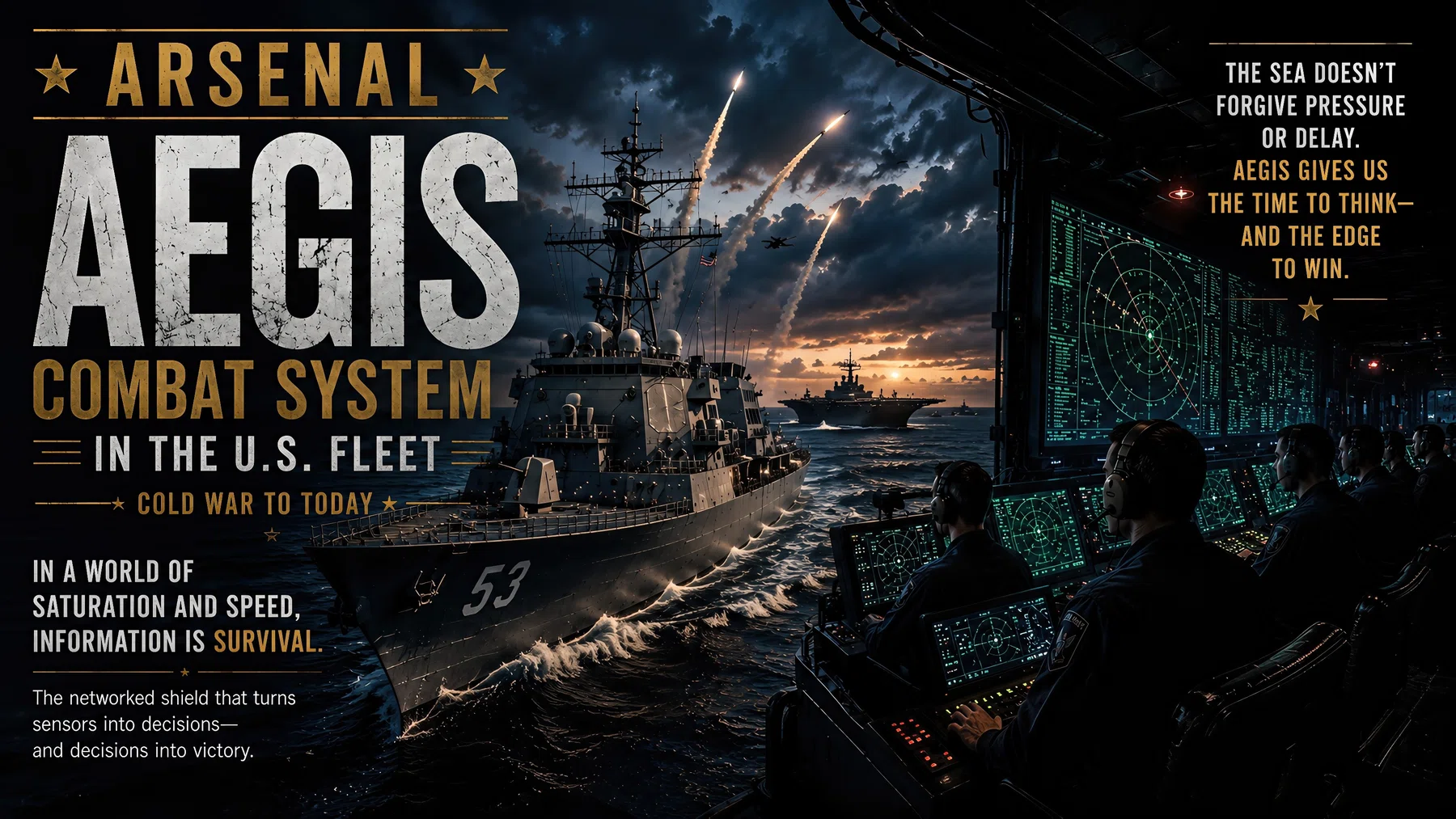
The Persian Gulf is blacked out beyond the carrier’s wake. Inside the Aegis cruiser’s combat information center, there is nothing but light. Radar scopes glow soft green. Large, squared-off displays paint the air picture in symbols and track numbers. The ship’s own hull is almost irrelevant now; this room is the weapon.
It is the opening night of Operation Desert Storm. Strike aircraft are streaming inland toward Iraq and Kuwait. Tankers are orbiting, airborne early warning platforms are circling, and patrol fighters are stacked at different altitudes. Somewhere beyond that busy sky, Iraqi aircraft and anti-ship missiles remain a real possibility. The job of this single cruiser is to see everything and miss nothing.
A contact appears at long range, then another. Operators call out track numbers as the radar skin-paints are turned into stable, computer-maintained symbols. The Aegis system automatically correlates sensors, predicts motion, and assigns threat levels faster than human teams ever could. Sailors still make the decisions, but they are riding on the back of a machine that never blinks and never gets tired.
On the vertical launchers topside, Standard missiles sit ready. Deep in the ship, watchstanders juggle identification signals, flight plans, and radio calls, separating friendly from unknown, routine from dangerous. Tonight, no missile salvos come screaming in, but the stakes are no lower. If Aegis falters, a coalition strike package could vanish into blue-on-blue confusion. If it works, hundreds of sorties move safely in and out as if guided by an invisible hand. That calm competence, built for an even more terrifying threat, is the real story behind the glowing screens.
The Problem It Was Built To Solve
Aegis did not begin with the Persian Gulf. It began with nightmares of the North Atlantic and Norwegian Sea in the 1960s and 1970s. The United States Navy knew that, in a war with the Soviet Union, its carrier battle groups and convoys could face waves of long-range bombers launching volleys of anti-ship missiles from beyond the horizon. Each missile would be fast, low, and deadly, and they would not come alone.
Earlier missile-era air defense systems could handle a handful of high-flying targets. They married mechanically scanned radars to individual missile batteries, with operators manually juggling search, track, and engagement. That was enough for defending against a small raid, but not against dozens of sea-skimming missiles arriving from several directions at once, mixed with friendly aircraft and neutral traffic. The mathematics of that kind of battle favored the attacker, and Navy planners knew it.
There were other problems. Existing systems were complex, maintenance-heavy, and slow to react. Ships bristled with different radars and directors that did not easily share information. Each engagement consumed operator attention that could not be spared for the next threat. In exercises, simulated saturation attacks showed how quickly a screen could be overwhelmed. In the background, real-world combat elsewhere, like the missile battles fought off the coasts of the Middle East, offered bloody demonstrations of what modern anti-ship weapons could do.
The Navy needed more than a better radar or a faster missile. It needed a unified combat system, one that could search, track, classify, and engage many targets at once while giving commanders a coherent picture of the fight. The main service branch driving that requirement was the United States Navy’s surface warfare community, defending carriers and convoys in the Cold War oceans. Out of that demand came the decision to build Aegis: a powerful phased-array radar linked to a digital brain that would turn a single ship into a floating air-defense command post, and eventually a cornerstone of a wider fleet defense network.
From Design Board To Production
Aegis grew out of hard lessons with earlier missile-era air defense systems. In the late 1960s, engineers and officers began pressing for a completely new approach, not just another radar bolted onto an existing ship. The United States Navy wanted a combat system that fused search, tracking, identification, and engagement into one digital whole, able to manage many targets at once. That meant replacing mechanically scanned antennas and analog plotting with solid-state components and computers that could build and maintain a living picture of the sky in real time.
The heart of the new design was a powerful phased-array radar, which uses many small fixed elements to steer its beam electronically instead of physically turning a large dish. This promised much faster updates and the ability to track dozens, then hundreds, of targets simultaneously. Around that radar, designers wrapped a “command and decision” computer core, dedicated weapons control processors, and a new generation of shipboard displays. They also wrestled with tradeoffs: a system this capable would demand significant electrical power, cooling, and space, as well as highly trained operators and maintainers.
Over the 1970s, test rigs on land and at sea proved that the concept could work. Prototype arrays stared out over test ranges while engineers fired drones, rockets, and target missiles to see whether the system could find, sort, and engage them under tight timelines. The first full Aegis installations went to new-built guided-missile cruisers, designed from the keel up to carry the radar faces and large missile batteries these ships required. Later, Aegis shifted into modern destroyers, spreading the capability across more of the fleet.
At a glance, Aegis is a naval combat system built by the United States for long-range air and missile defense at sea. It first went to sea on Ticonderoga-class cruisers and then on Arleigh Burke-class destroyers, serving primarily with the United States Navy’s carrier and expeditionary strike groups from the late Cold War onward. A typical Aegis warship carries a crew of several hundred sailors, with dozens assigned directly to combat systems, and its primary armament for air and missile defense is the Standard Missile family launched from vertical cells, supported by a radar that can see and track threats at ranges measured in hundreds of miles. From those first cruisers, production and upgrades turned Aegis from an experiment into the backbone of the fleet’s shield.
Inside The Weapon
To understand Aegis, it helps to walk through an Aegis ship from the outside in. On deck, the most visible signs of the system are the large, flat radar faces set into the superstructure. These fixed panels, usually four of them arranged around the ship, form the SPY-1 phased-array radar that continuously scans the sky and sea surface without moving parts. Nearby, but often hidden below armored hatches, are the vertical launch cells that hold dozens of missiles ready to fire. To a visitor, the ship may look like any other modern gray hull, but the geometry of those panels and the presence of those launchers mark it as something different.
Inside, the real “weapon” is the combat information center, often deep in the ship with no windows. Here, rows of consoles arc around larger central displays. Each console hosts a sailor responsible for a piece of the picture: air search, surface search, identification, electronic warfare, weapons control, and external data links. The tactical action officer, often abbreviated as TAO, sits in a position to see everything and give or relay engagement orders on behalf of the ship’s captain. Nearby, the air warfare coordinator focuses specifically on the air picture, including friendly aircraft, incoming threats, and missile engagements.
Crew roles are tightly choreographed. Radar operators watch both raw returns and processed tracks, ready to refine or challenge what the computer suggests. Identification specialists compare radar tracks with flight plans, transponder codes, and established procedures to label each contact as friendly, neutral, or unknown. Weapons control operators manage the missile batteries, selecting launchers, choosing missile types, and executing engagements when ordered. Communications and data-link operators keep the ship connected to aircraft, other ships, and higher headquarters, feeding Aegis with information from beyond its own sensors.
Under the consoles and behind bulkheads sit the subsystems that make this possible: cabinets full of processors, cooling systems, power converters, and signal lines. The fire control system coordinates missile guidance and illumination, while the command and decision core hosts the software that turns sensor inputs into a coherent tactical picture. In training, this is often described with neat diagrams and step-by-step scripts, but veterans talk just as much about the pace and pressure. In real operations, watch teams feel Aegis as a living rhythm of track numbers, radio calls, and priority updates, a system that can support them brilliantly if it is healthy and understood, or drown them in data if discipline slips. To live with Aegis is to live inside that rhythm, trusting the machine while never surrendering human judgment.
Baptism Of Fire
The Aegis combat system’s first real proving ground came not in a world war but in the crowded airspace off Lebanon in the early 1980s. The newly commissioned USS Ticonderoga arrived on station with its unfamiliar flat radar panels and digital combat system, joining carriers and older escorts already juggling combat air patrols, reconnaissance flights, and nearby hostile aircraft. In that tense environment, Aegis was asked to do in real time what earlier systems had struggled to manage in slow, scripted exercises: keep track of everything and help fighters sort friend from foe under pressure. It was a laboratory of live sorties, ambiguous radar returns, and split-second decisions.
During the Lebanon crisis, Ticonderoga’s watch teams used Aegis to control thousands of air intercepts, as fighters repeatedly probed and turned back radar contacts along the coast. The phased-array radar refreshed tracks quickly enough that controllers could vector aircraft confidently without waiting for a spinning dish to come back around. The command and decision computers stitched together inputs and presented them as a clean, shared picture, turning what had once been a blur of plots on grease pencils into an integrated view the whole team could work from. For many officers and sailors, that deployment cemented a core belief: if they could keep the picture clear in that cluttered airspace, they could do it anywhere.
Yet the same period showed how brutally unforgiving the marriage of complex systems and human stress can be. In 1988, the Aegis-equipped cruiser USS Vincennes misidentified an Iranian civilian airliner as a hostile military aircraft and shot it down over the Persian Gulf, killing all on board. Post-incident investigations pointed to misread displays, hurried assumptions about altitude and intent, and user interface quirks that recycled track numbers in ways that confused watchstanders. The hardware had done what it was designed to do, but human beings, under threat and short of time, interpreted it in fatally wrong ways. Aegis gained a reputation not only as a shield, but as a reminder that technology does not erase the fog of war.
In the Gulf War a few years later, Aegis cruisers were again at the center of a sky thick with aircraft and missiles, this time over the northern Persian Gulf. Ships such as USS Bunker Hill served as air warfare commanders, coordinating carrier fighters, land-based aircraft, and missile-equipped escorts. The same ability to maintain a stable, wide-area air picture now helped deconflict coalition sorties and guard against Iraqi aircraft or anti-ship missiles trying to slip through. Instead of the sharp, isolated exchange many planners had once imagined, this was a sustained campaign of complex air operations where the greatest danger often came from confusion, not a single inbound raid, and Aegis helped keep that confusion under control.
By the early twenty-first century, Aegis had moved beyond defending ships and carriers into the realm of ballistic missile defense. In 2008, the cruiser USS Lake Erie used a modified Standard Missile-3 to intercept a failing American reconnaissance satellite, USA-193, high above the Pacific. The operation required precise timing, careful software adjustments, and confidence that the system could track and hit a small, fast object in space rather than an aircraft or cruise missile. When the missile struck and the satellite broke apart, it showed that the same basic architecture built to defeat massed bomber raids could be adapted to missions far beyond the horizon line.
Most recently, Aegis has been tested almost continuously in the missile and drone battles of the Red Sea and surrounding waters. Arleigh Burke-class destroyers have spent months shooting down land-attack cruise missiles, drones, and even anti-ship ballistic missiles launched by armed groups on shore, often while protecting merchant shipping and nearby warships. In one widely reported engagement, USS Carney fought through a ten-hour series of attacks, destroying a large number of drones and missiles without allowing a single hit on the ships it was guarding, an intensity of combat not seen by a United States surface ship since the Second World War. Across these engagements, Aegis has been the nervous system tying together radar, missiles, guns, and allied forces in a constantly shifting fight, still learning, still adapting, and still proving itself under fire.
Strengths And Weaknesses
Ask crews and commanders what they value most about Aegis, and they usually start with the picture. The system’s greatest strength is its ability to build and maintain a coherent view of air and missile threats over a wide area, then share that view across a task group. The combination of phased-array radar, fast computers, and integrated displays allows a single ship to spot, track, and help control engagements against many targets at once, all while contributing to the defense of carriers, amphibious groups, and convoys. In modern fleets, Aegis ships are treated as the front-line shield that lets other forces project power.
A second strength is depth. An Aegis warship ties a family of missiles, guns, and sensors into one layered system, from long-range Standard Missiles designed to engage aircraft and ballistic missiles to shorter-range interceptors and close-in weapons. The same command and decision core that drives the original anti-air warfare mission has been expanded to handle ballistic missile defense tasks, integrating the AN/SPY-1 radar and, on newer ships, more advanced arrays with Standard Missile-3 and newer missile families. This gives commanders options: they can engage threats far away, build overlapping engagement windows with other ships, or hold fire until a threat closes, all while the system keeps track of probabilities and geometry in the background.
The system’s long production run and wide adoption by allied navies are strengths in their own right. Aegis-equipped ships sail under the flags of Japan, Spain, Norway, South Korea, Australia, and others, and the core software and hardware continue to receive upgrades and new baselines. That shared architecture makes combined operations easier, because many partners are speaking what is, in effect, the same digital language. It also allows lessons from one navy’s tests and exercises to spread quickly to others, improving tactics and reliability without having to rediscover the same issues in parallel.
The weaknesses are tied closely to those strengths. Aegis is a complex, software-intensive system that demands extensive training and disciplined procedures. Incidents such as the Vincennes shootdown showed how user interface design, track labeling, and stress can interact in dangerous ways when a crew is pushed to make rapid decisions. As threats evolve toward faster, more numerous, and more sophisticated missiles, even an advanced system can face saturation, forcing hard choices about which targets to engage first and how much to trust automation. The hardware itself has had to keep pace with new threats, driving expensive upgrades like more powerful radars and open-architecture computing, even as aging Aegis cruisers confront the limits of their hulls and budgets. Aegis remains formidable, but it is not magic; it is a tool whose effectiveness depends on constant modernization and the judgment of the people behind the consoles.
Variants And Evolution
From its earliest days, Aegis has evolved through a series of hardware and software “baselines” that reflect both technological change and wartime experience. The first operational installations on Ticonderoga-class cruisers used early variants of the SPY-1 radar—designated SPY-1A and later SPY-1B—paired with twin-arm launchers and then vertical launch cells as the class matured. Over successive baselines, the system’s computers grew more powerful, displays improved, and new weapons were integrated, including Tomahawk land-attack cruise missiles and advanced anti-submarine warfare munitions, making these cruisers true multi-mission platforms built around the Aegis core.
Aegis then spread into the Arleigh Burke-class destroyers, which adopted vertical launch from the start and gradually added capabilities as new flights entered service. Over time, dedicated versions of the system were developed for ballistic missile defense, allowing Aegis ships to track and engage short- and intermediate-range ballistic missiles at sea using Standard Missile-3 interceptors and other upgraded weapons. That sea-based defense has been extended ashore through Aegis Ashore installations, notably at a site in Romania and a newer facility in Poland, both contributing to a broader NATO missile defense architecture. The same underlying ideas that once guarded carriers now help protect allied territory and forces on land.
Recent years have brought further evolution toward what the Navy calls integrated air and missile defense. New baselines aim to handle a wider mix of threats, from low-flying cruise missiles and drones to ballistic and maneuvering missiles, within a single decision framework. On the newest Flight III destroyers, Aegis is paired with more capable SPY-6 radars designed to improve detection and tracking performance against demanding targets, while software updates roll out across the fleet to add features, refine human-machine interfaces, and incorporate new weapons. As of the early 2020s, more than a hundred Aegis-equipped ships are in service worldwide, with many more planned, and almost none of them carry exactly the same version of the system as their earliest predecessors. Aegis today is a family, not a single frozen design.
Legacy And Where To See It Today
Aegis’s legacy reaches far beyond the specific ships that carry it. Conceptually, it helped cement the idea that the true “weapon” on a modern warship is a combat system that fuses sensors, weapons, and communications into a single, software-driven whole. That model has shaped how navies design new surface combatants, how they think about networked operations, and how they tackle the challenge of defending against ballistic and cruise missiles at the same time. Within alliances like NATO, Aegis Ballistic Missile Defense and Aegis Ashore sites have become key pillars of collective protection against missile threats, linking seaborne and land-based interceptors with shared command and control.
Physically, the class that first carried Aegis is already passing into history. USS Ticonderoga herself has been scrapped, and many of her sisters are decommissioned or slated for retirement, their radar faces and vertical launch cells removed as part of the recycling process. The system they pioneered lives on in the Arleigh Burke-class destroyers that still crowd the piers of American and allied ports, where visitors during fleet weeks and open days can pick out the distinctive flat arrays on their superstructures and, sometimes, step inside mockups or exhibits that explain how the combat system works. On land, Aegis Ashore facilities in Europe are not tourist sites, but their activation is a visible sign that what began as a shipboard shield has become a central element of regional missile defense.
For students of naval history, images and footage of Aegis ships at sea, in tests, and in combat are now part of the visual record of late Cold War and post–Cold War operations, from Lebanon and the Persian Gulf to satellite shootdowns and Red Sea convoy fights. Many museums and heritage projects include Aegis consoles, radar panels, or educational displays to help visitors grasp how this digital shield fits into the story of the surface fleet. For readers of Dispatch, Arsenal sits alongside features like Beyond the Call and Living History interviews that follow the sailors, aviators, and opponents who lived under that shield. However advanced the software and sensors become, the stakes remain the same as in that dark combat information center on a gulf night: behind every radar track and missile icon are crews, civilians, and adversaries whose lives depend on how well this system, and the people who run it, perform.