In Action
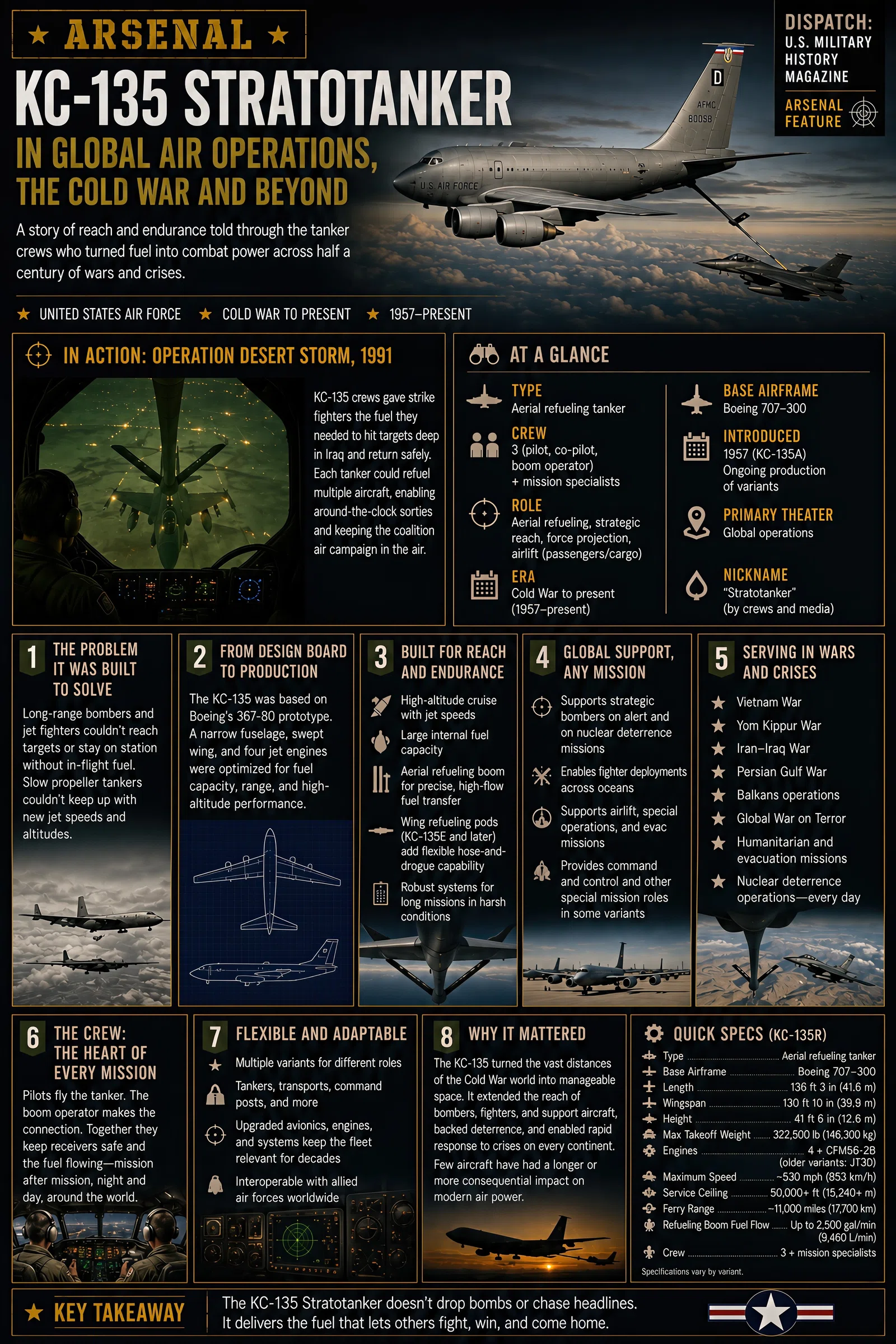
The night sky over the Persian Gulf is clear but busy. Far below, the faint glow of burning oil wells stains the horizon. At altitude, riding a long, invisible racetrack in the dark, a KC-135 Stratotanker holds steady, its engines humming and cockpit lights dimmed as the crew scans their instruments and the black sky beyond the glass. They have been here for hours already, a lone aluminum gas station in hostile airspace during Operation Desert Storm.
Off the nose, a pair of tiny wingtip strobes begins to grow. An incoming flight of strike aircraft, low on fuel after hunting Iraqi targets, is climbing toward the rendezvous. In the boom operator’s station at the rear of the KC-135, a crew member lies prone, peering through a window at the night below. When the fighters slide into position behind the tanker, he extends the refueling boom, guiding it with precise fingertip movements, talking calmly over the interphone as he edges the flying probe toward the first receiver’s refueling receptacle.
The moment the connection is made, thousands of pounds of fuel begin to flow. The fighters’ bingo fuel worries ease. They will make it back to their base, and they will launch again before dawn because the tanker crews stayed on station long enough to top them off. Far from the headlines and camera lenses focused on smart bombs and strike packages, the KC-135 is doing what it has done for decades: quietly turning range into strategy, keeping bombers, fighters, and reconnaissance aircraft in the fight. This seemingly routine refueling track is one small glimpse into why the Stratotanker was built and how it reshaped airpower itself.
The Problem It Was Built To Solve
The KC-135’s story begins in the tense early years of the Cold War, when the United States Air Force faced a simple but unforgiving problem: its bombers and, increasingly, its jet fighters could not be in the right place at the right time without reliable fuel in the sky. Strategic Air Command wanted nuclear-armed bombers able to reach targets deep inside the Soviet Union and, if necessary, loiter on airborne alert for hours. Tactical air forces needed fighters that could deploy quickly across oceans and then stay on station over distant battlefields. The existing tankers, mostly converted propeller-driven transports, were too slow and too low to keep up with new jet aircraft.
The gap was more than technical inconvenience. It was a strategic vulnerability. Bombers forced to descend and slow down to refuel behind older tankers lost the speed and altitude that helped them survive. Fighters ferrying across the Atlantic or Pacific relied on complicated chains of bases, island stops, and favorable winds. In a crisis, those delays could mean the difference between getting a squadron into theater in time or watching events unfold without them. The geography of the Cold War world, with its long distances and limited friendly airfields, turned fuel into a weapon in its own right.
What the Air Force needed was a jet-powered tanker that could cruise at the same altitudes and speeds as the B-52 and the latest fighters, carrying enough fuel to matter while remaining reliable and simple enough to build in large numbers. It had to fit into a doctrine that assumed global operations at short notice, supporting everything from nuclear deterrent patrols to conventional deployments. Out of that mix of strategic anxiety, technological opportunity, and operational frustration came the decision to adopt a new kind of tanker: a purpose-built, swept-wing jet that would become the KC-135 Stratotanker.
From Design Board To Production
The jet tanker that would become the KC-135 grew out of a gamble. Boeing built a privately funded prototype jet transport, the Model 367-80, as a full-scale demonstration that swept-wing jet technology was ready for both airlines and the Air Force. Strategic Air Command leaders saw in that sleek prototype a chance to solve their refueling problem in one stroke. Rather than converting another propeller transport, they could have a purpose-built tanker that shared its basic shape with a new generation of jet airliners but was tailored from the start for the bomber force.
Engineers and planners wrestled with tradeoffs. A wider fuselage would be more comfortable for passengers, but Strategic Air Command cared more about fuel volume and high-altitude performance than cabin width. A heavier structure could carry more fuel, but every extra pound cut into range and climb. Designers chose a relatively narrow fuselage, a high-mounted swept wing, and four powerful turbojet engines slung in pods beneath it, optimized for speed and altitude rather than cargo flexibility. Inside, the structure and plumbing were arranged around the refueling mission: fuel tanks, pumps, and the rigid flying boom that would become the tanker’s signature.
At a glance, the KC-135 Stratotanker is a four engine jet tanker designed and built in the United States, serving primarily with the United States Air Force from the late nineteen fifties onward. Its typical crew includes two pilots, a navigator in early variants, and a boom operator, with room for additional mission specialists or passengers when needed. The aircraft’s primary capability is to transfer large quantities of fuel in flight using a controllable boom and, in some configurations, pods that trail flexible hose and drogue units. It cruises at high subsonic speed at altitudes compatible with bomber and fighter operations and can range across continents with enough fuel on board to refuel multiple receiver aircraft.
Once the concept was approved, production ramped up quickly. Assembly lines turned out hundreds of KC-135s as part of a broader shift to jet-powered fleets. The tanker entered service alongside the latest bombers and quickly spread across air refueling wings stationed in the United States, Europe, and the Pacific. Built to a common core design but with room for later upgrades, the Stratotanker was meant to last decades, its basic airframe a durable platform for new engines, updated avionics, and changing refueling needs.
Inside The Weapon
Walk up to a KC-135 on the ramp and the first impression is of a lean, purposeful machine. The fuselage is long and relatively narrow, crowned by a modest vertical tail and swept wings that angle back toward four engine pods. Under the tail, the refueling boom hangs like a stinger, its fins and control surfaces giving away its nature as a small aircraft in its own right. Access doors and service panels along the belly and sides hint at the maze of fuel lines, pumps, and valves within. From the outside, it looks like a transport, but almost every major feature is there to support putting fuel into other aircraft at the right place and time.
Inside the forward fuselage, the cockpit is a compact, workmanlike space. The aircraft commander and copilot sit side by side surrounded by instrument panels, engine gauges, navigation displays, and radios. In early years, a navigator sat at a dedicated station with charts and celestial navigation tools; later, updated avionics and satellite navigation reduced the need for that position, but the idea of a team managing the mission never went away. Behind the flight deck, there are seats for additional crew, mission planning tables, and racks of communication and navigation equipment that keep the tanker in touch with air traffic control and the receiver aircraft it serves.
Further aft, the aircraft’s true specialty comes into focus. The boom operator’s station sits low in the rear fuselage, originally with a padded couch where the operator lies prone, looking through a set of windows at the receiver aircraft below and behind the tanker. Hand controllers and panels allow fine control of the boom’s position, with indicators showing fuel flow and the status of the connection. Later modifications added improved optics and displays, but the essential task stayed the same: guide the boom into a small receptacle on another aircraft, sometimes in turbulence or darkness, while maintaining calm, precise communication over the interphone.
The rest of the cabin is a mix of functional spaces. There are fuel tank bays separated by structural members, access tunnels where maintainers can inspect lines and valves, and in some configurations, pallet positions where cargo or passengers can ride along. The human side of the mission is visible here: fold-down web seats, storage for flight meals and coffee, and small areas where off-duty crew can stretch their legs during long orbits. Life on board can be noisy, with the rumble of engines and the hiss of airflow, and the smell of jet fuel and warmed electronics is a constant companion.
Training material paints the refueling process as a smooth choreography, and under ideal conditions it can be. In real-world operations, boom operators and pilots talk about battling weather, fatigue, and the quirks of different receiver aircraft. A heavy bomber sliding into position behaves very differently from a nimble fighter in rough air. Pilots must hold a steady platform, fine-tuning throttle and trim while respecting strict clearances. Boom operators need the judgment to call a disconnect if things look unsafe, knowing that a frustrated receiver crew may be low on fuel. Inside the KC-135, the layout, equipment, and crew workflow all exist to turn those tense minutes behind the tanker into a routine that can be repeated, safely, thousands of times over the life of the airframe.
Baptism Of Fire
The KC-135’s first true test under fire came over Southeast Asia. By the mid nineteen sixties, United States bombers were flying from Guam and Thailand toward targets in North Vietnam and Laos, missions that could last sixteen hours or more from takeoff to landing. Without tankers, a B-52 would have to trade bombs for fuel, cutting into the weight of ordnance it could deliver or forcing it to operate closer to enemy defenses. With KC-135s orbiting along the route, bombers could launch heavy, refuel en route, strike, and then top off again on the way home, turning the tanker into a quiet partner on every sortie.
The tempo was relentless. Fighter-bombers such as F-105s and F-4s clawed for extra minutes on station by taking fuel above the jungle, sliding into position behind the tanker with anti-aircraft fire and surface-to-air missiles lurking not far away. Tankers tried to stay outside the densest threats, but combat is messy, and crews sometimes found themselves closer to danger than the training syllabi suggested. In some cases, KC-135s escorted damaged aircraft out of hostile airspace, feeding them fuel as they limped toward a safer place to land or ditch, using the boom like a lifeline stretched across the sky.
Those years fixed the Stratotanker’s reputation as a force multiplier rather than a headline-grabber. Pilots of receivers remembered the calm voice of the boom operator and the sight of the tanker’s belly filling the windscreen at the end of a long mission. Meanwhile, Strategic Air Command continued to use KC-135s to support bomber alert and training in other theaters, proving that the aircraft could sustain high utilization without wearing out quickly. When the Vietnam War wound down, the tankers did not retire to quiet backwaters. They shifted focus to NATO exercises, long-range deployments, and the constant background work of keeping global airpower connected by fuel.
By the time Operation Desert Storm opened in early nineteen ninety one, KC-135 crews were veterans of decades of real-world deployments. The air campaign against Iraq demanded a web of refueling tracks over Saudi Arabia and the Gulf, supporting everything from stealth bombers launching from the continental United States to Marine and Navy strike aircraft flying from carriers and forward bases. On the first night alone, tankers formed part of the largest aerial refueling effort yet seen, a silent scaffolding beneath the famous “shock and awe” strikes. Their experience from Southeast Asia translated into tight timing, safe procedures, and the confidence to manage complex refueling plans in crowded skies.
In later conflicts over the Balkans, Afghanistan, and Iraq again, the pattern repeated. Tankers moved forward or back with the needs of the campaign, sometimes refueling aircraft on long overwater flights, sometimes orbiting close enough to the front that crews could see flashes on the horizon. The KC-135’s baptism of fire in Vietnam was not a single moment but a long, grinding education that proved the concept of jet-powered aerial refueling in sustained combat. From that foundation, every later operation built on lessons learned by crews who had spent long nights on the boom over Southeast Asia.
Strengths And Weaknesses
Ask crews and commanders what made the KC-135 valuable and the answers often start with reliability and reach. The Stratotanker’s swept wings and jet engines allowed it to match bomber and fighter cruising speeds and altitudes, cutting down on awkward descents and climbs for refueling. Its large internal fuel capacity meant that a single tanker could “top off” multiple receivers or give a single thirsty bomber the fuel load it needed to complete a demanding mission profile. In calm conditions, refueling behind a well-flown KC-135 could feel almost routine, a testament to the aircraft’s stable platform and mature procedures.
Over time, re-engining programs sharpened those strengths. Many original KC-135As, which used older turbojet engines, were rebuilt as KC-135R or KC-135T aircraft with modern high-bypass turbofans. These updates significantly increased fuel efficiency and reduced noise while allowing tankers to offload more fuel to their receivers. Another program produced KC-135E models with different engines, which later left the inventory as the R and T versions became standard. These changes kept the basic airframe relevant without replacing it entirely, smoothing maintenance and training while giving crews better performance and more comfortable operating margins.
The weaknesses grew more apparent as decades passed. The KC-135’s narrow fuselage and design focus on fuel left limited space and flexibility for cargo and passengers compared to newer multirole tankers like the KC-10 and later KC-46. Early models with older engines were loud and fuel hungry by modern standards, and even re-engined aircraft carried the burdens of an aging structure. Corrosion, wiring, and fatigue demanded careful inspection and repair, driving up maintenance hours per flight hour. Avionics upgrades modernized the cockpit, but the basic layout remained that of a mid twentieth-century jet airframe.
Enemy forces also learned that tankers were high-value targets, even if they rarely approached front lines. While KC-135s usually operated under fighter cover and outside the reach of most ground-based threats, commanders knew that losing a single tanker could ripple through an entire day’s schedule of strikes and reconnaissance missions. The aircraft’s large radar and infrared signature made it easy to track, so protection rested more on distance, timing, and air superiority than on stealth or defensive systems. In a future fight against a peer adversary with long-range missiles, those vulnerabilities would weigh heavily, one reason why planners began looking to newer designs even as the KC-135 soldiered on.
Variants And Evolution
From the outside, many KC-135s look similar, but their internal details tell a story of steady evolution. The original KC-135A carried early-generation turbojet engines and analog avionics suited to the late nineteen fifties. As missions expanded and fuel prices climbed, the Air Force invested in re-engining, producing KC-135E aircraft with different powerplants and, more significantly, KC-135R and KC-135T models with modern turbofans. These re-engined versions could offload significantly more fuel for a given mission, burn less themselves, and meet stricter noise standards at crowded civilian airfields.
The modifications extended beyond engines. Over the years, KC-135s received updated navigation and communication systems, improved defensive equipment where needed, and cockpit changes that gradually replaced some crew positions with automation. The navigator’s traditional table and tools gave way to satellite navigation and modern flight management systems, though training cultures often preserved an emphasis on manual skills. In some aircraft, additional equipment allowed operations with probe-and-drogue receiver aircraft using pods or adapters, increasing flexibility to support joint and coalition partners whose jets lacked boom receptacles.
The same basic airframe also served as the backbone for a family of specialized aircraft. Reconnaissance and intelligence-gathering versions, airborne command posts, and testbed aircraft all traced their ancestry to the C-135 line that shared much with the KC-135. Outside the United States, related tankers served with allied air forces, which later transitioned to newer platforms as replacement programs matured. Inside the United States Air Force, the longevity of the Stratotanker meant that transition plans had to be carefully staged so the fleet could keep meeting daily commitments while newer aircraft like the KC-46 Pegasus came online.
Today, as modernization efforts accelerate, the KC-135 fleet sits at a crossroads. Some airframes have been flying for more than six decades, kept young through structural repairs and avionics refreshes. At the same time, defense planners and legislators debate how quickly to shift squadrons to their successors. Recent decisions, such as assigning new KC-46s to units that have long flown KC-135s, show how the tanker community is preparing for a mixed fleet in which Stratotankers and next-generation aircraft share the burden, just as KC-135s once entered service alongside older KC-97s.
Legacy And Where To See It Today
The KC-135’s legacy rests less on individual dramatic moments and more on the countless missions that simply worked. By enabling bombers and fighters to cross oceans without landing, to loiter for hours over remote battlefields, and to respond rapidly to crises, the Stratotanker helped turn aerial refueling from a specialized stunt into a routine tool of strategy. From Vietnam through the Gulf War and post–September eleventh operations, tankers made it possible to base high-value aircraft where politics and infrastructure allowed while still reaching distant targets on demand.
In doctrinal terms, the aircraft changed how planners thought about distance and time. Air campaigns could be designed around optimal axes of attack rather than the limits of internal fuel, knowing that KC-135s would be there to knit together stages of the mission. Humanitarian airlifts, deterrent patrols, and exercises with allies all benefited from the same capacity to keep aircraft aloft longer and move them farther. The Stratotanker’s long service life made it a familiar sight on ramps from Europe to the Pacific, its presence a quiet signal that the United States could project airpower and support partners far from home bases.
For those who want to see the aircraft up close, preserved KC-135s sit at air parks, base gates, and museums across the United States. One of the earliest airframes stands guard at McConnell Air Force Base in Kansas, another rests at March Field Air Museum in California, and others appear at Castle Air Museum, Barksdale Global Power Museum, and heritage parks at Scott and Dyess Air Force Bases, among other sites. These displays mirror the operational fleet: often overshadowed by bombers and fighters in the public imagination, yet essential to understanding how modern air forces actually work.
The visual record is rich as well, with photographs and video of KC-135s supporting bombers, fighters, and reconnaissance aircraft in many eras, including coverage by communities and collections such as those gathered around Trackpads and the broader Dispatch ecosystem. Future Arsenal features naturally connect this story to companion pieces on aircraft like the B-52, the C-130, and later tankers that inherited the mission. You can also hear narrated versions of Arsenal features as part of the Trackpads podcast feeds and Dispatch audio editions. Above all, the KC-135’s enduring legacy is written in the lives of the crews who spent long hours on dark racetracks over hostile territory, and of the pilots who saw that gray tanker appear ahead when their fuel gauges were sliding toward empty.