The Trackpads collection

FIND YOUR NEXT DISCOVERY.

Search the people, battles, citations, stories, books and audio behind military history.

Type at least two letters or numbers.Full search & filters

Medal of Honor Recipient

John Cooper

U.S. Navy · U.S. Civil War / Interim 1865 - 1870

MOH-RC-002261Source-based record

The awards

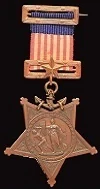
Representative medal image: early Navy star design and striped ribbon. Not a portrait or a photograph of this recipient’s own medal.
Award 1 · Navy Medal of HonorAction-era reference: 1864
Representative medal image: early Navy star design and striped ribbon. Not a portrait or a photograph of this recipient’s own medal.
Award 2 · Navy Medal of HonorAction-era reference: 1865

Portrait not yet available. Representative medals shown.

About these images

Award 1. Presentation date is not usable for design selection. This is an action-era reference; a later presentation or replacement medal may differ.

Award 2. Presentation date is not usable for design selection. This is an action-era reference; a later presentation or replacement medal may differ.

Medal imagery and historical designs →

Award 1 · First Award

August 5, 1864

Mobile Bay, Alabama, USA

Rank at action
Coxswain
Service
U.S. Navy
Conflict
U.S. Civil War
Unit or command
U.S.S. Brooklyn

The Citation

Sources ↓
First Award: On board the U.S.S. Brooklyn during action against rebel forts and gunboats and with the ram Tennessee, in Mobile Bay, on 5 August 1864. Despite severe damage to his ship and the loss of several men on board as enemy fire raked her decks from stem to stern, Cooper fought his gun with skill and courage throughout the furious battle which resulted in the surrender of the prize rebel ram Tennessee and in the damaging and destruction of batteries at Fort Morgan.
Preserved earlier transcription
On board the U.S.S. Brooklyn during action against rebel forts and gunboats and with the ram Tennessee, in Mobile Bay, 5 August 1864. Despite severe damage to his ship and the loss of several men on board as enemy fire raked her decks from stem to stern, Cooper fought his gun with skill and courage throughout the furious battle which resulted in the surrender of the prize rebel ram Tennessee and in the damaging and destruction of batteries at Fort Morgan. SECOND AWARD Served as quartermaster on Acting Rear Admiral Thatcher's staff. During the terrific fire at Mobile, on 26 April 1865, at the risk of being blown to pieces by exploding shells, Cooper advanced through the burning locality, rescued a wounded man from certain death, and bore him on his back to a place of safety. G.O. No.: 62, 29 June 1865.

Sources & record notes

General Order comparison: pending. Current-profile review does not mean that the underlying original order has been examined.

  1. John Cooper — current Society profile (First Award) ↗Congressional Medal of Honor Society · Checked 2026-08-30

    current identity, service, action metadata, award multiplicity, and citation comparison

Transcription, metadata & provenance notes
Award ID
MOH-AW-002271
Transcription status
Current-profile multi-award transcription
Last source check
2026-08-30
Recorded order reference (not verified against the original)
45
Later or highest recorded rank
Quartermaster
Accredited to
New York
Archive transcription SHA-256
72323d3981b58784a7fb2c3a45d307c08ec8f0d7e72b6dbd2b60af896f3e4c6c

Legacy combined-row transcription preserved; separately documented current awards transcribed as distinct canonical award records.

The inherited rank-2 Society candidate was confirmed by substantive comparison of identity, service, rank, unit or command, action context, and citation; the higher candidate rank was not treated as verification by itself, and every inherited candidate remains preserved. Documented aliases remain attached to this stable recipient identity: Mather, John Laver, John Laver Mather. No identity merge or split was performed. The action rank Coxswain remains distinct from the later or highest rank Quartermaster. The controlled canonical unit or command is U.S.S. Brooklyn; the current structured profile renders U.S.S. Brooklyn, and the inherited wording Not documented remains preserved as a separately attributed variant. The current authoritative evidence controls the action date as 1864-08-05 and classifies the action under U.S. Civil War; the inherited unnormalized date and conflict values remain preserved in the audit record. The controlled historical action place is Mobile Bay, Alabama, USA; the current structured place Mobile Bay, Alabama, USA and the complete inherited geocoder value Mobile Bay, Alabama, USA remain preserved in the audit evidence. The inherited row combines two distinct Medal of Honor awards. It is expanded into separate first- and second-award records under one stable recipient identity; the inherited combined citation and checksum are retained in full, and the two current citations remain separate. No underlying General Order was examined, so the exact-order gate remains pending and no General Order verification is claimed.

Award 2 · Second Award

April 26, 1865

Mobile, Alabama, USA

Rank at action
Quartermaster
Service
U.S. Navy
Conflict
Interim 1865 - 1870
Unit or command
Acting Rear Adm. Thatcher's staff, U.S.S. Stockdale

The Citation

Sources ↓
Second Award: Served as quartermaster on Acting Rear Adm. Thatcher's staff. During the terrific fire at Mobile, on 26 April 1865, at the risk of being blown to pieces by exploding shells, Cooper advanced through the burning locality, rescued a wounded man from certain death, and bore him on his back to a place of safety.
Preserved earlier transcription
On board the U.S.S. Brooklyn during action against rebel forts and gunboats and with the ram Tennessee, in Mobile Bay, 5 August 1864. Despite severe damage to his ship and the loss of several men on board as enemy fire raked her decks from stem to stern, Cooper fought his gun with skill and courage throughout the furious battle which resulted in the surrender of the prize rebel ram Tennessee and in the damaging and destruction of batteries at Fort Morgan. SECOND AWARD Served as quartermaster on Acting Rear Admiral Thatcher's staff. During the terrific fire at Mobile, on 26 April 1865, at the risk of being blown to pieces by exploding shells, Cooper advanced through the burning locality, rescued a wounded man from certain death, and bore him on his back to a place of safety. G.O. No.: 62, 29 June 1865.

Sources & record notes

General Order comparison: pending. Current-profile review does not mean that the underlying original order has been examined.

  1. John Cooper — current Society profile (Second Award) ↗Congressional Medal of Honor Society · Checked 2026-08-30

    current identity, service, action metadata, award multiplicity, and citation comparison

Transcription, metadata & provenance notes
Award ID
MOH-AW-002272
Transcription status
Current-profile multi-award transcription
Last source check
2026-08-30
Recorded order reference (not verified against the original)
45
Later or highest recorded rank
Quartermaster
Accredited to
New York
Archive transcription SHA-256
78bde92fe374030b20d3fced276dc0d730880c413316285f15826b5bc65ed53f

Legacy combined-row transcription preserved; separately documented current awards transcribed as distinct canonical award records.

The inherited rank-2 Society candidate was confirmed by substantive comparison of identity, service, rank, unit or command, action context, and citation; the higher candidate rank was not treated as verification by itself, and every inherited candidate remains preserved. Documented aliases remain attached to this stable recipient identity: Mather, John Laver, John Laver Mather. No identity merge or split was performed. The action rank Coxswain remains distinct from the later or highest rank Quartermaster. The controlled canonical unit or command is U.S.S. Brooklyn; the current structured profile renders U.S.S. Brooklyn, and the inherited wording Not documented remains preserved as a separately attributed variant. The current authoritative evidence controls the action date as 1864-08-05 and classifies the action under U.S. Civil War; the inherited unnormalized date and conflict values remain preserved in the audit record. The controlled historical action place is Mobile Bay, Alabama, USA; the current structured place Mobile Bay, Alabama, USA and the complete inherited geocoder value Mobile Bay, Alabama, USA remain preserved in the audit evidence. The inherited row combines two distinct Medal of Honor awards. It is expanded into separate first- and second-award records under one stable recipient identity; the inherited combined citation and checksum are retained in full, and the two current citations remain separate. No underlying General Order was examined, so the exact-order gate remains pending and no General Order verification is claimed.