Scope of this edition
This edition contains 3,478 recipient records and 3,497 awards. Its research baseline is P10-C082, closed on September 3, 2026. These are counts for this archive edition—not a claim to include every later award or source revision. Public references are associated with individual awards; the same external document may support more than one award. Internal import and audit records are retained separately and are not listed as public source citations.
A person with multiple awards has one recipient page with separate award entries, action details, citations, and sources. Stable recipient and award identifiers preserve the distinction.
How to read the citations
Each award shows its source references and transcription status. Some transcriptions preserve the original imported wording after comparison with a current recipient profile; others were retranscribed from a current profile or an official service source. The principal current recipient source is the Congressional Medal of Honor Society, with additional institutional sources identified where used.
When sources disagree, their attributed wording and review notes remain separate. An identified historical correction is labeled explicitly, with the inherited wording retained as a historical variant rather than silently substituted. Review dates identify when a source was checked, not a promise that an external page has remained unchanged.
What remains pending
Legacy gaps and source differences may remain in particular fields. Missing information is shown as not recorded or omitted, rather than inferred. Historical geographic coordinates from the research files are not published as verified action locations.
Browse labels and historical wording
The directory combines equivalent conflict labels, such as “Civil War” and “U.S. Civil War,” into one browse group. Some reserve service designations are grouped with their service for navigation. Award pages retain the source’s actual service and conflict wording. Group counts may overlap when a recipient’s awards fall into different groups.
Connections to Trackpads
Recipient pages link to Dispatch coverage only when the identity connection is established. Companion audio is carried over from that article’s existing verified episode mapping. Related campaign reading is labeled separately and does not imply that a recipient appears in a particular book. Existing matching recipient Wiki records and their already-published, linked subjects are connected in both directions. A related battle link provides reading context; it is not a new assertion that every award action occurred in that battle. New connections inferred from names, locations, dates, units, or citation keywords must be reviewed before publication. Existing Wiki pages remain available during this integration review.
Medal imagery and recipient portraits
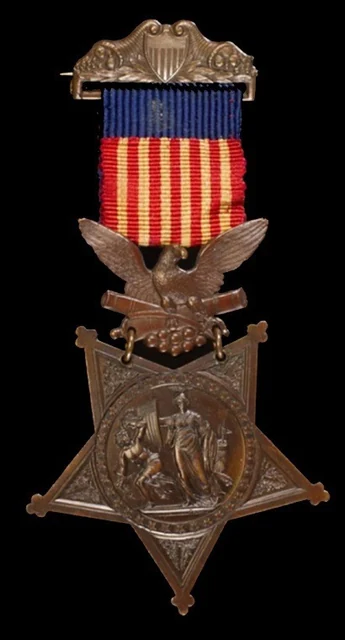
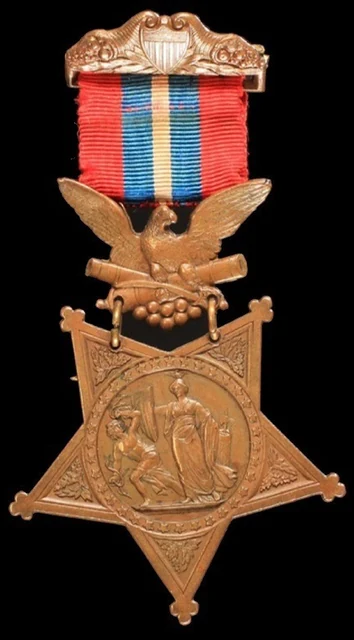
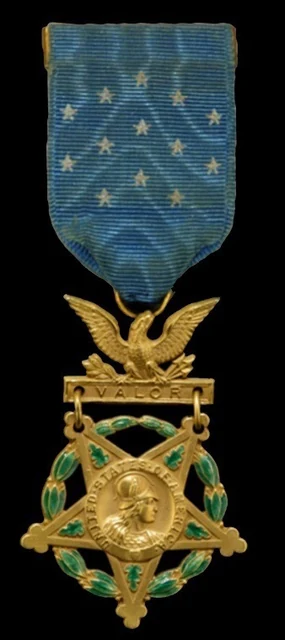
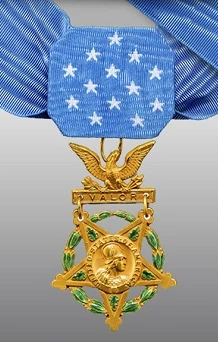
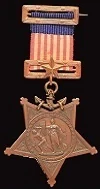
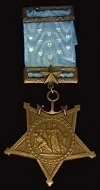
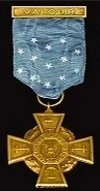
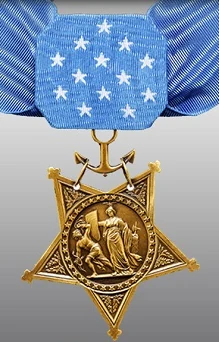
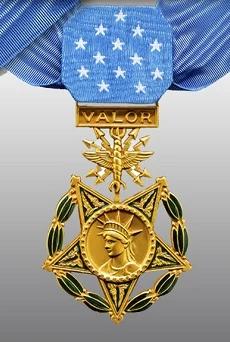
Where a recipient portrait is not yet available, this archive shows a representative Medal of Honor design. These are photographs of medal designs, not authenticated photographs of that recipient’s own medal. An approved portrait will replace the placeholder when added.
A recorded presentation year takes priority when selecting a historical form. Otherwise, the image is labeled as an action-era reference. Awards made much later, replacement medals, and changes in suspension ribbons can differ from that illustration. A year alone does not resolve the precise form in a design-transition year. Unestablished service or date information is labeled, not filled in as fact.
Army designs changed in 1896 and 1904; the Army’s present neck ribbon was adopted in 1944. Airmen used the Army design before the separate Air Force design was introduced in 1965. Marine Corps and Coast Guard awards generally use the Navy design. When a record explicitly identifies separate Army and Navy awards, each award is illustrated separately.
The Navy used overlapping designs during the Tiffany Cross period. The archive does not infer that a person received the Tiffany Cross simply from a service or a First World War date. The Navy star design can therefore appear as a representative reference, with the uncertainty noted. Early wartime neck-ribbon transitions are also identified as illustrative rather than exact.
The images here are cropped from the three reference photographs supplied for the Trackpads archive. Original reference files and crop details are retained in the build’s media manifest. The Grand Army of the Republic membership badge in one reference image is not a Medal of Honor and is not used as a medal placeholder.
Design references: U.S. Army design history ↗ · Naval History and Heritage Command ↗ · U.S. Air Force design history ↗ · Congressional Medal of Honor Society design guide ↗.
View the medal design reference
Corrections and further research
Trackpads is an independent military-history publication, not an official awards authority. Corrections should identify the recipient, award or action, the disputed wording, and an accessible source reference. Citations reproduce historical source language; preserving that wording is not an endorsement of every historical description or characterization.