A lieutenant with plywood boats and an impossible mission
In the winter of 1941–42, as Japanese forces closed their grip on the Philippines, the proud prewar Asiatic Fleet had been shattered. Battleships were gone. Cruisers and destroyers were sunk, damaged, or ordered away before they could be lost in harbor.
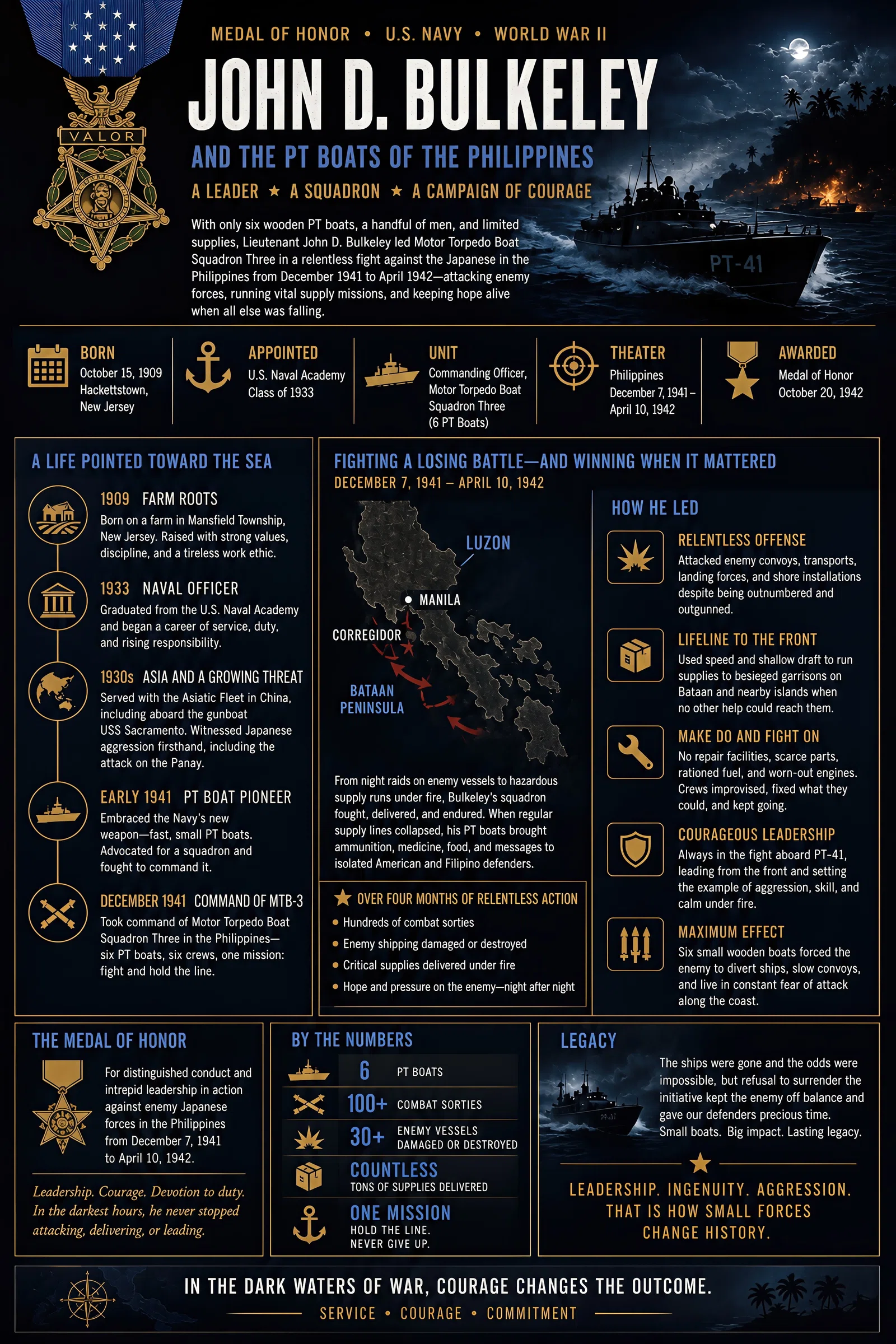
What the Americans still had, in the dark waters around Luzon and Bataan, were a handful of fast wooden patrol torpedo boats—“PT boats”—and a 30-year-old lieutenant named John Duncan Bulkeley.
Bulkeley commanded Motor Torpedo Boat Squadron Three, a tiny force of six aging 77-foot PT boats. They were built of wood, powered by temperamental gasoline engines, and armed with torpedoes that did not always run straight. On paper, it was a mosquito fleet facing an empire. In practice, it was the only offensive surface punch the U.S. Navy still had in the Philippines.
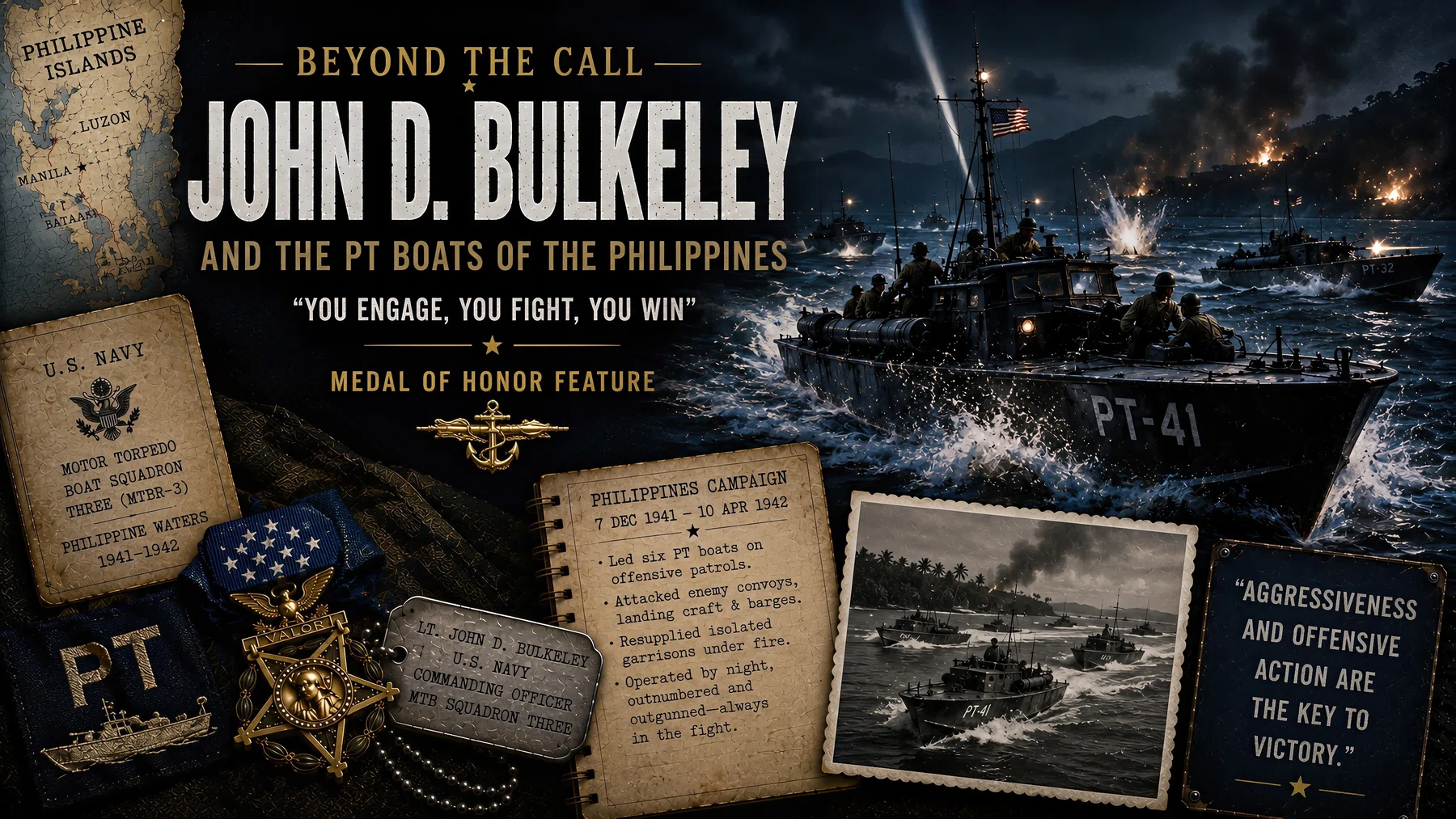
Over four brutal months, from the outbreak of war on 7 December 1941 through 10 April 1942, Bulkeley and his men would run those boats night after night against enemy convoys, shore batteries, and landing forces—usually outnumbered, often outgunned, and always one breakdown away from being stranded under enemy air cover. The Medal of Honor he eventually received was not for a single dramatic dash, but for an entire campaign of stubborn, improvised, relentless resistance.
To understand how he got there, you have to start much earlier, with a farm kid who kept finding his way back to the sea.
Bulkeley grew up on a farm in Mansfield Township, New Jersey, far from any battleship anchorage. Chores came before school, and hard work was taken for granted. He graduated from high school in Hackettstown in 1928 and then from the U.S. Naval Academy in 1933, joining a generation of young officers who would spend most of their early careers in a Navy that had more tradition than funding.
His first assignments were conventional enough—destroyer duty, then an engineering billet in the old gunboat USS Sacramento with the Asiatic Fleet. But service in Asian waters in the late 1930s meant watching a storm gather. Based in China, Bulkeley saw the Japanese invasion at close range, including the infamous attack on the U.S. river gunboat Panay on the Yangtze. Those experiences left him with no doubts about Japanese intentions or capabilities.
At the same time, he was drawn to the Navy’s experiments with small, fast attack craft. Where some senior officers saw only fragile boats and unreliable weapons, Bulkeley saw opportunity: a way to strike hard in confined waters and then disappear into the dark. When the Navy began forming its first PT-boat squadrons, he was there early—and he fought to get one of his own.
He got his wish. On the eve of war, Lieutenant Bulkeley took command of Motor Torpedo Boat Squadron Three in the Philippines. The boats were new to the theater, their crews were still learning, and nobody had ever used them in a sustained campaign. That learning curve was about to be compressed into the most desperate months of the Pacific war.
The Philippines, December 1941: outnumbered from the first shot
The attack on Pearl Harbor on 7 December 1941 was followed, within hours, by Japanese air strikes on U.S. bases in the Philippines. Airfields were wrecked; much of the Far East Air Force was caught on the ground. The Asiatic Fleet’s main base at Cavite was bombed into a smoking ruin. For Bulkeley’s squadron, those first days of war were a crash course in survival.
The PT boats had been intended for aggressive patrols and short, sharp torpedo attacks. Almost overnight, they also became couriers, scouts, and lifelines. When regular supply lines broke down under bombing and blockade, Bulkeley’s crews used their speed and shallow draft to slip along the coast, bringing ammunition, medicine, and messages to isolated garrisons on Bataan and nearby islands.
Conditions were brutal. There were no proper repair facilities once Cavite went up in flames. Engines that should have been overhauled after a few weeks of hard running kept going for months, their crews nursing them along with scavenged parts and sheer stubbornness. Fuel was rationed and hoarded for combat sorties. Food ran short; sleep was a luxury measured in minutes rather than hours.
Yet the squadron kept attacking. On blacked-out nights, the PTs would race out to reported enemy landings or convoys, throttles wide open, rooster tails of phosphorescent water streaming behind them. They would launch torpedoes at silhouettes on the horizon, then weave away at full speed while Japanese searchlights stabbed the sea and coastal batteries opened fire. Often they operated alone, without reliable air cover and with only sketchy intelligence.
Bulkeley was usually at the center of it all, on the bridge of PT-41. He led from the front, not the chart table. He learned the local waters well enough to thread his boat through reefs and shoals at speed in the dark. He also understood the psychological effect of a sudden torpedo strike: even if the damage was limited, the appearance of PT boats forced Japanese commanders to slow down, disperse, and guard against attacks that might come from anywhere along the coast.
As the enemy advanced down the Bataan Peninsula and across the islands, the situation grew steadily worse for the Americans and Filipinos. Manila was declared an open city and occupied. Corregidor—the island fortress guarding the entrance to Manila Bay—became the beleaguered seat of command. Bataan’s defenders were starving, sick, and short of everything except courage.
In that collapsing perimeter, Bulkeley’s squadron became something more than a small tactical unit. The PT boats were proof that the Navy was still fighting, still striking back. Their very existence—reports of patrol torpedo boats darting through Japanese lines, evacuating personnel, rescuing downed pilots, and attacking shipping—helped sustain morale on shore even as the strategic picture grew almost hopeless.
“Get MacArthur out”: a plywood lifeline in hostile waters
By early March 1942, the situation on Bataan and Corregidor had gone from desperate to untenable. Disease, hunger, and relentless bombardment were grinding the defenders down. Strategic reality left Washington and the high command with a hard decision: General Douglas MacArthur and key members of his staff had to be withdrawn to continue the war from Australia. The only way out ran through waters dominated by Japanese ships and aircraft. Submarines were considered, but there was real concern that a single torpedo or bomb could wipe out the entire party in one blow. The assignment instead fell to Bulkeley and his small command of PT boats.
The plan demanded that the boats push off from Corregidor at night, run south through enemy-controlled seas, and deliver the general, his family, and senior officers to the southern island of Mindanao. The distance was long for small craft already worn by constant combat. Fuel had to be staged and cached. Engines that had been run hard for months would have to keep turning in heavy seas. Bulkeley took the lead, knowing that any mechanical failure or chance encounter with an enemy patrol could end the mission, and with it one of the central figures in the Allied war effort in the Pacific.
The crossing was a test of everything the squadron had learned since December: hugging dark coastlines, throttling back when aircraft might be overhead, then surging to full speed when the risk of discovery was lower. Crews were exhausted, navigating through spray and darkness while trying to read the water and avoid reefs. At any point, Japanese destroyers or patrol craft could have cut them off. Instead, the PTs slipped past unseen, delivering MacArthur and his party safely to Mindanao, where they could continue on by air toward Australia. For the hungry, bomb-scarred men still on Bataan and Corregidor, news that the PT boats had pulled off this mission became another symbol that the fight would go on, even if they themselves were running out of time.
The evacuation did not end Bulkeley’s work in the islands. The boats went back to the same deadly waters, still carrying out raids, supply runs, and evacuations as Bataan finally fell and Corregidor endured its last weeks. There were no illusions left about the overall outcome. The enemy had overwhelming numbers, control of the air, and fresh troops. But as long as there was fuel in the tanks and the engines would start, Bulkeley treated each patrol as another chance to inflict damage, rescue someone cut off by the advance, or simply remind the enemy that the Americans and Filipinos had not yet surrendered the sea.
Four months and eight days: what the Medal of Honor saw
When Bulkeley’s campaign in the Philippines finally ended in April 1942, it represented something rare in naval history: four months and eight days of continuous small-boat operations with almost no repair or overhaul facilities, carried out under near-constant enemy pressure. The official Medal of Honor citation would later highlight how his squadron damaged or destroyed enemy aircraft, surface warships, and merchant vessels, and how its attacks repeatedly broke up landing attempts and shore concentrations. It also emphasized that these missions were conducted without the usual safety net of shipyard support, spare parts, or secure bases, which made every sortie a calculated gamble with long odds.
Behind those dry phrases lay dozens of individual actions. There were nights when PT boats dashed in to launch torpedoes at heavily defended convoys and then clawed their way back through shell splashes and searchlight beams. There were days when the same boats crept close to shore to land supplies or evacuate personnel under artillery fire. There were long hours spent coaxing damaged engines back to life with improvised repairs because there was no replacement coming. The citation singled out Bulkeley’s “dynamic forcefulness and daring in offensive action” and his “unique resourcefulness and ingenuity,” but it also pointed to his disregard for personal safety and the example that set for his men, who followed him into situations where a single mistake could have been fatal for everyone aboard.
Recognition came even as the larger war turned in new directions. In August 1942, at the White House, Bulkeley received the Medal of Honor from President Franklin D. Roosevelt, standing as a representative not only of his squadron but of all those who had fought and fallen in the doomed defense of the Philippines. He would go on to serve through the remainder of the war and beyond, eventually rising to the rank of vice admiral, but that medal tied him forever to the dark nights off Bataan and Corregidor, and to the men who went to sea with him in plywood boats. The story of what he did with that small command—and what it meant to those still fighting on shore—remains one of the clearest examples of how courage and ingenuity can stretch limited tools far beyond what anyone expected.
From the Philippines to the Channel: always toward the sound of the guns
Bulkeley did not come home from the Philippines to a quiet desk job. After escaping the fall of the islands and receiving the Medal of Honor, he went straight back into the fight. He served in the Mediterranean and then in the English Channel, where small, fast craft again became his natural element. In 1944 he took command of a mixed force of American and British patrol boats and destroyers that hunted German torpedo boats and coastal traffic along the French coast. The terrain was different—cold, rough northern seas instead of the tropical waters off Bataan—but the problem was similar: use thin-skinned ships and fast thinking to claw at a stronger enemy’s edges.
One of his best-known actions in this phase of the war came in August 1944, when his forces engaged a German convoy off the French coast near the island of Le Verdon. Bulkeley’s command closed in under cover of darkness and confusion, tangling with enemy escorts at close range. In the fighting that followed, his flagship destroyer slugged it out with a larger German ship while his smaller craft picked away at the rest of the convoy. It was the same pattern he had learned in the Philippines, translated to a larger scale: close fast, hit hard, and refuse to be intimidated by the enemy’s size or reputation. The decorations he earned in European waters added new ribbons to his uniform, but they came from the same instinct that had driven him to lead from the bridge of PT-41.
“You engage, you fight, you win”: a hard standard for peacetime
After the war, Bulkeley stayed in the Navy and brought his combat instincts into peacetime roles. He served in a variety of commands, including destroyer and cruiser duty, and eventually became president of the Board of Inspection and Survey, the body responsible for evaluating the readiness and condition of Navy ships. It was not a glamorous job, but it was one that suited an officer who had spent his life asking whether equipment would hold up under real stress. He became known for a blunt approach: if a system did not work or a ship fell short, he said so, regardless of whose reputation might be bruised.
That attitude was captured in the phrase often associated with him: “You engage, you fight, you win.” It was more than a slogan. For Bulkeley, it described an expectation that, when American sailors went into harm’s way, they would do so in ships that had been tested honestly, commanded by officers who understood what real battle looked like. His insistence on tough standards sometimes made him an uncomfortable figure in bureaucratic circles, but it also meant that his influence reached far beyond the small torpedo boats with which he had first made his name. He carried the lessons of the Philippines into every inspection report and every recommendation, making sure that future crews would not have to improvise under fire with unreliable tools.
Why John D. Bulkeley’s story still matters
Bulkeley retired as a vice admiral in 1988, closing a career that had stretched from the gunboats of the Asiatic Fleet to the nuclear age. He died in 1996 and is buried at Arlington National Cemetery, his grave one among many rows of white markers. On paper, his story can be summarized in a few lines: Medal of Honor in the Philippines, highly decorated service in two theaters, decades of leadership in shaping the postwar Navy. But the full weight of his story lies in the way he used small means to achieve outsized effects, and in how he carried responsibility for others long after the shooting stopped.
For students of military history, his PT boats in the Philippines show how initiative and daring can buy time and disrupt a stronger enemy’s plans. For sailors and soldiers today, his later career offers a quieter example: a senior officer who treated readiness as a moral obligation, not a paperwork exercise. And for readers of Beyond the Call, his life is a reminder that heroism is rarely a single moment. It is a pattern of decisions taken under pressure, in the dark, when failure feels likely and no one is guaranteed a safe way out. John D. Bulkeley’s plywood boats and hard questions still speak to that kind of courage.