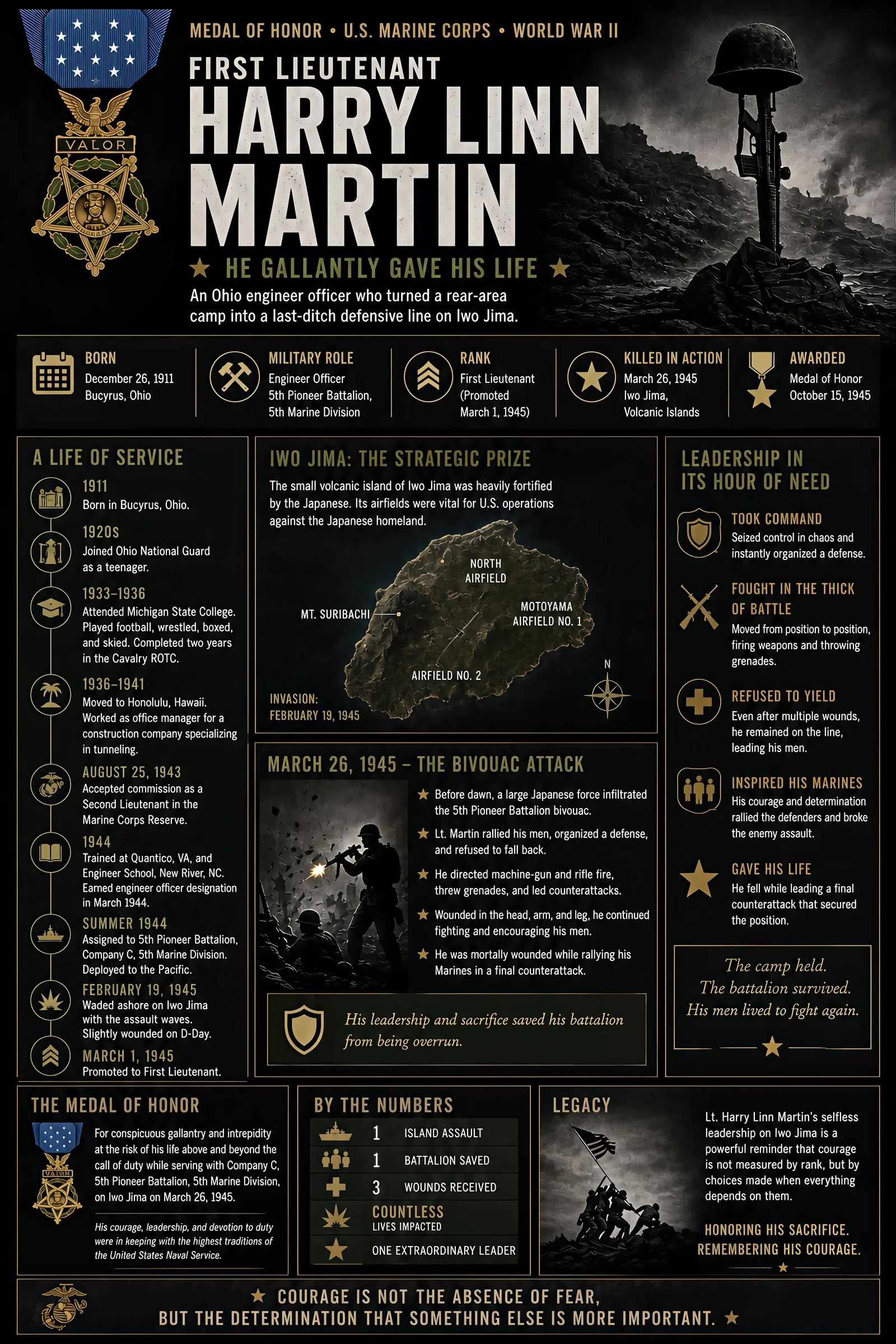
1. From Bucyrus to the battlefields of the Pacific
On the surface, Harry Linn Martin’s story could have been a very ordinary Midwestern life. He grew up in Bucyrus, a small Ohio town where the railroad tracks and church steeples defined the skyline. Born in 1911, he came of age between two world wars, part of a generation that watched the Great War’s veterans age into quiet respectability while new storms gathered overseas.
As a teenager he joined the Ohio National Guard, getting his first taste of military discipline and horsemanship. After graduating from Bucyrus High School, Martin headed to Michigan State College, where he studied business administration. He was not just a student buried in textbooks; he played football and wrestled, boxed a little on the side, and even took up skiing when the Michigan winters cooperated. Friends remembered him as steady rather than flashy—someone who would simply shoulder more weight when the team needed it.
At college he also joined the cavalry unit of the Reserve Officers’ Training Corps. In peacetime ROTC, horses and sabers might have looked like a relic of a bygone era, but the training gave Martin something that would matter later: a comfort with leading men and making decisions under pressure. He completed two years in that unit before graduating in 1936.
The next chapter of his life was surprisingly far from the American heartland. Martin moved to Honolulu, Hawaii, serving as an office manager for a construction company that specialized in tunneling. It was steady work, well suited to a business graduate with a head for numbers and logistics. The Pacific war still lay a few years in the future, and from his vantage point, the islands were more a scenic workplace than a looming battlefield.
When the United States was dragged into World War II, Martin was in his early thirties—older than many of the young men who would soon fill the ranks. Rather than let the war pass him by, he answered the call. On August 25, 1943, he accepted a commission as a second lieutenant in the Marine Corps Reserve. Training followed at Quantico, Virginia, and then at the Engineer School at New River, North Carolina, where he earned his designation as an engineer officer in March 1944.
2. The 5th Pioneer Battalion and the road to Iwo Jima
Martin’s new specialty placed him in an often overlooked corner of the Marine Corps: the pioneers. These were combat engineers—troops who built roads and supply points, cleared obstacles, and dug fortifications, usually under fire and often close enough to the front lines to smell the cordite. Assigned to the engineer regiment of the newly formed 5th Marine Division, he joined what would soon be redesignated as the 5th Pioneer Battalion, Company C.
With his unit, Martin shipped overseas in the summer of 1944. The Marines trained hard in Hawaii, rehearsing amphibious landings, practicing beach assaults, and studying the bare volcanic rock of a small island called Iwo Jima. The island’s airfields made it strategically vital as a base and emergency landing site for American bombers headed to and from Japan. Japanese forces had spent months turning its ridges, caves, and ravines into an interlocking fortress. Every yard of ground would have to be taken the hard way.
On February 19, 1945—the first day of the invasion—Second Lieutenant Martin waded ashore with the assault waves of the 5th Marine Division. The black sand beaches of Iwo Jima were steep and treacherous, and enemy fire raked the shoreline. Pioneers like Martin organized working parties under that fire, opening lanes for vehicles, clearing obstacles, and establishing supply dumps so the rifle companies could keep moving inland. At some point during that brutal first day he sustained a slight wound, a reminder that engineer officers on Iwo were never far from the fighting.
By March 1 he had been promoted to first lieutenant, a reflection of his performance and the simple fact that casualties among leaders were high. The division pushed slowly across the island, one pillbox, cave, and ravine at a time. Japanese units rarely surrendered; they preferred to fight to the last man or slip behind American lines to launch sudden night attacks. Even areas thought to be secure—like the rear-area bivouac where the pioneers slept and rearmed—could never truly be considered safe.
In the pre-dawn darkness of March 26, 1945, that reality crashed into Martin’s world. A concentrated enemy force infiltrated through the shattered landscape and burst into the bivouac area of the 5th Pioneer Battalion. The men there were engineers and support troops, many without their weapons immediately at hand. What happened in the next few minutes would determine whether the sleeping Marines behind the lines survived the war’s final terror on Iwo Jima—or were overrun in their own camp.
3. A bivouac becomes a battlefield
In the early morning darkness of March 26, 1945, the bivouac of the 5th Pioneer Battalion lay in uneasy quiet. Marines slept in foxholes and shallow scrapes, boots and weapons close at hand but not always within reach. The front lines were some distance away, and many of the men thought of this ground as “behind” the worst of the fighting. That illusion vanished in an instant when a coordinated Japanese force slipped through the broken terrain and crashed into the camp. Grenades burst among tents and foxholes, shouts of alarm cut through the night, and enemy soldiers began firing and charging at point-blank range.
First Lieutenant Harry Linn Martin was jolted awake into that chaos. Instead of diving for cover or trying to escape, he sprinted toward the sound of firing. With only moments to act, he began pulling scattered Marines into a rough firing line anchored near his own foxhole. He shouted directions, pushed men into position, and returned fire with his own weapon, buying a few precious seconds of order out of confusion. The hastily formed line checked the initial rush, knocking down attackers and forcing others to peel away into the darkness. In that shocked and half-awake crowd, Martin’s calm, urgent leadership turned a cluster of vulnerable foxholes into the skeleton of a defensive position.
Even as he organized the defense, Martin was already thinking beyond his own patch of ground. He understood that the pioneers’ bivouac sat among other units and that if this sudden infiltration rolled over them, it could spill into neighboring positions and start a chain reaction of disaster. The line he had formed was not just about survival; it was about holding the door closed on the far side of Iwo Jima. In the smoky dark he could see men still cut off, their foxholes isolated amid the press of enemy troops. To leave them behind would mean watching friends die within sight of help. For Martin, that was not an option.
4. Into the teeth of the attack
Once the first crash of the assault had been blunted, Martin made a choice that fixed his place in Marine Corps history. He left the relative safety of the line he had just organized and began moving toward the pockets of men who were still trapped under direct attack. The ground between was swept by fire, and Japanese grenades cracked and flared in the dark, but he pushed through, crouching low, calling for the isolated Marines to hold on. Reaching them, he rallied the survivors, redistributed weapons where he could, and led them back toward the improvised defensive line, effectively stitching a torn section of the perimeter back together.
During these movements he was hit and wounded, not once but twice. The pain and blood loss were real, but witnesses later remembered that he refused evacuation and kept moving, still armed only with his pistol. At one point, an enemy group seized an abandoned machine-gun position that commanded part of the bivouac area, turning it into a makeshift strongpoint. Martin recognized the danger at once. Without waiting for reinforcement, he charged the position alone, hurling grenades into the emplacement and finishing the fight at close range with his sidearm, silencing a weapon that could have ripped open the Marines’ fragile line.
The battle around him remained fluid and deadly. Small groups of Japanese soldiers continued to probe and rush, looking for gaps to exploit. Martin, still bleeding, spotted another hostile position anchoring a fresh thrust toward his sector. Once more he moved to the front, calling nearby Marines to follow. Leading from just a few steps ahead, he stormed the position and killed its occupants in violent close combat, breaking up that attack as well. Moments later, as he pressed the counterattack against a larger enemy group, a grenade explosion mortally wounded him. Even as he fell, the force of his actions had already shifted the momentum. The coordinated Japanese assault began to unravel, and the Marines of his battalion—and neighboring units—held their ground instead of being overrun in their own rear area.
5. Aftermath of a night attack
When the first light began to seep over Iwo Jima that morning, the bivouac of the 5th Pioneer Battalion looked very different from the quiet camp it had been only hours earlier. Bodies lay scattered among torn canvas and churned black sand, and the air still held the acrid smell of smoke and explosives. The Japanese force that had slipped into the rear area had been broken and driven off, but at a heavy cost. Among the Marines who would not see another sunrise was First Lieutenant Harry Linn Martin, who had fallen in the act of leading yet another charge to blunt the attack. In the confusion that follows any close-quarters fight, it took time to understand exactly what his actions had meant.
As reports filtered in from scattered foxholes and neighboring units, a picture emerged. The improvised line he had formed in the opening moments had checked the enemy’s momentum at a critical point. The small groups of men he had personally rallied and led back into the defense filled gaps that might otherwise have become fatal breaches. The enemy positions he had assaulted and destroyed, often with only a pistol and grenades, had been key firing points that could have raked the bivouac and nearby positions. Taken together, those choices helped prevent the rear area from collapsing and turned what might have been a cascading disaster into a hard-fought stand. In the final days of a brutal campaign, an engineer officer’s refusal to give ground had preserved the fighting strength of the division.
6. The Medal of Honor and the measure of a Marine officer
In the months after the battle, as the war in the Pacific ground toward its end, the Marine Corps gathered eyewitness accounts and formal reports from Iwo Jima. Those documents would eventually form the basis for Harry Linn Martin’s posthumous Medal of Honor. The citation describes how he repeatedly left cover to organize and reinforce defenses, how he personally attacked and destroyed enemy positions threatening his men, and how he continued to lead even after sustaining multiple wounds, until he was mortally hit in the act of charging another hostile group. It emphasizes that his actions were not a single moment of courage but a chain of decisions, each one accepting greater risk in order to shield others.
For students of military history, Martin’s story illustrates what leadership can look like in its most concentrated form. He was an engineer officer whose normal duties revolved around building, clearing, and maintaining the infrastructure of battle. When that world collapsed into close combat, he did not stand aside and hope that someone else would impose order. Instead, he applied the same instincts that made him a capable organizer—seeing the ground, understanding the flow of danger, and moving resources where they were needed—to the desperate work of holding a line. The Medal of Honor in his name recognizes not only personal bravery, but also the responsibility he embraced for the lives around him.
7. Legacy of a last stand on Iwo Jima
Harry Linn Martin’s body was returned home after the war, and his name joined the long roll of American dead from the Pacific. In Bucyrus, Ohio, he is remembered as the local boy who left a small town and never returned, except in stories, photographs, and the solemn language of his Medal of Honor citation. His alma mater, his hometown, and the Marine Corps all treat his memory as part of a larger narrative: that of citizen-soldiers who brought their civilian skills and quiet character into a conflict that demanded more of them than anyone could have predicted. For the engineers and pioneers who followed him, his example underscores that no job in a combat zone is truly “rear area” work when the enemy is determined and willing to die in the attempt to break through.
On Iwo Jima, the last major Japanese counterattack failed to dislodge the Marines who had clawed their way across the volcanic island. The cost of that failure, for the attacking force and for defenders like Martin, was measured in lives cut short. Yet the outcome also meant that the airfields on Iwo would be available as emergency landing grounds for damaged bombers and as stepping stones for the final drive across the Pacific. When we study Martin’s final night, we see more than a single act of heroism. We see how one officer’s refusal to abandon his men, expressed in a series of split-second decisions in the dark, helped hold together a fragile line at a decisive moment—and how that, in turn, left a legacy worthy of the title Beyond the Call.