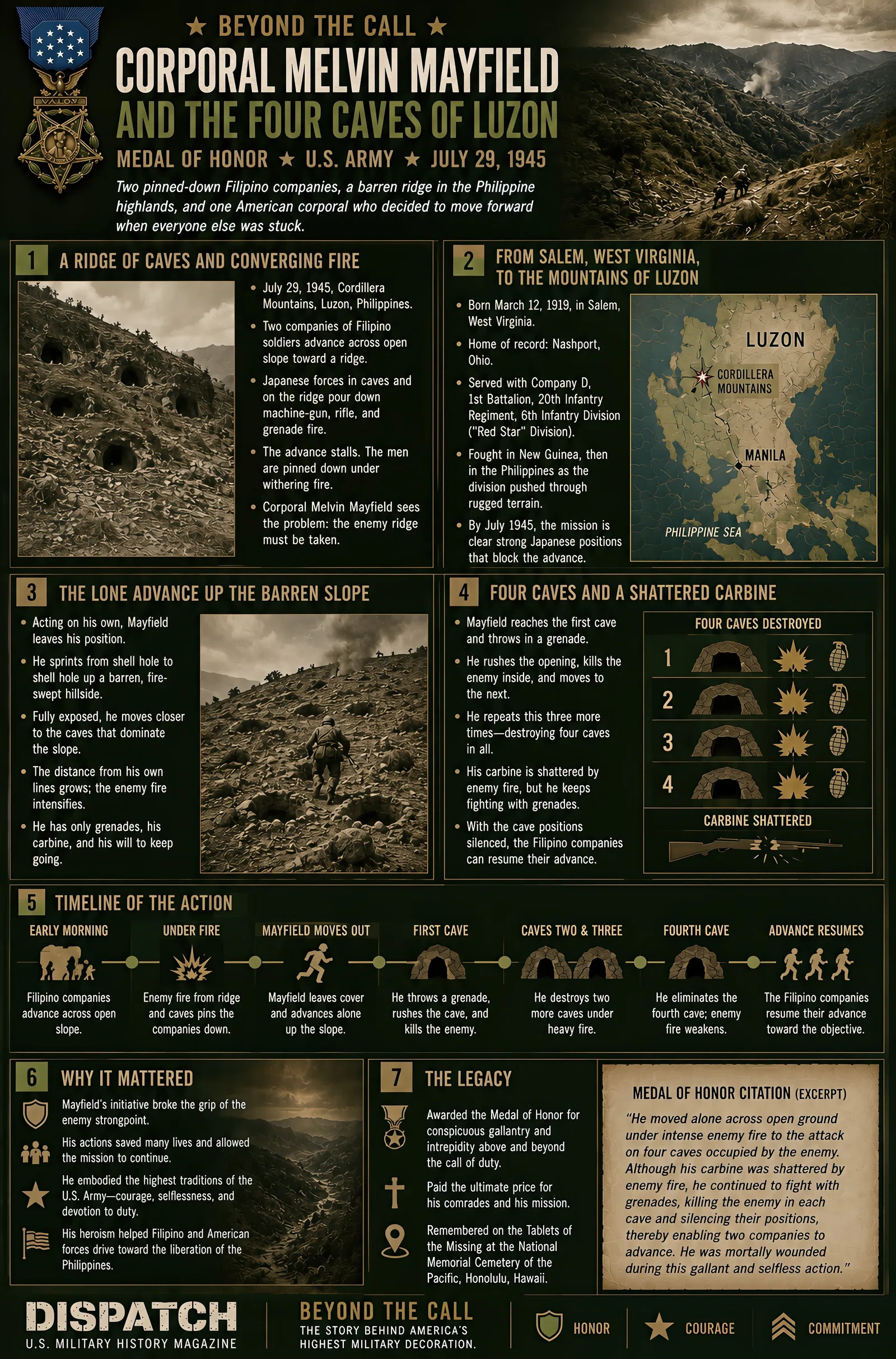
A ridge of caves and converging fire
On 29 July 1945, high in the Cordillera Mountains of northern Luzon, the war in the Pacific had narrowed to a steep, barren slope dotted with caves. Two companies of Filipino soldiers were trying to advance across that slope, part of the long, grinding effort to pry Japanese forces out of their last strongholds in the mountains.
They never made it to the crest. As the companies moved forward, enemy fire erupted from above and around them. From a circular ridge that commanded the valley floor, Japanese positions poured down rifle and machine-gun fire. Hidden caves along the upper slope spat bullets and grenades. Within moments, the advance stalled and then froze. Anyone who tried to move was cut down or driven back into the shallow cover of shell holes and rock folds.
Among the Americans nearby was a corporal in Company D, 1st Battalion, 20th Infantry Regiment, 6th Infantry Division: Melvin Mayfield. The 20th Infantry had been fighting across Luzon for months, clearing valleys, ridges, and villages in support of Filipino units reclaiming their homeland. On this day, the Americans were in support, but support did not mean safety. From his position, Mayfield could see that the Filipino companies were pinned and that the enemy ridge was the problem. If that high ground wasn’t taken, the men in front of him would stay trapped under converging fire.
What he chose to do next would earn him the Medal of Honor—and would be remembered as one of the starkest examples of a single soldier taking the initiative against impossible odds.
From Salem, West Virginia, to the mountains of Luzon
Melvin Mayfield’s story began far from the jungles and ridges of the Philippines. He was born on 12 March 1919 in Salem, a small town in Harrison County, West Virginia. Like many young Americans who came of age between the world wars, he grew up in a country still haunted by the memory of one global conflict and slowly being pulled toward another.
By the time he entered the Army during World War II, Mayfield’s home of record was Nashport in Muskingum County, Ohio, reflecting the moves and migrations that were common for working families in those years. The Army would eventually send him to the Pacific, assigning him to the U.S. 6th Infantry Division—nicknamed the “Red Star” Division—which had already built a hard reputation in the campaigns of New Guinea before it came ashore in the Philippines.
Within the division, Mayfield served in Company D, 1st Battalion of the 20th Infantry Regiment. By mid-1945, that regiment was pushing through the rugged landscapes of Luzon, a world away from the hills of West Virginia and the farms and small towns of Ohio. The Cordillera Mountains were a maze of steep ridges, narrow valleys, and dug-in enemy positions. Even as the war in Europe had already ended, soldiers in the Pacific—Americans and Filipinos alike—still faced determined resistance from Japanese forces who showed no inclination to surrender.
In this unforgiving terrain, small-unit actions often decided whether a valley was safe or deadly, whether a village could be liberated or remained under threat. Corporal Mayfield was one of thousands of infantrymen scattered across those mountains. On 29 July, he would step out of anonymity when he left what little cover he had and began moving from shell hole to shell hole toward the caves that were holding up the entire advance.
The lone advance up the barren slope
From his vantage point on the lower ground, Corporal Mayfield could see the shape of the problem more clearly than the men pressed into the dirt on the hillside. The Japanese had turned a circular ridge into a fortress, carving caves into the rock and tying them together with overlapping fields of fire. Machine guns swept the open slope, and riflemen and grenade throwers covered the dead ground between. The Filipino soldiers who had led the assault were now trapped in place, facing the impossible choice between staying pinned down or rising into a storm of bullets.
Mayfield chose a third option. Acting on his own, he left his position and started forward, not in one mad dash but in a series of short, deliberate moves. Between bursts of enemy fire he sprinted from shell hole to shell hole, using each shallow crater as a temporary shield. The hill was described later as “barren” and “fire-swept,” meaning there were no trees or buildings to hide behind—only blasted earth and rock. That kind of terrain magnifies every movement, and a single standing figure can draw fire from every enemy eye on the ridge. Yet Mayfield kept going, inching his way toward the caves that were spitting death down onto the Filipino companies.
As he climbed, the distance between him and his own lines grew, and the space between him and the enemy shrank. Small-unit training in the infantry emphasizes working with a squad or a team, but here Mayfield found himself functionally alone on the slope. Behind him, dozens of men watched a single corporal moving steadily into the worst of the enemy fire. Ahead of him, dug into the rock, the first cave waited. Inside were soldiers who had every advantage of position, cover, and prepared fields of fire. The only advantages Mayfield carried were his grenades, his carbine, and his determination not to stop.
Four caves and a shattered carbine
Near the top of the hill, Mayfield reached grenade range of the first cave. A cave position like this was more than just a hole in the rock; it was a firing port for rifles and machine guns, a shelter from artillery, and often a storage point for ammunition and grenades. Mayfield pulled the pin on one of his own grenades and hurled it into the dark opening, then followed up with fire from his carbine as the explosion shook the ridge. The combined blast and gunfire silenced the cave, removing one of the anchored guns that had been raking the Filipino companies below.
Instead of stopping, he moved laterally along the crest, seeking the next source of fire. Three more caves ringed the ridge, each one part of a rough circle meant to trap attackers in overlapping arcs of bullets. Mayfield repeated his assault method again and again: close the distance under fire, throw grenades into the opening, then finish the job with his carbine. Each success weakened the enemy’s grip on the ridge and reduced the volume of fire pouring down the slope. For the men below, those sudden silences in the enemy line meant a little less steel in the air and a little more room to breathe and plan their next move.
Before he could neutralize the last hostile position, however, a burst from a machine gun found him. One round smashed his weapon, destroying his carbine, while another tore into his left hand. Losing a primary weapon in close combat is usually the end of an assault; a wounded hand only makes matters worse. Mayfield refused to withdraw. Instead, with his hand injured and his gun ruined, he made his way back just far enough to secure more grenades. Then he turned uphill once again, charging straight toward the last enemy observation post at near point-blank range. The grenades he carried finished what his shattered carbine could not, destroying the final position that threatened the ridge and opening the way for the Filipino troops and their American partners to finish clearing the area.
Recognition at the very end of a global war
In the weeks after the fight on that Luzon ridge, the war in the Pacific lurched toward its end. On 15 August 1945, hostilities ceased after years of brutal fighting across oceans and continents. Corporal Mayfield’s actions on 29 July came so late in the campaign that they would stand out in history for their timing as well as their courage. His charge up the barren hill, the four caves he silenced, and the way he rallied the pinned-down troops below were later recognized as the last combat actions of World War II to result in a Medal of Honor before the guns fell silent.
The process of investigation, recommendation, and approval for such an award always took time. Officers gathered statements, reconstructed the fight, and weighed the recommendation against the high standard of “above and beyond the call of duty.” In May 1946, about ten months after the battle, Mayfield received the Medal of Honor for what he had done on that fire-swept ridge in the Cordillera Mountains. He left the Army still wearing the stripes of a corporal, a reminder that the highest decoration in American military service often goes not to generals but to junior leaders who face immediate danger and act without waiting for orders. His citation emphasized that his gallant determination and leadership helped other soldiers push forward and eliminate the last pockets of resistance around the ridge, turning a stalled attack into a secured position.
A quiet life after a very loud day
When his time in uniform ended, Mayfield did not step into a life of parades and speeches. He went home to Ohio and built a working life that would have looked familiar to many veterans of his generation. Records show him running a sawmill in Licking County, working long weeks—seventy hours or more—at a demanding trade that depended on steady hands and real endurance. It was hard, physical labor in peacetime, very different from the violent climb up that Philippine ridge, yet still rooted in the same habits of perseverance and responsibility.
He later lived in Frazeysburg, Ohio, a small community where he spent his later years far from the battlefields that had shaped his youth. Mayfield died on 19 June 1990 at the age of seventy-one and was laid to rest in the Frazeysburg Cemetery, not far from the forests and hills where he had made his postwar living. Visitors to his grave today see a name, dates, and the simple acknowledgment that he was a Medal of Honor recipient, but the stone can only hint at the long path from Salem, West Virginia, to Nashport, to the jungles and mountains of Luzon, and finally back to rural Ohio. The man who once crossed a bare, fire-swept slope under converging enemy fire spent most of his adult life in the rhythm of work, family, and community, like so many veterans who carried extraordinary stories quietly.
Why Corporal Mayfield’s day on the ridge still matters
Looking back, it can be tempting to treat Mayfield’s actions as a single dramatic episode frozen in time, but the story reaches outward in several directions. It highlights the close partnership between American and Filipino forces in the Philippines, with a U.S. corporal risking everything to relieve two Filipino companies trapped under fire. It shows how terrain, preparation, and initiative can matter more than sheer numbers; a ring of enemy caves on a circular ridge nearly stopped an advance until one soldier chose to act. And it underlines the reality that even in the closing days of a long war, danger remained sharp and lethal on every contested hill.
For readers of Dispatch: U.S. Military History Magazine and listeners of the Beyond the Call podcast, Mayfield’s story offers a lens into the character of ordinary soldiers asked to do extraordinary things. His Medal of Honor did not come from a grand strategic decision, but from a split-second choice to stand up on a barren slope, move forward into converging fire, and keep going after being wounded and losing his weapon. The caves he silenced exist now mostly in memory and in the words of his citation, but the pattern of his actions—seeing others in peril, accepting risk, and pressing on until the job is done—still resonates with veterans and civilians alike. In honoring Corporal Melvin Mayfield, we honor not only one man on one ridge, but the wider generation whose courage and determination helped bring the most destructive war in history to an end.