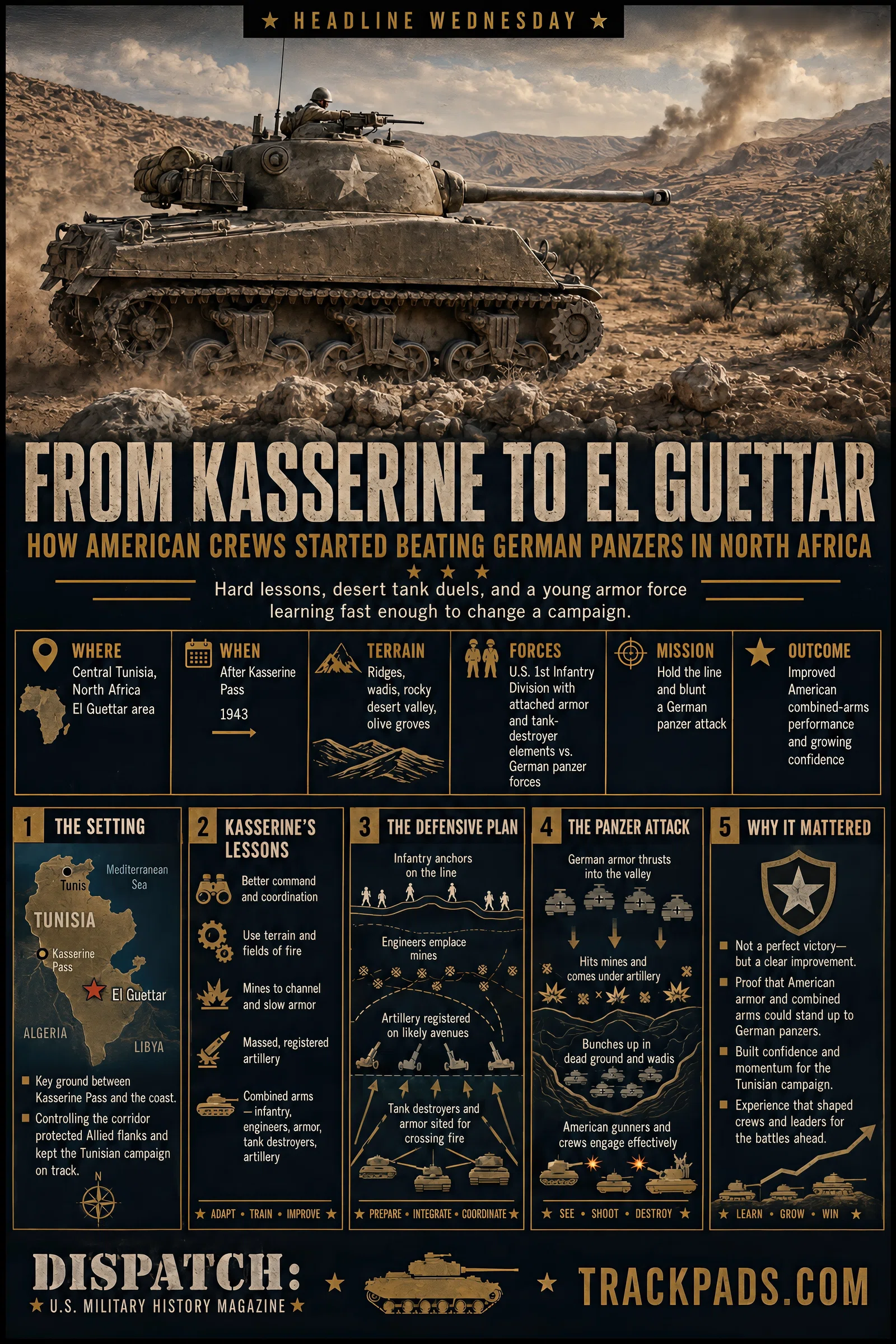
Dawn Over the Tunisian Hills
First light slipped over the low ridges around El Guettar, turning the scrub and rocky folds of central Tunisia a pale, dusty gold. In the shallow wadis and behind rough stone walls, American infantry from the 1st Infantry Division finished their coffee, checked weapons, and listened to the quiet rumble of engines from tank and tank destroyer positions behind them. The crews of Shermans and Lees had spent the night cleaning guns, checking radios, and trying not to think too much about what the next day might bring after the shocks of Kasserine. This was still the North African desert, but here the ground was cut by gullies and dotted with olive groves, a place where armor could move fast and also die fast.
Out beyond the mine belts and anti-tank guns lay the approaches from the east, where German armored columns had room to form up and drive hard. Reports had filtered in through the night that elements of a German panzer division were on the move, probing for a way through the American-held passes and valleys. The men on the line knew the reputation that came with those gray tanks: experienced crews, sharp gunnery, and a long string of victories against better seasoned Allied forces. Yet the Americans were not the same force that had been caught off balance a few weeks earlier.
Along the front, camouflage netting sagged over turret roofs, and tank destroyer crews double-checked their fields of fire between patches of brush and rock. The smell of oil, exhaust, and Tunisian earth mixed in the cool air. In the distance, a faint dust plume began to rise, the first visible sign that the enemy was indeed coming in strength. Radios crackled with short, clipped messages as officers confirmed fire plans and final defensive lines. This was the kind of morning that decided whether hard lessons stayed on paper or were finally turned into a different outcome. As the sun climbed higher, El Guettar was about to become the place where American armor tried to grow up in a single brutal day.
If This Line Breaks, So Does Confidence
To understand what was at stake on those Tunisian ridges, it helps to pull the camera back a few weeks. In February 1943, American units in North Africa had taken a painful blow at Kasserine Pass, where German forces punched through scattered defenses, exposed inexperience in command and control, and left a trail of burned-out vehicles and shaken soldiers. The North African campaign was supposed to be the proving ground for the United States Army in the Second World War, but Kasserine had raised doubts in Allied capitals about whether American forces were ready for the kind of hard, fast fighting the war demanded. El Guettar was one of the first chances to show that those doubts could be answered with better performance, not just promises.
On the map, the valley and high ground around El Guettar helped anchor the American sector of the front in central Tunisia. If German armor broke through here, they could disrupt the 1st Infantry Division, damage the attached elements of 1st Armored Division, and threaten the Allied push toward the coastal plain and Tunis. A successful German attack could have forced another pullback, complicated British operations to the north, and extended the campaign in North Africa at a moment when Allied planners were already thinking about the next steps in the Mediterranean. The line near El Guettar was not just a local defensive position; it was part of the hinge on which the entire central front in Tunisia swung.
There were also less visible stakes that weighed heavily on the men in American uniforms. Crews and commanders knew they were under scrutiny from their British partners, from higher headquarters, and from a home front that had begun to read about desert defeats in the newspapers. Tank units were still refining how to coordinate with artillery, infantry, and tank destroyers, still learning where to place vehicles on broken ground and how to fight panzers without charging blindly into their guns. The question was whether those adjustments would be enough to meet a concentrated German blow. At El Guettar, success would mean more than holding a valley. It would signal that American armor and combined arms could learn quickly enough to stand toe to toe with one of the most experienced armored forces in the world.
From Desert Setback to Second Chance
In late 1942, American troops had come ashore in North Africa full of energy and optimism after the Torch landings, but their first serious clashes with German and Italian forces exposed how much they still had to learn. Units were scattered over long distances, communications broke down under pressure, and commanders sometimes placed tanks and infantry where they could not support each other. At Kasserine Pass in February 1943, those weaknesses collided with a skilled enemy. German armor and mobile infantry sliced through poorly coordinated defenses, forced a hasty withdrawal, and left wrecked American vehicles lining the roads and passes. For many young crewmen, the first close look at a German panzer came as it fired into their position.
The aftermath of Kasserine brought changes that were more than just words in orders. Command arrangements were tightened, defensive lines pulled back into more coherent shapes, and fresh emphasis placed on digging in, laying mines, and coordinating artillery with armor and tank destroyers. II Corps received a new sense of urgency from the top. Training sessions in the brief pauses between engagements focused on gunnery, communication discipline, and how to use terrain instead of charging across it. Tank crews learned to respect enemy long-range guns but also to trust that, with proper support, their own vehicles could hit back.
El Guettar emerged as the natural place where these adjustments would be tested. The ground offered a mix of open approaches and broken, defensible ridges where infantry and anti-tank weapons could anchor a line. The 1st Infantry Division, already hardened by months in theater, dug in along the valley and its flanks, while elements of American armor and tank destroyer battalions moved into positions designed to catch any German thrust in crossing fire. Engineers seeded likely avenues of approach with mines and prepared demolition charges. Artillery batteries surveyed their targets, registering planned barrages to break up columns before they reached the infantry.
Across the lines, German commanders were not blind to American changes, but they still believed that a concentrated armored blow could crack the newcomers. Their plan at El Guettar called for driving heavy elements of a panzer division straight into the American-held valley, confident that shock, speed, and seasoned crews would carry the day. That decision set the stage for a collision between a force that had built its reputation on rapid desert victories and another that was determined not to be surprised in the same way twice within a single campaign. The path from Kasserine led directly to the ridges and mine belts surrounding El Guettar.
Panzers in the Valley, Guns on the Heights
When the German attack finally came, it began as a growing dust cloud on the horizon, then the glint of armor in the morning light, and finally the steady grinding roar of tanks advancing in formation toward the American positions. Infantrymen along the front line watched as the column resolved into ranks of panzers and supporting vehicles, moving with a confidence that came from long practice in desert warfare. The plan was straightforward: drive through the valley, brush aside the forward defenses, and roll up the American line before reserves could react. On higher ground behind the front, American artillery observers tracked the advance through field glasses and radioed corrections to batteries waiting for the signal to fire.
The first real blow landed not from tank guns but from the ground itself. As the German armor pressed into the valley, vehicles began to strike the minefields laid in depth across likely routes of advance. Explosions threw tracks into the air, stalled key vehicles, and forced the following tanks to bunch up or swing into narrower gaps. That congestion made them better targets. American artillery opened up, heavy shells crashing down among the stalled and maneuvering panzers, throwing dust, smoke, and shrapnel into the air. Tank destroyer crews, positioned to fire along the valley and from its shoulders, waited for the range to close to distances where their guns could do real damage.
As the range shortened, the fight turned into a deadly exchange between German armor trying to push through and American gunners determined to hold their ground. German tank commanders used their optics and long-range guns to search for the flashes of American positions, while machine-gun fire lashed the infantry on the forward slopes. American crews responded with disciplined volleys, picking out lead vehicles and command tanks to break the cohesion of the attack. The earlier chaos seen at Kasserine, where units fired in all directions and lost track of one another, was replaced here by more controlled fields of fire and a clearer sense of who was covering which sector.
There were still moments of intense danger. Some German tanks managed to pick their way through gaps in the mine belts and close within ranges where their guns could pick off American vehicles and gun crews. In those sectors, individual tank and tank destroyer crews found themselves in duels where a few seconds’ difference in spotting and firing meant survival or a burning wreck. American officers moved among their positions under fire, shifting reserves, calling for extra artillery missions, and urging crews to hold a little longer. The fight unfolded not as a smooth, perfectly executed plan but as a series of hard, local struggles linked together by better communications and a shared understanding that this time, the line could not be allowed to buckle.
Through the long hours of that day, the valley around El Guettar echoed with gunfire, exploding shells, and the grinding of damaged vehicles trying to escape or re-position. Smoke lay in dirty layers over the battlefield, sometimes hiding threats, sometimes masking friendly movements. German units probed for weak spots, adjusted their axes of advance, and tried fresh pushes against different parts of the American defense. Each time, they ran into combinations of mines, artillery, and direct fire that cost them tanks and momentum. By the time the main weight of the attack had spent itself, the ground in front of the American lines was littered with wrecks that marked just how costly the attempt to break through had become. The battle was not over, but the character of the fight had shifted in important ways that would define the remainder of the day.
Minefields, Artillery, and a Different Kind of Fight
What turned the day at El Guettar was not a single dramatic charge or a lone tank dashing forward, but a web of decisions and preparations that made the battlefield itself hostile to German armor. The mine belts that slowed and funneled the attack did exactly what they were meant to do, turning open desert into a series of killing lanes where American gunners could concentrate their fire. Artillery, registered in advance on likely approach routes, came down in coordinated barrages instead of scattered, reactive shots. When German tanks tried to shift to fresh axes of advance, they found new belts of explosives under the soil and fresh curtains of shellfire waiting for them.
Just as important was how American armor and tank destroyers were employed. Instead of being hurled forward in loosely coordinated countercharges, many vehicles were positioned to fire from hull-down or concealed positions, using the broken Tunisian ground as a shield. Tank destroyer crews, who had been searching for a clear role, now fought from preplanned ambush points where their guns could reach out and hit panzers forced into narrow corridors by mines and terrain. Shermans and Lees, while still at a disadvantage in some long-range duels, were brought into action in ways that emphasized numbers, angles, and combined arms support rather than isolated bravado.
Leadership also mattered. From corps down to battalion, commanders were more deliberate about holding ground that favored them and avoiding the kind of confused, overlapping movements that had plagued earlier battles. Communications, while far from perfect, were better organized, making it easier to shift reserves and coordinate artillery with front-line reports. When local counterattacks were ordered, they tended to be limited, aimed at restoring a line or destroying a specific pocket of resistance rather than launching into wide, unsupported thrusts. Each of these changes might have seemed small on its own, but together they created a kind of disciplined stubbornness that the German assault could not easily crack.
By midday and into the afternoon, the pattern was clear. German armor could still hit hard in local engagements and inflict painful losses, but it was no longer able to drive straight through American lines on the strength of surprise and experience alone. The cost of each push grew heavier, as more panzers brewed up on minefields or fell to concentrated fire. Eventually, the momentum that had carried German armored units through earlier desert campaigns began to fade in the Tunisian dust. At El Guettar, the shock was not that American units could fight bravely; it was that they could fight bravely within a better design for battle.
From Tunisian Valley to Lasting Lessons
When the smoke began to clear, the valley around El Guettar told its own story in burned wrecks, churned earth, and exhausted crews. German forces had failed to achieve the breakthrough they sought. They left behind a trail of damaged and destroyed tanks that could not be easily replaced in the tightening supply situation of Tunisia. For the Americans, the line had held. Infantry still clung to their positions along the ridges and in the wadis, artillery batteries remained in action, and many of the tanks and tank destroyers that had dueled with panzers were still in place, battered but functioning. It was a costly day, but it was not another Kasserine.
Operationally, the outcome at El Guettar helped blunt the ability of German armor in central Tunisia to mount decisive offensive thrusts against II Corps. The failure to punch through here limited the options available to Axis commanders as Allied pressure increased from multiple directions. As the campaign moved toward its final stages, German forces in North Africa had fewer chances to use armored shock to reset the lines. For Allied planners, seeing American units absorb and repel a major panzer attack provided reassurance that the growing United States contribution to the war could be counted on in more demanding operations to come.
The battle also left a mark on doctrine and training. Officers and historians studying El Guettar drew lessons about layered defenses, the careful siting of anti-tank weapons, and the value of preplanned artillery fire against armored columns. The coordination between infantry, armor, tank destroyers, engineers, and guns in that Tunisian valley became a reference point for how a young army could adapt under fire. Later campaigns in Italy and northwest Europe would see American units refine and expand on those lessons, but the core idea that combined arms, not individual branches acting alone, decided outcomes had been reinforced in blood at El Guettar.
For students of military history, staff rides, and museum visitors today, El Guettar stands as a reminder that growth in war is often measured not in perfect victories but in fewer repeated mistakes. The men who fought there carried memories of burned-out hulls, shattered minefields, and long hours under shellfire, yet they also carried proof that they could face the same enemy that had beaten them weeks before and fight him to a different result. In a rough valley in Tunisia, American armor began to shed some of its early-war reputation for chaos and inexperience, replacing it with a more disciplined, hard-earned confidence that would carry forward into the rest of the war.