Marines Step Into the Wheat
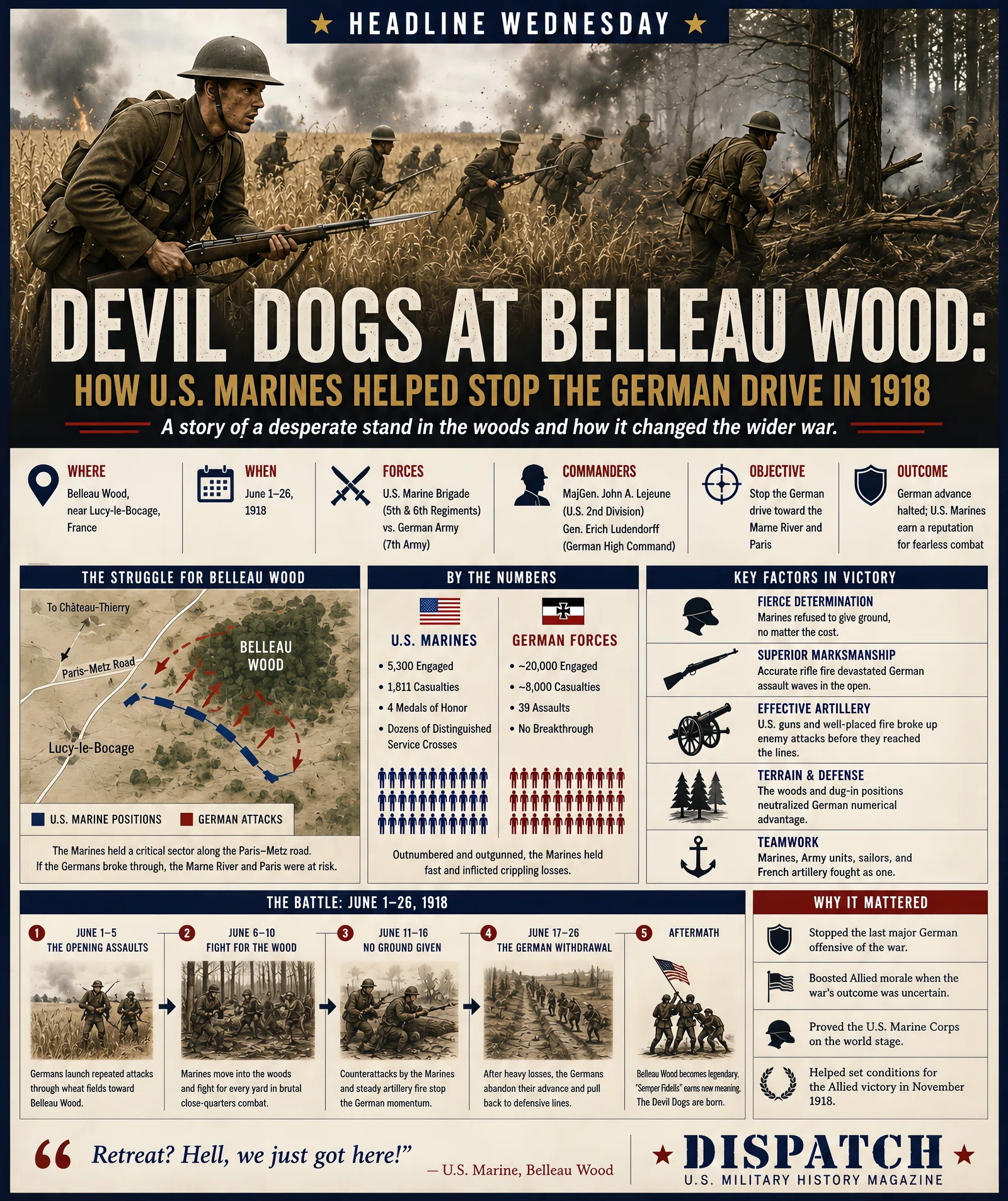
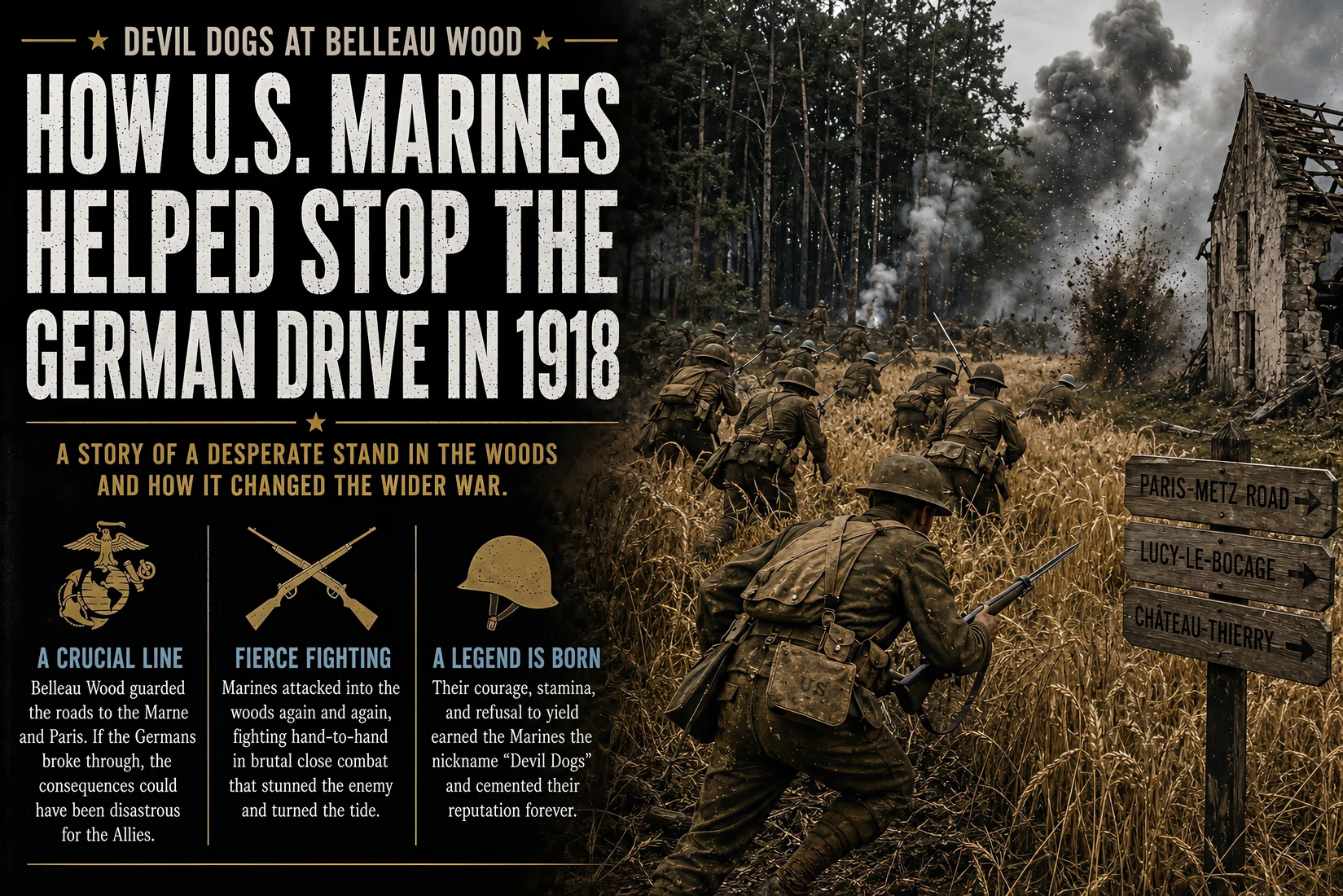
The wheat was high enough to brush a man’s shoulders, golden and still in the June heat, when the first German machine guns opened up. Out beyond the French village of Belleau in 1918, Marines of the United States 2nd Division moved forward in loose lines, the only cover that chest-high grain and shallow folds of ground. Somewhere ahead lay a dark tangle of trees already infamous to the French as a death trap: Belleau Wood.
The Marines had been told to hold the line near the Paris–Metz road and stop any further German advance toward the Marne. That road and the patchwork of fields around it were suddenly swept by fire. The sharp crack of German Mausers and the hammering beat of machine guns tore into the stalks, dropping men who had never seen combat until this week. Shells burst in the tree line, throwing splinters and branches into the air, turning the wood into a smoky wall.
Company commanders shouted to keep moving, to get out of the open before the guns found the exact range. Small groups of Marines rushed forward by rushes, dropping behind any fold in the earth, a roadside ditch, or a low stone wall. The French units that had held here earlier had chosen to fall back, warning that the assault was hopeless. The Marines, new to the Western Front but determined to prove themselves, dug in instead.
Behind them, artillery barked, sending rounds into the German positions, but the enemy guns kept working. The air smelled of cut grain, cordite, and the damp earth of hastily scraped firing pits. Men called for corpsmen, rifles worked steadily, and the black edge of Belleau Wood seemed to pull at the entire line. The moment was raw, chaotic, and close-run, and it was only the opening act of a battle that would reshape how friend and foe alike saw the American Marines.
If This Line Fails, Paris Opens
To understand why those wheat fields and that patch of forest mattered, it helps to step back a few weeks. In the spring of 1918, the German Army launched a series of massive offensives on the Western Front, hoping to win the war before American troops arrived in overwhelming numbers. One of those pushes drove hard toward the Marne River and the routes that pointed straight at Paris. French forces, already bloodied by years of trench warfare, were under enormous strain.
Belleau Wood sat near the village of Lucy-le-Bocage and the larger town of Château-Thierry, astride key approaches to the Marne. If German infantry and stormtrooper units could break through here, they would have a clearer path toward the river crossings and, beyond them, the French capital. The French command, desperate to plug the gap, turned to the newly arrived American Expeditionary Forces, including the 2nd Division and its Marine Brigade, to hold this sector.
For the Marines, this was more than just another sector of trenches. Their presence in France had been watched closely by both Allied and German leaders. If they held, it would prove that American troops could fight and absorb punishment in the hardest part of the line. If they broke, it would embolden German commanders and feed doubts in Paris and London about relying on these fresh arrivals from across the Atlantic.
On the German side, success here promised more than ground. A breakthrough could shake French morale yet again, push reserves into a frantic defense, and buy Berlin leverage at any future negotiating table. The men firing those machine guns from the treeline were part of a calculated effort to end the war on German terms before American strength fully tipped the balance.
That is why, as Marines in those wheat fields dug their boots into French soil and refused to yield, the fight at Belleau Wood began to carry weight far beyond its few square miles. This was where a relatively small American force stood in the path of a much larger offensive, and where a reputation—soon wrapped in the nickname “Devil Dogs”—started to take shape under fire.
From Drill Fields to a Crisis Line
The Marines who found themselves staring at Belleau Wood in June 1918 had not come to France expecting quiet duty, but few imagined how quickly they would be thrown into the center of a major German offensive. The American Expeditionary Forces had been building up for months, moving from stateside camps to ports, then across the Atlantic into French villages and training areas. For many Marines of the 5th and 6th Regiments, the early weeks in France meant long marches, familiarization with French weapons and gas masks, and instruction on surviving artillery fire in trenches that had already consumed whole generations of European soldiers.
By late May, that training collided with events. The German Army, freed from the Eastern Front by Russia’s collapse, launched a fresh series of hammer blows against the Allied lines in the west. One of those pushes ripped open sectors near the Marne and rolled back French divisions that had already endured years of strain. Headquarters began urgently shifting reserves to threatened areas, and the 2nd Division, which included the Marine Brigade alongside an Army brigade, received orders to move toward Château-Thierry to help plug a widening gap.
The Marines had a strong identity and tradition before they ever set foot in France, but they had not yet been tested in a sustained, large-scale land battle on the Western Front. Many senior European officers doubted whether these newcomers, energetic but inexperienced in trench warfare, could stand up to the kind of concentrated artillery and machine-gun fire that had broken so many earlier attacks. The Marines themselves were determined to prove that they could, and unit pride ran high as they moved into position near Belleau Wood and the neighboring villages.
There were tense exchanges with retreating French troops who urged the Americans to fall back to a more defensible line. Marine officers refused, choosing instead to dig in along the existing front and prepare to absorb whatever came. Behind the lines, staff officers studied maps of the wooded ridges and wheat fields, trying to understand how this small patch of ground tied into the larger German advance. The decisions made in those hurried conferences, and the stubborn choice to hold rather than withdraw, set the stage for the grinding, close-quarter fight that was about to unfold among the trees.
Into the Trees, Again and Again
The battle for Belleau Wood did not happen in a single rush and a single victory. It unfolded over weeks, in repeated assaults and counterassaults, with the dense forest turning every attack into a confused, close-range struggle. After the first brutal encounter across the wheat fields, Marine companies moved up to assault the wood itself, advancing into a tangle of undergrowth, shattered trees, and concealed machine-gun nests that had been carefully prepared by the Germans. Visibility dropped to a few yards in places. The crisp linear formations taught on parade grounds broke down into small groups advancing from tree to tree.
German units inside the wood had the advantage of cover and prepared positions. Their machine guns were sited to sweep likely avenues of approach, and artillery behind the lines pounded the edges of the forest and the fields beyond whenever American movements were detected. Marines responded with disciplined rifle fire, using the marksmanship that had been a point of pride in their training. Small squads worked to locate and flank individual nests, sometimes crawling forward on their bellies before rushing in with grenades and bayonets to clear positions one by one.
Progress was measured in yards and in the capture of specific knolls, rock outcroppings, and crossroads. A company might seize a German trench or gun position at great cost, only to be driven back by a counterattack and have to fight for the same ground again hours later. Casualties mounted rapidly, and gaps opened in the ranks that had to be filled with hastily reassigned men. Medical teams worked under fire, dragging wounded Marines back through the underbrush to improvised aid stations where shells still fell nearby.
Meanwhile, on the flanks and in the rear areas, artillery units and supporting infantry worked to keep the pressure on German positions beyond the wood, preventing reinforcements from moving freely. Runners carried messages through shell-torn ravines and over trampled wheat, trying to keep battalion commanders informed about which units were still advancing, which were pinned down, and where the next push might succeed. For the Germans, the wood became a stubborn salient that refused to fall despite repeated efforts to crush the American attacks with concentrated fire.
Day by day, the forest itself changed. Trees were stripped of leaves, trunks shattered, and the ground churned into a mix of splinters, shell craters, and scattered equipment. Night brought no real rest, only repositioning, hurried digging, and the grim work of evacuation. Yet, despite the punishment and confusion, the Marines kept pressing back into the trees. By the time the first reports began to speak of an American force that fought with unusual tenacity, the battle for Belleau Wood was still not decided. The outcome would turn on a combination of endurance, adaptation, and a willingness to keep attacking into that shattered forest long after many units might have broken off the assault.
Bayonets, Barrages, and Devil Dogs
What finally began to turn Belleau Wood was not a single glorious charge but a grinding series of adjustments made under fire. Early attacks had gone in with limited coordination, brave but costly rushes into machine-gun belts. As the days wore on, Marine and Army officers learned the contours of the wood almost tree by tree, mapping where the German nests lay and how the ground funneled attackers into killing zones. Artillery officers began to work closer with front-line units, walking barrages ahead of the Marines so that shells crashed into suspected positions moments before assault squads moved in behind the curtain of smoke and splinters.
Smaller units became the cutting edge. Instead of large, exposed waves, platoons and squads slipped forward in short bounds, using craters, stumps, and the carcasses of shattered trees as cover. Riflemen picked off exposed gunners while others looped around to hit strongpoints from the side or rear. When a machine-gun nest finally fell, Marines turned the captured weapon back along the German lines, using their own fire lanes against them. The same patches of ground changed hands multiple times, but each time the Marines learned more about how their enemy defended the wood and where its defenses were thin.
Leadership at the company and battalion level played a crucial role. Officers and senior noncommissioned officers moved forward to steady shaken men, reorganize scattered groups, and launch new pushes as soon as ammunition and strength allowed. At Hill 142 and other nearby positions, successful attacks and stubborn defenses gave the Marines footholds that anchored further advances into the forest. Word spread through the ranks that retreat was off the table, that the line here would hold no matter how heavy the shelling or how many counterattacks came hammering back out of the trees.
Somewhere in the middle of this ordeal, an enemy nickname began to circulate: “Teufel Hunden,” or Devil Dogs, a rough, accented way of saying that these Americans fought like relentless hounds. Whether the phrase was born in a specific German unit or polished later in Allied telling, it captured something real about the turning of the battle. The Marines had shifted from newcomers under test to a shock force that the German infantry could not easily push aside. By late June, after repeated assaults and relentless pressure, the remaining German defenders pulled back, and the wood was finally reported as cleared. The long, blood-soaked fight had tilted, and it did so because the Americans refused to break while steadily improving how they fought among those shattered trees.
From Wooded Hell to Enduring Legend
The immediate aftermath of Belleau Wood was measured in wreckage and casualty lists. The forest itself had been reduced to a tangle of splintered trunks and churned earth, and the fields around it were scarred by shell holes and shallow graves. Marine units that had gone into the battle at full strength came out missing entire platoons, with companies reduced to a fraction of their original numbers. German units that had held the wood suffered heavily as well, leaving behind abandoned positions, damaged guns, and the dead scattered among the roots and rocks. Yet, for all the destruction, a crucial fact stood: the German advance toward the Marne and Paris had been stopped on this line.
At the campaign level, holding Belleau Wood helped blunt a key phase of the 1918 German offensive. By preventing a breakthrough near Château-Thierry, the Marines and their Army partners bought time for the Allies to bring in more reserves and stabilize the front. The failure to crack through here contributed to the larger pattern of German offensives losing steam, opening the way for later Allied counteroffensives that would push the front eastward. In French cities and villages, news that American troops had stood firm under some of the worst fire the war could offer did more than lift spirits; it reassured a weary population that fresh strength had truly arrived.
Within the United States Marine Corps, Belleau Wood became a touchstone almost immediately. Stories of riflemen advancing through wheat and trees under terrible fire, of bayonet charges and hand-to-hand struggles in the dark forest, fed a growing sense of a distinct identity. The term Devil Dogs, the memory of June 1918, and images of Marines locked in close combat all fused into a narrative of toughness and determination. Training, recruiting, and internal culture drew heavily on that legacy, reinforcing the idea that every Marine, no matter the specialty, was first and always a rifleman capable of holding a hard line.
Today, visitors can walk the ground around Belleau Wood, seeing memorials, preserved trenches, and the quiet landscape that once shook with artillery and machine-gun fire. For students of military history, staff rides, or anyone trying to understand the First World War, this battle offers more than tales of bravery. It shows how a relatively small area, held by determined troops, can influence a much larger campaign. It illustrates how adaptation under pressure, cooperation between services, and sheer human endurance can turn a crisis into a foothold. And it reminds modern readers that reputations in war are not born in slogans or posters, but in places like this, where men in the line decide, again and again, not to yield.