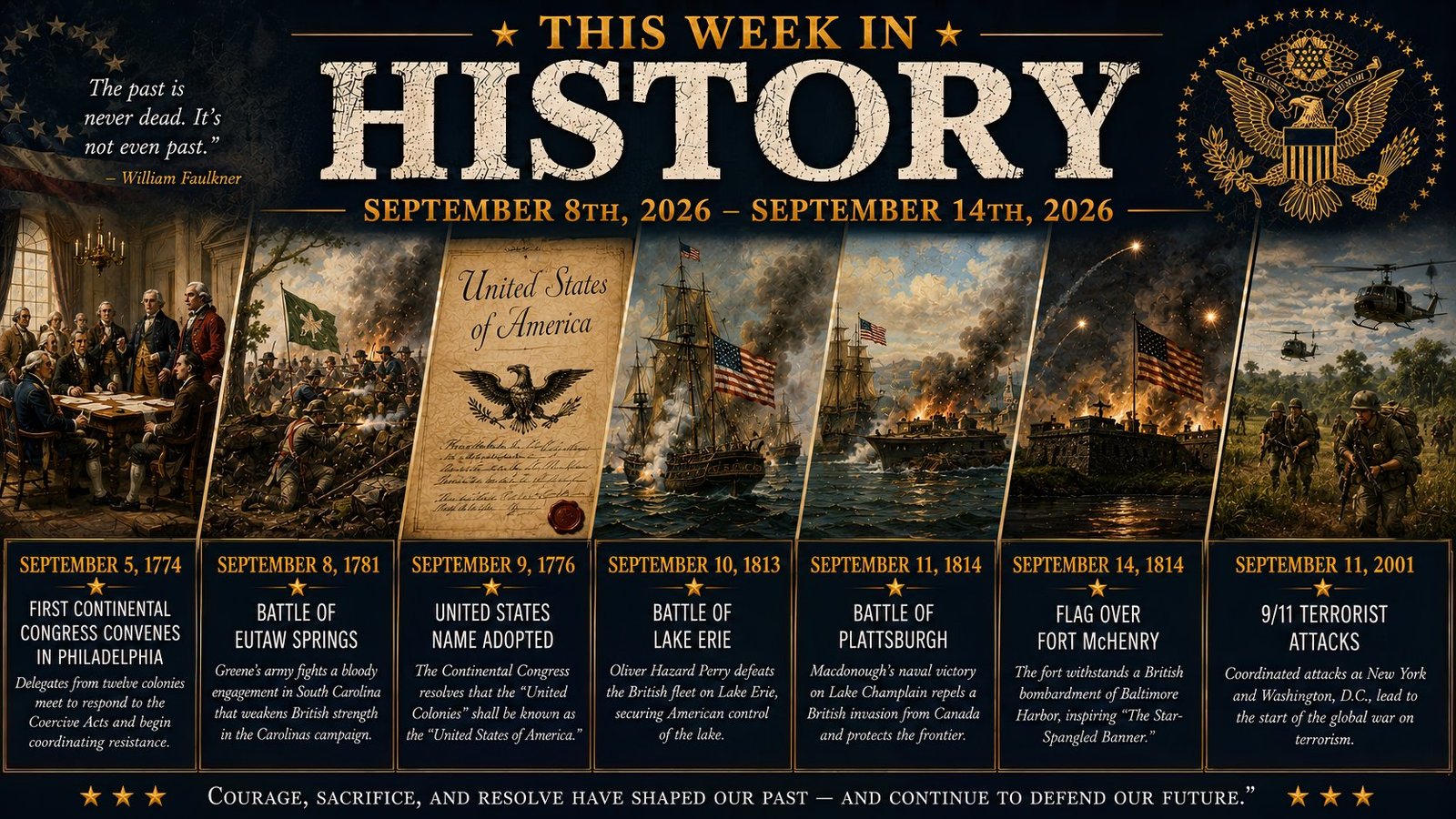
From September 8th, 2026 through September 14th, 2026, the calendar touches some of the most consequential hinges in United States military history. Across these same seven days in earlier years, Americans have renamed their young country, fought for control of inland seas and harbor forts, stormed walls on the road to foreign capitals, and held thin lines in distant jungles. Other anniversaries in this span remind us that wars turn not only on firepower, but also on intelligence windfalls, political decisions, and catastrophic attacks on the homeland. In this week’s “This Week in U.S. Military History” feature from Dispatch: U.S. Military History Magazine, developed by Trackpads dot com, we move from the Revolutionary War to the global war on terror, watching a nation grow into a world power and grapple with the costs that follow. The stories that follow show how much can change in a single week when the stakes are national survival, contested frontiers, or the defense of cities and citizens.
United States name adopted
On this date, the Continental Congress resolved that the “United Colonies” would henceforth be known as the “United States of America.” It was a decision made in the middle of a war whose outcome was far from certain, but it gave the rebellion a clearer political identity and a name that soldiers, sailors, and militiamen could carry into battle. The term soon appeared on military commissions, in official correspondence, and on flags that flew over encampments and warships. For officers like George Washington and the men under his command, fighting for the United States rather than a loose set of colonies reinforced the idea of a shared cause, not just thirteen separate struggles. Over time, that name would frame everything from enlistment oaths to the markings on aircraft and armored vehicles. The choice made in the heat of 1776 still underpins how Americans talk about their armed forces and the country they defend.
Open the Wiki entryBattle of Eutaw Springs
Near the end of the Revolutionary War’s brutal southern campaign, American forces under Nathanael Greene clashed with a British column commanded by Alexander Stewart near Eutaw Springs in South Carolina. The fighting was savage and close, with Continental regulars, militia, and British regulars trading volleys and bayonet charges in stifling heat. Tactically, the battle was inconclusive: the Americans suffered heavy losses and eventually pulled back, while the British held the field for a time before withdrawing toward Charleston. Strategically, however, Eutaw Springs further weakened British strength in the South and convinced many that their position could not be sustained. The campaign Greene had waged across the Carolinas had already bled British forces dry, and this battle was one more step toward their ultimate evacuation. For the soldiers who fought there, it became a grim reminder that even the last engagements of a war can be among the hardest.
Open the Wiki entryBattle of Lake Erie
On this day in the War of 1812, Master Commandant Oliver Hazard Perry led a hastily built American squadron against a British flotilla on Lake Erie. The fight was chaotic, with cannon smoke drifting across the water and ships maneuvering at close range as crews worked their guns under terrible conditions. Perry’s flagship was battered and nearly disabled, but he transferred his flag to another vessel and pressed the attack. By the battle’s end, every major British ship had been captured or destroyed, prompting Perry’s famous report that “we have met the enemy and they are ours.” Control of Lake Erie allowed American forces to recover Detroit and cut a key British supply line into the Old Northwest. The victory also sent a surge of confidence through a country that had seen setbacks on land, proving that its young navy could prevail in a stand-up fight.
Open the Wiki entryBattle of Plattsburgh
As peace negotiations played out in Europe, British commanders attempted a major invasion down the Lake Champlain corridor, hoping to carve off parts of northern New York and influence the terms of any treaty. American forces under Brigadier General Alexander Macomb fortified positions around Plattsburgh while a small naval squadron under Master Commandant Thomas Macdonough prepared to contest the lake. When British warships sailed into the bay, Macdonough’s careful anchoring plan allowed his outgunned vessels to fight at close range and even rotate to bring fresh broadsides to bear. On land, American troops and militia held against British attacks that depended on success at sea. The British fleet’s defeat forced the invading army to withdraw, blunting the offensive. The outcome helped convince British negotiators that sweeping territorial gains were unlikely, strengthening the American hand at Ghent and preserving the nation’s northern border.
Open the Wiki entryFlag over Fort McHenry
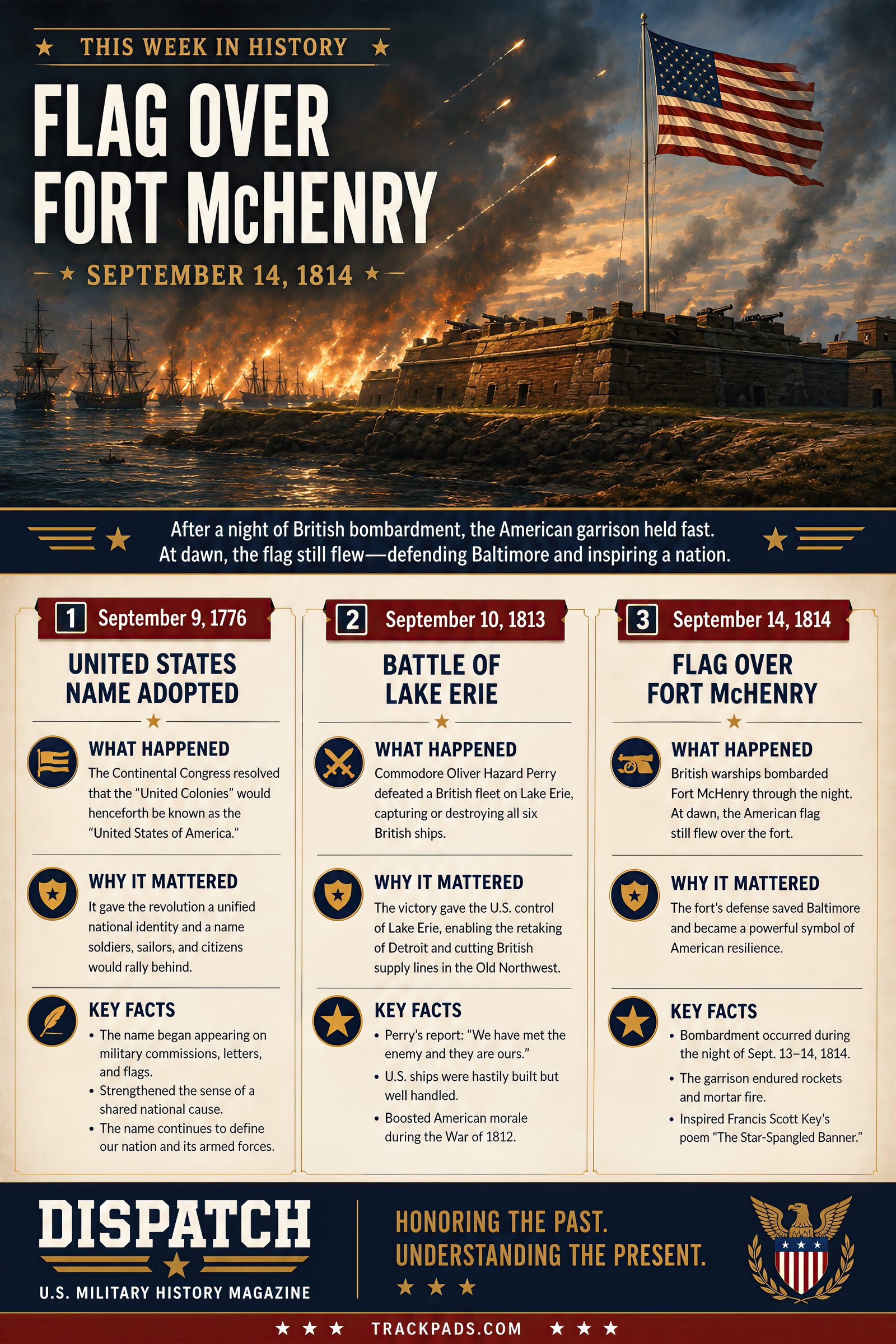
Two days after Plattsburgh, another critical gateway came under fire when British warships bombarded Fort McHenry, guardian of Baltimore’s inner harbor. Through the night of September 13th, rockets and mortar shells arched over the star-shaped fort as its garrison endured a carefully timed bombardment meant to break their will and clear the way for an assault. The British fleet stayed just beyond the fort’s main guns, while smaller craft probed for weaknesses in the defenses. At dawn on September 14th, the large garrison flag still flew over the fortifications, signaling that the position had held and that Baltimore’s harbor remained closed to the enemy. An American lawyer, watching from a ship in the harbor, turned the sight of that flag at first light into a poem that would later become the national anthem. The defense of Fort McHenry became a symbol of resilience under fire and a point of pride for generations of service members.
Open the Wiki entryBattle of Chapultepec
During the Mexican–American War, United States forces under Major General Winfield Scott advanced on Mexico City, meeting fierce resistance at fortified positions west of the capital. A bloody attack at Molino del Rey on September 8th cleared some of the outer defenses but did not yet open the road into the city. Five days later, attention turned to Chapultepec, a hilltop fortress and military academy that dominated the approaches. American infantry, artillery, and engineers worked together to batter the defenses and then storm the heights in hard fighting that included a prominent role for the United States Marine Corps. Once Chapultepec fell, the causeways leading directly into Mexico City lay open, and resistance within the capital quickly crumbled. The battle imprinted itself on American memory, later echoed in the Marine Corps hymn’s reference to “the Halls of Montezuma,” and it marked a decisive moment in a controversial war that reshaped both nations’ maps.
Open the Wiki entryDiscovery of Special Order 191
In the Maryland countryside, as Confederate General Robert E. Lee maneuvered his Army of Northern Virginia during the Antietam campaign, a lost copy of his marching orders fell into Union hands. Union soldiers found the document wrapped around cigars in a field near Frederick, Maryland, and passed it up the chain of command until it reached Major General George B. McClellan. The order laid out Confederate dispositions and plans with unusual clarity, offering a rare glimpse into Lee’s intentions at a critical moment. Armed with this information, McClellan moved to strike the separated Confederate columns, leading to the battles along South Mountain and setting the stage for Antietam. The intelligence coup did not instantly translate into a crushing Union victory, in part because McClellan still moved cautiously, but it narrowed Confederate options. The episode has since become a classic case study in how chance, paperwork, and frontline initiative can shape an entire campaign.
Open the Wiki entrySecond Battle of Sabine Pass
Along the Gulf Coast, Union planners sought to open a route into Texas by sending a naval expedition and troop transports toward Sabine Pass at the border with Louisiana. They expected to batter a modest Confederate fortification and land forces to seize nearby towns and infrastructure. Instead, they encountered a small but well-trained Confederate artillery detachment that knew the channels intimately and had carefully ranged its guns. As Union gunboats steamed into the narrow approach, Confederate gunners scored a series of devastating hits, crippling ships and throwing the flotilla into confusion. The planned landing was abandoned, and the expedition retreated with significant losses captured or destroyed. For the Confederates, the lopsided victory at Sabine Pass became a celebrated defense of Texas. For Union commanders, it underscored the risks of underestimating coastal fortifications and the importance of detailed local knowledge in amphibious operations.
Open the Wiki entrySt. Mihiel offensive begins
Near the end of the First World War, the American Expeditionary Forces launched their first major offensive as a largely independent army against the German-held St. Mihiel salient in France. General John J. Pershing had long argued that American troops should fight as a unified force rather than being scattered piecemeal into Allied units, and this operation put that idea to the test. United States divisions, supported by French units, tanks, and a growing air component, attacked along a broad front to pinch off the salient that had threatened Allied communications for years. Despite mud, congestion on narrow roads, and the challenges of coordinating a large-scale assault, the offensive quickly compressed and eliminated the salient. The success boosted American confidence, showed that the United States Army could plan and execute a modern combined-arms operation, and set the stage for the even larger Meuse–Argonne campaign to follow. It also signaled to allies and adversaries that American manpower and logistics could shift the balance.
Open the Wiki entryBattle of Edson’s Ridge
On Guadalcanal in the Solomon Islands, United States Marines were fighting to hold Henderson Field, an airstrip whose control would decide who could dominate the skies over the surrounding seas. Japanese commanders attempted to seize the airfield by sending infantry to attack along a jungle-covered ridge south of the runway, believing that night assaults could break the Marine perimeter. Colonel Merritt “Red Mike” Edson and his Marine Raiders, later reinforced by other units, dug in along the high ground, stringing out thin lines and preparing for hand-to-hand combat in the dark. Over successive nights, Japanese forces launched repeated attacks, sometimes penetrating the American defenses and forcing desperate counterattacks at close range. By September 14th, the final major assault had failed, with heavy Japanese casualties and the ridge still in American hands. The defense of Edson’s Ridge preserved Henderson Field as a functioning base, helping to secure eventual Allied control over the campaign’s seas and skies.
Open the Wiki entrySalerno landings and the Italian armistice
In early September 1943, the strategic picture in the Mediterranean shifted rapidly. On September 8th, Italy announced an armistice with the Allies, effectively ending its role as a formal Axis partner even as German forces moved quickly to disarm Italian units and seize key positions. The very next day, American and British troops of Fifth Army came ashore near Salerno in Operation Avalanche, beginning the invasion of the Italian mainland. The armistice complicated everything: some Italian units cooperated with the Allies, others were overrun, and German defenders fought tenaciously to drive the landing force back into the sea. On the beaches and in the surrounding hills, infantry endured artillery fire, counterattacks, and the challenge of coordinating naval gunfire and air support. The beachhead nearly broke at several points, but Allied forces held on and pushed inland. The combination of a collapsing partner and a fiercely contested landing illustrated how fluid alliances, politics, and battlefield realities could become in midwar Europe.
Open the Wiki entryTerrorist attacks on the United States
On this date, coordinated terrorist attacks struck the United States homeland in a way not seen before. Hijacked airliners were flown into the World Trade Center towers in New York City and the Pentagon outside Washington, D.C., while passengers on a fourth flight fought back and brought their aircraft down in a Pennsylvania field. Thousands of civilians, first responders, and military personnel were killed or injured, and the images of burning towers and a shattered Pentagon left a deep imprint on the national memory. For the armed forces, the attacks led to a rapid shift in priorities: deployments to Afghanistan, later operations in other regions, and an expanded focus on counterterrorism, homeland defense, and intelligence. New commands, doctrines, and technologies emerged as the country grappled with the challenge of a long, irregular conflict. The anniversaries of that day remain a moment of solemn reflection for service members and families who have carried the burdens of the wars that followed.
Open the Wiki entryAcross the Week
The events that fall between September 8th and September 14th remind us how many different kinds of turning points can shape United States military history. Some are battlefield struggles over ridges, forts, and lakes, where small units and individual decisions tilt the balance at critical moments. Others unfold in council chambers, on pieces of misplaced paper, or in the sudden shock of an attack that forces a nation to rethink its security and commitments. Taken together, these stories trace a long arc from a young republic choosing its name to a global power confronting twenty-first-century threats. They show a military that has been called to defend coasts and cities, open distant fronts, and adapt to new forms of warfare. As we mark these anniversaries, we also acknowledge the enduring weight carried by those in uniform and the communities that support them, in every era touched by this week on the calendar.