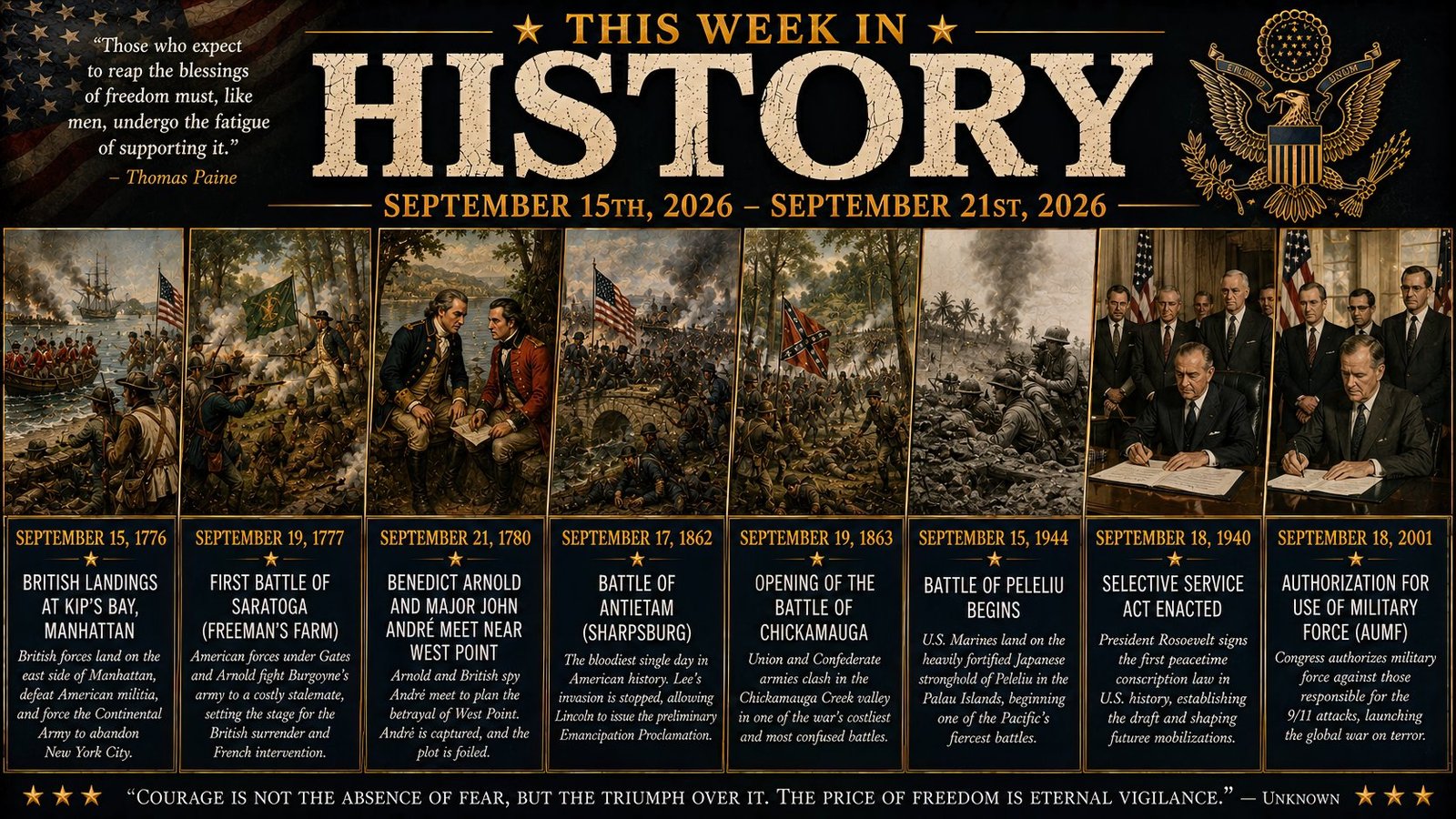
From September 15th, 2026 through September 21st, 2026, the calendar links moments of crisis, adaptation, and transformation across American arms. In these same seven days, separated by decades and even centuries, Continental soldiers fight for independence, Civil War armies clash in blood-soaked fields, and Marines struggle across Pacific coral. The week also carries quieter but equally decisive turning points: a peacetime draft law, a service birthdate, and a short piece of legislation that reshapes how the nation fights terrorism. Together, these anniversaries remind us that military history is not just a sequence of battles but a web of decisions, experiments, and consequences. This Tuesday edition of Dispatch: U.S. Military History Magazine highlights a selection of those stories, with an eye on both the people in the line and the institutions they served. Each vignette offers a window into how the United States has learned, stumbled, and adjusted under pressure.
British landings at Kip's Bay, Manhattan
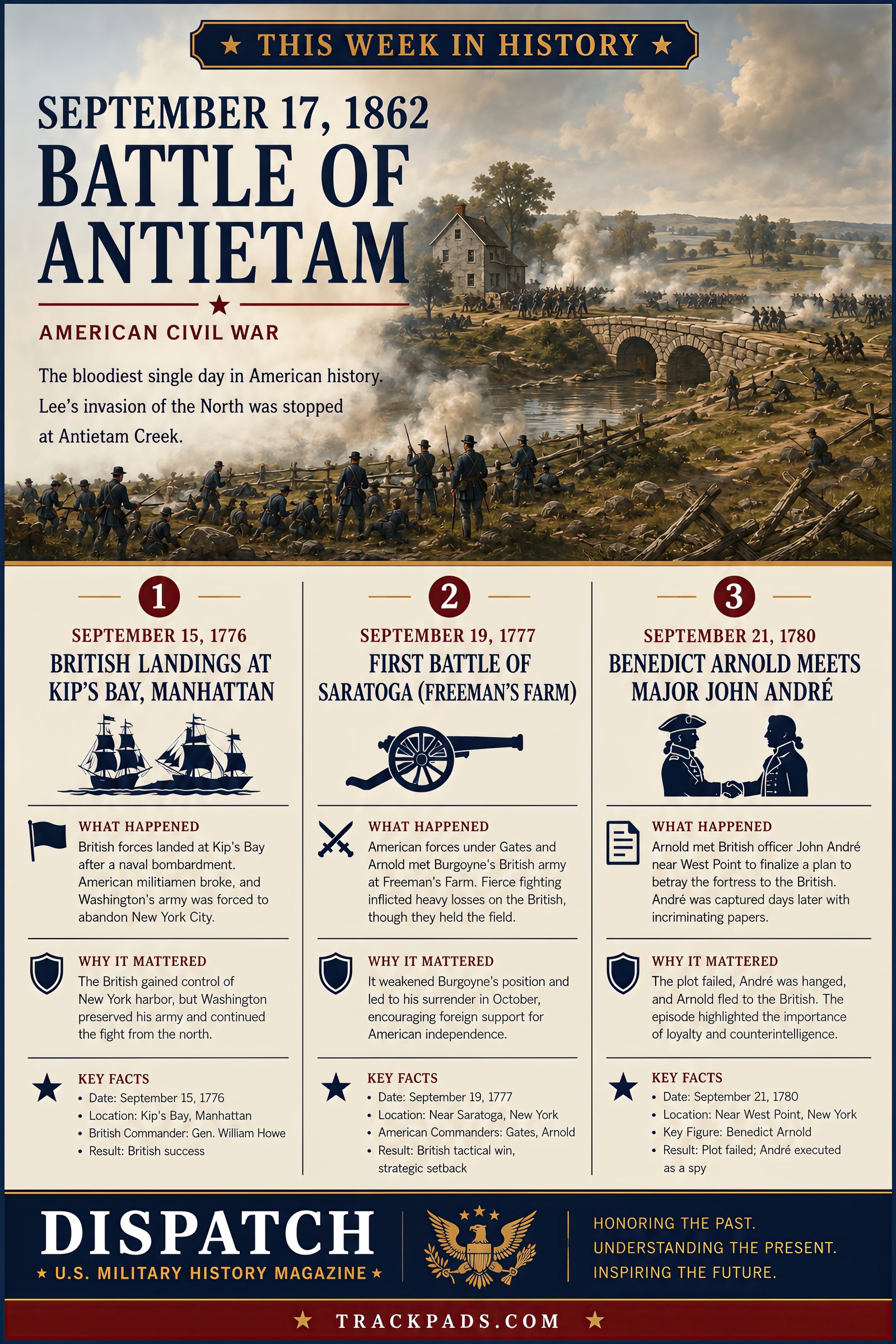
On a gray September morning, British warships and transports massed off the east side of Manhattan and began pounding the American positions at Kip's Bay. The defenders, mostly inexperienced militiamen, faced a bombardment unlike anything they had seen and soon broke under the pressure as British troops rowed ashore. George Washington, arriving on the scene, reportedly tried to rally the fleeing soldiers and was nearly cut off himself in the confusion. The collapse at Kip's Bay forced the Continental Army to abandon most of New York City, ceding the key port and its harbor to the British for the rest of the war. Yet the retreat preserved the core of Washington's army, allowing it to fight on from more defensible ground farther north on Manhattan and beyond. This sobering episode underscored the challenges of training, discipline, and morale that would haunt the young army even as it gained experience.
Open the Wiki entryFirst Battle of Saratoga (Freeman's Farm)
A year later and hundreds of miles to the north, American troops faced a British advance aimed at cutting New England off from the rest of the colonies. At Freeman's Farm near Saratoga, New York, Continental and militia forces under Horatio Gates and the aggressive Benedict Arnold met John Burgoyne's redcoats in a series of fierce, close-range engagements. American riflemen and artillery repeatedly mauled British assaults, trading ground for blood and denying Burgoyne the clean breakthrough he needed. Although the British technically held the field at day's end, their losses were severe, and their strategic position grew weaker as supplies dwindled and American reinforcements gathered. The first battle at Saratoga set the conditions for Burgoyne's surrender in October, a capitulation that convinced foreign powers that the American cause had real staying power. In the long view, the fight at Freeman's Farm marks a shift from survival to genuine opportunity in the struggle for independence.
Open the Wiki entryBenedict Arnold and Major John André meet near West Point
Three years after Saratoga, one of its heroes met secretly with a British officer to betray the very cause he once championed. On September 21st, 1780, Benedict Arnold and Major John André conferred along the Hudson River to finalize a plan to hand over the vital fortress at West Point. Arnold had grown embittered over perceived slights and financial troubles, and the British saw a chance to seize a key strongpoint that guarded the river route into the interior. The details of the meeting would unravel within days when André was captured carrying incriminating documents, exposing the plot. Arnold escaped to British lines, while André was hanged as a spy, and the episode shocked the Continental Army and the public alike. In military terms, the failed betrayal underscored the importance of internal security, loyalty, and counterintelligence inside a besieged revolutionary movement. The near loss of West Point remains a cautionary tale about the human vulnerabilities that can endanger even the strongest positions.
Open the Wiki entryBattle of Antietam (Sharpsburg)
In the Civil War's Eastern Theater, September 17th, 1862 brought the single bloodiest day in American military history along Antietam Creek in Maryland. After Robert E. Lee carried his Army of Northern Virginia across the Potomac in a bid to influence Northern politics and foreign opinion, Union forces under George McClellan finally moved to confront him near the crossroads town of Sharpsburg. The battle unfolded in brutal phases: cornfields swept by musketry, a sunken road turned into a killing ground, and a stone bridge wrested from stubborn defenders. Union troops gained local successes but never quite delivered a decisive blow, while Confederate units fought desperately to plug gaps in a dangerously stretched line. By nightfall, about twenty-three thousand men were killed, wounded, or missing, and Lee's invasion had been checked, forcing him back into Virginia. The Union's strategic advantage allowed Abraham Lincoln to issue a preliminary Emancipation Proclamation, tying the war effort more directly to the destruction of slavery and reshaping its moral and political stakes.
Open the Wiki entryOpening of the Battle of Chickamauga
In the wooded hills of north Georgia, the Western Theater saw its own grim test when Union and Confederate armies collided along Chickamauga Creek. On September 19th, 1863, forces under William Rosecrans and Braxton Bragg groped for each other's flanks in dense timber, often fighting at close quarters with limited visibility. Units became separated, and the battle devolved into a series of vicious local fights where regiments sometimes charged and countercharged the same ground. Although the first day's combat was inconclusive, it set the stage for a Confederate breakthrough the following day that would send much of the Union army reeling back toward Chattanooga. Chickamauga's opening day demonstrated how terrain, command confusion, and the fog of war could magnify the cost of every decision. The eventual Union retreat left an important city under threat and forced the Federal high command to rethink leadership and reinforcement in the West, paving the way for later campaigns under Ulysses S. Grant and William T. Sherman.
Open the Wiki entryArmy aviation crash at Fort Myer
At the dawn of military aviation, the United States Army experimented with powered flight on a parade ground at Fort Myer, Virginia. On September 17th, 1908, Orville Wright was demonstrating his aircraft to Army observers with Lieutenant Thomas Selfridge aboard as a passenger. A propeller failure led to a loss of control, and the machine plunged to the ground, killing Selfridge and severely injuring Wright. For the Army, the crash was a stark reminder that embracing new technology often carries tragic risk, especially in its earliest stages. Investigations and follow-on tests focused heavily on structural reliability and safety, influencing how future aircraft would be evaluated before entering service. Selfridge's death, the first in powered flight for the military, left a lasting mark on the culture of test flying and procurement. It also underscored that progress in airpower would be built on both innovation and hard-earned lessons about engineering limits.
Open the Wiki entrySelective Training and Service Act signed into law
As war raged overseas but before the United States formally entered the Second World War, political leaders grappled with how to prepare a peacetime democracy for potential conflict. On September 16th, 1940, the president signed the Selective Training and Service Act, instituting the first peacetime draft in American history. Men within specified age brackets were required to register, and the legislation set up a nationwide system to induct and train soldiers on a large scale. The law was controversial in some quarters, but it reflected a growing recognition that modern war demanded mass mobilization and advance planning. In practical terms, the act allowed the Army to expand, organize new divisions, and improve training infrastructure before the attack on Pearl Harbor. When war came, this head start in building manpower and structure helped the United States absorb early shocks and eventually project power on multiple fronts. The peacetime draft thus stands as a crucial institutional step in turning a relatively small prewar force into a global army.
Open the Wiki entryMarines land on Peleliu in the Pacific
In the western Pacific, Marines of the First Marine Division stepped off amtracs onto the coral beaches of Peleliu on September 15th, 1944. The objective was an airfield whose capture was expected to support operations in the Philippines, and planners initially predicted a short campaign. Instead, Japanese defenders sheltered in an intricate network of caves and fortified ridges, turning the island into a maze of interlocking fields of fire. The heat, terrain, and stubborn resistance combined to produce extraordinarily high casualties for the assaulting Marines and later Army units committed to the fight. While the airfield was eventually secured and the island declared under control, the operation's value relative to its human cost was questioned even by participants. Peleliu became a symbol of the brutal, grinding character of late-war Pacific island battles and influenced debates about strategy, target selection, and the balance between operational objectives and troop welfare.
Open the Wiki entryOperation Market Garden airborne landings
Two days after the Peleliu landings, American paratroopers were jumping over the Netherlands as part of an ambitious Allied plan to seize a route across major rivers into Germany. On September 17th, 1944, the 82nd and 101st Airborne Divisions descended onto fields and roads near key Dutch towns, aiming to grab bridges and secure corridors for British armored columns. Initial drops achieved many of their objectives, but scattered landings, stiff German resistance, and delays on the ground soon complicated the plan. While American airborne units fought doggedly to hold and expand their positions, the overall offensive fell short of its ultimate goal of crossing the Rhine. Operationally, Market Garden illustrated both the promise and the limits of large-scale airborne assaults, particularly when intelligence about enemy strength and terrain is incomplete. Lessons from the operation would shape postwar doctrine on airborne operations, joint planning, and the critical importance of realistic assumptions in high-risk offensives.
Open the Wiki entryUnited States Air Force becomes a separate service
In the aftermath of global war, American leaders restructured their armed forces to meet emerging strategic realities. On September 18th, 1947, the provisions of the National Security Act came into full effect, and the United States Air Force emerged as an independent service, separating from the Army Air Forces. The redesign created a new Department of the Air Force alongside the Army and Navy, formalized a unified defense establishment, and recognized airpower as a distinct domain with its own doctrine and leadership. For airmen, the change offered new opportunities to shape strategy, technology priorities, and career paths focused on the air and, eventually, space. Organizationally, the birth of the Air Force marked a shift toward a more integrated, modern military structure designed for global commitments and nuclear-era demands. This anniversary remains central to understanding how the United States thinks about air and space power, from long-range bombers to satellites.
Open the Wiki entryAmphibious landing at Inchon, Korea
Early in the Korean War, United Nations forces clung to a shrinking perimeter around Pusan while North Korean troops pressed hard along the front. On September 15th, 1950, an amphibious landing force under Douglas MacArthur went ashore at the port of Inchon, far behind enemy lines on Korea's west coast. The operation faced daunting tides, narrow channels, and heavily defended approaches, but its very audacity helped achieve surprise. Once established ashore, United States Marines and soldiers quickly cut vital supply routes and pressed toward Seoul, throwing the North Korean advance into disarray. The Inchon landing turned a defensive struggle into an offensive opportunity, allowing United Nations forces to break out from the Pusan perimeter and reclaim lost ground. Strategically, the operation became a textbook example of how a well-executed amphibious assault at an unexpected location can alter the course of a war, even as later setbacks would remind planners of the limits of bold strokes.
Open the Wiki entryAuthorization for Use of Military Force enacted
Only a week after the attacks of September 11th, lawmakers and the president moved to define the legal framework for military response. On September 18th, 2001, the Authorization for Use of Military Force became law, granting the executive broad authority to employ armed force against those responsible for the attacks and associated organizations. In practice, this short piece of legislation would underpin operations in Afghanistan, counterterrorism campaigns across multiple regions, and a wide range of activities by forces and intelligence agencies. For commanders and planners, the AUMF shaped deployment patterns, rules of engagement, and long-term commitments in ways that extended far beyond the initial crisis. The anniversary underscores how a few paragraphs of legal language can have enduring consequences for service members, veterans, and the societies touched by their missions. It also serves as a reminder that modern warfare sits at the intersection of policy, law, and the lived experience of those who carry out decisions made in the capital.
Open the Wiki entryAcross the Week
In tracing these seven days across different years, a handful of themes stands out: the weight of decisions made under pressure, the cost of innovation, and the constant tension between ambition and reality. From a panicked militia line at Kip's Bay to carefully orchestrated landings at Peleliu and Inchon, American forces have learned and relearned how preparation and leadership shape outcomes. Legal and organizational turning points, like the peacetime draft law, the establishment of the Air Force, and the post–September eleventh authorization, show that the architecture around the battlefield can matter as much as the clash itself. These stories also highlight how individuals, whether an embittered general plotting treason or a young lieutenant in a fragile flying machine, can become symbols of larger forces at work. As readers look back on this week in history, the echoes of those choices continue to inform how today's service members train, adapt, and shoulder responsibility in an uncertain world.