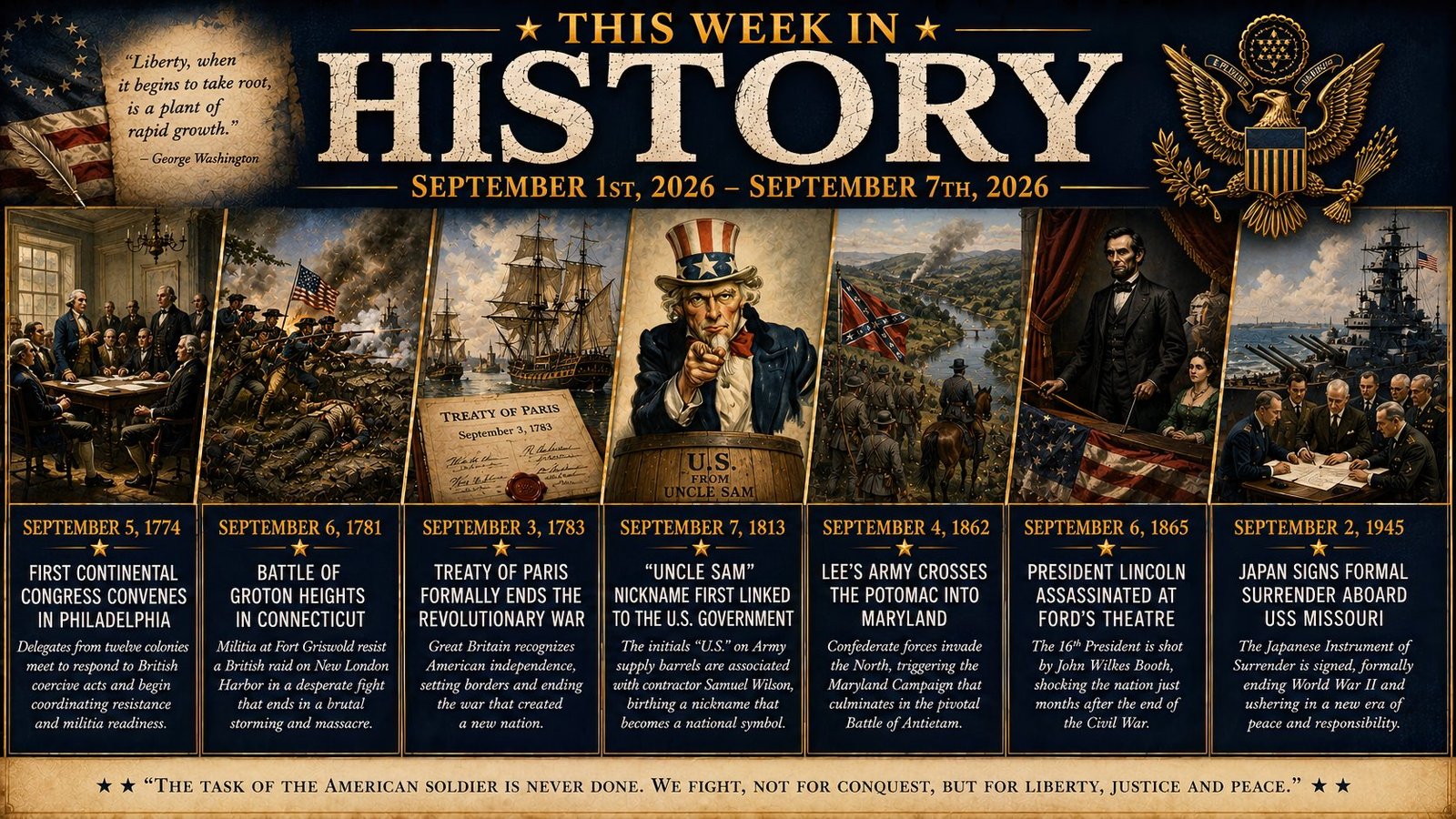
From September 1st, 2026 through September 7th, 2026, the calendar lines up with a remarkably rich run of moments in United States military history. Across these seven days we see colonial delegates edging toward open resistance, militia companies fighting desperate local battles, and Civil War armies maneuvering for advantage around capital cities and key rail hubs. We watch the Revolutionary struggle close with a formal peace, even as a new national symbol takes shape in the figure of “Uncle Sam.” Later in the week the story shifts to industrial-age conflict, from the shock of presidential assassination to the global crises of the twentieth century and the diplomatic work of building alliances. Taken together, these anniversaries trace how a loose collection of colonies hardened into a nation, fielded mass armies, and eventually shouldered worldwide security commitments. This edition of “This Week in U.S. Military History” follows those threads from Philadelphia’s meeting halls to the deck of a battleship in Tokyo Bay and a treaty table in San Francisco.
First Continental Congress convenes in Philadelphia
On this day delegates from twelve colonies gathered in Philadelphia to respond to what they called the Coercive or Intolerable Acts, punitive measures imposed after the Boston Tea Party. Many of these men had military experience from earlier frontier wars, and they understood that protests alone might not settle the crisis. In the meeting halls they debated boycotts, issued declarations of rights, and quietly began talking about how colonial militias might be strengthened if force became necessary. Committees of safety, which were local bodies that supervised militia readiness and enforced boycotts, gained new prominence. Although the Congress still professed loyalty to the crown, it created a framework for coordinated resistance that would soon support the raising of a Continental Army. In hindsight, this opening session marked a shift from scattered protests to an emerging national political and military strategy.
Open the Wiki entryBattle of Groton Heights in Connecticut
Near the end of the Revolutionary War, British forces raided the harbor town of New London, Connecticut, to burn supplies and shipping that supported the American cause. Militia under Colonel William Ledyard took position at Fort Griswold on Groton Heights, a small earthwork fortification guarding the approach. The defenders were outnumbered and lightly supported, but they chose to resist rather than abandon the post. After a fierce assault and close-quarters fighting, the British stormed the works and inflicted heavy casualties, including a brutal aftermath remembered as a massacre. Strategically the raid did not alter the course of the war, but it left deep scars in local memory and showed how even late in the conflict small coastal communities were exposed to sudden violence. The fight at Groton Heights illustrates the risks militia companies accepted in defending their own towns and the personal cost of a war often remembered through larger campaigns.
Open the Wiki entryTreaty of Paris formally ends the Revolutionary War
Two years after Yorktown, diplomats concluded the conflict on paper in a treaty signed in Paris. In that document Great Britain recognized the independence of the United States and agreed to boundaries that ran from the Atlantic coast to the Mississippi River. For the Continental Army and state forces, this meant a transition from wartime mobilization to peacetime demobilization, with all the strain that placed on officers and soldiers awaiting back pay and land grants. The treaty also forced British garrisons to evacuate posts within the new borders, handing over forts and supply points that had been flashpoints during the war. At the same time, the new nation now had to secure long frontiers with limited regular forces and a patchwork of militia systems. This formal peace closed one chapter of armed struggle while opening another centered on defending an expanded republic.
Open the Wiki entry“Uncle Sam” nickname first linked to the United States government
During the War of 1812, a newspaper account connected the initials “U.S.” on Army supply barrels with a contractor named Samuel Wilson of Troy, New York. Wilson, a meat packer who provided rations for troops, became known locally as “Uncle Sam,” and the story claimed that soldiers joked the barrels came from “Uncle Sam” himself. Over time that casual nickname evolved into a national personification of the United States government, especially in military recruiting art and patriotic imagery. Although no one at the time could have predicted how far the symbol would spread, the association between a civilian supplier and uniformed service is telling. It underscores how military power depended on networks of farmers, packers, merchants, and transport workers who kept armies fed and equipped. The figure of Uncle Sam grew from those practical roots into a powerful symbol used to encourage enlistment and rally public support in later wars.
Open the Wiki entryLee’s army crosses the Potomac into Maryland
In the late summer of the Civil War, Confederate General Robert E. Lee led the Army of Northern Virginia northward across the Potomac River and into Maryland. His aim was to relieve pressure on war-torn Virginia, influence Northern public opinion ahead of elections, and possibly win European recognition with a striking victory on Union soil. For the United States Army, this crossing triggered a crisis and an opportunity. Under new leadership, the Union Army of the Potomac marched out to intercept Lee, setting up the Maryland Campaign that would culminate at the Battle of Antietam later in September. The invasion forced Union commanders to think not only about battlefield tactics but also about protecting key cities, rail lines, and river crossings across a broad front. This move into Maryland showed how campaigns could shift from one theater to another in a matter of days, dragging civilians into the path of marching armies.
Open the Wiki entryBattle of Jonesborough near Atlanta
As the Atlanta Campaign ground on, Union forces under Major General William T. Sherman sought to cut the last Confederate railroad lifelines into the city. Near Jonesborough, south of Atlanta, Union troops attacked positions guarding the Macon and Western Railroad, one of the remaining supply routes. The fighting extended over two days, but the crucial blows fell on September 1st, when Union assaults broke through parts of the Confederate line. With their rail connection severed and their positions compromised, Confederate leaders concluded they could no longer hold Atlanta without risking encirclement. That night they began evacuating the city, destroying stores they could not carry away. Jonesborough thus served as the immediate tactical trigger for the loss of Atlanta, translating months of maneuver and hard fighting into a decisive break in the Confederate defense.
Open the Wiki entryUnion forces occupy Atlanta, Georgia
The day after the fighting at Jonesborough, Union troops moved into Atlanta and took control of one of the Confederacy’s most important industrial and railroad hubs. For the soldiers entering the city, the capture marked the end of a grueling campaign through northern Georgia and the beginning of a new phase focused on disrupting the Southern war effort from deep inside its territory. Politically, news of Atlanta’s fall reached the Northern home front in the middle of a difficult election year, boosting morale and strengthening support for President Abraham Lincoln’s determination to continue the war. The occupation also gave Union forces a base for further operations, including the later March to the Sea, which targeted infrastructure and logistics across Georgia. Atlanta’s capture showed how seizing a transportation hub could have outsized effects on both enemy supply systems and public opinion, shaping the broader course of the war.
Open the Wiki entryPresident William McKinley shot in Buffalo
At a public reception in Buffalo, New York, President McKinley was shot by an assassin, suffering wounds that would prove fatal days later. His death brought Vice President Theodore Roosevelt into the presidency at a relatively young age and at a time when the United States was adjusting to new overseas responsibilities after the Spanish–American War. Roosevelt became a strong advocate for a modern, powerful navy and for reforms that professionalized the Army and linked national defense more closely to emerging industrial capacity. He backed the construction of new battleships, supported the idea of sending a “Great White Fleet” around the world, and pushed for officer education that emphasized both technology and global strategy. The tragedy in Buffalo thus had long-term consequences for how the nation thought about sea power, readiness, and the role of armed forces in projecting influence abroad.
Open the Wiki entryGermany invades Poland
When German forces crossed into Poland on this date, they triggered a European war that would ultimately reshape American security policy. Although the United States remained officially neutral for more than two years, officers, planners, and lawmakers watched the rapid collapse of Poland and later campaigns with growing concern. The conflict highlighted the dangers posed by modern combined arms warfare, where armor, aircraft, and mechanized infantry worked together at high speed. In response, American leaders began expanding defense budgets, experimenting with armored formations, and debating how to balance isolationist sentiment with the need to prepare. The invasion of Poland did not draw United States forces into combat immediately, but it set in motion the chain of events that would eventually make them central to a global coalition. This moment at the start of the war helps explain later decisions on rearmament and alliance-building.
Open the Wiki entryJapan surrenders aboard USS Missouri in Tokyo Bay
On this day representatives of Imperial Japan signed an instrument of surrender on the deck of the battleship Missouri, anchored in Tokyo Bay and surrounded by Allied warships. United States Army, Navy, and Marine Corps leaders stood alongside Allied counterparts as they accepted the formal end of the Pacific War. For American service members who had fought through island campaigns, naval battles, and long bombing missions, the ceremony marked the close of years of intense combat. Yet it also signaled the beginning of occupation duties, reconstruction, and new responsibilities in shaping postwar Asia. United States forces would remain in the region as guarantors of security, helping to rebuild former enemies and support new partners. The scene on the Missouri symbolized both victory and the transition to a world in which American military power would be a central feature of the international order.
Open the Wiki entryANZUS security treaty signed in San Francisco
In the early Cold War, the United States joined with Australia and New Zealand to sign a mutual security pact known as the ANZUS treaty. The agreement committed the three nations to consult and act in response to threats in the Pacific, formalizing bonds that had been strengthened by fighting side by side in both World Wars. For American planners, ANZUS became one piece of a wider network of regional alliances designed to deter aggression and reassure partners. It also acknowledged the importance of sea lanes, island bases, and shared intelligence in a vast ocean theater. Over time, the treaty helped structure joint exercises, standardize procedures, and deepen people-to-people ties among the armed forces. This step showed how, by mid-century, United States military history included not only battles but also enduring cooperative frameworks with distant friends.
Open the Wiki entryAcross the Week
Across this week on the calendar, the story of United States military history runs from improvised committees and militia forts to globe-spanning fleets and alliance councils. The early dates highlight a nation still forming, where local defenders at places like Groton Heights stood alongside diplomats in Paris to secure independence and define borders. Later, the Civil War events around Atlanta and the Maryland Campaign reveal how railroads, industry, and public opinion could shape campaigns as much as muskets and cannon. Twentieth-century anniversaries bring in the weight of world wars, the responsibilities of occupation, and the careful work of building treaties like ANZUS to prevent future conflict. Together these moments remind us that uniforms, institutions, and symbols such as Uncle Sam all grew out of concrete struggles and choices. Remembering them connects today’s service members and citizens to a long tradition of adaptation, sacrifice, and shared defense.